
 100% FREE ACCESS
10th Standard CBSE Syllabus & Materials
10th Standard CBSE
CBSE 10th Social Science ECO - Globalisation and the Indian Economy - New Model Questions Papers Study Material - QB365 Set A
NEW10th Standard CBSE
CBSE 10th Social Science ECO - Money and Credit - New Model Questions Papers Study Material - QB365 Set A
NEW10th Standard CBSE
CBSE 10th Social Science ECO - Sectors of the Indian Economy - New Model Questions Papers Study Material - QB365 Set A
NEW10th Standard CBSE
CBSE 10th Social Science ECO - Development - New Model Questions Papers Study Material - QB365 Set A
NEW10th Standard CBSE
CBSE 10th Social Science PS - Outcomes of Democracy - New Model Questions Papers Study Material - QB365 Set A
NEW10th Standard CBSE
CBSE 10th Social Science PS - Gender, Religion and Caste - New Model Questions Papers Study Material - QB365 Set A

Published on: 26/10/2025
Download CBSE Class 10th Standard CBSE Science question papers, sample papers, important questions, and previous year solved papers in PDF format. Get free study materials, NCERT solutions, and exam preparation resources for Class 10th Standard CBSE Science
Questions + Answers key
Take MCQ Science Test
1.
Name the element of halogen family required for the proper functioning of thyroid gland.
2.
Three metals looks similar in the lab and they are zinc, magnesium and aluminium. A student wants to confirm the identity of each metal. How can he use the reactivity test to do so?
3.
Why is aluminium extracted from alumina (Al2O3) by electrolytic reduction and not by reducing with carbon?
4.
Differentiate between tropic and nastic movements in plants. Give one example of each.
5.
Which part of the brain maintains posture and equilibrium of the body?
6.
Which metals do not corrode easily?
7.
Iodine is necessary for thyroid gland to make thyroxin hormone which regulates
Carbohydrate metabolism
Protein metabolism
Fat metabolism
All of these
8.
Two plant hormones which regulate growth of plant are:
Cytokinin and Auxin
Abscisic acid and Auxin
Auxin and Gibberellin
All of these
9.
Directional movements can be:
Towards stimulus
Away from stimulus
Either (a) or (b)
Towards sun/roots/etc.
10.
Cu + 2Ag(NO3)2 \(\longrightarrow \) CU(NO3)2 + 2Ag
Pb + CU(NO3)2 \(\longrightarrow \) Pb(NO3)2 + Cu
Zn + Pb(NO3)2 \(\longrightarrow \) Zn(NO3)2 + Pb
The most reactive metal is
Ag
Pb
Cu
Zn
11.
Although metals form basic oxides, which of the following metals form an amphoteric oxide?
Na
Ca
Al
Cu
12.
Stainless steel is very useful material for our life. In stainless steel, iron is mixed with
Ni and Cr
Cu and Cr
Ni and Cu
Cu and Au
13.
Metals are refined by using different methods. Which of the following metals are refined by electrolytic refining?
(i) Au (ii) Cu (iii) Na (iv) K
(i) and (ii)
(i) and (iii)
(ii) and (iii)
(iii) and (iv)
14.
The growth of tendril in pea plants is due to
Effect of light
Effect of gravity
Rapid cell divisions in tendrillar cells that are away from the support
Rapid cell divisions in tendrillar cells in contact with the support
15.
The gap between two neurons is called as
Dendrite
Synapse
Axon
Impulse
16.
Which of the following methods is suitable for preventing an iron frying pan from rusting?
Applying grease
Applying paint
Applying a coating of zinc
All of the above
17.
Following are the two examples of plant movement.
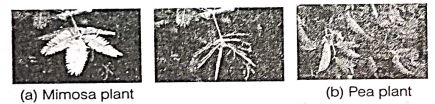
(i) Which stimulus is common for movement in both the cases?
(ii) Does the movement take place towards the point where stimulus is received? Mention separately for both plants.
(iii) Give one reason for the movement in each case.
18.
Discuss the functioning of muscles under the nervous control
19.
You are given samples of three metals. Sodium, magnesium and copper. Suggest any two activities to arrange them in order of decreasing activity.
20.
(a) Define activity series of metals. Arrange the metals gold, copper, iron and magnesium in order of their increase in reactivity.
(b) What will you observe when:
(i) Some zinc pieces are put in copper sulphate solution.
(ii) Some silver pieces are put into green coloured ferrous sulphate solution.
21.
What is the function of receptors in our body? Think of situations where receptors do not work properly. What problems are likely to arise?
22.
Differentiate between metals and non-metals on the basis of their chemical properties.
23.
(i) Name the disorder which a person is likely to suffer from due to the following
(a) Over-secretion of growth hormone.
(b) Deficiency of oestrogen in females.
(c) Less secretion of thyroxine.
Also, name the gland that secretes each of the hormones.
(ii) How is the timing and amount of hormone released regulated? Explain with the help of an example.
24.
Give reasons for the following:
(i) Silver and copper lose their shine when they are exposed to air. Name the substance formed on their surface in-each case.
(ii) Tarnished copper vessels are cleaned with tamarind juice.
(iii) Aluminium is more reactive than iron, yet there is less corrosion of aluminium as compared to iron when both are exposed to air.
25.
Look at Fig
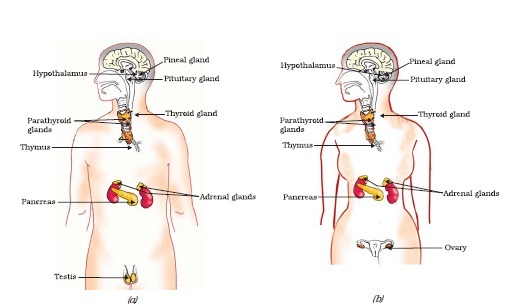
1.Identify the endocrine glands mentioned in the figure.
2. Some of these glands have been discussed in the text. Consult books in the library and discuss with your teachers to find out about the functions of other glands.
26.
1. Collect all the metal samples except sodium and potassium again. If the samples are tarnished, rub them clean with sand paper.
CAUTION:
Do not take sodium and potassium as they react vigorously even with cold water.
2. Put the samples separately in test tubes containing dilute hydrochloric acid.
3. Suspend thermometers in the test tubes, so that their bulbs are dipped in the acid.
4. Observe the rate of formation of bubbles carefully.
5. Which metals reacted vigorously with dilute hydrochloric acid?
6. With which metal did you record the highest temperature?
7. Arrange the metals in the decreasing order of reactivity with dilute acids.
27.
Assertion: Non-metals are electronegative in nature.
Reason: They have tendency to lose electrons.
Codes
(a) Both A and R are true, and R is correct explanation of the assertion.
(b) Both A and R are true, but R is not the correct explanation of the assertion.
(c) A is true, but R is false.
(d) A is false, but R is true.
28.
Assertion: Gustatory receptor detect taste while olfactory receptors detect smell.
Reason: Receptors helps in detecting the environment, they are present on the nerve cells.
Codes
(a) If both assertion and reason are true and the reason is correct explanation of assertion.
(b) If both assertion and reason are true but reason is not a correct explanation of assertion.
(c) If assertion is true and reason is false.
(d) If both assertion and reason are false.
29.
Two students decided to investigate the effect of water and air on iron object under identical experimental conditions. They measured the mass of each object before placing it partially immersed in 10 ml of water. After a few days, the object were removed, dried and their masses were measured. The table shows their results.
| Student | Object | Mass of object before rusting in g | Mass of the coated object in g |
| A | Nail | 3.0 | 3.15 |
| B | Thin plate | 6.0 | 6.33 |
(i) What might be the reason for the varied observations of the two students?
(ii) In another set up the students coated iron nails with zinc metal and noted that, iron nails coated with zinc prevents rusting. They also observed that zinc initially acts as a physical barrier, but an extra advantage of using zinc is that it continues to prevent rusting even, if the layer of zinc is damaged. Name this process of rust prevention and give any two other methods to prevent rusting.
(iii) In which of the following applications of Iron, rusting will occur most? Support your answer with valid reason.
A. Iron bucket electroplated with zinc.
B. Electricity cables having iron wires covered with aluminium.
C. Iron hinges on a gate.
D. Painted iron fence.
Or
(iii) How is pure iron used for making different alloys?
1.
Iodine is the halogen element necessary for the making of thyroxine hormone by the thyroid gland, which prevents the formation of goitre.
2.
The student can take three test tubes containing zinc sulphate and add a small piece of each metal in it. The test tube in which no reaction takes place has zinc metal. To identify the aluminium metal, take two test tubes and add aluminium sulphate in it. Now add magnesium in one and aluminium in the other test tube. The one in which there is no reaction, the aluminium metal was added in it.
3.
The bond between aluminium and oxygen is much stronger for carbon to reduce oxygen from it. Hence carbon cannot be used as reducing agent. To reduce alumina (Al2O3) so as to obtain aluminium, electrolytic reduction is done, with the help of electricity, aluminium and oxygen are separated and aluminium is obtained at cathode.
4.
Tropic Movement : It is the movement of plants towards stimulus.
Example - stem growth, root growth, pollen tube growth etc.
nastic Movement : Which the movement of plant is neither towards nor away from the stimulus, it is called nastic movement.
Example : Movement in the leaves of touch me not plants in which leaves fold when touched
5.
Cerebellum is the part of hindbrain that maintains posture and equilibrium of the body.
6.
Metals present at the bottom of the reactivity series do not corrode easily, e.g. gold, silver, platinum etc.
7.
(d)
All of these
8.
(d)
All of these
9.
(c)
Either (a) or (b)
10.
(d)
Zn
11.
(c)
Al
12.
(a)
Ni and Cr
13.
(a)
(i) and (ii)
14.
(c)
Rapid cell divisions in tendrillar cells that are away from the support
15.
(b)
Synapse
16.
(c)
Applying a coating of zinc
17.
(i) In both the cases stimulus of touch is same.
(ii) In the mimosa plant, the movements of leaves are in the opposite direction to the touch. On touching the leaves, they curl up towards the stem.
This is because plant cell change, their shape by changing the amount of the water in them. This happen due to swelling or shrinking of cell.
In case of the pea, plant tendrils cling over the object or the support so the movement takes places in the direction of the stimulus.
(iii) In mimosa plant, this movement is seen because of the change in concentration of water in the leaves.
In pea plant, this movement is seen because of the rapid growth of that part of a tendril which is away from the stimulus or the support.
18.
Muscle tissues have special filaments called actin and myosin. When a muscle receives "a nerve signal a series of events is triggered in the muscle. Calcium ions enter the muscle cells. It results in actin and myosin filaments sliding towards each other and that is how a muscle contracts. Contraction in a muscle brings movement in the related organ.
19.
Activity:
Sodium reacts with cold water vigorously to form sodium hydroxide and hydrogen gas
2Na(s) + 2H2O(l).\(\longrightarrow \) 2NaOH(aq) + H2(g)
cold
Magnesium does not react with cold water but with hot water to form magnesium hydroxide and hydrogen gas.
Mg(s) + 2H2O(l) \(\longrightarrow \) Mg(OH)2(aq) + H2(g)
(hot)
Copper does not react even with steam.
Hence sodium is more reactive than magnesium which is more reactive than copper.
20.
(a) The series of metals in which metals are arranged in decreasing order of their reactivity. Au < Cu < Fe < Mg is increasing order of reactivity.
(b) (i) The blue solution will become colourless and reddish brown copper metal will be deposited.
Zn(s) + CuSO4(aq) \(\longrightarrow \) ZnSO4(aq) + Cu(s)
Blue colourless (reddish brown)
(ii) Ag(s) + FeSO4(aq) \(\longrightarrow \) No reaction
Reaction will not take place-because 'Ag' is less reactive than iron
21.
The function of receptors in our body is very important as they collect informations about changes in the environment around us. Receptors then pass the same information in the form of nerve impulse to the central nervous system, where the information is processed and the ultimate response is given. Now, for example, if the gustatory receptors of our tongue do not work properly, we will not be able to know the taste of different types of foods (whether it is sweet, salty, sour or bitter, etc.)
22.
| Chemical Properties | Metals | Non-metals |
| Formation of ions | They are electropositive elements, lose electron(s) and form cations,e.g. Na \(\rightarrow\) Na+ + e- | They are electronegative elements, gain electron(s) and form anions. Cl + e- \(\rightarrow\) Cl- |
| Discharge of ions | Discharge at the cathode during electrolysis of their Compound. At cathode, Na+ + e- \(\rightarrow\) Na Cation |
Liberated at anode during electrolysis. |
| Reducing or Oxidising agent | They are reducing agents as they donate electrons during chemical reaction. | They are oxidising agents, as they accept electrons during chemical reaction. |
| Nature of Oxides | Metallic oxides are basic. Some of them dissolves in water forming alkaline solution,e.g.Basic oxide: K2O, Na2O, CaO, MgO and CuO Amphoteric oxide : Al2O3, PbO and ZnO |
Non-metallic oxides are acidic in nature. Acidic oxide : CO2,SO2, SO3, NO2 and P2O5 Neutral oxide: CO, NO, N2O and H2O |
| Reaction with acids | Active metals react with dil. HCl/H2SO4 to yield H2 gas and salts. M + 2HCl \(\rightarrow\) MCl2 + H2 \(\uparrow\) |
Non-metals do not react with dilute acids, as they cannot replace H+ ion from an acid to form salt. |
23.
(i)
| Disorders | Glands | |
| (a) | Gigantism | Pituitary gland |
| (b) | Feebly growth in sexual characters | Ovary |
| (c) | Goitre | Thyroid gland |
(ii) The timing and amount of hormone release are regulated by feedback mechanism. Example: If sugar level in blood rises they are detected by the cells of the pancreas which respond by producing more insulin. As the blood sugar falls insulin secretion is reduced.
24.
(i) These metals get corroded. Silver forms black Ag2S (silver sulphide) and copper form greenish layer of CuCO3 (copper carbonate).
(ii) Tamarind contains acid which reacts with basic copper carbonate and product gets dissolved and removed from copper vessel.
(iii) Aluminium forms oxide layer on its surface which does not further react with air
25.
Endocrine glands in human beings (a) female, (b) male
(i) Identify the endocrine glands mentioned in the figure and give function of these glands.
| Gland | Secretion | Hormone function |
| l. Pituitary gland | Growth hormone | Regulates the growth. |
| 2. Hypothalamus | Releasing hormone | Regulates the secretion ofhormones from pituitary gland. |
| 3. Thyroid | Thyroxine | Controls metabolic rates of carbohydrates, fats and protein |
| 4. Parathyroid | (i) Calcitonin (ii) Parathormone |
Lowers blood calcium level Increases calcium and decreases phosphate level |
| 5. Adrenal | adrenaline | Increases heart beat rate, blood pressure |
| 6. Pancreas | (i) Insulin (ii) Glucagon |
Decreases blood glucose Increases blood sugar level |
| 7. Testis | Testosterone | Regulates the male secondary sexual characteristics |
| 8. Ovary | Progesterone and estrogen | Controls development of female sex organs, ovulation etc. |
| 9. Thymus | Thymosin | Produces immunity |
| 10. Pineal | Melatonin | Stimulates muscle Contraction |
26.
| Metal | Reaction with HCl | Reaction | Rate of reaction |
| Mg | dil. HCI | Mg + 2HCI\(\rightarrow\) MgCl2 + H2 | Very fast |
| Al | dil. HCI | 2Al + 6HCI \(\rightarrow\) 2AlCl3 + 3H2 | Fast |
| Zn | dil. HCI | Zn + 2HCl \(\rightarrow\) ZnCl2 + H2 | Fast |
| Fe | dil. HCI | Fe + 2HCI \(\rightarrow\) FeCl2 + H2 | Slow |
| Cu | dil. HCI | No reaction | - |
27.
(c): Non-metals have a tendency to gain electrons.
28.
(a) If both assertion and reason are true and the reason is correct explanation of assertion.
29.
(i) The main reason for varied observations of the two students is rusting that occured in both A and B. So, there is an increase in mass in both the cases. However, the surface area of B is more thus, extent of rusting is more.
(ii) This process is named as galvanisation which is used for rust prevention Oiling and greasing are other two methods used to prevent rusting.
(iii) The rusting will occur most is in iron hinges which are present on a gate. This is due to the fact that iron is in direct contact with both atmospheric oxygen and moisture or water vapours. In rest of the applications, rusting will be occur at very slow rate.
Or
Alloying is a process of mixing of other metals to a particular metal so that its properties can be improved. Iron is soft in its pure state. It can be mixed easily with other element to make desired substance. e.g. Steel is an alloy of iron and carbon.

10th Standard CBSE Syllabus & Materials
10th Standard CBSE
CBSE 10th Social Science PS - Federalism - New Model Questions Papers Study Material - QB365 Set A
NEW10th Standard CBSE
CBSE 10th Social Science PS - Power Sharing - New Model Questions Papers Study Material - QB365 Set A
NEW10th Standard CBSE
CBSE 10th Social Science GEO - Manufacturing Industries - New Model Questions Papers Study Material - QB365 Set A
NEW10th Standard CBSE
CBSE 10th Social Science GEO - Minerals and Energy Resources - New Model Questions Papers Study Material - QB365 Set A



NCERT Books

Syllabus

Exam Pattern

Sample Question Papers

Previous year Question Papers

Important Notes

MCQ Practice test

NCERT Exemplers

Case study Questions

Image Based Questions

Passage based Questions

HOT Questions

Value Based Questions

Model Questions Papers
NCERT ( Book Back ) Questions

Assertion and Reason
Important Questions And Answers

CBSE 10th Standard CBSE Subjects
CBSE Standards



