
 100% FREE ACCESS
10th Standard CBSE Syllabus & Materials
10th Standard CBSE
CBSE 10th Social Science ECO - Globalisation and the Indian Economy - New Model Questions Papers Study Material - QB365 Set A
NEW10th Standard CBSE
CBSE 10th Social Science ECO - Money and Credit - New Model Questions Papers Study Material - QB365 Set A
NEW10th Standard CBSE
CBSE 10th Social Science ECO - Sectors of the Indian Economy - New Model Questions Papers Study Material - QB365 Set A
NEW10th Standard CBSE
CBSE 10th Social Science ECO - Development - New Model Questions Papers Study Material - QB365 Set A
NEW10th Standard CBSE
CBSE 10th Social Science PS - Outcomes of Democracy - New Model Questions Papers Study Material - QB365 Set A
NEW10th Standard CBSE
CBSE 10th Social Science PS - Gender, Religion and Caste - New Model Questions Papers Study Material - QB365 Set A

Published on: 20/10/2025
Download CBSE Class 10th Standard CBSE Science question papers, sample papers, important questions, and previous year solved papers in PDF format. Get free study materials, NCERT solutions, and exam preparation resources for Class 10th Standard CBSE Science
Questions + Answers key
Take MCQ Science Test
1.
Refer to the given flowchart and select the option that correctly identifies X and Y.
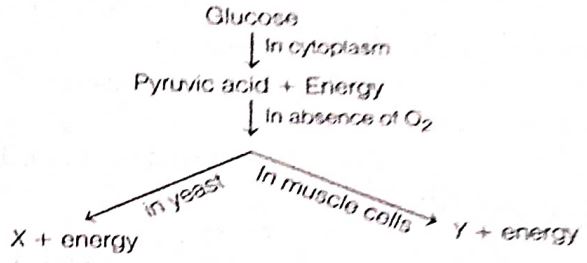
| X | Y |
| Ethanol + CO2 | Lactic acid |
| X | Y |
| Lactic acid | Ethanol |
| X | Y |
| Ethanol + CO2 | CO2 + H2O |
| X | Y |
| Lactic acid | CO2 + H2O |
2.
In the given transverse sectlon of the leaf, identify the layer of cells where maximum photosynthesis occurs.
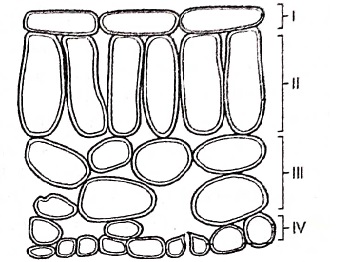
I, II
II, III
III,IV
I, IV
3.
Ankit brought some seeds and allowed them to germinate in a pot and kept that pot in some box made up of a cardboard opened from one side The box was allowed to be kept in such a manner that the open side of the box faces the sunlight near the window. After 3-4 days he observes the shoot bend towards the light as shown in the figure below.
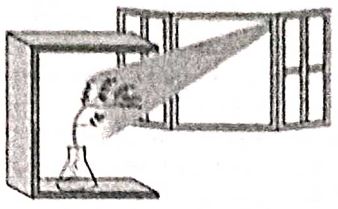
What type of tropism does the above situation prodicts?
Geotropism
Phototropism
Chemotropism
Hydrotropism
4.
Choose the right option.
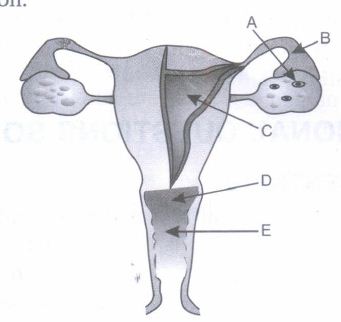
Fallopian tube Oviduct Uterus Cervix Vagina
Oviduct Vas deferens Ovary Vagina Cervix
Ovary Oviduct Uterus Cervix Vagina
Ovary Fallopian tube Uterus Vagina Cervix
5.
Diabetes is caused as a result of
Less amount of insulin in body
More amount of insulin in body
Either of the two
None of the above
6.
Auxin, in tendrils is synthesized at
Shoot tip
Leaves
Root tip
Stem
7.
Closing and opening of pores is a function of
Stomata
Chlorophyll
Chloroplast
Guard cells
8.
Which of the following constitute a food-chain?
Grass, wheat and mango
Grass, goat and human
Goat, cow and elephant
Grass, fish and goat
9.
The maleness of a child is determined by
the X chromosome in the zygote
the Y chromosome in zygote
the cytoplasm of germ cell which determines the sex.
sex is determined by chance
10.
Which among the following diseases is not sexually transmitted?
Syphilis
Hepatitis
HIV-AIDS
Gonorrhoea
11.
Asexual reproduction takes place through budding in
amoeba
yeast
plasmodium
leishmania
12.
Which of the following equation is the summary of photosynthesis?
6CO2+12H2O \(\rightarrow\) C6H12O6+6CO2+6H2O
6CO2+H2O+Sunlight \(\rightarrow\) C6H12O6+O2+6H2O
6CO2+12H2O+Chlorophyll+Sunlight \(\rightarrow\) C6H12O6+6O2+6H2O
6CO2+12H2O+Chlorophyll+Sunlight \(\rightarrow\) C6H12O6+6CO2+6H2O
13.
Which is the correct sequence of the components of a reflex arc?
Receptors \(\rightarrow\) Muscles \(\rightarrow\) Sensory neuron \(\rightarrow\) Motor neuron \(\rightarrow\) Spinal cord
Receptors \(\rightarrow\) Motor neuron \(\rightarrow\) Spinal cord \(\rightarrow\) Sensory neuron \(\rightarrow\)Muscle
Receptors \(\rightarrow\) Spinal cord \(\rightarrow\) Sensory neuron \(\rightarrow\) Motor neuron \(\rightarrow\) Muscle
Receptors \(\rightarrow\) Sensory neuron \(\rightarrow\) Spinal cord \(\rightarrow\) Motor neuron \(\rightarrow\) Muscle
14.
The gap between two neurons is called as
Dendrite
Synapse
Axon
Impulse
15.
The inner lining of stomach is protected by one of the following from hydrochloric acid. Choose the correct one.
Pepsin
Mucus
Salivary amylase
Oesophagus
16.
The breakdown of pyruvate to give carbon dioxide, water and energy takes place in
Cytoplasm
Mitochondria
Chloroplast
Nucleus
17.
What advantage over an aquatic organism does a terrestrial organism have with regard to obtaining oxygen for respiration?
18.
What is the role of acid in our stomach?
19.
What is the role of decomposers in the ecosystem?
20.
What are the different methods of contraception?
21.
How is the process of pollination different from fertilisation?
22.
Why are some patients of diabetes treated by giving injections of insulin?
23.
How do we detect the smell of an agarbatti (incense stick)?
24.
Write one important function for each of the following in the human respiratory system
(i) Rings of cartilage
(ii) Alveoli
(iii) Haemoglobin
(iv) Lining of mucus
25.
List the events in proper sequence that take place during the process of photosynthesis.
26.
Study the following cross and showing self-polination in F1, fill in the blank and answer the questions that follow.
RRYY \(\times\) rryy Parents
(Round yellow) (Wrinkled green)
RrYy \(\times\) ...... F1-generation
(Round yellow)
(i) ln above question, what is the combination of characters in the F2-progeny? What are the ratios?
(ii) Give reasons for the appearance of new combination of characters in the F1-progeny.
27.
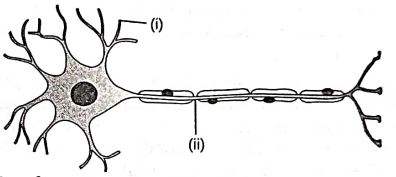
Write the name and function of parts (i) and (ii) in the diagram of a neuron given below.
28.
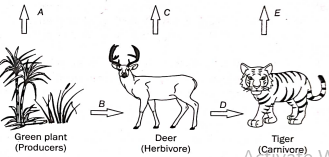
In the following food chain, vertical arrows indicate the energy lost to the environment and horizontal arrows indicate energy transferred to the next trophic level. Which one of the three vertical arrows (A, C and E) and which one of the two horizontal arrows (B and D) will represent more energy transfer? Give reason for your answer.
29.
How is the sex of the child determined in human beings?
30.
State the role of the following in human digestive system:
(i) Digestive enzymes (ii) Hydrochloric acid (iii) Villi
31.
Name the constituents of blood.Why white blood corpuscles are called 'soldiers of the body'?
32.
The diagram given below is the longitudinal section of human heart.
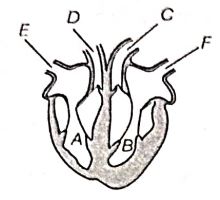
(i) What is the difference in composition of blood in parts C and F?
(ii) What is the function of part D?
(iii) Name the structure which separates part A and part B?
(iv) Describe the circulation of blood in amphibians and reptiles.
33.
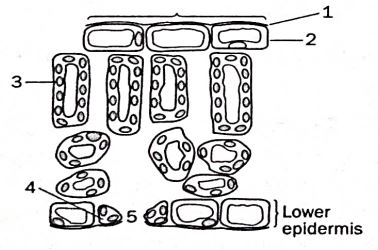
The diagram given below represents the vertical section of a leaf.
Answer the following questions based on the above diagram.
(i) Name the parts labelled as 1 to 5.
(ii) Which layer contains maximum number of chloroplast?
(iii) State the role played by the parts labelled as 4 and 5.
(iv) How stomatal pores open and close when water flow into them?
34.
Why do we call pituitary gland as the master gland? Where is it located and what are its functions?
35.
What are food-chains and food webs? Why are smaller food chains better? What is10% flow?
36.
(a) Identify A, B, C and D in the given diagram and write their names.
(b) What is pollination? Explain its significance.
(c) Explain the process of fertilisation in flowers. Name the parts of the flower that develop after fertilisation into
(i) seed, (ii) fruit
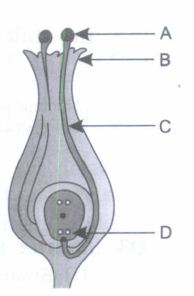
37.
(a) Name the parts labelled as A,B,C and D in the diagram given below:
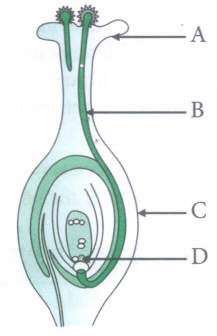
(b) What is pollination? State its significance.
(c) How does fertilisation occur in flowers? Name the parts of the floower that develop into
(i) seed, and (ii) fruit after fertilisation.
38.
The difference between fragmentation and regeneration is quite obvious in their respective names. In most cases, fragmentation happens when an organism wants to reproduce, so after the organism splits, as seen in spirogyra, regeperation through cell-to-cell division enables the creation of new individuals from the fragments. On the other hand, regeneration occurs where the organism is capable of regrowing certain parts of its body when it loses them. Only specialized cells, capable of proliferating may participate in this process. Regeneration is an asexual mode of reproduction, common in lower multicellular organisms, such as Planaria. Here, the organism fragments when it's ready to reproduce, and new organisms are regenerated from these fragmented parts. Regeneration in other animals does not mean the creation of new individuals, but just regrowing lost limbs. So technically, is regeneration a form of asexual reproduction? The answer to that is both "Yes" and "No."
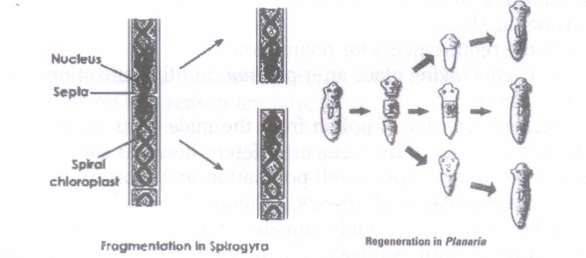
Answer the following questions based on the above information
(a) For a question, "is regeneration a form of asexual reproduction?" why is the answer to that both "Yes" and "No"?
(b) Why is fragmentation and regeneration not a way of reproduction in all organisms?
(c) Name the type of cells which undergo regeneration.
(d) Name two simple organisms which have ability of regeneration.
39.
The recent study has shown an alarming rise of rickets commonly seen in the children. Doctors say that the lack of outdoor activities and more time on indoor computer activities has led to the increase in this disease. Moreover the diet also plays an important role, the children nowadays are not eating healthy and balanced diet. The intake of carbohydrates and fats is more as they eat more of chips, fast food, cold drink etc.
Answer the following questions based on the above information
(a) The deficiency of which vitamin leads to the cause of rickets disease?
(b) Why do Doctors advise children to play outdoors games?
(c) Why is fast food not a preferable diet for children?
(d) What is the symptom for rickets?
40.
To demonstrate the transpiration from the leaf surface, Saily took four banyan leaves. Both the surfaces of the A leaf, lower surface (with stomata) of Bleaf, upper surface (without stomata) of C leaf are vaselined. The Vaseline is not applied on the D leaf. Now, as shown in the figure the leaves are hanged so that they may transpire freely.
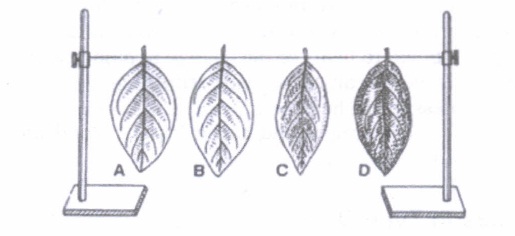
Comparison of transpiration. Demonstration by four leave
| Leaf number | Mass at start/g | Mass at end/g |
| A | 1.0 | 1.0 |
| B | 1.2 | 1.1 |
| C | 1.3 | 0.8 |
| D | 1.2 | 0.9 |
Answer the following questions based on the above information
(a) Was the Vaseline effective in prevention of water loss?
(b) Which surface allowed more loss of water?
(c) Percentage loss of mass in leaf C is-
(i) 38.5 (ii) 37.5 (iii) 36.5 (iv) 39.5
(d) The maximum loss of mass take place in leaf
(i) A (ii) B (iii) C (iv) D
41.
Assertion: Harmful chemicals enter our bodies through the food chain.
Reason: The highest member in the food chain has the least amount of chemical.
Codes
(a) If both assertion and reason are true and the reason is correct explanation of assertion.
(b) If both assertion and reason are true but reason is not a correct explanation of assertion.
(c) If assertion is true and reason is false.
(d) If both assertion and reason are false.
42.
Assertion: Natural selection in a population of organisms leads to variation.
Reason: It results in adaptations in the population of organisms to fit their environment better.
Codes
(a) If both assertion and reason are true and the reason is correct explanation of assertion.
(b) If both assertion and reason are true but reason is not a correct explanation of assertion.
(c) If assertion is true and reason is false.
(d) If both assertion and reason are false.
43.
Assertion: Gustatory receptor detect taste while olfactory receptors detect smell.
Reason: Receptors helps in detecting the environment, they are present on the nerve cells.
Codes
(a) If both assertion and reason are true and the reason is correct explanation of assertion.
(b) If both assertion and reason are true but reason is not a correct explanation of assertion.
(c) If assertion is true and reason is false.
(d) If both assertion and reason are false.
44.
Assertion: Nitrogen is an essential element used in the synthesis of proteins and other compounds in plants.
Reason: Plants take in nitrogen in the form of inorganic nitrates or nitrites.
Codes
(a) If both assertion and reason are true and the reason is correct explanation of assertion.
(b) If both assertion and reason are true but reason is not a correct explanation of assertion.
(c) If assertion is true and reason is false.
(d) If both assertion and reason are false.
1.
(a)
| X | Y |
| Ethanol + CO2 | Lactic acid |
2.
(b)
II, III
3.
(b)
Phototropism
4.
(c)
Ovary Oviduct Uterus Cervix Vagina
5.
(a)
Less amount of insulin in body
6.
(a)
Shoot tip
7.
(d)
Guard cells
8.
(b)
Grass, goat and human
9.
(b)
the Y chromosome in zygote
10.
(b)
Hepatitis
11.
(b)
yeast
12.
(c)
6CO2+12H2O+Chlorophyll+Sunlight \(\rightarrow\) C6H12O6+6O2+6H2O
13.
(d)
Receptors \(\rightarrow\) Sensory neuron \(\rightarrow\) Spinal cord \(\rightarrow\) Motor neuron \(\rightarrow\) Muscle
14.
(b)
Synapse
15.
(b)
Mucus
16.
(b)
Mitochondria
17.
A terrestrial organism can obtain oxygen directly from the air and has a slow breathing rate, whereas an aquatic organism has to obtain oxygen dissolved in water and so, it has a high breathing rate. The amount of oxygen dissolved in water is fairly low as compared to the amount of oxygen present in the air. So, aquatic organisms have high breathing rate. Therefore, terrestrial organisms have much easier access to oxygen and have an advantage over aquatic organisns.
18.
Hydrochloric acid (HCI) is the acid secreted inside the stomach and plays the following roles
(i) It makes medium inside the stomach acidic, which is necessary for the activation of enzyme called pepsin. It converts inactive pepsin into active pepsin.
(ii) It also kills any bacteria, entering the stomach along with the food.
19.
Organisms that feed on dead plants and animals are called decomposers, e.g. bacteria, fungi, etc. They breakdown the complex organic compounds present in the dead remains into simpler substances and obtain nutrition from them. These substances are released into the soil and the atmosphere.
Thus, they play the following roles
(i) They help in recycling of materials, replenishment of the soil's nutrients, etc.
(ii) They clean our surroundings by decomposing dead organisms and organic wastes.
20.
The different methods of contraception are:
(i) Barrier Methods The device such as condoms are used as physical barriers, which prevents sperms from meeting the egg
(ii) Hormonal Methods These contain hormonal preparations in the form of 'pills' which prevent the release of ovum.
(iii) Chemical Methods The vaginal pills contain the chemicals called spermicides which kill the sperms.
(iv) Surgical Methods In males, a small portion of sperm duct is cut by surgical method. The cut end is tied properly to prevent the sperms from coming out. In females, a small part of the Fallopian tube/oviduct is cut and tied to prevent the egg from entering the oviduct.
21.
Differences between pollination and fertilisation are
| Pollination | Fertilisation |
| The transfer of pollen grains from anther to the stigma of a flower is called pollination. | The fusion of male and female gamete to form zygote is called fertilisaton. |
| It involves only the male gamete (pollen grain). | It involves both male and female gamete. |
22.
Some diabetes patients are given injections of insulin to fulfil the requirement of insulin in their body. Insulin is a hormone produced by the pancreas and helps in regulating blood sugar levels in our body. If sugar level increases in the blood, due to lack of insulin, it leads to many harmful effects.
23.
The smell reaches the neurons of olfactory receptor of nose. It causes the generation of nerve impulses that reach the olfactory lobes of the forebrain to produce the sensation of smell.
24.
(i) Rings of cartilage They ensure that air passage does not collapse.
(ii) Alveoli They increase the surface area for exchange of gases in lungs.
(iii) Haemoglobin It is a respiratory pigment present in RBCs which takes up the oxygen from the air in lungs and carries it to the tissues.
(iv) Lining of mucus These along with fine hairs are present in nostrils which help to filter the air entering through nostrils.
25.
Photosynthesis is a process by which green plants, having chlorophyll, synthesise the simple sugar (glucose) from the simple raw materials, water and carbon dioxide using the energy of sunlight. Oxygen is released in this process.
\(\underset{\begin{array}{c} \text { Carbon } \\ \text { dioxide } \end{array}}{6 \mathrm{CO}_2}+\underset{\text { Water }}{12 \mathrm{H}_2 \mathrm{O}} \xrightarrow[\text { Chlorophyll }]{\text { Sunlight }} \underset{\text { Glucose }}{\mathrm{C}_6 \mathrm{H}_{12} \mathrm{O}_6}+6 \mathrm{H}_2 \mathrm{O}+\underset{\text { Oxygen }}{6 \mathrm{O}_2} \uparrow\)
The photosynthesis takes place in the following three steps
(i) Absorption of light energy by chlorophyll.
(ii) Conversion of light energy into chemical energy and splitting of water molecules into hydrogen and oxygen.
(iii) Reduction of carbon dioxide by hydrogen to form carbohydrate like glucose by utilising the chemical energy.
The steps do not need to take place one after the other immediately. For example, desert plants take up carbon dioxide at night and prepare intermediate which is acted upon by the energy absorbed by the chlorophyll during the day.
26.
RRYY \(\times\) rryy Parents
(Round yellow) (Wrinkled green)
RrYy \(\times\) RrYy F1-generation
(Round yellow) (Round yellow)
(i) In F1 - generation the combination of characters is
Round yellow = 9, Round green = 3
Wrinkled yellow = 3, Wrinkled green = 1
Thus, the genotypic ratio is 9 : 3 : 3 : 1
(ii) In F1 - generation, the production of all round yellow seeds explains that the round shape and yellow colour of the seeds were dominant traits over the wrinkled shape and green colour of the seeds which segregated during F2 - generation.
27.
(i) Dendrites These are the protoplasmic, branched finger-like projections of the cell body, which receive and transmit impulses.
(ii) Axon These are long, fibre-like cytoplasmic process. They conduct impulses away from the cell body. The axon may be covered by a protective sheath called myelin sheath.
28.
In accordance with 10% law of energy transfer in food chain, only 10% of energy available at one trophic level is transferred to the next trophic level. So, A will represent more energy transfer as compared to C and E and B will be represent more energy transfer as compared to D.
29.
A male germ cell which forms gametes carries one X and one Y-chromosome, while a female germ cell carries two X-chromosomes.
Therefore, sex of the child depends upon what happens during fertilisation.
(i) If a sperm carrying X-chromosome fertilises the egg then, the child born will be a female (XX).
(ii) If a sperm carrying Y-chromosome fertilises the egg then, the child born will be a male (XY).
Thus, the sperm (the male gamete) determines the sex of the child.
30.
(i) Digestive enzymes - Foods need to be broken into their small or simpler molecules so that they can be absorbed into the bloodstream. However, the physical breakdown of food is not enough. Enzymes are hence needed for the chemical breakdown of food and speeding up the digestive process. The products of digestion should be smaller enough to be absorbed.
(ii) Hydrochloric acid helps to kill the germs which might have entered into the system through food. It creates acidic medium for the pepsin to act on food to break down proteins.
(iii) Villi are finger-like projections in the small intestine. They help to increase the surface area for absorption of the digested food. Villi are richly supplied with blood vessel which help to absorb digested food from the bloodstream.
31.
The different constituents of blood are plasma (the fluid part of the bloo(d) and blood corpuscles consisting of RBCs, WBCs, and platelets)
WBCs are known as the soldiers of the body because they fight against the pathogenes that invade our body, thus preventing the occurence of diseases.
32.
(i) The blood vessel C (pulmonary artery) has got deoxygenated blood, while the blood vessel F (pulmonary vein) has got oxygenated blood.
(ii) The blood vessel D (aorta) receives oxygen rich blood from the left ventricle and circulates it to different parts of the body.
(iii) Interventricular septum separates part A (right ventricle) and part B (left ventricle).
(iv) Reptile and amphibian circulatory systems are both closed and entail double circulation, in which veins carry blood towards the heart and arteries carry it away from the heart. While reptiles have either a three or four-chambered heart, all amphibians have a three-chambered heart with two atria and one ventricle.
33.
(i) 1. Waxy cuticle
2. Upper epidermis
3. Chloroplast
4. Guard cell
5. Stomatal pore
34.
The pituitary gland secretes a number of hormones that regulate various functions of the body. It also controls the functioning of the other endocrine glands. Hence, called the master gland.
Location Pituitary gland is located just below the hypothalamus at the base of brain.
Pituitary gland secretes the following hormones, i.e.
(i) Growth hormnone regulates the growth and development of bones and muscles.
(ii) Tropic hormone regulates the secretion from other endocrine glands.
35.
Food chain: The flow of food from sun to autotrophs, from autotrophs to herbivores and from herbivores to carnivores is called food chain. A food chain can have two levels or five to six levels also.
Food web: When an organism is eaten by two or more other kinds of organisms, instead of straight chain an interlinked chain is formed, is termed as food web.
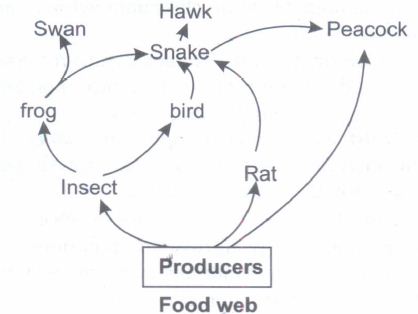
Smaller the food chain, the energy available for the next level of consumer in such a chain is more. As the loss of energy at each step takes place and very little energy is left after four trophic levels.
The green plants in terrestrial ecosystem capture about 1% of the sun's energy and convert it into food energy. When green plants are eaten by primary consumers-a great deal of energy is lost for the life processes and only 10% of the energy is available for the next level of consumers.
36.
(a) A - Stigma
B - Pollen tube
C - Ovary
D - Female germ cell / Egg cell
(b) Pollination - Transfer of pollen grains from anther to the stigma of a flower.
Significance of pollination - Process of pollination leads to fertilization as it brings the male and female gametes together for fusion.
(c) After a pollen falls on a suitable stigma, the pollen tube grows out of the pollen grain and travels through the style to reach the ovule in the ovary. Here the male germ cell (carried by the pollen tube) fuses with the female germ cell to form a zygote.
(i) Ovule (ii) Ovary
37.
(a) A - Stigma B - Pollen tube C - Ovary D - Ovule (ovum)
(b) The transfer of pollen grains from anther (male sexual part) of a flower to the stigma part of the pistil (female sexual part) is known as pollination. Signification of pollination. It may be the cause of variation in a species of a plant.
(c) Fertilisation in flower. A pollen grain contains two male gametes. When a pollen grain falls on the stigma of the carpel, it grows a pollen tube downwards into the
style. One of the male gametes reaches the ovary through pollen tube and fuses with female gamete present in the ovule. This fertilisation of the two germ cells forms a zygote. The zygote is capable of growing into a new plant. The other male gamete fuses with two polar nuclei to form endosperm nucleus. This fusion is called triple fusion. The zygote grows into an embryo and an endosperm nucleus grows into endosperm (the food storage tissue of seed).
(i) All the eggs in the ovule present in the ovary of a flower gets fertilised by male gametes from pollen grains and grow to become seeds.
(ii) The ovary of flower develops and becomes fruit.
38.
(a) No new organisms are formed in complex multicellular organisms like regrowing a lost limb, such as the tail of a lizard. In some organisms like planaria and hydra it is a mode of reproduction.
(b) Complex organisms' body is organized in different types of tissues, organs and organ system. Only specialised cells, capable of proliferating may participate in regeneration and fragmentation. Most of the cells cannot divide to reproduce therefore they have specialized organs and cells for reproduction as they have for other life processes .
(c) Specialised cells called regenerative cells which can make large number of new cells.
(d) Planaria and Hydra.
39.
(a) Vitamin D
(b) The exposure to sunlight helps in the formation of vitamin D by our body.
(c) Fast food has more of sugar and carbohydrates that leads to obesity and diabetes at very young age.
(d) Bent legs.
40.
(a) Yes it was
(b) The lower surface of leaf
(c) (i) 38.5
(d) (iii) C
41.
(c) If assertion is true and reason is false.
42.
(a) If both assertion and reason are true and the reason is correct explanation of assertion.
43.
(a) If both assertion and reason are true and the reason is correct explanation of assertion.
44.
(b) If both assertion and reason are true but reason is not a correct explanation of assertion.

10th Standard CBSE Syllabus & Materials
10th Standard CBSE
CBSE 10th Social Science PS - Federalism - New Model Questions Papers Study Material - QB365 Set A
NEW10th Standard CBSE
CBSE 10th Social Science PS - Power Sharing - New Model Questions Papers Study Material - QB365 Set A
NEW10th Standard CBSE
CBSE 10th Social Science GEO - Manufacturing Industries - New Model Questions Papers Study Material - QB365 Set A
NEW10th Standard CBSE
CBSE 10th Social Science GEO - Minerals and Energy Resources - New Model Questions Papers Study Material - QB365 Set A



NCERT Books

Syllabus

Exam Pattern

Sample Question Papers

Previous year Question Papers

Important Notes

MCQ Practice test

NCERT Exemplers

Case study Questions

Image Based Questions

Passage based Questions

HOT Questions

Value Based Questions

Model Questions Papers
NCERT ( Book Back ) Questions

Assertion and Reason
Important Questions And Answers

CBSE 10th Standard CBSE Subjects
CBSE Standards



