
 100% FREE ACCESS
10th Standard CBSE Syllabus & Materials
10th Standard CBSE
CBSE 10th Social Science ECO - Globalisation and the Indian Economy - New Model Questions Papers Study Material - QB365 Set A
NEW10th Standard CBSE
CBSE 10th Social Science ECO - Money and Credit - New Model Questions Papers Study Material - QB365 Set A
NEW10th Standard CBSE
CBSE 10th Social Science ECO - Sectors of the Indian Economy - New Model Questions Papers Study Material - QB365 Set A
NEW10th Standard CBSE
CBSE 10th Social Science ECO - Development - New Model Questions Papers Study Material - QB365 Set A
NEW10th Standard CBSE
CBSE 10th Social Science PS - Outcomes of Democracy - New Model Questions Papers Study Material - QB365 Set A
NEW10th Standard CBSE
CBSE 10th Social Science PS - Gender, Religion and Caste - New Model Questions Papers Study Material - QB365 Set A

Published on: 20/10/2025
Download CBSE Class 10th Standard CBSE Science question papers, sample papers, important questions, and previous year solved papers in PDF format. Get free study materials, NCERT solutions, and exam preparation resources for Class 10th Standard CBSE Science
Questions + Answers key
Take MCQ Science Test
1.
100 J of heat is produced each second in a 4 Ω resistance. Find the potential difference across the resistor.
2.
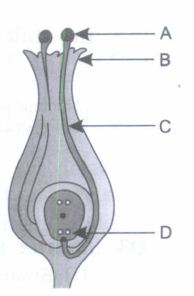
(a) Identify A, B, C and D in the given diagram and write their names.
(b) What is pollination? Explain its significance.
(c) Explain the process of fertilisation in flowers. Name the parts of the flower that develop after fertilisation into
(i) seed, (ii) fruit
3.
How does phototropism occur in plants?
4.
Which gas is usually liberated when an acid reacts with a metal? Illustrate with an example, How will you test for the presence of the gas?
5.
Examples of responses to hormones are listed.
1. Growth of facial hair.
2. Increased blood pressure and pulse rate.
3. Widened pupils.
Which responses are caused by the hormone adrenaline?
1 and 2
1 and 3
2 and 3
1, 2 and 3
6.
In domestic electric circuits, the wiring with 15 A current rating is for the electric devices which have
higher power ratings such as geyser
lower power ratings such as fan
metallic bodies and low power ratings
non-metallic bodies and low power ratings
7.
If four identical resistors, of resistance 8Ω, are first connected in series so as to give an effective resistance Rs, and then connected in parallel so as to give an effective resistance Rp, then the ratio of Rs/Rp is
32
2
0.5
16
8.
The resistivity of a wire
varies with its length
varies with its mass
varies with its cross section
is independent of length, cross section and mass of wire
9.
What is the puberty age in human males?
8-10
10-12
12-14
14-16
10.
Receptors are specialised tips of
Muscle cells
Glands
Sense organs
Nerve cells
11.
Substances exposed to atmosphere at ordinary temperature, lose their water of crystallisation are called as
hygroscopy
efflorescence
deliquescence
all of these
12.
A feature of reproduction that is common Amoeba, Spirogyra and Yeast is that
they reproduce asexually
they are all unicellular
they reproduce only sexually
they are all multicellular
13.
Characters transmitted from parents to offspring are present in
cytoplasm
ribosome
golgi bodies
genes
14.
2 ml each of concentrated HCl, HNO3 and a mixture of concentrated HCl and concentrated HNO3 in the ratio of 3 : 1 were taken in test tubes labelled as A, B and C. A small piece of metal was put in each test tube. No change occured in test tubes A and B but the metal got dissolved in test tube C respectively. The metal could be
Al
Au
Cu
Zn
15.
Iodine is necessary for the synthesis of which hormone?
Adrenaline
Thyroxin
Auxin
Insulin
16.
Calcium phosphate is present in tooth enamel. Its nature is
basic
acidic
neutral
amphoteric
17.
What is potential difference? Explain and give its unit with definition.
18.
How does binary fission differ from multiple fission?
19.
Which signals will get disrupted in case of a spinal cord injury?
20.
How is the movement of leaves of the sensitive plant different from the movement of a shoot towards light?
21.
What are plant hormones?
22.
You must have seen tarnished copper vessels being cleaned with lemon or tamarind juice. Explain why these sour substances are effective in cleansing the vessels.
23.
Give two points of difference between resistance and resistivity
24.
How are the modes for reproduction different in unicellular and multicellular organisms?
25.
what are the advantages of sexual reproduction over asexual reproduction?
1.
H = 100 J, R = 4 Ω, t = 1 s, V = ?
From Eq. we have the current through the resistor as
I = √(H/Rt)
= √[100 J/(4 Ω × 1 s)] = 5 A
Thus the potential difference across the resistor, V [from Eq. ] is V = IR = 5 A × 4 Ω = 20 V.
2.
(a) A - Stigma
B - Pollen tube
C - Ovary
D - Female germ cell / Egg cell
(b) Pollination - Transfer of pollen grains from anther to the stigma of a flower.
Significance of pollination - Process of pollination leads to fertilization as it brings the male and female gametes together for fusion.
(c) After a pollen falls on a suitable stigma, the pollen tube grows out of the pollen grain and travels through the style to reach the ovule in the ovary. Here the male germ cell (carried by the pollen tube) fuses with the female germ cell to form a zygote.
(i) Ovule (ii) Ovary
3.
The directional movement of the plant in response to light is called phototropism. The shoots respond by bending towards light and roots respond by bending away from the light.
This happens as follows:
(i) When sunlight falls straight on the plant, the auxin hormone synthesised at the tip of the stem spreads uniformly down the stem and due to equal concentration of auxin, stem grows straight.
(ii) When sunlight falls on only one side of the plant, the auxin diffuses towards the shady side of shoot. The concentration of auxin stimulates the cells to grow longer. Therefore, the stem appears to bend towards the source of light in the directional movement
4.
Hydrogen gas is usually liberated when an acid reacts with metal.
e.g. Zn(s) + H2SO4 (aq) \(\rightarrow\) ZnSO4(aq) + H2 \(\uparrow\)
Test for H2 gas Testing of H2 gas presence can be done by passing the gas through soap solution and then bringing a burning splinter near the soap bubble filled with the gas. If the gas burns with a pop sound, it confirms hydrogen.
5.
(c)
2 and 3
6.
(a)
higher power ratings such as geyser
7.
(d)
16
8.
(d)
is independent of length, cross section and mass of wire
9.
(c)
12-14
10.
(d)
Nerve cells
11.
(b)
efflorescence
12.
(a)
they reproduce asexually
13.
(d)
genes
14.
(b)
Au
15.
(b)
Thyroxin
16.
(a)
basic
17.
P.d.(V) between two points=\(\overset { Workdon(W) }{ \underset { charge(Q) }{ \_ \_ \_ \_ \_ \_ } } \)
V = \(\overset { W }{ \underset { Q }{ \_ \_ } } \)
The S.I. unit of electric potential difference is volt (V).
1 volt is the potential difference between two points in a current carrying conductor when 1Joule of work is done in moving a charge of 1 coulomb from one point to another.
\(1 \ volt=\frac{1 \ Joule}{1 \ Coulomb}\)
\(1V=\frac{1J}{1C}\)
18.
Differences between binary fission and multiple fission are given below
| Binary Fission | Multiple Fission |
| The parent organism splits to form two new organisms. | The parent organism splits to form many new organisms at the same time. |
| It takes place during favourable environmental conditions. | It takes place during unfavourable environmental Conditions |
| It takes place in organisms like Amoeba, Leishmania, etc. | It takes place in organisms like Plasmodium. |
19.
In case of a spinal cord injury, signals for reflex actions and involuntary actions will get disrupted.
20.
Differences between movement of leaves and movement of shoot towards light are as follows:
| Movement of Leaves(Sensitive Plant) | Movement of Shoot |
| This movement is independent of growth | This movement is dependent on growth. |
| Stimulus is touch. | Stimulus is light. |
| Movement is not directional. | Movement is directional. |
| Movement is neither away nor towards the stimulus. | Movement is towards the stimulus. |
21.
Plant hormones are organic substances produced naturally in higher plants. They control growth and other physiological functions of the plants. These are required in very small amounts.
22.
A layer of basic copper carbonate is formed by the reaction of air on copper metal.
This layer being insoluble in water, cannot be cleaned with water alone. But, it is soluble in acids so lemon containing citric acid, tamarind containing tartaric acid or any other sour substance containing acid can be effective in cleaning the vessels. As these acids neutralises the basic copper carbonate and dissolves the layer. Hence, surface of copper vessels are cleaned with lemon or tamarind juice to give its characteristics lustre.
23.
| Resistance | Resistivity |
| 1. It is the property of a conductor to resist the flow of charges through it. |
It is the resistance per unit length of a a unit cross-section area of the material. |
| 2. Its unit is ohm (\(\Omega \)). | Its unit is ohm meter (\(\Omega \)m). |
| 3. Resistance depends on length, cross sectional area of the wire, and material of wire and temperature. \(R \propto \frac{l}{A}(R \propto T)\) |
Resistivity is the constant value for a material that depends on its temperature \(\rho \propto T\) Resistivity increases with rise in temperature of metals and alloys. |
24.
Unicellular organisms are made up of only a single cell, which performs all the functions necessary for life. So, reproduction is done by simple, asexual methods but in multicellular organisms various cells perform different functions.
So, production of all these specialised cells is required and simple methods for reproduction are insignificant. Thus, they reproduce by sexual reproduction.
25.
Sexual reproduction is considered to be superior over asexual reproduction as it brings about variations in the progeny. These variations allow organisms to live in diverse habitats with the help of adaptations. On the other hand, asexual reproduction does not bring about variations among progeny.

10th Standard CBSE Syllabus & Materials
10th Standard CBSE
CBSE 10th Social Science PS - Federalism - New Model Questions Papers Study Material - QB365 Set A
NEW10th Standard CBSE
CBSE 10th Social Science PS - Power Sharing - New Model Questions Papers Study Material - QB365 Set A
NEW10th Standard CBSE
CBSE 10th Social Science GEO - Manufacturing Industries - New Model Questions Papers Study Material - QB365 Set A
NEW10th Standard CBSE
CBSE 10th Social Science GEO - Minerals and Energy Resources - New Model Questions Papers Study Material - QB365 Set A



NCERT Books

Syllabus

Exam Pattern

Sample Question Papers

Previous year Question Papers

Important Notes

MCQ Practice test

NCERT Exemplers

Case study Questions

Image Based Questions

Passage based Questions

HOT Questions

Value Based Questions

Model Questions Papers
NCERT ( Book Back ) Questions

Assertion and Reason
Important Questions And Answers

CBSE 10th Standard CBSE Subjects
CBSE Standards



