
 100% FREE ACCESS
10th Standard CBSE Syllabus & Materials
10th Standard CBSE
CBSE 10th Social Science ECO - Globalisation and the Indian Economy - New Model Questions Papers Study Material - QB365 Set A
NEW10th Standard CBSE
CBSE 10th Social Science ECO - Money and Credit - New Model Questions Papers Study Material - QB365 Set A
NEW10th Standard CBSE
CBSE 10th Social Science ECO - Sectors of the Indian Economy - New Model Questions Papers Study Material - QB365 Set A
NEW10th Standard CBSE
CBSE 10th Social Science ECO - Development - New Model Questions Papers Study Material - QB365 Set A
NEW10th Standard CBSE
CBSE 10th Social Science PS - Outcomes of Democracy - New Model Questions Papers Study Material - QB365 Set A
NEW10th Standard CBSE
CBSE 10th Social Science PS - Gender, Religion and Caste - New Model Questions Papers Study Material - QB365 Set A

Published on: 26/10/2025
Download CBSE Class 10th Standard CBSE Science question papers, sample papers, important questions, and previous year solved papers in PDF format. Get free study materials, NCERT solutions, and exam preparation resources for Class 10th Standard CBSE Science
Questions + Answers key
Take MCQ Science Test
1.
Judge the equivalent resistance when the following are connected in parallel
(a) 1\(\Omega \) and 106\(\Omega \)
(b) 1\(\Omega \), 103\(\Omega \) , and 106\(\Omega \).
2.
Draw a schematic diagram of a circuit consisting of a battery of three cells of 2V each, a 5\(\Omega \) resistor, an 8\(\Omega \) resistor, and a 12\(\Omega \) resistor and a plug key, all connected in series. Now, connect the ammeter to measure the current through the resistors and a voltmeter to measure the potential difference to measure the current through the resistors and a voltmeter to measure the potential difference across the 12\(\Omega \) resistors. What would be the readings in the ammeter and the voltmeter?
3.
Why are coils of electric toasters and electric irons made of an alloy rather than a pure metal?
4.
Let the resistance of an electrical component remains constant while the potential difference across the two ends of the component decreases to half of its former value. What change will occur in the current through it?
5.
Will current flow more easily through a thick wire or a thin wire of the same material, when connected to the same source? Why?
6.
On what factors do the resistance of a conductor depend?
7.
How much energy is given to each coulomb of charge passing through a 6 V battery?
8.
What is meant by saying that the potential difference between two points is 1 V?
9.
Name a device that helps to maintain a potential difference across a conductor.
10.
Calculate the number of electrons constituting one coulomb of charge.
11.
Define the unit of current.
12.
Which of the following terms does not represent electrical power in a circuit?
I2R
IR2
VI
V2/R
13.
A piece of wire of resistance R is cut into five equal parts. These parts are then connected in parallel. If the equivalent resistance of this combination is R' then the ratio R/R' is
1/25
1/5
5
25
14.
The potential difference between the terminals of an electric heater is 60 V when it draws a current of 4 A from the source. What current will the heater draw if the potential difference is increased to 120 V?
15.
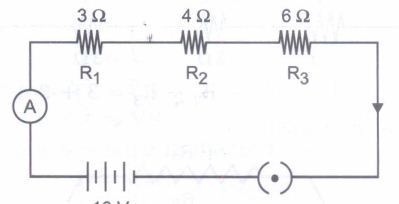
A battery of 10 V is connected in a circuit with 3 0, 4 0, 6 0 resistors connected in series. How much current will flow through 6 0 resistor?
16.
1. Take a nichrome wire, a torch bulb, a 10 W bulb and an ammeter (0 - 5 A range), a plug key and some connecting wires.
2. Set up the circuit by connecting four dry cells of 1.5 V each in series with the ammeter leaving a gap XY in the circuit, as shown in Fig.
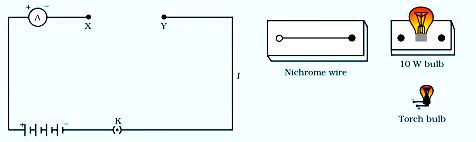
3. Complete the circuit by connecting the nichrome wire in the gap XY. Plug the key. Note down the ammeter reading. Take out the key from the plug. [Note: Always take out the key from the plug after measuring the current through the circuit.]
4. Replace the nichrome wire with the torch bulb in the circuit and find the current through it by measuring the reading of the ammeter.
5. Now repeat the above step with the 10 W bulb in the gap XY.
6. Are the ammeter readings differ for different components connected in the gap XY? What do the above observations indicate?
7. You may repeat this Activity by keeping any material component in the gap. Observe the ammeter readings in each case. Analyse the observations.
17.
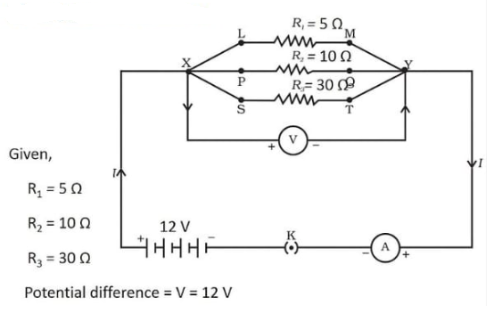
In the circuit diagram given in Fig, suppose the resistors R1, R2 and R3 have the values 5 Ω, 10 Ω, 30 Ω, respectively, which have been connected to a battery of 12 V. Calculate
(a) the current through each resistor,
(b) the total current in the circuit, and
(c) the total circuit
18.
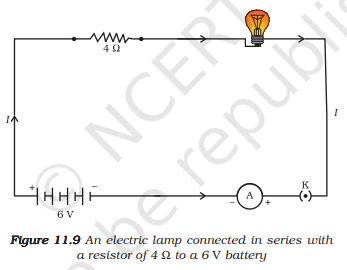
An electric lamp, whose resistance is 20 Ω, and a conductor of 4 Ω resistance are connected to a 6 V battery (Fig). Calculate (a) the total resistance of the circuit, (b) the current through the circuit, and (c) the potential difference across the electric lamp and conductor.
1.
(a) 1\(\Omega \) (b) 1\(\Omega \)
When resistors are connected in parallel, then the equivalent resistance is less than the least resistance connected in the combination. In both the above cases, the equivalent resistance is less than 1\(\Omega \) but is approximately 1\(\Omega \).
2.
Equivalent resistance of the circuit,
R = R1 + R2 + R3 = 5 + 8 + 12 = 25 \(\Omega\)
[\(\because\) R1, R2 and R3 are connected in series]
In series combination, current flowing through all the resistances is same and equal to the total current flowing through the circuit.
\(\therefore\) Current in the resistors, \(I=\frac{V}{R}=\frac{6}{25}=0.24 \mathrm{~A}\)
\(\therefore\) Ammeter reading = 0.24 A
Potential across 12 \(\Omega\) resistance,
V = IR = 0.24 \(\times\) 12 = 2.88 V
\(\therefore\) Voltmeter reading is 288 V.
3.
Alloys have a higher resistivity than their constituent metals. They do not oxidise or burn at higher temperatures as they have high melting point. Thus, they are used to make coils of electrical roasters and electric irons rather than pure metals.
4.
Let resistance be R. Potential difference V across the two ends becomes V/2. Since, I = V / R
As V \(\rightarrow\) V/2, \(I=\frac{V}{2R}=\frac{1}{2}I\)
In other words, current through the component becomes half of its original value.
5.
Resistance is inversely proportional to the area of cross-section of the wire. Since, thìck wire has a large area of cross-section, its resistance will be less. Thus, current will flow more easily through the thick wire.
6.
The resistance of a conductor depends on following factors:
(i) Length of the conductor.
(ii) Area of cross-section of the conductor.
(iii) Nature of material of the conductor.
7.
Given, charge, q = 1 C, potential, V = 6 V, W=?
As we know, W = q V = 1 \(\times\)6 = 6J
6J is given to each coulomb of charge passing through a 6V battery.
8.
The potential difference between two points is said to be 1 V if 1 J of work is done in moving 1 Coulomb of electric charge from one point to other point.
9.
Electric cell or battery is a device that helps to maintain a potential difference across a conductor.
10.
We know that, charge on one electron = 1.6 \(\times\) 10-19C
\(\Rightarrow\) 1.6 \(\times\) 10-19 coulomb charge = 1 electron.
\(\therefore\) 1 coulomb charge=\(\frac{1}{1.6\times 10^{-19}}\simeq 6.25\times 10^{18}\) electrons
11.
The SI unit of electric current is ampere (A).
The current flowing through a conductor is said to be 1A, if a charge of 1coulomb (C) flows through it in 1second (s)
or \(1 A=\frac{1 C}{1 s}\)
12.
(b)
IR2
13.
(d)
25
14.
We are given, potential difference V = 60 V, current I = 4 A.
According to Ohm's law, \(R=\frac{V}{I}=\frac{60 \mathrm{~V}}{4 \mathrm{~A}}=15 \Omega\).
When the potential difference is increased to 120 V the current is given by current \(=\frac{V}{R}=\frac{120 \mathrm{~V}}{15 \Omega}=8 \mathrm{~A}\)
The current through the heater becomes 8 A .
15.
Total resistance in series \({ R }_{ S }={ R }_{ 1 }+{ R }_{ 2 }+{ R }_{ 3 }=3+4+6\)
\({ R }_{ S }=13\Omega \)
V = 10 V
I = ?
\(\therefore\) I = \(\overset { V }{ \underset { R }{ \_ \_ } } =\overset { 10 }{ \underset { 13 }{ \_ \_ } } \)
I = 0.77A
The current flowing through 6\(\Omega \) resistor is i.e. 0.77 A.
In series connection same current flows through each resistor.
16.
1. To observe that flow of current is different for different components. Take a nichrome wire, a torch bulb, a 10 W bulb and an ammeter (0-5 A range), a plug key and some connecting wires.
2. Set up the circuit by connecting four dry cells of 1.5 V each in series with the ammeter leaving a gap XY in the circuit.
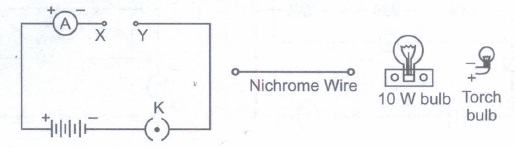
3. Complete the circuit using nichrome wire in gap XY. Note ammeter reading.
4. Now use torch bulb in the circuit.
5. Repeat the same with 10 W bulb.
17.
R1 = 5 Ω, R2 = 10 Ω, and R3 = 30 Ω.
Potential difference across the battery, V = 12 V.
This is also the potential difference across each of the individual resistor; therefore, to calculate the current in the resistors, we use Ohm’s law.
The current I1 , through R1 = V/ R1
I1 = 12 V/5 Ω = 2.4 A
The current l2, through R2 =V / R2
\(I_2=12 \mathrm{~V} / 10 \Omega=1.2 \mathrm{~A}\)
The current I3 , through R3 = V/R3
\(I_3=12 \mathrm{~V} / 30 \Omega=0.4 \mathrm{~A}\)
The total current in the circuit,
I = I1 + I2 + I3
= (2.4 + 1.2 + 0.4) A = 4 A
The total resistance Rp, is given by [Eq]
\(\frac{1}{R_p}=\frac{1}{5}+\frac{1}{10}+\frac{1}{30}=\frac{1}{3}\)
Thus, Rp = 3 Ω
18.
The resistance of electric lamp, R1 = 20 Ω,
The resistance of the conductor connected in series, R2 = 4 Ω.
Then the total resistance in the circuit
R = R1 + R2
Rs = 20 Ω + 4 Ω = 24 Ω.
The total potential difference across the two terminals of the battery
V = 6 V.
Now by Ohm’s law, the current through the circuit is given by
I = V/Rs
= 6 V/24 Ω
= 0.25 A
Applying Ohm’s law to the electric lamp and conductor separately,
we get potential difference across the electric lamp,
V1 = 20 Ω × 0.25 A = 5 V;
and, that across the conductor, V2 = 4 Ω × 0.25 A = 1 V.
Suppose that we like to replace the series combination of electric lamp and conductor by a single and equivalent resistor. Its resistance must be such that a potential difference of 6 V across the battery terminals will cause a current of 0.25 A in the circuit. The resistance R of this equivalent resistor would be
R = V/I
= 6 V/ 0.25 A
= 24 Ω.
This is the total resistance of the series circuit; it is equal to the sum of the two resistances.

10th Standard CBSE Syllabus & Materials
10th Standard CBSE
CBSE 10th Social Science PS - Federalism - New Model Questions Papers Study Material - QB365 Set A
NEW10th Standard CBSE
CBSE 10th Social Science PS - Power Sharing - New Model Questions Papers Study Material - QB365 Set A
NEW10th Standard CBSE
CBSE 10th Social Science GEO - Manufacturing Industries - New Model Questions Papers Study Material - QB365 Set A
NEW10th Standard CBSE
CBSE 10th Social Science GEO - Minerals and Energy Resources - New Model Questions Papers Study Material - QB365 Set A



NCERT Books

Syllabus

Exam Pattern

Sample Question Papers

Previous year Question Papers

Important Notes

MCQ Practice test

NCERT Exemplers

Case study Questions

Image Based Questions

Passage based Questions

HOT Questions

Value Based Questions

Model Questions Papers
NCERT ( Book Back ) Questions

Assertion and Reason
Important Questions And Answers

CBSE 10th Standard CBSE Subjects
CBSE Standards



