
 100% FREE ACCESS
10th Standard CBSE Syllabus & Materials
10th Standard CBSE
CBSE 10th Social Science ECO - Globalisation and the Indian Economy - New Model Questions Papers Study Material - QB365 Set A
NEW10th Standard CBSE
CBSE 10th Social Science ECO - Money and Credit - New Model Questions Papers Study Material - QB365 Set A
NEW10th Standard CBSE
CBSE 10th Social Science ECO - Sectors of the Indian Economy - New Model Questions Papers Study Material - QB365 Set A
NEW10th Standard CBSE
CBSE 10th Social Science ECO - Development - New Model Questions Papers Study Material - QB365 Set A
NEW10th Standard CBSE
CBSE 10th Social Science PS - Outcomes of Democracy - New Model Questions Papers Study Material - QB365 Set A
NEW10th Standard CBSE
CBSE 10th Social Science PS - Gender, Religion and Caste - New Model Questions Papers Study Material - QB365 Set A

Published on: 26/10/2025
Download CBSE Class 10th Standard CBSE Science question papers, sample papers, important questions, and previous year solved papers in PDF format. Get free study materials, NCERT solutions, and exam preparation resources for Class 10th Standard CBSE Science
Questions + Answers key
Take MCQ Science Test
1.
Why is it not advisable to connect electric bulb and electric heater in series?
2.
Calculate the electric energy consumed by 120 W toaster in 20 minutes.
3.
Why is the current constant in series connection of circuit?
4.
An electric iron has a rating of 750 W, 220 V. Calculate
(i) current passing through it, and
(ii) its resistance, when in use
5.
A bulb is rated at 5.0 volt, 100 mA. Calculate its
(i) power and
(ii) resistance
6.
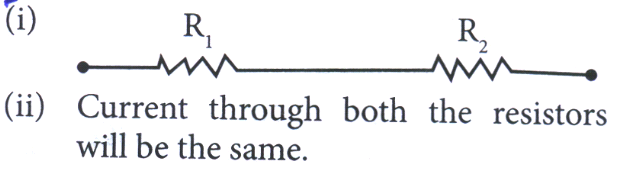
(i) Draw a diagram to show how two resistor R1 and R2 are connected in series.
(ii) In a circuit, if the two resistors of 5 ohm and 10 ohm are connected in series, how does the current passing through the two resistors compare?
7.
An electric lamp is marked 100 W, 220 V. It i used for 5 hours daily. Calculate.
(i) its reistance while glowing
(ii) energy consumed in kWh per day
8.
An electric heater is used on 220 V supply and takes a current of 3.4 A. Calculate (i) its power and (ii) its power and (ii) its resistance when it is in use.
9.
If a 12 V battery is connected to the arrangement of resistances given below, calculate
(i) the total effective resistance of the arrangement and
(ii) the total current flowing in the circuit
10.
(i) Draw a schematic diagram of a circuit consisting of a battery of five 2 V cells, a 5 Ohm resistor, a 10 Ohm resistor and a 15 Ohm resistor, and a plug key, all connected in series.
(ii) Calculate the electric current passing through the above circuit when the key is closed.
11.
The proper representation of series combination of cells obtaining maximum potential is
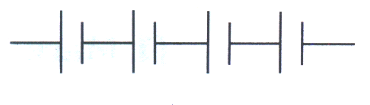
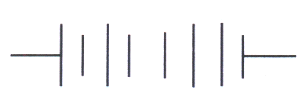

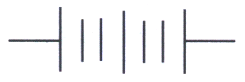
12.
Identify the circuit in which the electrical components have been properly connected.
-q.png)
-q.png)
-q.png)
-q.png)
13.
In the following circuits, heat produced in the resistor or combination of resistors connected to a 12 V battery will be
-q.png)
-q.png)
-q.png)
same in all the cases
maximum in case
maximum in case
minimum in case
14.
A cell, a resistor, a key and ammeter are arranged as shown in the circuit diagrams. The current recorded in the ammeter will be
maximum in
-q.png)
maximum in
-q.png)
maximum in
-q.png)
the same in all the cases
15.
Two conducting wires of the same material and of equal lengths and equal diameters are first connected in series and then parallel in a circuit across the same potential difference. The ratio of heat produced in series and parallel combination would be
1:2
2:1
1:4
4:1
16.
Which of the following terms does not represent electrical power in a circuit?
I2R
IR2
VI
V2/R
17.
A piece of wire of resistance R is cut into five equal parts. These parts are then connected in parallel. If the equivalent resistance of this combination is R' then the ratio R/R' is
1/25
1/5
5
25
18.
Unit of electric power may also be expressed as
volt ampere
kilowatt hour
watt second
joule second
19.
Two resistors of resistance 2\(\Omega \) and 4\(\Omega \) when connected to a battery will have
same current flowing through them when connected in parallel
same current flowing through them when connected in series
same potential difference across them when connected in series
different potential difference across them when connected in parallel
20.
An electric kettle consumes 1 Kw of electric power when operated at 220 V. A fuse wire of what rating must be used for it?
1A
2A
4A
5A
21.
In an electrical circuit two resistors of 2\(\Omega \) and 4\(\Omega \) respectively are connected in series to a 6 V battery. The heat dissipated by the 4\(\Omega \) resistor in 5s will be
5 J
10 J
20 J
30 J
22.
In an electrical circuit three incandescent bulbs A, B and C of rating 40 W, 60 W and 100 W respectively are connected in parallel to an electric source. Which of the following is likely to happen regarding their brightness?
Brightness of all the bulbs will be the same
Brightness of bulb A will be the maximum
Brightness of bulb B will be more than that of A
Brightness of bulb B will be less than that of B
23.
The resistivity does not charge if
the material is charged
the temperature is charged
the shape of the resistor is charge
both material and temperature are changed
24.
If the current through a resistor is increased by 100% (assume that temperature remains unchanged), the increase in power dissipated will be
100%
200%
300%
400%
25.
A cylindrical conductor of length l and uniform area of cross section A has resistance R, another conductor of length 2l and resistance R of the same material has area of cross section?
A/2
3A/2
2A
3A
26.
Which of the following represents voltage?
\(\frac { Work\ done }{ current\ \times \ time } \)
Work done \(\times\) charge
\(\frac { Work\ done \ \times \ time }{ current } \)
Work done \(\times\) charge \(\times\) time
27.
What is the maximum resistance while can be made using five resistors each of 1/5\(\Omega \).
1/5\(\Omega \)
10\(\Omega \)
1/10\(\Omega \)
25\(\Omega \)
28.
A current of 1 A is drawn by a filament of an electric bulb. Number of electrons passing through a cross section of the filament in 16 seconds would be roughly
1020
1016
1018
1023
29.
Electrical resistivity of a given metallic wire depends upon
its length
its thickness
its shape
nature of the material
30.
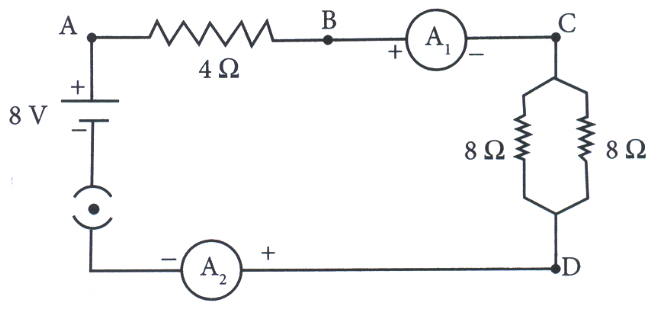
Find out the following in the electric circuit given in Figure
(a) Effective resistance of two 8 \(\Omega\) resistors in the combination
(b)Current flowing through 4 \(\Omega\) resistor
(c) Potential difference across 8 \(\Omega\) resistance
(d) Power dissipated in 4 \(\Omega\) resistor
(e) Difference in ammeter readings, if any.
1.
It is not advisable to connect electric bulb and electric heater in series because both the devices offer different resistance and the requirement of current for functioning is different. Moreover, the devices may damage and not function properly.
If one of the device stops working or fails then the current will not flow through the circuit.
2.
P = 120 W
t = 20 minutes E = P\(\times\)t
E = ? = 120 \(\times\) 20 \(\times\) 60 = 120 \(\times\) 1200
E = 144 \(\times\) 103 J
3.
The number of electrons flowing through the circuit will remain constant. Therefore the current flowing will also be constant. The number of electrons have to travel in a fixed path. Therefore, the value of current is same at each and every point.
4.
(i) Electric power is related to voltage and electric current as:
Power= Voltage x Current
It is given that the rating of the electric iron is 750W, 220V.
Let the current passing through the bulb be I.
Therefore,
750=220 x I
I=\(\frac{750}{220}\)=3.41A
Therefore, 3.41A current passes through the electric iron.
It is given that the rating of the electric bulb is 750W,220 V
Therefore, P=\(\frac { { V }^{ 2 } }{ P } \)=\(\frac { { 220 }^{ 2 } }{ 750 } \)=64.53\(\Omega \) when in use.
(ii) Electric power is related to voltage and resistance as:
\(\frac { { \left( Voltage \right) }^{ 2 } }{ Resistance } \)
That is,
P=\(\frac { { V }^{ 2 } }{ R } \)
=64.53\(\Omega \)
5.
Voltage (V) = 5.0 V
Current (I) = 100 mA = 0.1 A
(i) Power = VI = 5\(\times\)0.1= 0.5W
(ii) Resistance = \(\frac { V }{ I } =\frac { 5 }{ 0.1 } =50\Omega \)
6.
7.
(i) Resistance of a glowing lamp is related to its power and voltage as
Power=\(\frac { { \left( voltage \right) }^{ 2 } }{ Resistance } \)
or, P=\(\frac { { V }^{ 2 } }{ R } \)
Therefore, R=\(\frac { { V }^{ 2 } }{ P } \)=\(\frac { { 220 }^{ 2 } }{ 100 } \)=484\(\Omega \)
Therefore, the resistance of the bulb when glowing is 484\(\Omega \)
(ii) Power=100 W=0.1 kW
Energy= Power x time
=0.1 kW x 5h
=0.5 kWh
0.5 kWh is the amount of energy is consumed by the bulb per day.
8.
(i) Power = Voltage Current
= 220\(\times\)3.4
= 748 Watt
(ii) Power = Voltage / Resistance
P = V2 / R
R = V2 / P=2202 / 748 = 64.71 \(\Omega \)
9.
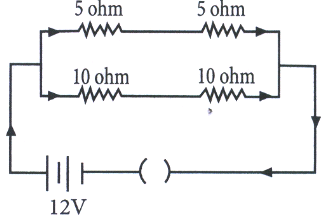
(i) The 5 Ω resistors are connected in series. Therefore, their effective resistance = (5 + 5) = 10 Ω
The 10 Ω resistors are connected in series. Therefore, their effective resistance = (10 + 10) = 20 Ω
Now these 10 Ω equivalent and 20 Ω equivalent are connected in parallel. Therefore, the equivalent resistance (Req) will be:
\(\frac { 1 }{ { R }_{ eq } } =\frac { 1 }{ { R }_{ 1 } } +\frac { 1 }{ { R }_{ 2 } } \)
\(\frac { 1 }{ { R }_{ eq } } =\frac { 1 }{ 10 } +\frac { 1 }{ 20 } \)
\(\frac { 1 }{ { R }_{ eq } } =\frac { 2+1 }{ 20 }
\)
\(\frac { 1 }{ { R }_{ eq } } =\frac { 20 }{ 3 } =6.76\Omega \)
(ii) Total Current = Total voltage / Total equivalent resistor
=12 / 6.67
= 1.8 A.
10.
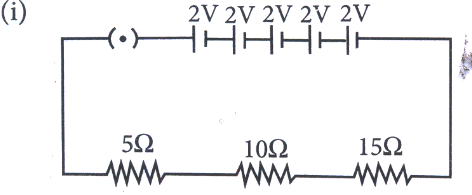
(ii) When the key is closed, total voltage applied across the circuit will be = 2 ✕ 5V = 10 V
Total resistance (R) applied across the circuit in Ohms = 5+10+15= \(30\Omega \)
By Ohm's Law,
Current (I) = \(\frac { V }{ R } \)
\(I=\frac { 10 }{ 30 } =0.33A\)
11.
(a)
12.
(b)
13.
(c)
maximum in case
14.
(d)
the same in all the cases
15.
(c)
1:4
16.
(b)
IR2
17.
(d)
25
18.
(a)
volt ampere
19.
(b)
same current flowing through them when connected in series
20.
(d)
5A
21.
(c)
20 J
22.
(c)
Brightness of bulb B will be more than that of A
23.
(c)
the shape of the resistor is charge
24.
(c)
300%
25.
(c)
2A
26.
(a)
\(\frac { Work\ done }{ current\ \times \ time } \)
27.
(b)
10\(\Omega \)
28.
(a)
1020
29.
(d)
nature of the material
30.
(a) Since two \(8\Omega \) resistors are in parallel, their effective resistance (\({ R }_{ P }\)) is given by,
\(\frac { 1 }{ { R }_{ P } } =\frac { 1 }{ 8 } +\frac { 1 }{ 8 } +\frac { 1 }{ 4 } \) or \({ R }_{ P }=4\Omega \)
(b) Total resistance in the circuit
\(R=4\Omega +{ R }_{ P }=4\Omega +4\Omega =84\Omega \)
Current through the electric circuit
\(I=\frac { V }{ R } =\frac { 8V }{ 8\Omega } =1A\)
(c) The potential difference \(4\Omega \) resistor V
I \(=IR=1\times 4=4V\)
(d) Power dissipated in \(4\Omega \) resistor P=\({ (I) }^{ 2 }\)
\(R={ (1) }^{ 2 }(4)=4W\)
(e) There is no difference in the readings of ammeters \({ A }_{ 1 }\) and \({ A }_{ 2 }\) as same current flows through all elements in a series circuit.

10th Standard CBSE Syllabus & Materials
10th Standard CBSE
CBSE 10th Social Science PS - Federalism - New Model Questions Papers Study Material - QB365 Set A
NEW10th Standard CBSE
CBSE 10th Social Science PS - Power Sharing - New Model Questions Papers Study Material - QB365 Set A
NEW10th Standard CBSE
CBSE 10th Social Science GEO - Manufacturing Industries - New Model Questions Papers Study Material - QB365 Set A
NEW10th Standard CBSE
CBSE 10th Social Science GEO - Minerals and Energy Resources - New Model Questions Papers Study Material - QB365 Set A



NCERT Books

Syllabus

Exam Pattern

Sample Question Papers

Previous year Question Papers

Important Notes

MCQ Practice test

NCERT Exemplers

Case study Questions

Image Based Questions

Passage based Questions

HOT Questions

Value Based Questions

Model Questions Papers
NCERT ( Book Back ) Questions

Assertion and Reason
Important Questions And Answers

CBSE 10th Standard CBSE Subjects
CBSE Standards



