100% FREE ACCESS
10th Standard CBSE Syllabus & Materials
10th Standard CBSE
CBSE 10th Social Science ECO - Globalisation and the Indian Economy - New Model Questions Papers Study Material - QB365 Set A
NEW10th Standard CBSE
CBSE 10th Social Science ECO - Money and Credit - New Model Questions Papers Study Material - QB365 Set A
NEW10th Standard CBSE
CBSE 10th Social Science ECO - Sectors of the Indian Economy - New Model Questions Papers Study Material - QB365 Set A
NEW10th Standard CBSE
CBSE 10th Social Science ECO - Development - New Model Questions Papers Study Material - QB365 Set A
NEW10th Standard CBSE
CBSE 10th Social Science PS - Outcomes of Democracy - New Model Questions Papers Study Material - QB365 Set A
NEW10th Standard CBSE
CBSE 10th Social Science PS - Gender, Religion and Caste - New Model Questions Papers Study Material - QB365 Set A

Published on: 20/10/2025
Download CBSE Class 10th Standard CBSE Science question papers, sample papers, important questions, and previous year solved papers in PDF format. Get free study materials, NCERT solutions, and exam preparation resources for Class 10th Standard CBSE Science
Questions + Answers key
Take MCQ Science Test
1.
An electron enters a magnetic field at a right angle to the field direction.
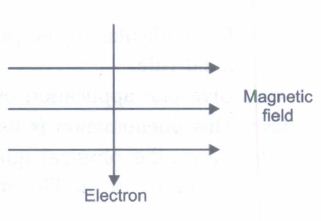
(a) State the rule to find the direction of force acting on the electron
(b) What will be direction of force acting on the electron in the above case?
2.
a) Two magnets are lying side by side as shown below. Draw magnetic field line between poles P and Q.
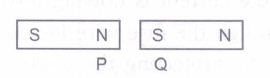
(b) What does the degree of closeness of magnetic field lines near the poles signify?
3.
What is an 'esterification' reaction? Describe an activity to show esterification.
4.
(a) Complete the following equations
(i) CH3CH2OH \(\overset { \quad conc.H_2SO_4 }{ \underset { heat }{ \longrightarrow } } \)
(ii) CH3COOH + NaHCO3 \(\longrightarrow \)
(iii) CH4 + Cl2 \(\overset { sunlight }{ \longrightarrow } \)
(b) Write the name of the following:
(i) CH3CH2COOH (ii) CH3CH2Br
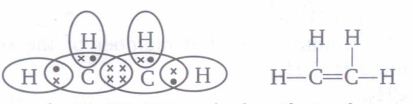
(c) Draw the electron dot structure of ethene(C2H4)
5.
Give the differences between series and parallel connections of resistors.
6.
(a) State Ohm's Law.
(b) Draw a schematic diagram of the circuit for studying Ohm's Law.
7.
Which of the following pattern correctly describes the magnetic field around sqpa long straight wire carrying current?
Straight lines perpendicular to the wire
Straight lines parallel to the wire
Radial lines originating from the wire
Concentric circles centred around the wire
8.
In all the electrical appliances, the switches are put in the
live wire
earth wire
neutral wire
none of the above
9.
It the resistance of wire A is four times resistance of wire B then ratio of radii of two wires is
1: 2
1:4
1:6
1:8
10.
Which of the following terms does not represent electrical power in a circuit?
I2R
IR2
VI
V2/R
11.
The name of the compound CH3 - CH2 - CHO is
Propanal
Propanone
Ethanol
Ethanal
12.
The soap molecule has a
hydrophilic head and a hydrophobic tail
hydrophobic head and a hydrophilic tail
hydrophobic head and a hydrophobic tail
hydrophilic head and a hydrophilic tail
13.
While cooking, if the bottom of the vessel is getting blackened on the outside, it means that
the food is not cooked completely.
the fuel is not burning completely.
the fuel is wet.
the fuel is burning completely.
14.
Choose the incorrect statement
Fleming's right-hand rule is a simple rule to know the direction of induced current.
The right-hand thumb rule is used to find the direction of magnetic fields due to current carrying conductors.
The difference between the direct and alternating currents is that the direct current always flows in one direction, whereas the alternating current reverses its direction periodically.
In India, the AC changes direction after every 1/50 second.
15.
Which of the following property of a proton can change while it moves freely in a magnetic field ?
mass
speed
velocity
momentum
16.
Write the properties of magnetic field lines.
17.
An electric refrigerator rated 400 W operates 8 hour/day. What is the cost of the energy to operate it for 30 days at Rs 3.00 per kW h?
18.
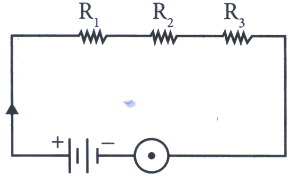
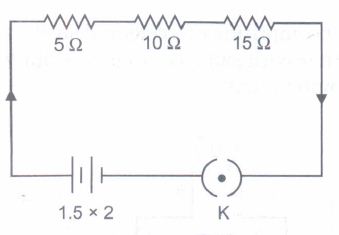
Draw a schematic diagram of an' electric circuit consisting of a battery of two cells each of 1.5 V, 5 \(\Omega \), 10 \(\Omega \) and 15 \(\Omega \) resistor and a plug key, all connected in series.
19.
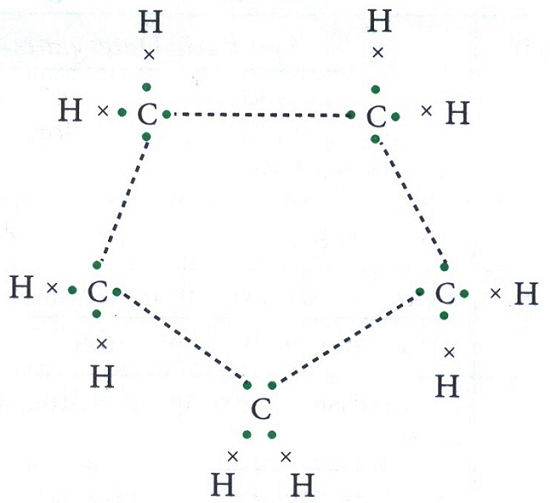
What will be the formula and electron dot structure of cyclopentane?
20.
What are soaps? Explain the mechanism of the cleansing action of soaps? Soaps form scum with hard water. Explain why? How this problem is overcome by use of detergents
21.
Two wires A and B are of equal length and have equal I resistance. If the resistivity of A is more than that of B which wire is thicker and why? For the electric circuit given below calculate:
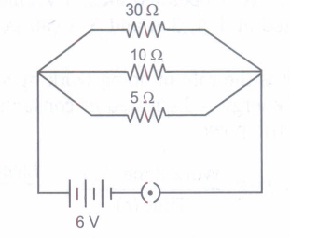
(i) Current in each resistor,
(ii) Total current drawn from the battery, and
(iii) Equivalent resistance of the Circuit
22.
(a) What is homologous series? Give one example.
(b) What will happens if ethanoic acid reacts with ethanol in the presence of an acid as a catalyst? Name the reaction. Write the chemical reaction for this reaction.
(c) Why are soaps ineffective in hard water?
23.
(a) What is an electromagnet?
(b) List any of its two uses.
(c) Draw a labelled diagram to show how an electromagnet is made.
(d) What is the purpose of the soft iron core used in making an electromagnet?
24.
Assertion: Solenoid is like a bar magnet.
Reason: One end of the solenoid behaves as a magnetic north pole, while the other behaves as the south pole.
Codes
(a) If both assertion and reason are true and the reason is correct explanation of assertion.
(b) If both assertion and reason are true but reason is not a correct explanation of assertion.
(c) If assertion is true and reason is false.
(d) If both assertion and reason are false.
25.
Assertion: Diamond and graphite are two isotopes of carbon.
Reason: Diamond is the hardest substance known while graphite is non conductor of electricity.
Codes
(a) If both assertion and reason are true and the reason is correct explanation of assertion.
(b) If both assertion and reason are true but reason is not a correct explanation of assertion.
(c) If assertion is true and reason is false.
(d) If both assertion and reason are false
26.
When a current is passed through the circular loop of wire, a magnetic field lines near the coil are nearly circular and concentric. At the centre of the circular loop, the magnetic field lines are straight. The strength of the magnetic field produced by a current-carrying circular coil (or circular wire) depends on
(i) current flowing through the coil.
(ii) radius of the circular coil.
(iii) number of turns of wire in the circular coil. The direction of the field lines can be found by applying right-hand thumb rule.
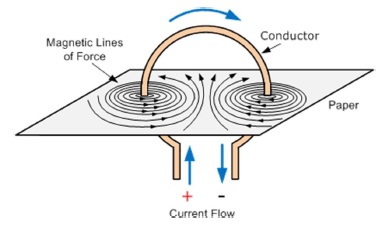
(i) A long horizontal power line is carrying a current of 100 A in the east-west direction. What is the direction of magnetic field at a point 1.0 m below it?
| (a) North-South | (b) East-West | (c) South-East | (d) North-West |
(ii) State the pattern of magnetic field lines for current carrying circular conductor.
(a) Magnetic field lines will be concentric circles to any point of the circular loop
(b) At centre, the field lines appear straight
(c) Both of these
(d) None of these
(iii) If a current carrying straight conductor is placed in east-west direction, then find the direction of the force experienced by the conductor due to earth's magnetic field.
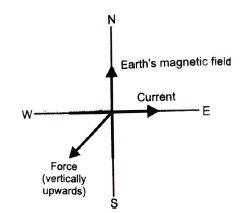
| (a) Upward | (b) Downward |
| (c) Can't determined | d) Same as of current |
(iv) According to right-hand thumb rule direction of the curl of fingers of the right hand gives the
| (a) electric field lines | (b) magnetic field lines |
| (c) direction of magnetic field | (d) direction of current |
(v) In case of circular loop carrying current, the strength of magnetic field is
(a) constant everywhere
(b) stronger inside the loop than outside the loop
(c) weaker inside the loop than outside the loop
(d) none of these
27.
Two or more resistances are connected in series or in parallel or both, depending upon whether we want to increase or decrease the circuit resistance.
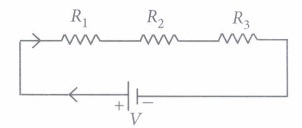
The two or more resistances are said to be connected in series if the current flowing through each resistor is same. The equivalent resistance in the series combination is given by
Rs = R1 + R2 + R3
(i) When three resistors are connected in series with a battery of voltage V and voltage drop across resistors is V1, V2 and V3, which of the relation is correct?
| (a) V = V1= V2 = V3 | (b) V = V1 + V2 + V3 |
| (c) V1 + V2 + V3 = 3V | (d) V > V1 + V2 + V3 |
(ii) When the three resistors each of resistance R ohm, connected in series, the equivalent resistance is
| (a) R/2 | (b) > R |
| (c) < R/2 | (d) < R |
(iii) There is a wire oflength 20 cm and having resistance 20 \(\begin{equation} \Omega \end{equation}\) cut into 4 equal pieces and then joined in series.
The equivalent resistance is
| (a) 20 \(\begin{equation} \Omega \end{equation}\) | (b) 4 \(\begin{equation} \Omega \end{equation}\) |
| (c) 5 \(\begin{equation} \Omega \end{equation}\) | (d) 10 \(\begin{equation} \Omega \end{equation}\) |
(iv) In the following circuit, find the equivalent resistance between A and B is (R = 2 \(\begin{equation} \Omega \end{equation}\))
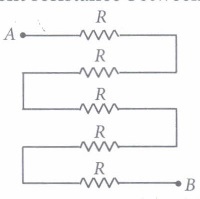
| (a) 10 \(\begin{equation} \Omega \end{equation}\) | (b) 5 \(\begin{equation} \Omega \end{equation}\) |
| (c) 2 \(\begin{equation} \Omega \end{equation}\) | (d) 4 \(\begin{equation} \Omega \end{equation}\) |
(v) In the given circuit, the current in each resistor is
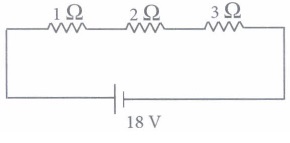
| (a) 3 A | (b) 6 A |
| (c) 9 A | (d) 18 A |
1.
(a) Fleming's Left Hand Rule: Stretch the first three fingers of the left hand mutually perpendicular to each other such that the fore-fingers points the direction of magnetic field, the middle finger points the direction of current, then the thumb will indicate the direction of force experienced by the conductor. It is to be applied when the current and field are perpendicular to each other.
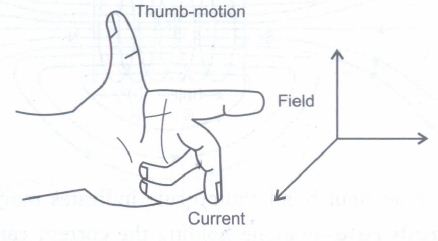
(b) Vertically downward or into the plane of the paper.
2.
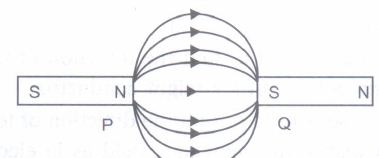
(b) The degree of closeness of magnetic field lines near the poles signify that the field is stronger there.
3.
When- carboxylic acid reacts with alcohol in the presence of cone. H2SO4, pleasant fruity smelling compound, ester is formed. This reaction is called esterification
\(CH_3COOH(l)+C_2H_5OH(l)\)\(\overset { conc. }{ \underset { H2SO4 }{ \leftrightarrows } } \)CH3COOC2H5(l) + H2O(l)
Ethanoic acid Ethanol Ethyl Ethanoate Water
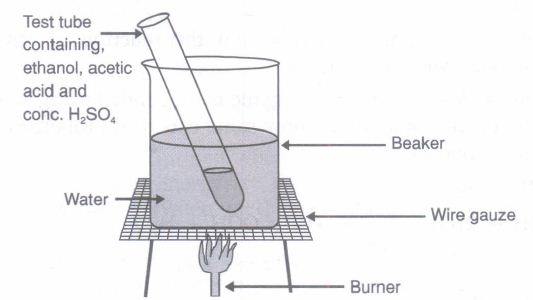
Activity:
1.Take 1 mL of ethanol in a test tube. Add 1 mL of acetic acid in this test tube.
2. Add few drops of cone. H2SO4 in the mixture
3. Heat the content on water bath for 5 minutes.
4. Smell the resulting mixture formed.
4.
(a) CH3CH2OH\(\overset { \quad conc.H2SO4 }{ \underset { heat }{ \longrightarrow } } \) H2C=CH2 + H2O
CH3COOH + NaHCO3 \(\longrightarrow \)CH3COONa + H2O + CO2
CH4 + Cl2 \(\overset { sunlight }{ \longrightarrow } \)CH3CI + HCI
(b) (i) Propanoic acid (ii) Bromoethane
(c) Electron dot structure of ethene
5.
| Series connection | Parallel connection |
| 1. The potential difference (V) across the combination of resistors connected in series is equal to the sum of all the individual potential differnece. | The potential difference across all resistors in parallel connection remains constant. |
|
2. Current (I) remains the same. |
Current (I) will be different for different resistor.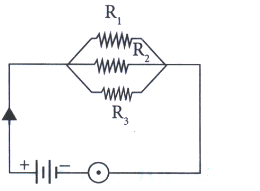 |
| 3. The resistance will be the sum of all the resistors in the circuit. Rs = R1 + R2 + R3. |
Total resistance will be given as \(\frac { 1 }{ { R }_{ p } } =\frac { 1 }{ { R }_{ 1 } } +\frac { 1 }{ { R }_{ 2 } } +\frac { 1 }{ { R }_{ 3 } } \) |
| 4. Equivalent resistance is high. | Equivalent resistance is less than each resistor. |
6.
(a) Ohm's Law states that at constant temperature, current flowing through a conductor is directly proportional to the potential difference across its ends.
-s.png)
7.
(d)
Concentric circles centred around the wire
8.
(c)
neutral wire
9.
(a)
1: 2
10.
(b)
IR2
11.
(a)
Propanal
12.
(a)
hydrophilic head and a hydrophobic tail
13.
(b)
the fuel is not burning completely.
14.
(d)
In India, the AC changes direction after every 1/50 second.
15.
(d)
momentum
16.
The magnetic field lines have the following properties
(i) They originate from North pole of a magnet and end at its south pole, by convention.
(ii) These lines are closed and continuous curve.
(iii) Field lines never intersect each other.
(iv) They are crowded near the poles, where the magnetic field is strong and separated far from the poles, where the magnetic field is weak.
17.
The total energy consumed by the refrigerator in 30 days would be 400 W × 8.0 hour/day × 30 days = 96000 W h = 96 kW h
Thus the cost of energy to operate the refrigerator for 30 days is 96 kW h × Rs 3.00 per kW h = Rs 288.00
18.
19.
The formula for cyclopentane is C5H10. Its electron dot structure is
20.
Soaps are sodium salts of fatty acids. It is biodegradable and shows cleansing action by removing dirt.
Mechanism of cleansing action:
Soap molecule has two ends, the charged end that gets attracted towards water is called hydrophilic and the long carbon chain that repels water is called hydrophobic tail. When soap is dissolved in water, the carbon chain i.e., hydrophobic end gets attracted towards the oil, dirt and grease. The hydrophilic end stays away from this. ' The micelle formation takes place. The tail entangles dirt, oil or grease, if required, the agitation is done. Lot of rinsing is done with water so that water molecules attract charged (Na+) end and carries the soap molecules with dirt attached to it and clean the clothes, utensils, etc:
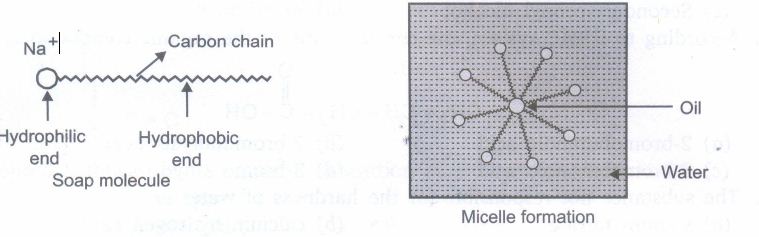
Scum formation: Hard water often contains salts of calcium and magnesium. Soap molecules react with the salts of calcium and magnesium and form a precipitate. This precipitate begins floating as an off-white layer over water. This layer is called scum. soaps lose their cleansing property in hard water because of formation of scum.
In case of detergents, the salts present in hard water does not react with the molecules of detergent to form insoluble scum, but the molecules of detergent remain as it is and helps in the cleansing action.
21.
\({ R }=\rho \overset { l }{ \underset { A }{ \_ \_ } } \)
\(\overset { \rho }{ \underset { A }{ \_ \_ } } =\overset { R }{ \underset { l }{ \_ \_ } } \) Constant = K (for same I and R)
\(\rho =kA\)
\(\rho \propto A\)
So, for different materials having same resistance per unit length, greater resistivity material wire has more cross-sectional area.
(i) Current through each resistor
II =\(\frac { V }{ { R }_{ 1 } } =\frac { 6 }{ 5 } =1.2A\)
I2 =\(\frac { V }{ { R }_{ 2 } } \frac { 6 }{ 10 } =0.6A\)
I3 =\(\frac { V }{ { R }_{ 3 } } \frac { 6 }{ 30 } =0.2A\)
Current in 5\(\Omega\), 10\(\Omega\) and 30\(\Omega\) are therefore, 1.2 A, 0.6 A and 0.2 A respectively.
(ii) Total current drawn from the battery
I = II + I2 + I3 = 1.2 + 0.6 + 0.2 = 2.0 A
(iii) Rl = 5\(\Omega\), R2 = 10\(\Omega \) nand R3 = 3\(\Omega \) n are connected in parallel. So their equivalent resistance
\(\frac { 1 }{ R } =\frac { 1 }{ { R }_{ 1 } } +\frac { 1 }{ { R }_{ 2 } } +\frac { 1 }{ { R }_{ 3 } } =\frac { 1 }{ 5 } +\frac { 1 }{ 10 } +\frac { 1 }{ 30 } =\frac { 1 }{ 3 } \)
R =3 \(\Omega \)
22.
(a) Homologous series is series of compounds having same functional group and same chemical properties. ,When members of the series are arranged in ascending order, two successive members differ by -CH2 group and mass 14 u.
Example: Alcohol
CH3OH
C2H5OH \(\longrightarrow\) differ by -CH2 group and mass 14. a.m.u.
C3H7OH
(b) Ethanol reacts with ethanoic acid to produce a fruity smelling compound called ester, the conc. sulphuric acid is used as dehydrating agent which removes water. Such reaction is called esterification.

(c) Hard water contains salts of Ca and Mg. Soap molecule reacts with these salts to produce white precipitate called scums which is insoluble in water and the cleansing action of soap becomes ineffective.
23.
(a) An electromagnet is a device used to produce magnetic field with the help of electricity.
(b) An electromagnet is used for lifting heavy loads. It is also used in automatic door locking systems.
(c)
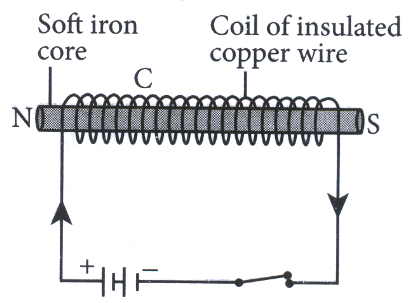
(d) A soft iron is used as a core in order to strengthen the magnetic field created by the electromagnet.
24.
(a) If both assertion and reason are true and the reason is correct explanation of assertion.
25.
(d) If both assertion and reason are false
26.
(i) (a) North-South
The current flows in the east-west direction. From right hand thumb rule, we get the direction of magnetic field as from north to south. The direction of magnetic field will be same at every point below the power line.
(ii) (c) Both of these
(iii) (a) Upward
The direction of the Earth's magnetic field is from geographic south to north. Let the direction of current in the conductor be from west to east. Applying Fleming's left-hand rule, we find, that the direction of the force acting on the conductor will be vertically upwards,
(iv) (b) magnetic field lines
The direction of curl of fingers of the right hand gives the direction of magnetic field lines.
(v) (b) stronger inside the loop than outside the loop
Magnetic field is strongest near the centre of the loop.
27.
(i) (b): In series combination, the total voltage is equal to the sum of voltage drop across each resistance.
(ii) (b): Rs = R1 + R2 + R3
So, Rs = R + R + R = 3R
(iii) (a): Resistance of each wire = 20/4 = 5 \(\begin{equation} \Omega \end{equation}\)
Equivalent resistance in series
Rs = 5 + 5 + 5 + 5 = 20 \(\begin{equation} \Omega \end{equation}\)
(iv) (a): All are in series, Rs = 5R= 5 x 2 = 10\(\begin{equation} \Omega \end{equation}\)
(v) (a): Rs = 1 + 2 + 3 = 6 \(\begin{equation} \Omega \end{equation}\)
\(\begin{equation} I=\frac{18}{6}=3 \mathrm{~A} \end{equation}\)

10th Standard CBSE Syllabus & Materials
10th Standard CBSE
CBSE 10th Social Science PS - Federalism - New Model Questions Papers Study Material - QB365 Set A
NEW10th Standard CBSE
CBSE 10th Social Science PS - Power Sharing - New Model Questions Papers Study Material - QB365 Set A
NEW10th Standard CBSE
CBSE 10th Social Science GEO - Manufacturing Industries - New Model Questions Papers Study Material - QB365 Set A
NEW10th Standard CBSE
CBSE 10th Social Science GEO - Minerals and Energy Resources - New Model Questions Papers Study Material - QB365 Set A



NCERT Books

Syllabus

Exam Pattern

Sample Question Papers

Previous year Question Papers

Important Notes

MCQ Practice test

NCERT Exemplers

Case study Questions

Image Based Questions

Passage based Questions

HOT Questions

Value Based Questions

Model Questions Papers
NCERT ( Book Back ) Questions

Assertion and Reason
Important Questions And Answers

CBSE 10th Standard CBSE Subjects
CBSE Standards