
 100% FREE ACCESS
10th Standard CBSE Syllabus & Materials
10th Standard CBSE
CBSE 10th Social Science ECO - Globalisation and the Indian Economy - New Model Questions Papers Study Material - QB365 Set A
NEW10th Standard CBSE
CBSE 10th Social Science ECO - Money and Credit - New Model Questions Papers Study Material - QB365 Set A
NEW10th Standard CBSE
CBSE 10th Social Science ECO - Sectors of the Indian Economy - New Model Questions Papers Study Material - QB365 Set A
NEW10th Standard CBSE
CBSE 10th Social Science ECO - Development - New Model Questions Papers Study Material - QB365 Set A
NEW10th Standard CBSE
CBSE 10th Social Science PS - Outcomes of Democracy - New Model Questions Papers Study Material - QB365 Set A
NEW10th Standard CBSE
CBSE 10th Social Science PS - Gender, Religion and Caste - New Model Questions Papers Study Material - QB365 Set A

Published on: 20/10/2025
Download CBSE Class 10th Standard CBSE Science question papers, sample papers, important questions, and previous year solved papers in PDF format. Get free study materials, NCERT solutions, and exam preparation resources for Class 10th Standard CBSE Science
Questions + Answers key
Take MCQ Science Test
1.
Name and define the Sl unit of current.
2.
What happens to the resistance when length of conductor is doubled without affecting the thickness of conductor
3.
Study the diagram and answer the questions following it.
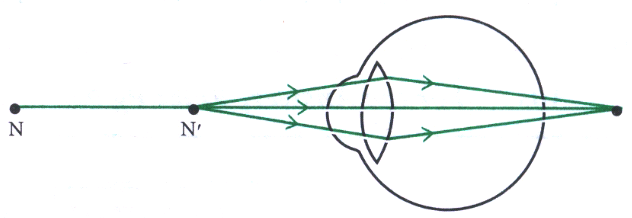
a) Which defect of vision is represented in this case? Give the reason for your answer.
b) What could be the two causes of this defect?
(c) With the help of a diagram show how this defect can be corrected by the use of a suitable lens.
4.
Why do we see a rainbow in the sky only after rainfall?
5.
A person needs a lens of power -5.5 D for correcting his distant vision. For correcting his near vision he needs a lens of power +1.5 D. What is the focal length of the lens required for correcting (i) distant vision, and (ii) near vision?
6.
On what factors do the resistance of a conductor depend?
7.
(a)Write the function of each of the following parts of human eye:
cornea; iris; crystalline lins; ciliary muscles
(b)Millions of people of the developing countries of the work are suffering from corneal blindness. These persons can be cured by replacing the defective cornea with the cornea of a donated eye. A charitable society of your city has organised a campaign in your neighbourhood in order to create awareness about this fact. If you are asked to participate in this mission how would you contribute in this noble cause?
(i)State the objective of organising such campaigns.
(ii)List two arguments which you would give to motivate the people to donate their eyes after death.
(iii)List two values which are developed in the persons who actively participate and contribute in such programmes.
8.
How will you infer with the help of an experiment that the same current flows through every part of the circuit containing three resistances in series connected to a battery?
9.
Twinkling of stars is due to atmospheric
dispersion of light by water droplets
refraction of light by different layers of varying refractive indices
scattering of light by dust particles
internal reflection of light by clouds
10.
The maximum resistance which can be made using four resistors, each of resistance 1/2 Ω is
2Ω
1Ω
2.5Ω
8Ω
11.
The persistence of vision for normal eye is
\(( \frac{1}{10} )\) th of a second
\(( \frac{1}{16} )\) th of a second
\(( \frac{1}{6} )\) th of a second
\(( \frac{1}{18} )\) th of a second
12.
Two metallic wires A and B are connected in parallel. Wire A has length 'l' and radius 'r' and wire B has a length '2l' and radius '2r'. Then the ratio of total resistance of parallel combination and the resistance of wire A is
1:2
1:3
1:4
1:5
13.
It the resistance of wire A is four times resistance of wire B then ratio of radii of two wires is
1: 2
1:4
1:6
1:8
14.
The resistivity of a wire
varies with its length
varies with its mass
varies with its cross section
is independent of length, cross section and mass of wire
15.
When light rays enter the eye, most of the refraction occurs at the
crystalline lens
outer surface of the cornea
iris
pupil
16.
At noon the sun appears white as
light is least scattered
all the colours of the white light are scattered away
blue colour is scattered the most
red colour is scattered the most
17.
Name and explain the phenomenon of light due to which the path of a beam of light becomes visible when it enters a smoke filled room through a small hole. Also, state the dependence of colour of the light we receive on the size of the particle of the medium through which the beam of light passes.
18.
White light is passed through a prism to yield a spectrum.
(i) Which colour of the ray will show the maximum angle of deviation and which one will show the least angle of deviation?
(ii) A blue-coloured ray is passed through a glass prism. What will be the colour of the emergent ray? Justify your answer.
19.
Three resistors in a circuit are attached as shown below. The resistance of F and G are \(10 \Omega\) and \(5 \Omega\), respectively. The resistance of E Is unknown. These resistors are connected to a battery with potential difference 6 V .
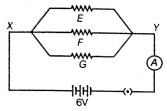
(i) What is the term used to describe such an arrangement of resistors?
(ii) What is the resistance of E if 0.3 A current flows through it?
(iii) What is the total current flowing in the circuit?
20.
Derlve an expression for equivalent resistance in the following case
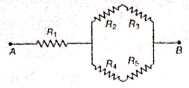
Decide which resistances are in series and parallel. Solve for series and then for parallel. Combine both the results to get the equivalent resistance.
21.
The potential difference between the terminals of an electric heater is 60 V when it draws a current of 4 A from the source. What current will the heater draw if the potential difference is increased to 120 V?
22.
Give the difference between myopia and hypermetropia
23.
Draw a labelled diagram of rainbow formation. Also explain the phenomenon of rainbow formation
24.
1. Take a nichrome wire, a torch bulb, a 10 W bulb and an ammeter (0 - 5 A range), a plug key and some connecting wires.
2. Set up the circuit by connecting four dry cells of 1.5 V each in series with the ammeter leaving a gap XY in the circuit, as shown in Fig.
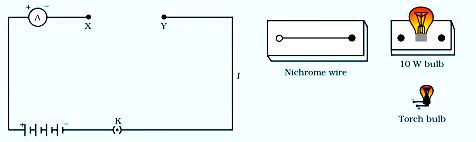
3. Complete the circuit by connecting the nichrome wire in the gap XY. Plug the key. Note down the ammeter reading. Take out the key from the plug. [Note: Always take out the key from the plug after measuring the current through the circuit.]
4. Replace the nichrome wire with the torch bulb in the circuit and find the current through it by measuring the reading of the ammeter.
5. Now repeat the above step with the 10 W bulb in the gap XY.
6. Are the ammeter readings differ for different components connected in the gap XY? What do the above observations indicate?
7. You may repeat this Activity by keeping any material component in the gap. Observe the ammeter readings in each case. Analyse the observations.
25.
Assertion: A current carrying wire should be charged.
Reason: The current in a wire is due to flow of free electrons in a definite direction.
Codes
(a) Both A and R are true, and R is correct explanation of the assertion.
(b) Both A and R are true, but R is not the correct explanation of the assertion.
(c) A is true, but R is false.
(d) A is false, but R is true.
26.
Assertion: There is no dispersion of light refracted through a rectangular glass slab.
Reason: Dispersion of light is the phenomenon of splitting of a beam of white light into its constituents colours.
Codes
(a) Both A and R are true, and R is correct explanation of the assertion.
(b) Both A and R are true, but R is not the correct explanation of the assertion.
(c) A is true, but R is false.
(d) A is false, but R is true.
27.
Assertion: White light of the Sun gives us various colours of the rainbow
Reason: The bending ability of red is least and the violet is the most.
Codes
(a) If both assertion and reason are true and the reason is correct explanation of assertion.
(b) If both assertion and reason are true but reason is not a correct explanation of assertion.
(c) If assertion is true and reason is false.
(d) If both assertion and reason are false
28.
An electric lamp is a device that produces visible light from electric current. It is the most common form of artificial lighting and is essential to modern society. An electric lamp of resistance 20 Ω and a conductor of resistance 4 Ω are connected to a 6 V battery as shown in the circuit.
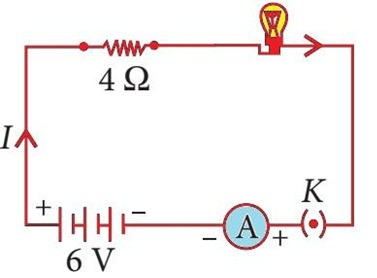
(i) Find the total resistance of the circuit.
(a) 20 Ω (b) 4 Ω (c) 24 Ω (d) 12 Ω
(ii) Find the current through the circuit, is
(a) 0.25 A (b) 0.50 A (c) 1 A (d) 4 A
(iii) Find the potential difference across the electric lamp.
(a) 5 V (b) 10 V (c) 15 V (d) 20 V
(iv) Find the potential difference across conductor.
(a) 0 V (b) 0.25 V (c) 0.5 V (d) 1 V
(v) Calculate power of the lamp.
(a) 2.0 W (b) 1.25 W (c) 0.25 W (d) 6.25 W
1.
The SI unit of electric current is ampere. 1 ampere is the electric current which flows through any part of a conductor, when 1 coulomb of charge flows through it in 1 second.
1 ampere = 1 coulomb/1 second
2.
Resistance is doubled because it is directly proportional to length.
3.
(a) Hypermetropia as the image is formed beyond the retina.
(b) (i) Increase in focal length of the lens (ii) Decrease in size of eyeball
(c)

4.
After rain, a large number of tiny rain drops remain suspended in air, when sunlight falls on these droplets, they get refract and dispersed in the atmosphere thereby each raindrops act as a tiny glass prism splitting into a spectrum.
since each raindrops act like prisms, when white sunlight enters and leaves these raindrops, the coloured rays in white light refracted by different amounts and so an arch of seven colours i.e., rainbow is formed.
5.
(i) We know that,
Focal length=\(\frac{1}{\text { Power }}=-\frac{1}{5.5}\)
[given, power, P = -5.5 D]
= - 0.18 m
= -18 cm [concave lens]
(ii) \(\text { Focal length }=\frac{1}{\text { Power }}=+\frac{1}{1.5}=0.67 \mathrm{~m}\)
[given, power, P = + 1.5 D]
= 67 cm [convex lens]
6.
The resistance of a conductor depends on following factors:
(i) Length of the conductor.
(ii) Area of cross-section of the conductor.
(iii) Nature of material of the conductor.
7.
(a) Functions of the following parts of human eye:
(i) Comea: Objects enters the eye through cornea.
(ii) Iris: Iris controls the size of the pupil.
(iii) Crystalline lens: It focuses the image of the object on the retina.
(iv) Ciliary muscles: Ciliary muscles hold the eye lens and change the thickness of eye lens while focussing.
(b) (i) Objective of such campaigns. To make people aware of corneal blindness and make them realise their duties towards the society by taking pledge for eye donation.
(ii) (a) One pair of eyes can give eyesight to two corneal blind persons and make them see this beautiful world.
(b) Our eyes can live even after our death. People belonging to all age groups, even people with medical conditions like cataract, diabetes, hypertension can donate their eyes.
(iii) Values developed in persons who actively participate in such programmes:
(a) Concern for others and social welfare.
(b) Responsible behaviour and awareness.
8.
A number of resistors are said to be connected in series, if these are joined end to end and the same, current flows through each one of them when a potential difference is applied across the combination. If we connect ammeter first between the point A and R1, then between R1 and R2:R2 and R3 and lastly between R3 and the point B; it is same as current.
9.
(b)
refraction of light by different layers of varying refractive indices
10.
(a)
2Ω
11.
(b)
\(( \frac{1}{16} )\) th of a second
12.
(a)
1:2
13.
(a)
1: 2
14.
(d)
is independent of length, cross section and mass of wire
15.
(b)
outer surface of the cornea
16.
(a)
light is least scattered
17.
Tyndall effect. The earth's atmosphere is a heterogeneous mixture of minute particles of smoke, tiny water droplets, suspended particles of dust and molecules of air.
So, when a beam of light strikes such particles of smoke filled room through a small hole, the path of the beam of light become visible. This happens due to Tyndall effect. It's a phenomena based on scattering of light.
The colour of scattered light depend on the size of the particle of the medium through which the beam of light passes and wavelength of light.
and scattering \(\alpha\) diameter. [Where d = diameter of particle of medium]
18.
(i) The angle of deviation is inversely proportional to the wavelength of light. Therefore, violet colour will show maximum angle of deviation and red colour will show minimum angle of deviation.
(ii) The emergent ray will be blue in colour. White light passing through a prism undergoes dispersion but blue colour ray passed through prism is undispersed.
19.
(i) The term used to describe such an arrangement of resistors is parallel combination of resistors.
(ii) To find the resistance, we use the following equation.
\(V_E =I_E R_E \)
\(6 =0.3 \times R \)
\(R_E =\frac{6}{0.3}=20 \Omega\)
(iii) The total current flowing in the circuit,
\( I=I_E+I_F+I_G \)
\( I=\frac{V}{R_E}+\frac{V}{R_F}+\frac{V}{R_G} \)
\( I=\frac{6}{20}+\frac{6}{10}+\frac{6}{5}=2.1 \mathrm{~A}\)
20.
R2 and R3 are in series, thus for this combination,
\(R^{\prime}=R_2+R_3\)
Similarly, R4 and R5 are in series.
So, \(R^{\prime \prime}=R_4+R_5\)
K' and \(R^{\prime}\) are in parallel.
R1 and R''' are in series.
\(\therefore R_{\text {eq }}=R_1+\frac{\left(R_2+R_3\right)\left(R_4+R_5\right)}{R_2+R_3+R_4+R_5}\)
\(\therefore \quad R^{\prime \prime}=\frac{R^{\prime} R^{\prime \prime}}{R^{\prime}+R^{\prime}} \)
\(R^{\prime \prime \prime}=\frac{\left(R_2+R_3\right)\left(R_4+R_5\right)}{R_2+R_3+R_4+R_5}\)
21.
We are given, potential difference V = 60 V, current I = 4 A.
According to Ohm's law, \(R=\frac{V}{I}=\frac{60 \mathrm{~V}}{4 \mathrm{~A}}=15 \Omega\).
When the potential difference is increased to 120 V the current is given by current \(=\frac{V}{R}=\frac{120 \mathrm{~V}}{15 \Omega}=8 \mathrm{~A}\)
The current through the heater becomes 8 A .
22.
| S .NO | Myopia | Hypermetropia |
| 1 | Short-sightedness-can see nearby object but cannot see far off objects |
Long-sightedness-can see far off objects but cannot see nearby objects |
| 2. | Image is formed in front of retina | Image is formed beyond retina. |
| 3. | The size of eyeball increases. | The size of eyeball decreases. |
| 4. | Focal length of eye lens decreases | Focal length of eye lens increases. |
| 5. | Corrected by using concave lens.. | Corrected by using convex lens |
23.
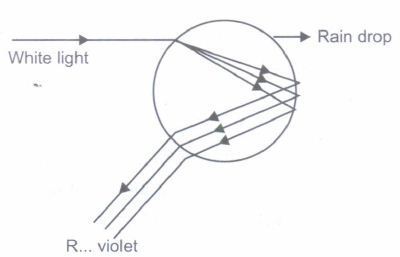
Water droplets acts as tiny prism in the sky. The sunlight when enters these tiny droplets undergo internal reflection and also refract these rays which are dispersed causing a band of seven colours called rainbow. Rainbow is always formed in the direction opposite to the sun.
24.
1. To observe that flow of current is different for different components. Take a nichrome wire, a torch bulb, a 10 W bulb and an ammeter (0-5 A range), a plug key and some connecting wires.
2. Set up the circuit by connecting four dry cells of 1.5 V each in series with the ammeter leaving a gap XY in the circuit.
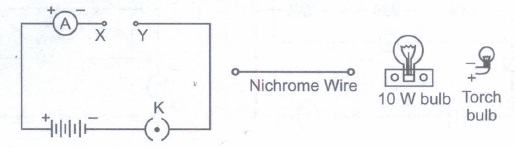
3. Complete the circuit using nichrome wire in gap XY. Note ammeter reading.
4. Now use torch bulb in the circuit.
5. Repeat the same with 10 W bulb.
25.
(d): The current in a wire is due to flow of free electrons in a definite direction. But the number of protons in the wire at any instant is equal to number of electrons and charge on electrons is equal and opposite to that of proton. Hence, net charge on the wire is zero.
26.
(b): After refraction at two parallel faces of a glass slab, a ray of light emerges in a direction parallel to the direction of incidence of white light on the slab. As rays of all colours emerge in same direction, hence there is no dispersion only lateral displacement takes place.
27.
(b) If both assertion and reason are true but reason is not a correct explanation of assertion.
28.
(i) (c) 24 Ω
(ii) (a) 0.25 A
(iii) (a) 5 V
(iv) (d) 1 V
(v) (b) 1.25 W

10th Standard CBSE Syllabus & Materials
10th Standard CBSE
CBSE 10th Social Science PS - Federalism - New Model Questions Papers Study Material - QB365 Set A
NEW10th Standard CBSE
CBSE 10th Social Science PS - Power Sharing - New Model Questions Papers Study Material - QB365 Set A
NEW10th Standard CBSE
CBSE 10th Social Science GEO - Manufacturing Industries - New Model Questions Papers Study Material - QB365 Set A
NEW10th Standard CBSE
CBSE 10th Social Science GEO - Minerals and Energy Resources - New Model Questions Papers Study Material - QB365 Set A



NCERT Books

Syllabus

Exam Pattern

Sample Question Papers

Previous year Question Papers

Important Notes

MCQ Practice test

NCERT Exemplers

Case study Questions

Image Based Questions

Passage based Questions

HOT Questions

Value Based Questions

Model Questions Papers
NCERT ( Book Back ) Questions

Assertion and Reason
Important Questions And Answers

CBSE 10th Standard CBSE Subjects
CBSE Standards



