
 100% FREE ACCESS
10th Standard CBSE Syllabus & Materials
10th Standard CBSE
CBSE 10th Social Science ECO - Globalisation and the Indian Economy - New Model Questions Papers Study Material - QB365 Set A
NEW10th Standard CBSE
CBSE 10th Social Science ECO - Money and Credit - New Model Questions Papers Study Material - QB365 Set A
NEW10th Standard CBSE
CBSE 10th Social Science ECO - Sectors of the Indian Economy - New Model Questions Papers Study Material - QB365 Set A
NEW10th Standard CBSE
CBSE 10th Social Science ECO - Development - New Model Questions Papers Study Material - QB365 Set A
NEW10th Standard CBSE
CBSE 10th Social Science PS - Outcomes of Democracy - New Model Questions Papers Study Material - QB365 Set A
NEW10th Standard CBSE
CBSE 10th Social Science PS - Gender, Religion and Caste - New Model Questions Papers Study Material - QB365 Set A

Published on: 26/10/2025
Download CBSE Class 10th Standard CBSE Science question papers, sample papers, important questions, and previous year solved papers in PDF format. Get free study materials, NCERT solutions, and exam preparation resources for Class 10th Standard CBSE Science
Questions + Answers key
Take MCQ Science Test
1.
Given below is a diagram of bisexual flower.
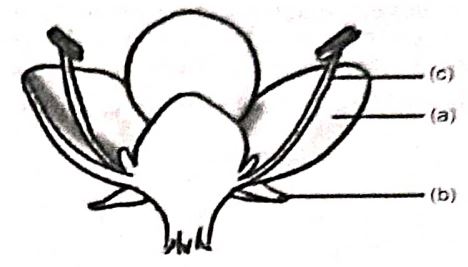
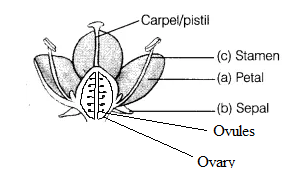
(i) Draw the missing parts of a flower.
(ii) Explain with help of a diagram, how the male germ cells reaches the female germ cells present in the ovary?
(iii) Justify the statement "Pollination may occur without fertilisation, but fertilisation will not take place without pollination."
2.
(a) Draw a diagram showing germination of pollen on stigma of a flower and mark on it the following organs/parts
(i) Pollen tube
(ii) Pollen grain
(iii) Stigma
(iv) Female germ cell
(b) State the significance of pollen tube.
(c) Name the parts of flower that develop after fertilisation into
(i) Seed (ii) Fruit
3.
What are various evidences in factors of evolution
4.
(i) What are traits?
(ii) Explain the inherited trait and acquired traits.
(iii) Define speciation. What are the factors which could lead to the rise of a new species?
5.
State in brief the changes that take place in a fertillsed egg (zygote) till birth of the child in the human female reproductive system. What happens to the egg when it is not fertilised?
6.
Explain how sexual reproduction gives rise to more viable variations than asexual reproduction. How does this affect the evolution of those organisms that reproduce sexually?
7.
What is phylogeny and molecular phylogeny?
8.
When does copying of DNA occur
9.
In the following crosses write the characteristics of the progeny
| Cross | Progeny | |
| (a) | RR YY \(\times\) RR YY | ................... |
| Round, yellow Round yellow | ................... | |
| (b) | Rr Yy \(\times\) Re Yy | ................... |
| Round, yellow Round, | ................... | |
| (c) | rr yy \(\times\) rr yy | ................... |
| Wrinkled, green wrinkled, green | ................... | |
| (d) | RR YY \(\times\) rr yy | ................... |
| Round, yellow wrinkled green | ................... | |
10.
Expand AIDS. List any four methods of prevention (control) of AIDS.
11.
Mala is four-month pregnant and is worried whether the child is male or female. One day she reads an advertisement regarding a medicine which of taken for 3 months results in birth of male child. What should she do?
(a) Get the medicine and take it regularly.
(b) Visit a doctor and discuss the problem with him/her.
(c) What, in your opinion, are the chances of having a male child?
12.
What would be the ratio of chromosome number between an egg its zygote? How is the sperm genetically different from the egg?
13.
During adolescence, reproductive phase starts and
general growth rate begins to slow down
height becomes less
the body weight is reduced
hair growth decreases
14.
Which Mendelian law states that inheritance of one character is always independent to the inheritance of other character within the same individual?
Law of dominance
Law of segregation
Law of independent assortment
Both (b) and (c)
15.
A cross between two tall pea plants resulted in offsprings having a few dwarf plants. The gene-combination of the parental plants must be
Tt and Tt
Tt and tt
TT and tt
TT and Tt
16.
A cross between pea plant with white flowers (vv) and pea plant with violet flowers (VV) resulted in F2-progeny in which ratio of violet (VV) and white (vv) flowers will be
1 : 1
2 : 1
3 : 1
1 : 3
17.
Which of the following can be called a characteristic?
Plants can photosynthesise
We have 2 eyes
Mango tree is multicellular
All of these
18.
There is an inbuilt tendency of variation during reproduction because of-
(i) Errors in DNA copying (ii) Sexual reproduction
only (i)
only (ii)
both (i) and (ii)
none of them
19.
Identify the organism
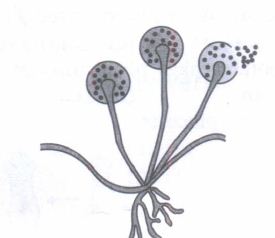
Rhizobium
Rhizopus
Rhizoid
Mushroom
20.
After fertilisation name the part which develops into the seeds
Ovary
Ovule
Pollen grain
None of the above
21.
What are the functions performed by the testis in human males
Production of gametes-eggs and secretion of sex hormones-estrogen
Production of gametes-sperms and secretion of sex hormones-testosterone
Production of gametes-sperms and secretion of sex hormones-estrogen
None of the above
22.
Some dinosaurs had feathers although they could not fly but birds have feathers that help them to fly. In the context of evolution this means that
reptiles have evolved from birds
there is no evolutionary connection between reptiles and birds
feathers are homologous structures in both the organisms
birds have evolved from reptiles.
23.
New species may be formed if
(i) DNA undergoes significant changes in germ cells
(ii) chromosome number changes in the gamete
(iii) there is no change in the genetic material
(iv) mating does not take place
(i) and (ii)
(i) and (iii)
(ii), (iii) and (iv)
(i), (ii) and (iii)
24.
Which among the following diseases is not sexually transmitted?
Syphilis
Hepatitis
HIV-AIDS
Gonorrhoea
25.
In human males, the testes lie in the scrotum because it helps in the
process of mating
formation of sperm
easy transfer of gametes
all the above
26.
The ability of a cell to divide into several cells during reproduction in Plasmodium is called
budding
reduction division
binary fission
multiple fission
27.
(a) State one drawback of each of the following
(i) Oral contraceptive pills
(ii) Copper-T
(b) Under which category of contraceptive methods is the use of condom kept?
In what way, its use is better as compared to other methods of contraception?
28.
(i) Name the reproductive and non-reproductive parts of bread mould (Rhizopus).
(ii) List any two advantages of vegetative propagation.
29.
(i) Why is the F1-progeny always tall, when a tall pea plant is crossed with a short pea plant?
(ii) How is F2-progeny obtained by self-pollination of F1-progeny different from F1-progeny? Give reason for this observation.
(iii) State a conclusion that can be drawn on the basis of this observation.
30.
Define Genotype and Phenotype.
31.
"It is a matter of chance whether a couple will have a male or a female child." Justify this statement by drawing a flow chart.
32.
What is natural selection?
33.
Assertion (A) Dominant allele is an allele whose phenotype expresses even in the presence of another allele of that gene.
Reason (R) It is represented by a capital letter, e.g. T.
(a) Both A and R are true and R is the correct explanation of A
(b) Both A and R are true, but R is not the correct explanation of A
(c) A is true, but R is false
(d) A is false, but R is true
34.
Assertion: When pea plants (pureline) having round yellow seeds are crossed with pureline plants having wrinkled green seeds, then all pea plants obtained in F1 generation bear wrinkled green seeds.
Reason: Round and yellow seeds are dominant to wrinkled and green seeds.
Codes:
(a) Both A and R are true and R is correct explanation of the assertion
(b) Both A and R are true but R is not the correct explanation of the assertion
(c) A is true but R is false
(d) A is false but R is true.
35.
Assertion: Pea plant is considered ideal for hybridisation experiments.
Reason: Pea is self pollinating plant with short life cycle and bears visible contrasting traits.
Codes:
(a) Both A and R are true and R is correct explanation of the assertion
(b) Both A and R are true but R is not the correct explanation of the assertion
(c) A is true but R is false
(d) A is false but R is true.
36.
Assertion: Self-pollination occurs when the pollen grains from the anther of a flower are transferred to the stigma of same flower or another flower on the same plant.
Reason: Insects and wind help in autogamy.
Codes
(a) Both A and R are true and R is correct explanation of the assertion.
(b) Both A and R are true but R is not the correct explanation of the assertion.
(c) A is true but R is false.
(d) A is false but R is true.
37.
Assertion: All the sepals together are called corolla.
Reason: The function of sepals is to protect the flower in the bud stage.
Codes
(a) Both A and R are true and R is correct explanation of the assertion.
(b) Both A and R are true but R is not the correct explanation of the assertion.
(c) A is true but R is false.
(d) A is false but R is true.
38.
Assertion: If the DNA copying mechanisms were to be less accurate, many of the resultant DNA copies would not be able to work with the cellular apparatus, and would die.
Reason: Combining variations from two or more individuals would create new combinations of variants that are novel.
Codes
(a) If both assertion and reason are true and the reason is correct explanation of assertion.
(b). If both assertion and reason are true but reason is not a correct explanation of assertion.
(c) If assertion is true and reason is false.
(d) If both assertion and reason are false.
1.
(i)
2.
(a)
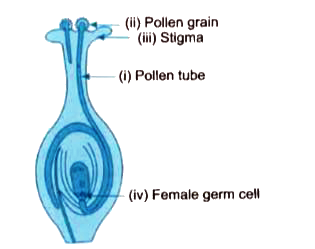
(b) The pollen tube moves through the style and reaches the ovule. It carries male gerrn cells to the ovule for fertilisation.
(c) (i) Ovules develops into seed.
(ii) Ovary develops into fruit.
3.
Evidences are:
(a) Homologous organs: Organs which have same structure but different function. E.g., wings of a bat, hands of man and limbs of monkey.
(b) Analogous organ. Organs which perform similar function but are structurally different are called analogous organ. E.g., wings of bat, insects, birds.
(c) Vestigial organs: These organs are those which appear in an organism but are functionless e.g., vermiform appendix, nictitating membrane in eye is present in human beings but has no function.
(d) Embryological evidence: The study of embryos of vertebrates shows that all of them have same origin as their structure at initial stage is same. Embryo of frog, fish, man looks alike.
(e) Fossils as evidence: Archaeopteryx fossils shows a link between bird and reptiles as this fossil has some feature of bird and some of reptile.
4.
(i) Traits: A characteristic feature is called trait.
(ii) Inherited and acquired trait: Inherited traits are the characteristics transmitted from parents to their offspring. Acquired traits are characteristics which are developed during the lifetime of an individual. Acquired traits are not passed on to the next generation. For example, if we breed a group of mice, all their progeny will have tails. Now, if the tails of these mice are removed by surgery and allowed to breed, the next generation mice will also have tails. If these tails are also removed and allowed to breed, the progeny of mice will again have tails. Removal of tail by surgery is an acquired trait and do not change the genes of germ cells and hence, are not passed on to the next generation.
(iii) Speciation and factors: It is the process of evolution of a new species from pre-existing species. Occurring due to accumulation of variations. The processes like genetic drift/geographical barriers like mountains, rivers etc., lead to incapability to reproduce amongst themselves in the population.
5.
The egg gets fertilised in the oviduct. The fertilised egg, the zygote gets implanted in the lining of the uterus and starts dividing. The uterus prepares itself every month to receive and nurture the growing embryo. The lining thickness and is richly supplies with blood to nourish the growing embryo.
The embryo gets nutrition from the mother's blood with the help of a special tissue called placenta. The development of the child inside the mother's body takes approximately nine months. On completion of 9 months, the child is born as a result of rhythmic contractions of the muscles in the uterus.
If the egg is not fertilised, the thick and nourishing lining of the uterus breaks and comes out through vagina as blood and mucous.
6.
In sexual reproduction, two individuals having different variations combine their DNA to give rise to a new individual. Therefore, sexual reproduction allows more variations, whereas in asexual reproduction, very less chance of variations can only occur when the copying of DNA is not accurate. However, if there are more variations, then the resultant DNA will not be able to survive inside the inherited cellular apparatus. Thus, the resultant DNA will be able to survive making the variations viable. Variants help the species to survive in all the conditions. Environmental conditions such as heat, light, pests, and food availability can change suddenly at only one place. At that time, only those variants resistant to these conditions would be able to survive. This will slowly lead to the evolution of a better adapted species. Thus, variation helps in the evolution of sexually reproducing organisms.
7.
Phylogeny is the evolutionary history of an organism. Molecular phylogeny traces the evolutionary relationships by comparing the differences in the DNA of different organisms.
8.
Copying of DNA occurs during cell division.
9.
(a) Round yellow
(b) Round yellow, Round green, Wrinkled yellow, Wrinkled green.
(c) Wrinkled green
(d) Round yellow.
10.
AIDS stands for Acquired Immune Deficiency Syndrome.
Four methods of prevention or control of AIDS are as follows:
(i)Use condom during sex
(ii)Avoid sharing of needles.
(iii)Test blood for AIDS before transfusion.
(iv)Avoid sexual contact with unknown person.
11.
(a) No, she should not take the medicine.
(b) Of course she should visit a doctor to get information.
(c) She is having 50% chances of having a male child as 50% sperms carry Y chromosome and 50% X chromosome.
12.
The ratio of chromosome number between and egg and its zygote is 1:2. Sperm and eggs are genetically different in terms of the nature of the 23rd chromosome. The 23rd chromosome is an Y chromosome in sperm, while it is an X chromosome in egg.
13.
(a)
general growth rate begins to slow down
14.
(c)
Law of independent assortment
15.
(a)
Tt and Tt
16.
(c)
3 : 1
17.
(d)
All of these
18.
(b)
only (ii)
19.
(b)
Rhizopus
20.
(b)
Ovule
21.
(b)
Production of gametes-sperms and secretion of sex hormones-testosterone
22.
(d)
birds have evolved from reptiles.
23.
(a)
(i) and (ii)
24.
(b)
Hepatitis
25.
(b)
formation of sperm
26.
(d)
multiple fission
27.
(a) (i) Oral contraceptive pills may disturb the hormonal balance of the body.
(ii) Copper-T cannot prevent sexually transmitted diseases.
(b) The use of condom is kept under barrier method of contraceptives. The condoms are better contraceptive method as compared to others due to the following reasons.
(i) It helps to prevent STDs.
(ii) It cannot disturb the hormonal balance of the body and normal menstrual cycle in females.
28.
(i) Hyphae is the non-reproductive parts of bread mould whereas, sporangia present on hyphae is the reproductive part.
(ii) (a) Vegetative propagation helps in growing seedless plants.
(b) It helps in the preservation of the characters of the parent plant.
29.
(i) When tall pea plant (TT) is crossed with dwarf pea plant tt, every progeny is inherited with tall and dwarf gene together. Tall is dominant character, so plant becomes tall.
(ii) The genotype of F1 progeny is Tt.
The selfing between these plants is done in the follow way to obtain F2 progeny
 |
T | t |
| T | TT Tall (homozygous) |
Tt Tall (Heterozygous) |
| t | Tt Tall (Heterozygous) |
tt Dwarf (Homozygous) |
Here, recessive and dominant gene get segregated and we obtain one tall (homozygous), one dwarf (homozygous) and two tall (heterozygous) plants.
(iii) This cross shows the law of segregation of character. lt means character like tall and dwarf plant height do not mix while crossing them.
30.
Genotype: The complete set of genes in an organism's genome is called genotype.
Phenotype: The observable characters in an organism make the phenotype. Phenotype is a result of genotype's interaction with the environment. Due to this reason, many phenotypes are not inheritable.
31.
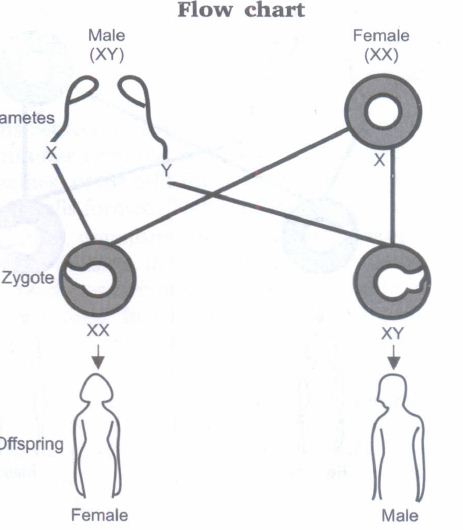
Justification: Women produce only one type of ovum (carrying X chromosome) and males produce two types of sperms (carrying either X or Y chromosome) in equal proportions. So the sex of a child is a matter of chance depending upon the type of sperm fertilizing the ovum.
32.
According to Darwin, natural selection is the process which brings about evolution of new species of plants and animals. It consists of the following processes:
(i) He noted that the size of population tends to remain constant despite the fact that more offsprings are produced than needed.
(ii) Variations provide adaptations.
(iii) The best adopted survive in the changing environment (survival of the fittest).
(iv) Nature selects the best organisms with better adaptations and after many generations new species are formed (natural selection).
33.
(b) Both A and R are true but R is not the correct explanation of A.
Dominant alleles mask the expression of recessive counter part.
34.
(d): When pureline pea plants having round yellow seeds are crossed with that of wrinkled green seeds then plant obtained in Flare all with round yellow seeds as round yellow seeds are dominant to wrinkled green seeds.
35.
(a): Mendel chose pea plants for studying inheritance because of number of reasons. Pea plants are self pollinating which enables them to produce next generation of plants easily, also pure lines could be easily obtained. Due to short life cycle, many generations of pea plants can be produced in a comparatively short span of time. Also pea plant shows a number of clear cut visible contrasting traits like tall and dwarf height, round and wrinkled seeds, etc.
36.
(c) : Insects help in cross-pollination. When an insect sits on the flower of a plant for sucking nectar then the pollen grains from anther of the flower stick to its body and when this insect sits on another flower of similar plant, pollen grains sticking to its body are transferred to the stigma of another flower. In this way, the insect transfers the pollen grains from the anther of flower in one plant to the stigma of flower in another plant and causes cross-pollination. The blowing wind also carries pollen grains from one flower to another flower and helps in cross pollination.
37.
(d): All the sepals taken together are called calyx.
38.
(b). If both assertion and reason are true but reason is not a correct explanation of assertion.

10th Standard CBSE Syllabus & Materials
10th Standard CBSE
CBSE 10th Social Science PS - Federalism - New Model Questions Papers Study Material - QB365 Set A
NEW10th Standard CBSE
CBSE 10th Social Science PS - Power Sharing - New Model Questions Papers Study Material - QB365 Set A
NEW10th Standard CBSE
CBSE 10th Social Science GEO - Manufacturing Industries - New Model Questions Papers Study Material - QB365 Set A
NEW10th Standard CBSE
CBSE 10th Social Science GEO - Minerals and Energy Resources - New Model Questions Papers Study Material - QB365 Set A



NCERT Books

Syllabus

Exam Pattern

Sample Question Papers

Previous year Question Papers

Important Notes

MCQ Practice test

NCERT Exemplers

Case study Questions

Image Based Questions

Passage based Questions

HOT Questions

Value Based Questions

Model Questions Papers
NCERT ( Book Back ) Questions

Assertion and Reason
Important Questions And Answers

CBSE 10th Standard CBSE Subjects
CBSE Standards



