
 100% FREE ACCESS
10th Standard CBSE Syllabus & Materials
10th Standard CBSE
CBSE 10th Social Science ECO - Globalisation and the Indian Economy - New Model Questions Papers Study Material - QB365 Set A
NEW10th Standard CBSE
CBSE 10th Social Science ECO - Money and Credit - New Model Questions Papers Study Material - QB365 Set A
NEW10th Standard CBSE
CBSE 10th Social Science ECO - Sectors of the Indian Economy - New Model Questions Papers Study Material - QB365 Set A
NEW10th Standard CBSE
CBSE 10th Social Science ECO - Development - New Model Questions Papers Study Material - QB365 Set A
NEW10th Standard CBSE
CBSE 10th Social Science PS - Outcomes of Democracy - New Model Questions Papers Study Material - QB365 Set A
NEW10th Standard CBSE
CBSE 10th Social Science PS - Gender, Religion and Caste - New Model Questions Papers Study Material - QB365 Set A

Published on: 26/10/2025
Download CBSE Class 10th Standard CBSE Science question papers, sample papers, important questions, and previous year solved papers in PDF format. Get free study materials, NCERT solutions, and exam preparation resources for Class 10th Standard CBSE Science
Questions + Answers key
Take MCQ Science Test
1.
Answer the questions on the basis of your understanding of the following passage and related studied concepts.
In some families, either rural or urban, females are tortured for giving birth to a female child. They do not seem to understand the scientific reason behind the birth of a boy or a girl.
In fact, the mother is not responsible for the sex of the child and it has been genetically proved that the sex of a newborn is determined by what the child inherits from the father.
(i) State the basis on which the sex of a newborn baby is determined in humans.
(ii) Why is the pair of sex chromosomes called a mismatched pair in males ?
(iii) How is the original number of chromosomes present in the parents restored in the progeny?
Or
(iii) Explain by giving two examples of the organisms in which the sex is not genetically determined.
2.
Answer the questions on the basis of your understanding of the following passage and related studied concepts.
Mendel blended his knowledge of science and mathematics to keep the count of the individual exhibiting a particular trait in each generation. He observed a number of contrasting visible characters controlled in pea plants in a field. He conducted many experiments to arrive at the laws of inheritance.
(i) What do the F1 progeny of tall plants with round seeds and short plants with wrinkled seeds look like?
(ii) What are recessive traits ?
(iii) Mention the type of the new combination of plants obtained in F2 progeny along with their ratio, if F1 progeny was allowed to self-pollinate.
Or
(iii) If 1600 plants were obtained in F2 progeny, write the number of plants having traits.
(a) Tall with round seeds
(b) Short with wrinkled seeds
Write the conclusion of the above experiment.
3.
The transfer of pollen grains from the anther to the stigma of a flower is called pollination. It takes place by wind, water or insects. If the pollen grains are transferred from the anther to the stigma of the same flower it is known as self- pollination and if it is transferred from the anther of one flower to the stigma of another flower it is called cross-pollination.
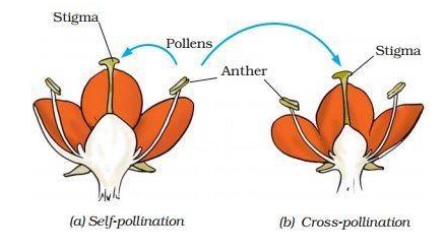
(i) Pollen grains are produced by :
| (a) ovary | (b) ovule | (c) anther | (d) corolla |
(ii) Pollination is the process by which the pollen grains are transferred from the to the
| (a) anther, ovary | (b) stigma, ovary |
| (c) anther, stigma | (d) stigma, filament |
(iii) An insect pollinated flower is :
| (a) Hibiscus | (b) mustard | (c) maize | (d) orchids |
(iv) Stigma of wind pollinated flower is :
| (a) sticky | (b) feathery | (c) plain | (d) dry |
(v) Pollen grains of wind pollinated flowers are :
| (a) sticky and light weight | (b) light weight and in a huge quantity |
| (c) light weight and little quantity | (d) sticky and huge quantity |
4.
Reproduction is a process by which living organisms are able to produce young ones of their new kind. Living organisms reproduce by two ways - asexual reproduction and sexual reproduction. Asexual reproduction involves the production of an offspring from a single parent without the fusion of gametes. This mostly occurs in unicellular organisms, some plants and certain multicellular organisms. There are various types of asexual reproduction.
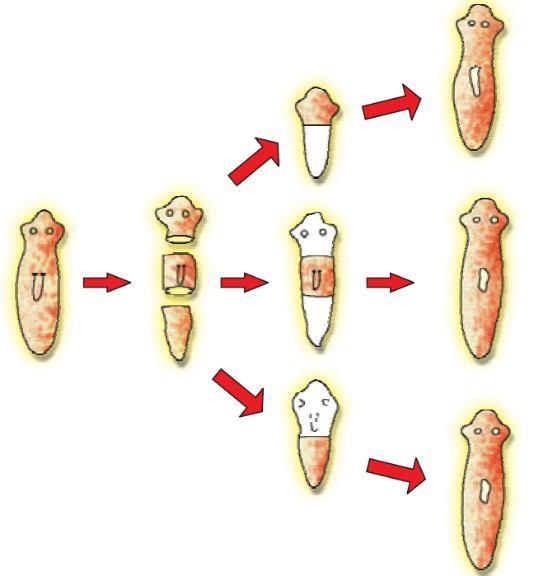
(i) The type of reproduction shown in the figure is
| (a) budding | (b) fragmentation | (c) regeneration | (d) fission. |
(ii) Which of the following is correct example of the process shown in the given figure?
| (a) Hydra | (b) Planaria | (c) Amoeba | (d) Both (a) and (b) |
(iii) A feature of reproduction that is common to Amoeba, yeast and bacteria is that
| (a) they are all unicellular | (b) they are all multicellular |
| (c) they reproduce only sexually | (d) they reproduce asexually |
(iv) Asexual reproduction is
(a) a fusion of specialised cells
(b) a method by which all types of organism reproduce
(c) a method producing genetically identical offspring
(d) a method in which more than one parent are involved.
(v) From the given list of organisms, those which reproduce by the asexual method are:
| (a) Aspergillus | (b) Dog | (c) Papaya | (d) Paramecium |
5.
Refer to the given table regarding results of F2 generation of Mendelian cross.
| Plants with round and yellow coloured seeds (P) | 315 |
| Plants with round and green coloured seeds (Q) | 108 |
| Plants with wrinkled and yellow coloured seeds (R) | 101 |
| Plants with wrinkled and green coloured seeds (S) | 32 |
(i) Which of the following would be the phenotype of F1 generation regarding given data of F2 generation?
(a) Plants with round and yellow coloured seeds
(b) Plants with round and green coloured seeds
(c) Plants with wrinkled and yellow coloured seeds
(d) Plants with wrinkled and green coloured seeds.
(ii) Which of the following would be the genotype of parental generation regarding given result of F2 generation?
| (a) YYRR and yyrr | (b) YYRR and YYRR |
| (c) YYRR and YyRr | (d) YyRr and YyRr |
(iii) If plant with wrinkled and green coloured seeds (S) is crossed with plant having wrinkled and yellow coloured seeds (R), what will be the probable phenotype of offsprings?
(a) All plants with wrinkled and yellow coloured seeds
(b) 50% plants with wrinkled and yellow coloured seeds and 50% plants with wrinkled and green coloured seeds
(c) All plants with wrinkled and green coloured seeds
(d) Both (a) and (b).
(iv) Which of the following will result when plant YyRr is self-pollinated?
(a) 9: 3 : 3 : 1 ratio of phenotypes only
(b) 9: 3 : 3 : 1 ratio of genotypes only
(c) 1-: 1 : 1 : 1 ratio of phenotypes only
(d) 1: 1 : 1 : 1 ratio of phenotypes and genotypes
(v) The percentage of yR gamete produced by YyRR parent will be
| (a) 25% | (b) 50% |
| (c) 75% | (d) 12.5% |
6.
Purebred pea plant with smooth seeds (dominated characteristic) were crossed with purebred pea plant with wrinkled seeds (recessive characteristic). The F1 generation was self pollinated to give rise to the F2 generation.
(i) What is the expected observation of the F1 generation of plants?
(a) 1/2 of them have smooth seeds and 1/2 of the have wrinkled seeds.
(b) 1/4 of them have wrinkled seeds and 3/4 of them have smooth seeds.
(c) 3/4 of them have wrinkled seeds and 1/4 of them have smooth seeds.
(d) All of them have smooth seeds.
(ii) What is the expected observation of the F2 generation of plants?
(a) 1/2 of them have smooth seeds and 1/2 of them have wrinkled seeds.
(b) 1/4 of them have wrinkled seeds and 3/4 of them have smooth seeds.
(c) 3/4 of them have wrinkled seeds and 1/4 of them have smooth seeds.
(d) All of them have smooth seeds.
(iii) If a genotype consists of different types of alleles, it is called
| (a) homozygous | (b) heterozygous |
| (c) monoallelic | (d) uniallelic |
(iv) The alternative form of gene is called
| (a) dominant character | (b) recessive character |
| (c) alternative genes | (d) allele. |
(v) Which of the following will be the genotypic ratio of given F2 generation?
| (a) 1: 3 | (b) 3: 1 |
| (c) 1: 2 : 1 | (d) 1: 1 : 1 |
7.
In human, the allele for brown eyes (B) is dominant over that for blue eyes (b). A brown eyed woman marries a blue eyed man, and they have six children. Four of the children are brown eyed and two of them are blue eyed.
(i) What is the genotype of blue eyed offspring?
| (a) BB | (b) Bb |
| (c) bb | (d) Cannot be determined |
(ii) What is the woman's genotype?
| (a) BB | (b) Bb |
| (c) bb | (d) Cannot be determined |
(iii) The ovum, produced by the mother carries the gene regarding eye colour is
| (a) BB | (b) Bb |
| (c) B or b | (d) B only. |
(iv) The ratio of brown eyed children to blue eyed children in this family is 2 : 1, which deviates from typical phenotypic ratios for monohybrid inheritance. What might be the reason?
(a) Gametes carrying the brown eyed allele are more viable then those with the blue eyed allele.
(b) A different pattern of inheritance other than monohybrid inheritance is involved.
(c) Not all of their babies survived childbirth, thus causing a distortion in the actual ratio.
(d) The actual ratio differs from the expected ratio because the sample size is too small.
(v) What is the gene carried by of the man's sperm regarding the eye colour?
| (a) BB | (b) Bb |
| (c) b only | (d) b or B. |
8.
The cross that include the inheritance of two pairs of contrasting characters simultaneously is referred as dihybrid cross. Mendel chose pure breeding plants for yellow and green seeds and round and wrinkled shape of seeds. He cross pollinated the plant having yellow round seeds with plant having green wrinkled seeds. All the plants produced in F1 generation were having, yellow round seeds. The plants raised from these seeds were self pollinated, that resulted in production of plants having four phenotypically different types of seeds.
(i) When a cross is made between a yellow round seeded plant (YyRr) and a yellow wrinkled seeded plant (Yyrr), what is true regarding the proportions of phenotypes of the offsprings in F1 generation?
| Proportion of yellow wrinkled seeds | Proportion of green wrinkled seeds | |
| (a) | 3/8 | 1/8 |
| (b) | 2/8 | 1/8 |
| (c) | 1/8 | 3/8 |
| (d) | 2/8 | 2/8 |
(ii) How many types of gametes can be produced by YYrr?
| (a) 1 | (b) 2 |
| (c) 3 | (d) 4 |
(iii) In Mendelian dihybrid cross, when heterozygous tall plant with green seeds are self crossed the progenies are
| (a) TtYy, TtYY, TTYy | (b) Ttyy, TTyy, ttyy |
| (c) ttYy, ttyy | (d) Ttyy, TTyy |
(iv) When round yellow seeded heterozygous pea plants are self fertilised, the frequency of occurrence of RrYY genotype among the offsprings is
| (a) 9/16 | (b) 3/16 |
| (c) 2/16 | (d) 1/16. |
(v) The percentage of yr gamete produced by YyRr parent will be
| (a) 25% | (b) 50% |
| (c) 75% | (d) 12.5%. |
9.
Mendel crossed tall and dwarf pea plants to study the inheritance of one gene. He collected the seeds produced as a result of this cross and grew them to generate plants of the first hybrid generation which is called the first filial progeny or F1: Mendel then self pollinated the tall F1 plants and he obtained F2 generation.
(i) In garden pea, round shape of seeds is dominant over wrinkled shape. A pea plant heterozygous for round shape of seed is selfed and 1600 seeds produced during the cross are subsequently germinated. How many seedlings would have non-parental phenotype?
| (a) 1600 | (b) 1200 |
| (c) 400 | (d) 800 |
(ii) If 'A' represents the dominant gene and 'a' represents its recessive allele, which of the following would be the most likely result in the first generation offspring when Aa is crossed with aa ?
(a) All will exhibit dominant phenotype.
(b) All will exhibit recessive phenotype.
(c) Dominant and recessive phenotypes will be 50% each.
(d) Dominant phenotype will be 75%.
(iii) Which of the following crosses will give tall and dwarf pea plants in same proportions?
A) 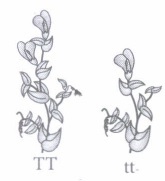 |
B)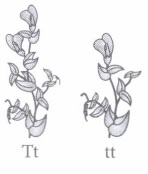 |
c) 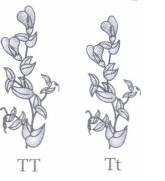 |
D) 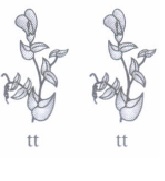 |
(iv) What result Mendel would have got, if he self pollinated a homozygous tall F2 plant?
(a) TT and Tt
(b) All Tt
(c) All TT
(d) All tt
(v) In plant, tall phenotype is dominant over dwarf phenotype, and the alleles are designated as T and t, respectively. Upon crossing one tall and one dwarf plant, total 250 plants were obtained, out of which 124 displayed tall phenotype and rest were dwarf. Thus, the genotype of the parent plants were
(a) TT x TT
(b) TT x tt
(c) Tt x Tt
d) Tt x tt.
10.
Gregor Mendel conducted hybridisation experiments on garden peas for seven years and proposed the laws of inheritance in living organisms. He investigated characters in the garden pea plant that were manifested as two opposing traits, e.g., tall or dwarf plants, yellow and green seeds, etc.
(i) Among the seven pairs of contrasting traits in pea plant as studied by Mendel, the number of traits related
to flower, pod and seed respectively were
| (a) 2,2,2 | (b) 2,2,1 |
| (c) 1,2,2 | (d) 1,1,2. |
(ii) The colour based contrasting traits in seven contrasting pairs, studied by Mendel in pea plant were
| (a) 1 | (b) 2 |
| (c) 3 | (d) 4. |
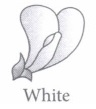
(iii) Refer to the given table of contrasting traits in pea plants studied by Mendel.
| Character | Dominant trait | Recessive trait |
| (i) Seed colour |  |
 |
| (ii) Flower colour | 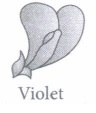 |
 |
| (iii) Pod shape | 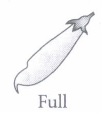 |
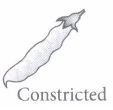 |
| (iv) Flower position | 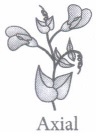 |
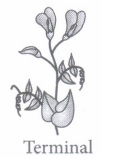 |
Which of the given traits is correctly placed?
(a) (i), (ii) and (iii) only
(b) (ii), (iii) and (iv) only
(c) (ii) and (iii) only
(d) (i), (ii), (iii) and (iv)
(iv) Some of the dominant traits studied by Mendel were
(a) round seed shape, green seed colour and axial flower position
(b) terminal flower position, green pod colour and inflated pod shape
(c) violet flower colour, green pod colour and round seed shape
(d) wrinkled seed shape, yellow pod colour and axial flower position.
(v) Which of the following characters was not chosen by Mendel?
| (a) Pod shape | (b) Pod colour |
| (c) Position of flower | (d) Position of pod |
11.
Sex determination is the method by which distinction between males and females is established in a species. The sex of an individual is determined by specific chromosomes. These chromosomes are called sex chromosomes or allosomes. X and Y chromosomes are called sex chromosomes. The normal chromosomes other than the sex chromosomes of an individual are known as autosomes.
(i) In XX-XO type of sex determination
(a) females produce two different types of gametes
(b) males produce two different types of gametes
(c) females produce gametes with Y chromosome
(d) males produce gametes with Y chromosome.
(ii) A couple has six daughters. What is the possibility of their having a girl next time?
| (a) 10% | (b) 50% |
| (c) 90% | (d) 100% |
(iii) Number of autosomes present in liver cells of a human female is
| (a) 22 autosomes | (b) 22 pairs |
| (c) 23 autosomes | (d) 23 pairs. |
(iv) XX-XO type of sex determination and XX-XY type of sex determination are the examples of
| (a) male heterogamety | (b) female heterogamety |
| (c) male homogamety | (d) both (b) and (c). |
(v) Select the incorrect statement.
(a) In male grasshoppers, 50% of sperms have no sex chromosome
(b) Female fruitfly is heterogametic
(c) Human male produces two types of sperms 50% having X chromosome and 50% having Y chromosomes
(d) In turtle, sex determination is regulated by environmental factors.
12.
X, Y and Z are three sexually transmitted diseases (STDs). X and Z are caused by bacteria whereas Y is caused by virus P. Virus P lowers the immunity of a person and leads to an incurable disease. X starts as painless sores on genitals rectum or mouth. Z causes painful urination and abnormal discharge from genitals.
(i) Select the option that correctly identifies disease X, Y and Z?
| X | Y | Z |
| (a) AIDS | Syphilis | Gonorrhoea |
| (b) Syphilis | AIDS | Gonorrhoea |
| (c) Gonorrhoea | Syphilis | AIDS |
| (d) Syphilis | Gonorrhoea | AIDS |
(ii) Identify virus P from the given paragraph.
(a) Human papilloma virus
(b) Human adenovirus
(c) Human immunodeficiency virus
(d) Human cytomegalovirus
(iii) What are the symptoms of disease Y?
(a) Weight loss
(b) Fever or night sweats
(c) Fatigue and weakness infections
(d) All of these
(iv) Select the incorrect statement regarding diseases X and Y.
(a) Both X and Y can spread from infected mother to unborn baby during pregnancy
(b) Both X and Y can spread from infected partner to healthy partner by unprotected sex
(c) Y can also spread through use of contaminated needles and blood transfusion
(d) None of these.
(v) How can disease Y be prevented?
(a) By following polygamy and having protected sex
(b) Use of sterilised needles for injecting medicines, blood tests, etc
(c) Collecting blood from unknown donors without background check by blood bank professionals
(d) All of these.
13.
Menstrual cycle is the cycle of events taking place in female reproductive organs, under the control of sex hormones, in every 28 days. At an interval of 28 days, a single egg is released from either of two ovaries. Regular menstrual cycle stopped abruptly in a married women. She got herself tested and was happy to discover that she is pregnant with her first baby.
(i) Why menstruation stops in a pregnant female?
(a) The egg gets fertilised so need not to be expelled out of body
(b) Ovulation stops during pregnancy and so do menstruation
(c) Thick uterine lining is needed for proper development of embryo, so that it is retained
(d) All of these
(ii) Select the correct sequence of acts that leads to pregnancy in a female.
A. Fertilisation of egg
B. Ovulation
C. Formation of zygote
D. Implantation
| (a) D \(\Rightarrow\)C \(\Rightarrow\)B \(\Rightarrow\)A | (b) B\(\Rightarrow\) A\(\Rightarrow\)C\(\Rightarrow\)D |
| (c) A \(\Rightarrow\) B\(\Rightarrow\) C\(\Rightarrow\) D | (d) D\(\Rightarrow\) C\(\Rightarrow\) A \(\Rightarrow\)B |
(iii) How is a zygote different from embryo?
(a) Zygote is formed by repeated division of embryo
(b) Zygote is formed by fusion of sperm and egg whereas embryo is formed by fusion of zygote with other zygote
(c) Zygote is single celled but embryo is multicellular
(d) Zygote is formed by fertilisation but embryo is formed without fertilisation
(iv) What change takes place in the uterus of a pregnant female?
(a) Uterine lining becomes thick and vascular
(b) Placenta develops which links the embryo to mother through umbilical cord
(c) Uterus lining containing lots of blood capillaries breaks down
(d) Both (a) and (b)
(v) Select the correct statement.
(a) The average duration of human pregnancy is about nine months
(b) The time period from fertilisation up to the birth of baby is called gestation
(c) If doctor finds any anomaly in the developing fetus then he may terminate pregnancy at an early stage, known as abortion
(d) All of these
14.
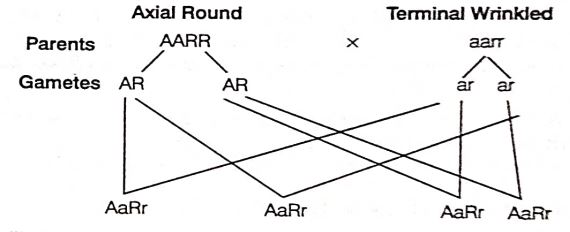
Given below is a schematic diagram showing Mendel's experiment on sweet pea plants having axial flowers with round seeds (AARR) and terminal flowers with round seeds (AARR) and terminal flowers with wrinkled seeds (aarr). Study the same and answer the questions that follows.
(i) Give the phenotype of the F1-progeny.
(ii) Give the phenotype of F2-progeny produced by self-pollination of F1-progeny.
(iii) Give the phenotypic ratio of the F2-progeny.
(iv) Name and explain the law introduced by Mendel on the basis of the above equation.
15.
The most obvious outcome of the reproductive process is the generation of individuals of similar design, but in sexual reproduction they may not be exactly alike. The resemblances as well as differences are marked. The rules of heredity determine the process by which traits and characteristics are reliably inherited. Many experiments have been done to study the rules of inheritance.
(i) Why an offspring of human being is not a true copy of his parents in sexual reproduction?
(ii) While performing experiments of inheritance in plants, what is the difference between F1 and F2- generation?
(iii) Why do we say that variations are useful for the survival of a species over time?
Or (iii) Study Mendel's cross between two plants with a pair of contrasting characters.
RRYY \(\times\) rryy
Round Yellow Wrinkled Green
He observed 4 types of combinations in F2 - generation. Which of these were new combinations? Why do new features which are not present in the parents appear in F2-generation ?
16.
If we cross pure-breed tall (dominant) pea plants with pure-breed dwarf (recessive) pea plants, we get pea plants of F1-generation. If we now self-cross the pea plant of F1-generation, then we obtain pea plants of F2-generation.
(i) What do the plants of F1-generation look like?
(ii) What is the ratio of tall plants to dwarf plants in F2-generation?
(iii) State the type of plants not found in F1-generation but appeared in F2-generation mentioning the reason for the same.
17.
A person first crossed pure-breed pea plants having round-yellow seeds with pure-breed pea plants having wrinkled-green seeds and found that only A-B type of seeds were produced in the F1-generation. When F1-generation pea plants having A-B type of seeds were cross-bred by self-pollination, then in addition to the original round yellow and wrinkled-green seeds, two new varieties A-D and C-B types of seeds were also obtained.
(i) What are A-B type of seeds?
(ii) State whether A and B are dominant traits or recessive traits.
(iii) What are A-D type of seeds?
(iv) What are C-B type of seeds?
(v) Out of A-B and A-D types of seeds, which one will be produced in (a) minimum number and (b) maximum number in the F2-generation?
1.
(i) In humans, the sex of the individual is genetically determined, i.e. genes inherited from parents decide whether the newborn baby will be boy or a girl. A newborn who inherits an X-chromosome from father will be a girl and one who inherits a Y-chromosome will be boy.
(ii) Males sex chromosome are known as mismatched pairs because one is of a normal size called 'X'-chromosome and the other is a short called the 'Y'-chromosome.
(iii) Gametes have half the number of chromosomes. When they fuse, the original number is restored. Therefore the chromosome number of sexually reproducing parents and their offspring are same.
Or
(iii) The two examples in which the sex is not genetically determined
(i) In few reptiles, the temperature at which fertilised eggs are kept determines whether the animals developing in the eggs will be male or female.
(ii) In snails, individuals can change sex, indicating that sex is not genetically determined.
2.
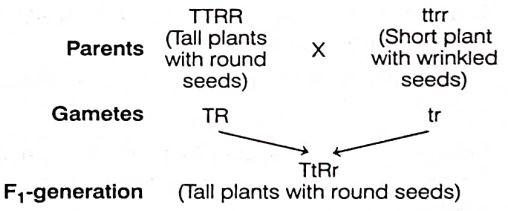
(i) As tall and round are the dominant characters, then the F1 progeny of tall plants with round seeds and short plants with wrinkled seeds will be heterozygous tall plants with round seeds (TtRr)
This can be explained as
(ii) Short plants with wrinkled seeds are the recessive traits.
(iii) After self-pollination in F1 progeny, different type of combination obtained in F2 progeny are
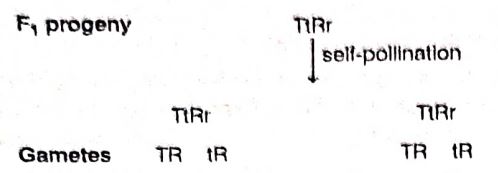
 |
TR | tR | Tr | tr |
| TR | TTRR Tall round |
TtRR Tall Round |
TTRr Tall Round |
TtRr Tall Round |
| tR | TtRR Tall Round |
ttRR Short Round |
TtRr Tall Round |
ttRr Short Round |
| Tr | TTRr Tall Round |
TtRr Tall Round |
TTrr Tall wrinkled |
Ttrr Tall wrinkled |
| tr | TtRr Tall Round |
ttRr Short Round |
Ttrr Tall wrinkled |
ttrr short wrinkled |
Tall plants with round seeds = 9
Tall plants with wrinkled seeds = 3
Short plants with round seeds = 3
Short plants with wrinkled seeds = 1
Phenotypic ratio will be = Tall round : Tall wrinkled : Short round : Short wrinkled
= 9 : 3 : 3 : 1
Or
(iii) If 1600 plants were obtained in F2 progeny, the number of plants having traits will be
(a) Tall plants with round seeds
\(\frac{9}{16} \times 1600=900\)
(b) Short plants with wrinkled seeds
\(\frac{1}{16} \times 1600=100\)
The conclusion of the above experiment state the "Law of independent assortment". This states that the alleles of two different genes get sorted into gametes Independently of one another.
3.
(i) (c) anther
(ii) (c) anther, stigma
(iii) (d) orchids
(iv) (b) feathery
Stigma is feathery or sticky and found hanging out of petals.
(v) (b) light weight and in a huge quantity
Pollen grains of wind-pollinated flowers are produced in large quantities to make sure that at least some pollen grains reach the stigmas of other flowers and successful pollination takes place as many pollen grains are wasted. These pollen grains are light and hence are easily transferred to other flowers.
4.
(i) (c) regeneration
Regeneration is the process by which small cut parts of body organism grow to form whole new organisms.
(ii) (d) Both (a) and (b)
Simple animals like Hydra and Planaria can be cut into any number of pieces and each piece grows into a complete organism by regeneration.
(iii) (d) they reproduce asexually
(iv) (c) a method producing genetically identical offspring
In asexual reproduction, the young one receives all its genes from one parent, so offspring produced are genetically identical to the parents.
(v) (c) (i) and (iv)
Aspergillus and Paramecium reproduce by spore formation and fission respectively. All these are methods of asexual reproduction. Dog and papaya reproduces through sexual methods.
5.
(i) (a)
(ii) (a)
(iii) (d): Plant with wrinkled and green coloured seeds (S) (genotype rryy) is crossed with plant with wrinkled and yellow coloured seeds (R) (genotype rrYY or rrYr). If plant with wrinkled and green coloured seeds (rryy) is crossed with plant having wrinkled and yellow coloured seeds of genotype rrYY then all plants produced with wrinkled and yellow coloured seeds whereas if plant with wrinkled and green coloured seeds (rryy) is crossed with plant having wrinkled and yellow coloured seeds that has genotype rrYy then 50% plants with wrinkled and yellow coloured seeds and 50% plants with wrinkled and green coloured seeds are produced.
(iv) (a): When plant YyRr is self pollinated, 9: 3 :3 : 1 ratio of phenotypes will be observed. This can be explained as follows:
Parents: \(\begin{array}{ll}
\text { YyRr } & \times \quad \text { YyRr }
\end{array}\)
Progenies:
 |
YR | Yr | yR | yr |
| YR | YYRR Yellow round |
YYRr Yellow round |
YyRR Yellow round |
YyRr Yellow round |
| Yr | YYRr Yellow round |
YYrr Yellow Wrinkled |
YyRr Yellow round |
Yyrr Yellow Wrinkled |
| yR | YyRR Yellow round |
YyRr Yellow round |
yyRR Green round |
yyRr Green round |
| yr | YyRr Yellow round |
Yyrr Yellow Wrinkled |
yyRr Green round |
yyrr Green Wrinkled |
Phenotypic ratio = 9 yellow and round: 3 yellow and wrinkled: 3 green and round: 1 green and wrinkled.
(v) (b): Gametes produced by YyRR parent would be 50% YR and 50% yR.
6.
(i) (d)
(ii) (b)
(iii) (b): Factors representing the alternate or same form of a character are called alleles. In heterozygous individuals or hybrids, a character is represented by two contrasting alleles. Out of the two contrasting alleles, only one is able to express its effect in the individual. It is called dominant allele. The other allele which does not show its effect in the heterozygous individual is called recessive allele, e.g., in case of hybrid tall pea plants (Tt). 'T' is dominant allele whereas 't' is recessive allele.
(iv) (d): Factors representing the alternate or same form of a character are called alleles. In heterozygous individuals or hybrids, a character is represented by two contrasting alleles. Out of the two contrasting alleles, only one is able to express its effect in the individual. It is called dominant allele. The other allele which does not show its effect in the heterozygous individual is called recessive allele, e.g., in case of hybrid tall pea plants (Tt). 'T' is dominant allele whereas 't' is recessive allele.
(v) (c): In given case, genotypic ratio of F2 progeny will be 1: 2 : 1 where, one is homozygous dominant, two are heterozygous dominant and one is homozygous recessive.
7.
(i) (c)
(ii) (b): According to the given passage some children show recessive trait, i.e., homozygous. So, the woman must be heterozygous.
(iii) (c): Human ova are haploid, hence they only contain one copy of each gene. Since the woman has a Bb genotype her ova would contain either B or b allele.
(iv) (d): According to the given passage, within a single family, the sample size of offspring in each generation is very small. Hence, the actual phenotypic and genotypic ratios often deviate from expected ratios. It is only when sample sizes of offspring is large that actual ratios approach theoretical or expected ratios more closely.
(v) (c): Human sperm is haploid, hence they only contain one copy of each gene. Since the man has a bb genotype, his sperm would contain allele b only.
8.
(i) (a): A cross between yellow round seeds (YyRr) and yellow wrinkled seeds (Yyrr) will be:
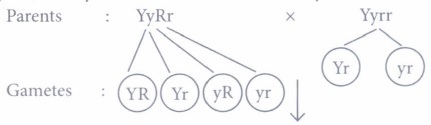
Progenies :
 |
Yr | yr |
| YR | YYRr Yellow round |
YyRr Yellow round |
| Yr | YYrr Yellow wrinkled |
Yy rr Yellow wrinkled |
| yR | YyRr Yellow round |
yy Rr Green round |
| yr | Yy rr Yellow wrinkled |
yyrr Green wrinkled |
Phenotypic ratio is:
| Yellow round seeds : | Yellow wrinkled seeds: | Green round seeds : | Green wrinkled seeds: |
| 3: | 3: | 1: | 1 |
| 3/8, | 3/8, | 1/8, | 1/8 |
(ii) (a)
(iii) (b)
(iv) (c): Round yellow heterozygous pea plant may be represented by genotype RrYy. On selfing such plants following results will be obtained.
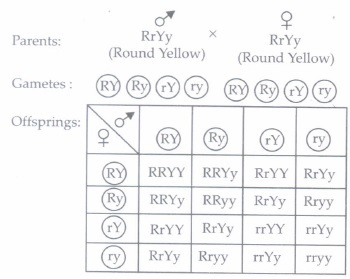
Hence, total 16 genotypes will be obtained in the next generation out of which the frequency of occurrence of RrYY genotype is 2, as illustrated by the given Punnett square chart.
(v) (a): Gametes produced by YyRr parent would be 25% YR, 25% yR, 25% Yr and 25% yr.
9.
(i) (c): Since this pea plant is heterozygous for round shape, its genotype would be Rr.
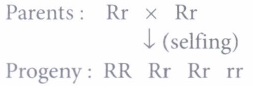
Phenotypically, the ratio will be 3 : 1, i.e., only rr seedlings will show wrinkled seed phenotype, rest will show round seed shape.
1200 \(\Rightarrow\) Round shape (RR, Rr)
400 \(\Rightarrow\) Wrinkled (rr)
(ii) (c): 'A'. represents the dominant gene and 'a' represents its recessive allele. The most likely result in the first generation offspring when Aa is crossed with aa is:
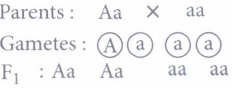
Hence, Aa: aa
1 : 1
(iii) (b): This is an example of a test cross in which a cross is made between heterozygous tall and homozygous dwarf individuals and tall and dwarf plants are obtained in same proportion.
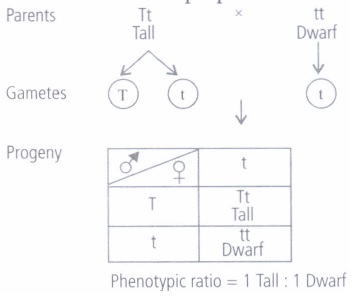
(iv) (c): Self pollination of homozygous tall F2 plant (TT) will give rise to all individuals of genotype TT.
(v) (d)
10.
(i) (a): Characters studied by Mendel are as follows:
| Trait studied | Dominant | Recessive | |
| 1 | Plant height | Tall (T) | Dwarf (t) |
| 2 | Flower position | Axial (A) | Terminal (a) |
| 3 | Flower colour | Violet (V) or (W) | White (v) or (w) |
| 4 | Pod shape | Full or Inflated (I) or (C) | Constricted (i) or (c) |
| 5 | Pod colour | Green (G) or (Y) | Yellow (g) or (y) |
| 6 | Seed shape | Round (R) or (W) | Wrinkled (r) or (w) |
| 7 | Seed colour | Yellow (Y) or (G) | Green (y) or (g) |
(ii) (c)
| Trait studied | Dominant | Recessive | |
| 1 | Plant height | Tall (T) | Dwarf (t) |
| 2 | Flower position | Axial (A) | Terminal (a) |
| 3 | Flower colour | Violet (V) or (W) | White (v) or (w) |
| 4 | Pod shape | Full or Inflated (I) or (C) | Constricted (i) or (c) |
| 5 | Pod colour | Green (G) or (Y) | Yellow (g) or (y) |
| 6 | Seed shape | Round (R) or (W) | Wrinkled (r) or (w) |
| 7 | Seed colour | Yellow (Y) or (G) | Green (y) or (g) |
(iii) (d)
| Trait studied | Dominant | Recessive | |
| 1 | Plant height | Tall (T) | Dwarf (t) |
| 2 | Flower position | Axial (A) | Terminal (a) |
| 3 | Flower colour | Violet (V) or (W) | White (v) or (w) |
| 4 | Pod shape | Full or Inflated (I) or (C) | Constricted (i) or (c) |
| 5 | Pod colour | Green (G) or (Y) | Yellow (g) or (y) |
| 6 | Seed shape | Round (R) or (W) | Wrinkled (r) or (w) |
| 7 | Seed colour | Yellow (Y) or (G) | Green (y) or (g) |
(iv) (c)
| Trait studied | Dominant | Recessive | |
| 1 | Plant height | Tall (T) | Dwarf (t) |
| 2 | Flower position | Axial (A) | Terminal (a) |
| 3 | Flower colour | Violet (V) or (W) | White (v) or (w) |
| 4 | Pod shape | Full or Inflated (I) or (C) | Constricted (i) or (c) |
| 5 | Pod colour | Green (G) or (Y) | Yellow (g) or (y) |
| 6 | Seed shape | Round (R) or (W) | Wrinkled (r) or (w) |
| 7 | Seed colour | Yellow (Y) or (G) | Green (y) or (g) |
(v) (d)
| Trait studied | Dominant | Recessive | |
| 1 | Plant height | Tall (T) | Dwarf (t) |
| 2 | Flower position | Axial (A) | Terminal (a) |
| 3 | Flower colour | Violet (V) or (W) | White (v) or (w) |
| 4 | Pod shape | Full or Inflated (I) or (C) | Constricted (i) or (c) |
| 5 | Pod colour | Green (G) or (Y) | Yellow (g) or (y) |
| 6 | Seed shape | Round (R) or (W) | Wrinkled (r) or (w) |
| 7 | Seed colour | Yellow (Y) or (G) | Green (y) or (g) |
11.
(i) (b) : In XX-XO type and XX-XY type of sex determining mechanisms, males produce two different types of gametes, either with or without X-chromosome (XO type), or some gametes with X-chromosome and some with Y-chromosome (XY type). Such type of sex determination mechanism is designated to be the example of male heterogamety. In both, females are homogametic and produce X type of gametes in both the cases and have XX genotype.
(ii) (b): The possibility of having a girl or boy child is equal i.e., 50%, as 50% male gametes are Y type and 50% are X type. Fusion of egg with X type sperm will produce a girl child.
(iii) (b): In humans, number of autosomes are 2n = 44 or 22 pairs regardless of the sex.
(iv) (a): In XX-XO type and XX-XY type of sex determining mechanisms, males produce two different types of gametes, either with or without X-chromosome (XO type), or some gametes with X-chromosome and some with Y-chromosome (XY type). Such type of sex determination mechanism is designated to be the example of male heterogamety. In both, females are homogametic and produce X type of gametes in both the cases and have XX genotype.
(v) (b): Male fruitfly is heterogametic whereas female fruitfly is homogametic.
12.
(i) (b): X could be Syphilis, Y could be AIDS and Z could be gonorrhoea.
(ii) (c): Human immunodeficiency virus (HIV) cause immunodeficiency syndrome a condition characterised by progressive failure of immune system allowing life threatening conditions.
(iii) (d)
iv) (d)
(v) (b): Sterilised needles are free from any kinds of germs.
13.
(i) (d)
(ii) (b): First of all ovulation takes place. Then the eggs get fertilised by sperm. This leads to formation of zygote. Zygote divides to form few celled embryo which gets embedded at the proper site in the thick lining of uterus. This is called implantation.
(iii) (c) : Zygote is formed by fusion of sperm and egg i.e., fertilisation. It is single celled and it gives rise to embryo by repeated cell divisions.
(iv) (d): After implantation, a disc like tissue develops between thick uterine wall and embryo, called placenta. Placenta links the embryo to the mother through umbilical cord. All the requirements of the developing fetus like nutrition, respiration, excretion etc., are met from mother's body through placenta.This is because in placenta, embryo's blood vessels lie in close association with mother's blood vessels.
(v) (d)
14.
(i) All plants have axial flowers and round seeds.
(ii)
| AR | Ar | aR | ar | |
| AR | AARR | AARr | AaRR | AaRr |
| Ar | AARr | AArr | AaRr | Aarr |
| aR | AaRR | AaRr | aaRR | aaRr |
| ar | AaRr | Aarr | aaRr | aarr |
Phenotypes of F2 progeny
(i) Plants with axial flowers and round seeds.
(ii) Plants with axial flowers and wrinkled seeds.
(iii) Plants with terminal flowers and wrinkled round seeds.
(iv) Plants with terminal flowers and wrinkled seeds.
(iii) Phenotypic ratio - 9:3:3:1
(iv) Law of Independent Assortment: When there are two pairs of contrasting characters, the distribution of the members of one pair into the gametes is independent of the distribution of the other pair.
15.
(i) In the sexual reproduction, the offspring of a human being is not a true copy of its parents because it inherits half of its genetic material from each parent. During the formation of sperm and egg cell, the genetic material undergoes the process of crossing over that leads to variation in progeny.
(ii)
| F1- Generation | F2-Generation |
| It refers to first filial generation | It refers to second filial generation. |
| It is the cross between two pure breed parents that have different genotypes. | It is the cross between two F1-generation plants. |
| The offspring will be heterozygous. | F2-generation may have heterozygous and homozygous offspring. |
(iii) Variations are useful for the survival of species over time because they provide the raw material for natural selection to act upon. In any population, there is always some degree of variations present that can be beneficial, neutral or deterimental to the individual.
Or
(iii) This resulted in 4 different combinations of seeds in F2-generation while wrinkled-green and round-yellow were parental type. The wrinkled-yellow and round-green are new combination. Therefore, the phenotypic ratio is 9 : 3 : 3 : 1. The reason of new feature in F2 - generation is when two pairs of traits are combined in a hybrid, one pair of character segregate independent of the other pair of character in progeny.
16.
(i) In F1 -generation, all plants will be tall.
(ii) The phenotypic ratio of tall plants to dwarf plants in F2-generation will be 3 : 1 and genotypic ratio will be 1 : 2 : 1.
(iii) In F1 -generation, the dwarf plants (tt) would not appeared but will appear in F2-generation because the trait for tallness (i.e. TT) being dominant as the effect of dwarfness in the progeny in first generation.
17.
(i) A-B type of seeds are round in shape and yellow in colour as round and yellow both constitute the dominant character, hence expressed in F1-generation.
(ii) A(round) and B(yellow) are dominant traits.
(iii) Round-green (A-D).
(iv) Wrinkled-yellow (C-B).
(v) (a) A-D in minimum number.
(b) A-B in maximum number.

10th Standard CBSE Syllabus & Materials
10th Standard CBSE
CBSE 10th Social Science PS - Federalism - New Model Questions Papers Study Material - QB365 Set A
NEW10th Standard CBSE
CBSE 10th Social Science PS - Power Sharing - New Model Questions Papers Study Material - QB365 Set A
NEW10th Standard CBSE
CBSE 10th Social Science GEO - Manufacturing Industries - New Model Questions Papers Study Material - QB365 Set A
NEW10th Standard CBSE
CBSE 10th Social Science GEO - Minerals and Energy Resources - New Model Questions Papers Study Material - QB365 Set A



NCERT Books

Syllabus

Exam Pattern

Sample Question Papers

Previous year Question Papers

Important Notes

MCQ Practice test

NCERT Exemplers

Case study Questions

Image Based Questions

Passage based Questions

HOT Questions

Value Based Questions

Model Questions Papers
NCERT ( Book Back ) Questions

Assertion and Reason
Important Questions And Answers

CBSE 10th Standard CBSE Subjects
CBSE Standards



