
 100% FREE ACCESS
10th Standard CBSE Syllabus & Materials
10th Standard CBSE
CBSE 10th Social Science ECO - Globalisation and the Indian Economy - New Model Questions Papers Study Material - QB365 Set A
NEW10th Standard CBSE
CBSE 10th Social Science ECO - Money and Credit - New Model Questions Papers Study Material - QB365 Set A
NEW10th Standard CBSE
CBSE 10th Social Science ECO - Sectors of the Indian Economy - New Model Questions Papers Study Material - QB365 Set A
NEW10th Standard CBSE
CBSE 10th Social Science ECO - Development - New Model Questions Papers Study Material - QB365 Set A
NEW10th Standard CBSE
CBSE 10th Social Science PS - Outcomes of Democracy - New Model Questions Papers Study Material - QB365 Set A
NEW10th Standard CBSE
CBSE 10th Social Science PS - Gender, Religion and Caste - New Model Questions Papers Study Material - QB365 Set A

Published on: 20/10/2025
Download CBSE Class 10th Standard CBSE Science question papers, sample papers, important questions, and previous year solved papers in PDF format. Get free study materials, NCERT solutions, and exam preparation resources for Class 10th Standard CBSE Science
Questions + Answers key
Take MCQ Science Test
1.
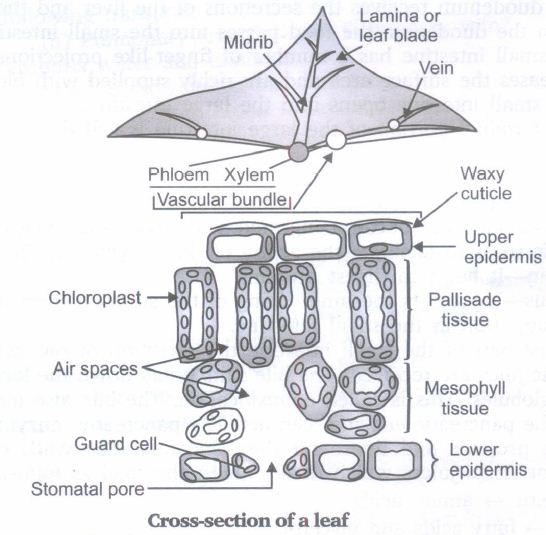
Draw a labelled diagram of transverse section of a leaf.
2.
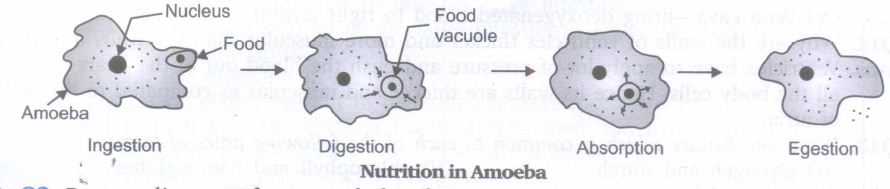
How does nutrition occur in amoeba?
3.
In human alimentary canal, name the site of complete digestion of various components of food. Explain the process of digestion
4.
Describe the digestive system.
5.
How will an organism be benefited if it reproduces through spores?
6.
How does binary fission differ from multiple fission?
7.
Write the functions of the following in the digestive process:
(i)Bile
(ii)Bicarbonate secreted by the duodenum
(iii)Pancreatic amylase
8.
How is the small intestine designed to absorb digested food?
9.
What are outside raw materials used for by an organism?
10.
Look at the diagram below carefully.
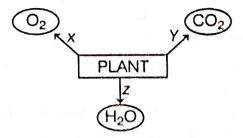
ldentify the process taking place at Z.
Reproduction
Transpiration
Photosynthesis
Translocation
11.
The anther contains
sepals
ovules
carpel
pollen grains
12.
Which of the following is not a part of the female reproductive system in human beings?
Ovary
Uterus
Vas deferens
Fallopian
13.
Asexual reproduction takes place through budding in
amoeba
yeast
plasmodium
leishmania
14.
A few drops of iodine solution were added to rice water. The solution turned blue-black in colour. This indicates that rice water contains
Complex proteins
simple proteins
fats
Starch
15.
Select the correct statement
Heterotrophs do not synthesise their own food
Heterotrophs utilise solar energy for photosynthesis
Heterotrophs synthesise their own food
Heterotrophs are capable of converting carbon dioxide and water into carbohydrates
16.
Which of the following statements about the autotrophs is incorrect?
They synthesise carbohydrates from carbon dioxide and water in the presence of sunlight and chlorophyll
They store carbohydrates in the form of starch
They convert carbon dioxide and water into carbohydrates in the absence of sunlight
They constitute the first trophic level in food chains
17.
The autotrophic mode of nutrition requires
Carbon dioxide and water
Chlorophyll
Sunlight
All of the above
18.
The xylem in plants is responsible for
Transport of water
Transport of food
Transport of amino acids
Transport of oxygen
19.
The kidneys in human beings are a part of the system for
Nutrition
Respiration
Excretion
Transportation
20.
(a) Draw a diagram depicting human alimentary canal and label on it gall bladder, liver and pancreas.
(b) State the roles of liver and pancreas.
(c) Name the organ which performs the following functions in human:
(i) Absorption of digested food. (ii) Absorption of water.
21.
What are the changes seen in girls at the time of puberty?
22.
Describe the process of urine formation in kidneys.
23.
Explain the mechanism of photosymthesis.
24.
Explain the important of soil for plant growth.
1.
2.
Amoeba gives out pseudopodia which fuse over the food particle forming a food vacuole. Inside the food vacuole, complex substances are broken down into simpler ones which then diffuse into the cytoplasm. The remaining undigested material is movied to the surface of the cell and thrown out .
3.
The site of complete digestion of carbohydrates, fats, proteins is small intestine.
Process of digestion: "'Food is chewed with digestion of starch by the action of salivary amylase present in mouth. The formed bolus passes down the esophagus into the stomach by the action of peristalsis. Gastric juices further acts on food for the digestion of proteins and forms chyme. Chyme enters the duodenum where digestive enzymes from pancreas and bile juice from liver mixes with it and then passes through small intestine. Absorbtion of nutrients occur in small intestine and reabsorption of water and minerals too.
4.
The different parts of the digestive system are as follows:
(i) Buccal cavity opens outside through the mouth. It has the tongue, teeth and the opening of the salivary gland.
(ii) Buccal cavity leads to oesophagus.
(iii) The oesophagus opens into the stomach. The wall of the stomach contains gastric glands.
(iv) The stomach opens into the duodenum. This opening is regulated by a sphincter muscle which releases small amount of food at a time.
(v) The duodenum receives the secretions of the liver and the pancreas.
(vi) From the duodenum the food passes into the small intestine. The inner wall of the small intestine has a number of finger-like projections called villi. The villi increases the surface area and are richly supplied with blood vessels.
(vii) The small intestine opens into the large intestine. (viii) The terminal portion of the large intestine is called the rectum that opens out through the anus.
5.
Spores are tiny, spherical, asexual reproductive bodies. They are covered with a hard protective wall. This enables them to survive in unfavourable conditions. They can only germinate and produce new plant under favourable conditions thereby benefitting the organism from dying out.
6.
Differences between binary fission and multiple fission are given below
| Binary Fission | Multiple Fission |
| The parent organism splits to form two new organisms. | The parent organism splits to form many new organisms at the same time. |
| It takes place during favourable environmental conditions. | It takes place during unfavourable environmental Conditions |
| It takes place in organisms like Amoeba, Leishmania, etc. | It takes place in organisms like Plasmodium. |
7.
(i)Bile is helpful in the emulsification of fats i.e., the breaking down of large fat droplets into smaller fat globules, which the pancreatic enzymes can act upon.
(ii)The pancreatic juice contains enzymes that require an alkaline medium to act. The bicarbonate secreted by the duodenum provides this alkaline medium.
(iii)The function of pancreatic amylase is to convert complex carbohydrates into glucose, which is absorbed in the blood.
8.
The small intestine is the main region for the absorption of digested food. The inner lining of the small intestine is covered by millions of tiny finger-like projections called villi. The presence of villi gives the inner walls of the small intestine a very large surface area for the absorption of digestad food.
9.
Carbon based molecules, i.e. food is used by body to meet its energy nced. Oxygen is used to oxidise food which release energy. Water is requircd for operating most of the functions inside the body. So, food, water and oxygen are the basic raw materials used by an organism.
10.
(b)
Transpiration
11.
(d)
pollen grains
12.
(c)
Vas deferens
13.
(b)
yeast
14.
(d)
Starch
15.
(a)
Heterotrophs do not synthesise their own food
16.
(c)
They convert carbon dioxide and water into carbohydrates in the absence of sunlight
17.
(d)
All of the above
18.
(a)
Transport of water
19.
(c)
Excretion
20.
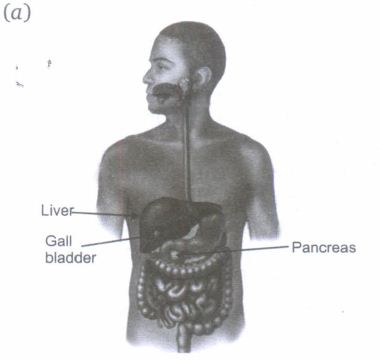
(b) Liver-It secret - bile juice which makes medium alkaline and emulsifies the fat.
Pancreas - It secretes pancreatic juice which contains amylase, lipase and trypsin .
Amylase digest carbohydrates
Lipase digest fats
Trypsin digest proteins
(c) (i) Villi in small intestine absorbs digested food.
(ii) Large intestine absorbs water.
21.
Changes seen in girls at the time of puberty are as follows:
(i) Growth of hairs in armpits and pubic region.
(ii) Mammary glands (breast) develop and hips its broaden.
(iii) Utrerus, vagina, Fallopian tube enlarge and pelvis widens.
(iv) Menstruation and ovulation also start.
22.
The mechanism of urine formation includes three steps namely,
(i) Glomerular ultra-filtration
(ii) Tubular reabsorption
(iii) Tubular secretion
(i)Glomerular Ultrafiltration:
Ultrafiltration of blood takes place inthe Malphighian body which acts as a biological filter. A Malphighian body comprises of Bowman's capsule and glomeruli.
The blood from the kidney flows through the capillaries of glomerulus where the blood pressure, is comparatively high and so brings about effective filtration. The hydrostatic pressure of the blood is always greater than the opposing pressures existing in the plasma protein and renal capillaries. Thus, the available net filtering force is chiefly responsible for glomerular filtration. The fluid in the capsule which is obtained by this process is termed glomerular filtrate. In man it is about 125ml/min. In 24 hours, the total volume of glomerular filtrate is 170 to 180 litres.
(ii) Tubular Reabsorption: Reabsorption takes place in the 'uriniferous tubules. Reabsorption of useful substances is a differential or selective process. The glomerular filtrate contains many useful substances such as glucose, amino acids, mineral salts and vitamins dissolved in large amount of water. Substances such as glucose, sodium and calcium, are actively reabsorbed in large quantities. Substances like urea and uric acid etc are reabsorbed in small quantities by a simple diffusion process or passive reabsorption. Substances like creatinine are not reabsorbed. They are completely eliminated.
Proximal convoluted tubule is responsible for the reabsorption of water, glucose, sodium phosphate and bicarbonates. On entering the distal convoluted tubule, the urine becomes nearly isotonic to the surrounding tissue fluid due to the active transport of sodium and passive transport of water. As urine (isotonic) passes into the collecting tubule it becomes once again hypertonic by the osmotic reabsorption of water under the influence of the hormone ADH. Thus the urine formed contains 96% of water, 2% urea and 2% of the metabolic products.
(iii) Tubular Secretion: This is the final step in the formation of urine during which the walls of tubule actively remove additional waste substances which are harmful to the body from the blood that have escaped filtration.
23.
Food is prepared in the green leaves of the plant by combining carbon dioxide and water in presence of sunlight and chlorophyll. The carbon dioxide required for photosynthesis is taken by the plants from air. The carbon dioxide enters the leaves through tiny pores called stomata. The water required is taken from soil. The sunlight provides the energy required to carry out the preparation of food. The green pigment called chlorophyll present in green leaves help to absorb energy from sunlight. The oxygen produced as a by-product goes into the air.
The food prepared by the green leaves is in the form of glucose. This glucose is sent to different parts of the plant. The excess glucose is changed into starch and is stored in the leaves of the plant. The food prepared by photosynthesis provides all the energy to a plant which it needs to grow. Thus, it is clear that the green plants convert sunlight energy into chemical energy. by making food. When we eat plant foods such as fruits, vegetables, food grains etc., the chemical energy stored in them is released in our body during respiration.
During the process of photosynthesis, the following three steps take place:
(i) Absorption of sunlight energy by chlorophyll.
(ii) Conversion of sunlight energy into chemical energy and splitting of water into hydrogen and oxygen using sunlight energy.
(iii) Reduction of carbon dioxide to form carbohydrates using the chemical energy.
24.
(i)Anchoring the plant
(ii)Source of water and minerals
(iii)Availability of oxygen for respiration of root cells
(iv)Symbiotic association with microbes.

10th Standard CBSE Syllabus & Materials
10th Standard CBSE
CBSE 10th Social Science PS - Federalism - New Model Questions Papers Study Material - QB365 Set A
NEW10th Standard CBSE
CBSE 10th Social Science PS - Power Sharing - New Model Questions Papers Study Material - QB365 Set A
NEW10th Standard CBSE
CBSE 10th Social Science GEO - Manufacturing Industries - New Model Questions Papers Study Material - QB365 Set A
NEW10th Standard CBSE
CBSE 10th Social Science GEO - Minerals and Energy Resources - New Model Questions Papers Study Material - QB365 Set A



NCERT Books

Syllabus

Exam Pattern

Sample Question Papers

Previous year Question Papers

Important Notes

MCQ Practice test

NCERT Exemplers

Case study Questions

Image Based Questions

Passage based Questions

HOT Questions

Value Based Questions

Model Questions Papers
NCERT ( Book Back ) Questions

Assertion and Reason
Important Questions And Answers

CBSE 10th Standard CBSE Subjects
CBSE Standards



