
 100% FREE ACCESS
10th Standard CBSE Syllabus & Materials
10th Standard CBSE
CBSE 10th Social Science ECO - Globalisation and the Indian Economy - New Model Questions Papers Study Material - QB365 Set A
NEW10th Standard CBSE
CBSE 10th Social Science ECO - Money and Credit - New Model Questions Papers Study Material - QB365 Set A
NEW10th Standard CBSE
CBSE 10th Social Science ECO - Sectors of the Indian Economy - New Model Questions Papers Study Material - QB365 Set A
NEW10th Standard CBSE
CBSE 10th Social Science ECO - Development - New Model Questions Papers Study Material - QB365 Set A
NEW10th Standard CBSE
CBSE 10th Social Science PS - Outcomes of Democracy - New Model Questions Papers Study Material - QB365 Set A
NEW10th Standard CBSE
CBSE 10th Social Science PS - Gender, Religion and Caste - New Model Questions Papers Study Material - QB365 Set A

Published on: 20/10/2025
Download CBSE Class 10th Standard CBSE Science question papers, sample papers, important questions, and previous year solved papers in PDF format. Get free study materials, NCERT solutions, and exam preparation resources for Class 10th Standard CBSE Science
Questions + Answers key
Take MCQ Science Test
1.
Rajesh observed a patch of greenish black powdery mass on a stale piece of bread.
(i) Name the organism responsible for this and its specific mode of asexual reproduction.
(ii) Name its vegetative and reproductive parts.
2.
How is ozone formed in the upper atmosphere? State its importance. What is responsible for its depletion? Write one harmful effect of ozone depletion.
3.
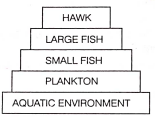
DDT was sprayed in a lake to regulate breeding of mosquitoes. How would it affect the trophic levels In the following food chain associated with a lake? Justify your answer.
4.
List any four methods of contraceptions used by humans. How does their use have a direct effect on the health and prosperity of a family?
5.
Give any two ways in which biodegradable substances would affect the environment.
6.
Why is vegetative propagation practiced for growing some types of plants?
7.
State one ill-effect of the absence of decomposers from a natural ecosystem.
8.
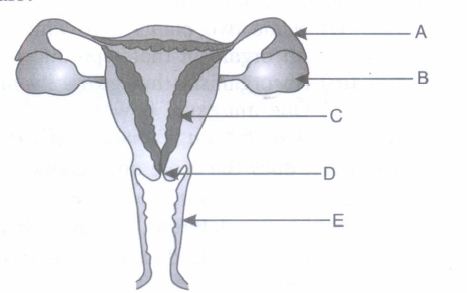
(a) Name the parts labelled A, B, C, D, and E
(b) Where do the following functions occurs?
(i) Production of an egg
(ii) Fertilisation
(iii) Implantation of zygote
(c) What happens to the lining of uterus
(i) before release of fertilised egg. (ii) if no fertilisation occurs
9.
Which of the following will have the maximum concentration of harmful chemicals in its body?
Peacock, Frog, Grass, Snake, Grasshopper.
10.
If all the waste we generate is biodegradable, will this have no impact on the environment?
11.
Differentiate between 'Self-pollination' and 'Cross-pollination'. Describe double fertilisation in plants.
12.
How is the process of pollination different from fertilisation?
13.
Consider the following statements about ozone.
(A) Ozone is a poisonous gas.
(B) Ozone shield the earth surface from the infrared radiations in the Sun.
(C) Ozone is a product of UV radiation acting on oxygen molecules.
(D) At the lower level of the earth atmosphere ozone performs most essential function.
The correct statements are
(A) and (B)
(A) and (C)
(B) and (C)
(B) and (D)
14.
Which of the following constituents do not form ecosystem?
Biotic constituents
Plastic bags
Abiotic constituents
All of these
15.
The full form of AIDS is
Acquired Immune Deficiency System
Acquired Immune Disease Syndrome
Acquired Immediate Deficiency Syndrome
Acquired Immuno Deficiency Syndrome
16.
The process where the unfertilised egg is released out of the body with the blood used to nourish the embryo is known as
Menstruation
Fertilisaytion
Germination
Pollination
17.
The decomposers in an ecosystem
Convert inorganic material, to simpler forms
Convert organic material to inorganic forms
Convert inorganic materials into organic compounds
Do not breakdown organic compounds
18.
In a food chain, the third trophic level is always occupied by
Carnivores
Herbivores
Decomposers
Producers
19.
Which among the following diseases is not sexually transmitted?
Syphilis
Hepatitis
HIV-AIDS
Gonorrhoea
20.
During adolescence, several changes occur in the human body. Mark one change associated with sexual maturation in boys
loss of milk teeth
increase in height
cracking of voice
weight gain
21.
Assertion (A) Offspring produced by asexual reproduction are genetically similar to the parents.
Reason (R) Asexual reproduction involves a single parent.
(a) If both A and R are true and R is the correct explanation of A
(b) If both A and R are true, but R is not the correct explanation of A
(c) If A is true, but R is false
(d) If A is false, but R is true
22.
Assertion: Ozone, is a deadly poison at the ground level.
Reason: Ozone at the higher levels of the atmosphere is protective in nature.
Codes
(a) If both assertion and reason are true and the reason is correct explanation of assertion.
(b) If both assertion and reason are true but reason is not a correct explanation of assertion.
(c) If assertion is true and reason is false.
(d) If both assertion and reason are false.
23.
Assertion: Harmful chemicals enter our bodies through the food chain.
Reason: The highest member in the food chain has the least amount of chemical.
Codes
(a) If both assertion and reason are true and the reason is correct explanation of assertion.
(b) If both assertion and reason are true but reason is not a correct explanation of assertion.
(c) If assertion is true and reason is false.
(d) If both assertion and reason are false.
24.
Assertion: The ovary releases one egg every month.
Reason: This process is repeated every month and is called menstruation.
Codes
(a) If both assertion and reason are true and the reason is correct explanation of assertion.
(b). If both assertion and reason are true but reason is not a correct explanation of assertion.
(c) If assertion is true and reason is false.
(d) If both assertion and reason are false
25.
In any given ecosystem, all living organisms are linked in a systematic chain with respect to their mode of manufacturing food/feeding habits. This sequential interlinking of organisms involving transfer of food energy from producers through a series of organisms with repeated eating and being eaten is called the food chain. A food chain may have 3-4 trophic levels.
(i) Which of the following statements regarding food chain is incorrect?
(a) It is a single straight pathway through which food energy travels in the ecosystem.
(b) It adds adaptability and competitiveness to the organisms.
(c) Presence of isolated food chains adds to instability of the ecosystem.
(d) Food chain binds up inorganic nutrients of the ecosystem.
(ii) Consider the following food chain.
Grass \(\longrightarrow\)A \(\longrightarrow\)Frog \(\longrightarrow\) Snake\(\longrightarrow\)Eagle
Which of the following can be placed at A?
| (a) Grasshopper | (b) Rabbit | (c) Phytoplankton | (d) Rat |
(iii) Select the correct food chain.
(a) Aquatic plants \(\longrightarrow\) Tadpole \(\longrightarrow\)Water beetle\(\longrightarrow\)Pike\(\longrightarrow\)Perch
(b) Grass\(\longrightarrow\)Grasshopper\(\longrightarrow\)Snake\(\longrightarrow\) Frog\(\longrightarrow\) Eagle
(c) Grass\(\longrightarrow\) Rabbit\(\longrightarrow\) Wild cat\(\longrightarrow\) Tiger
(d) Zooplankton \(\longrightarrow\) Phytoplankton \(\longrightarrow\)Small fish\(\longrightarrow\)Fish
(iv) Food chains are sustained by producers and _____________.
| (a) herbivores | (b) carnivores | (c) omnivores | (d) decomposers |
(v) Select the incorrect statement.
(a) Food chain may terminate at level of herbivore
(b) Food chain is always straight
(c) Food chain may have 3-5 trophic levels
(d) In a food chain, 80 to 90% of potential energy is lost as heat, at each transfer
26.
A newly married couple does not want have children for few years. They consulted a doctor who advised them barrier method and chemical method of birth control. Yet another couple who already have two children and are middle aged also consulted doctor for some permanent solution to avoid unwanted pregnancy. Doctor advised them surgical method of birth control.
(i) What are the barrier methods of birth control?
| (a) Condom | (b) Diaphragm |
| (c) Oral pills | (d) Both (a) and (b) |
(ii) How physical barrier prevent pregnancy?
(a) They kill the sperms
(b) They kill the ovum
(c) They prevent sperms from meeting the ovum
(d) They prevent intercourse
(iii) How chemical methods prevent pregnancy?
(a) Vaginal pills contain chemical called spermicides which kill the sperms
(b) Oral pills prevent ovulation so there will be no fertilisation
(c) Oral pills stop menstruation in females
(d) Both (a) and (b)
(iv) Select the correct statement regarding surgical method of birth control.
(a) It involves termination of pregnancies in women particularly after eight weeks of conception
(b) Small portion of sperm duct or vas deferences in males is removed by surgical operation and both cut ends are ligated properly
(c) Small portion of oviducts in females is removed by surgical operation and cut ends are ligated
(d) Both (b) and (c)
(v) Select the correct statement regarding birth control methods.
(a) Barrier method of birth control also protects the couple from sexually transmitted diseases
(b) Some women experience unpleasant side effects on taking oral pills because of change in hormonal balance in body
(c) Surgical method in males is called vasectomy and in females is called tubectomy
(d) All of these
27.
Given reason for the following.
(i) Name a unisexual and a bisexual flower.
(ii) Define cross-pollination. sate how it is carried out?
(iii) Observe the diagram given below and name the parts marked as 'A' and 'B'.
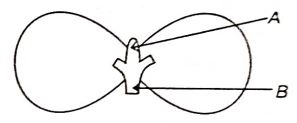
Mention the function of each of these parts.
28.
Why is Government of India imposing a ban on the use of polythene bags? Suggest two alternatives to these bags and explain how this ban is likely to improve the environment?
1.
(i) The greenish black powdery mass on a stale piece of bread is due to bread mould, Rhizopus. It reproduces by the spore formation.
(ii) The vegetative part of Rhizopus is thread-like projections called hyphae and the reproductive part is tiny blob-like structures known as sporangia, which contain spores as reproductive structures.
2.
Ozone is formed by there atoms of oxygen. In the higher levels of the atmosphere, it is a product of UV radiation acting on molecules that split it into free oxygen
. These combine with
to form Ozone
Importance: It is reflected back the UV rays of the sun, which are harmful for organisms.
Depletion of Ozone: It is caused by excessive use of CFC releasing gadgets like Air conditioners, refrigerators etc.
Effect of Ozone depletion: It can cause skin cancer
3.
DDT is a non-biodegradable pesticide which will enter the food chain from the first trophic level, i.e. plankton and from plankton, these are taken up by small fishes and large fishes.
In this manner, this toxic chemical enters the food chain. Its concentration keeps on increasing at each trophic level. This phenomenon is called as biological magnification.
So, the hawk will have the highest level of pesticide because they occupy the topmost place in the given food chain. 17 A modern insecticide has been introduced
4.
Four methods: (i) Mechanical or barrier method OR Male or female condoms.
(ii) Use of hormonal preparations OR Oral Pills/i-pill/Saheli.
(iii) Use of loop or copper T OR IUCD.
(iv) Surgical method OR tubectomy/vasectomy.
Effect on health and prosperity:
(i) Health of women is maintained.
(ii) Parents can give more attention to children.
(iii) More resources can be made available.
5.
The two ways in which biodegradable substances would affect the environment are
(i) Their degradation may release certain gases in the atmosphere thereby, polluting the environment.
(ii) They may become breeding places of flies and many other pests, thus causing diseases.
6.
Vegetative propagation is practiced for growing some types of plants because of the following reasons:
(i) Plants that have lost their capability to produce, seeds can be propagated by this method.
(ii) It helps to grow plants bearing superior traits, as they are genetically identical to the parent plant
(iii) It is used for growing plants which require a longer time to grow and become mature.
7.
Ill-effect is of the absence of decomposers from a natural ecosystem.
(i) Earth would be covered with dead bodies which would release foul smell.
(i) Recycling of materials will not take place. (Any one)
8.
(a) A - Fallopian tube
B - Ovary
C - Uterus
D - Cervix
E - Vagina
(b) (i) Production of an egg - ovary
(ii) Fertilisation - fallopian tubes
(iii) Implantation of zygote - lining of the uterus
(c) (i) Before release of fertilized egg - the uterus wall becomes thick.
(ii) If no fertilisation occurs - the lining of uterus slowly breaks down and comes out in the form of bleeding.
9.
Grass→Grasshopper→Frog→ Peacock Peacock will have maximum cone.
10.
If all the waste is biodegradable, then there will be no accumulation of waste and the Earth would be a cleaner place to live. But if, this biodegradable waste is too large in amount then its slow degradation may lead to air pollution (due to release of gases) as well as water and land pollution.
11.
| Self-pollination | Cross-pollination |
| 1. Self-pollination occurs within a flower or between two flowers of the same plants. | 1. Cross-pollination occurs between two flowers borne on different plants of the same species. |
| 2. Flowers do not depend on other agencies for pollination. | 2. Agents such as insects, water and wind are required for pollutions. |
| 3. Pollen grains are produced in small numbers. | 3. Pollen grains are produced in large numbers. |
| 4. No wastage of pollen grains occur and thus, economical. | 4. Wastage of pollen grains occurs and hence, not economical. |
| 5. Flowers are not attractive nor do they produce nectar. | 5. Flowers attract insects by various means like coloured petals, scent and nectar. |
| 6. The offsprings produced are of the same genetic make up, so purity of the race is maintained. | 6. The offsprings produced may show variations and differ in genetic make up |
12.
Differences between pollination and fertilisation are
| Pollination | Fertilisation |
| The transfer of pollen grains from anther to the stigma of a flower is called pollination. | The fusion of male and female gamete to form zygote is called fertilisaton. |
| It involves only the male gamete (pollen grain). | It involves both male and female gamete. |
13.
(b)
(A) and (C)
14.
(b)
Plastic bags
15.
(d)
Acquired Immuno Deficiency Syndrome
16.
(a)
Menstruation
17.
(b)
Convert organic material to inorganic forms
18.
(a)
Carnivores
19.
(b)
Hepatitis
20.
(c)
cracking of voice
21.
(a) Both A and R are true and R is the correct explanation of A.
Asexual reproduction is mode of reproduction that involves a single parent only. The new offspring produced by this method after cell division are genetically similar to their parents or are clone to their parents.
22.
(b) If both assertion and reason are true but reason is not a correct explanation of assertion.
23.
(c) If assertion is true and reason is false.
24.
(a) If both assertion and reason are true and the reason is correct explanation of assertion.
25.
(i) (b): Since a food chain is a sequential flow of food energy, it does not add to the adaptability and competitiveness of the organism.
(ii) (a) : In the given food chain, A is a primary consumer that feeds on grass and being eaten by frog. Therefore, among the given organisms, A should be grasshopper.
(iii) (c)
(iv) (d)
(v) (a): In a food chain, there is repeated eating in which each group eats the smaller one and is eaten by the larger one.
26.
(i) (d): In barrier methods of preventing pregnancy, the physical devices such as condom and diaphragm are used. Condoms are rubber tubes used by males whereas diaphragm are rubber cups used by females.
(ii) (c): Physical barriers prevent the sperm from meeting the ovum by acting as a barrier between them.
(iii) (d): Chemical methods of birth control include oral pills and vaginal pills. Oral pills are combination of estrogen and progesterone which prevent ovulation (release of egg during monthly cycle), so they prevent fertilisation. Vaginal pills are inserted in vagina before intercourse and release spermicides which kill sperms.
(iv) (d)
(v) (d)
27.
(i) Unisexual flower-Papaya
Bisexual flower-Hibiscus
(ii) Cross-pollination is defined as the transfer of pollen from the stamen of a flower to the stigma of a different flower. It is carried out through different agent like wind, water, insects, etc.
(iii) Name and functions of parts marked as A and B are
| Parts | Functions | |
| A | Plumule | It develops into future shoot of a plants. |
| B | Radicle | It develops in the future root of the plant. |
28.
Government of India is imposing a ban on the use of polythene bags because they cannot be degraded naturally by the action of microorganisms. Due to their non-biodegradability, they stay in the soil for a long time and continue to poison it with toxic byproducts that keep leaching from them. Also, they do not allow water to seep in, as they are waterproof. These polythene bags, when accidentally eaten by stray animals, can harm them and can even lead to their death. Jute and cloth bags can be used in place of polythene bags. The advantages of using cloth and jute bags are as follows
(i) They are environment-friendly as they are biodegradable.
(ii) They are renewable and can be easily recycled.
(iii) They have more strength than polythene bags ( because they are thick and can be used again and again. Thus, use of jute and cloth bags can help to reduce pollution.

10th Standard CBSE Syllabus & Materials
10th Standard CBSE
CBSE 10th Social Science PS - Federalism - New Model Questions Papers Study Material - QB365 Set A
NEW10th Standard CBSE
CBSE 10th Social Science PS - Power Sharing - New Model Questions Papers Study Material - QB365 Set A
NEW10th Standard CBSE
CBSE 10th Social Science GEO - Manufacturing Industries - New Model Questions Papers Study Material - QB365 Set A
NEW10th Standard CBSE
CBSE 10th Social Science GEO - Minerals and Energy Resources - New Model Questions Papers Study Material - QB365 Set A



NCERT Books

Syllabus

Exam Pattern

Sample Question Papers

Previous year Question Papers

Important Notes

MCQ Practice test

NCERT Exemplers

Case study Questions

Image Based Questions

Passage based Questions

HOT Questions

Value Based Questions

Model Questions Papers
NCERT ( Book Back ) Questions

Assertion and Reason
Important Questions And Answers

CBSE 10th Standard CBSE Subjects
CBSE Standards



