
 100% FREE ACCESS
10th Standard CBSE Syllabus & Materials
10th Standard CBSE
CBSE 10th Social Science ECO - Globalisation and the Indian Economy - New Model Questions Papers Study Material - QB365 Set A
NEW10th Standard CBSE
CBSE 10th Social Science ECO - Money and Credit - New Model Questions Papers Study Material - QB365 Set A
NEW10th Standard CBSE
CBSE 10th Social Science ECO - Sectors of the Indian Economy - New Model Questions Papers Study Material - QB365 Set A
NEW10th Standard CBSE
CBSE 10th Social Science ECO - Development - New Model Questions Papers Study Material - QB365 Set A
NEW10th Standard CBSE
CBSE 10th Social Science PS - Outcomes of Democracy - New Model Questions Papers Study Material - QB365 Set A
NEW10th Standard CBSE
CBSE 10th Social Science PS - Gender, Religion and Caste - New Model Questions Papers Study Material - QB365 Set A

Published on: 22/10/2025
Download CBSE Class 10th Standard CBSE Science question papers, sample papers, important questions, and previous year solved papers in PDF format. Get free study materials, NCERT solutions, and exam preparation resources for Class 10th Standard CBSE Science
Questions + Answers key
Take MCQ Science Test
1.
ldentify the phase of circulation which is represented in the diagram of heart given below. Arrows indicate contraction of the chambers shown.
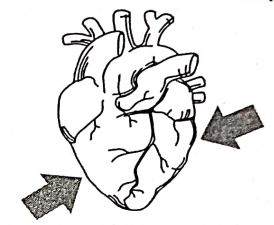
Blood transferred to the right ventricle and left ventricle simultaneously
Blood is transferred to lungs for oxygenation and is pumped into various organs simultaneously
Blood transferred to the right auricle and left auricle simultaneously
Blood is received from lungs after oxygenation and is received from various organs of the body
2.
In the following flowchart showing autotrophic nutrition in green plants, A and B respectively are
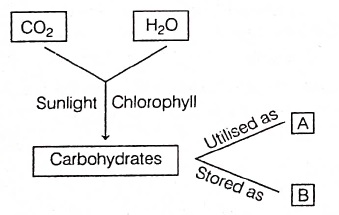
oxygen and energy
starch and oxygen
energy and starch
oxygen and water
3.
It which of the following devices CFCs are not produced?
Refrigerators
Fire extinguishers
Pressurized cans
Pencil
4.
Which group of organisms are not constituents of a food chain?
(i) Grass, lion, rabbit, wolf
(ii) Plankton, man, fish, grasshopper
(iii) Wolf, grass, snake, tiger
(iv) Frog, snake, eagle, grass, grasshopper
(i) and (iii)
(iii) and (iv)
(ii) and (iii)
(i) and (iv)
5.
Opening and closing of the stomatal pore depends upon
atmospheric temperature
oxygen concentration around stomata
carbon dioxide concentration around stomata
water content in the guard cells
6.
In which of the following vertebrate group/groups, heart does not pump oxygenated blood to different parts of the body?
Pisces and amphibians
Amphibians and reptiles
Amphibians only
Pisces only
7.
Which of the following is most appropriate for aerobic respiration?
Glucose \(\overset { mitochondria }{ \longrightarrow } \) pyruvate \(\overset { Cytoptasm }{ \longrightarrow } \) CO2+H2O+Energy
Glucose \(\overset { Cytoptasm }{ \longrightarrow } \) pyruvate \(\overset { mitochondria }{ \longrightarrow } \) CO2+H2O+Energy
Glucose \(\overset { Cytoptasm }{ \longrightarrow } \) pyruvate+energy \(\overset { mitochondria }{ \longrightarrow } \) CO2+H2O
Glucose \(\overset { Cytoptasm }{ \longrightarrow } \) pyruate+energy \(\overset { mitochondria }{ \longrightarrow } \) CO2+H2O+Energy
8.
We often use the word environment. What does it mean?
9.
Name the organs where the following functions in humans are performed
(i) Absorption of food. (ii) Absorption of water
10.
Differentiate between an autotroph and a heterotroph.
11.
If a plant is releasing carbon dioxide and taking in oxygen during the day, does it mean that there is no photosynthesis occurring? Justify your answer.
12.
What is the importance of ozone in the environment? Why is it depleting? What precautions are taken to preserve it?
13.
State the role of the following in human digestive system:
(i) Digestive enzymes (ii) Hydrochloric acid (iii) Villi
14.
Give reasons for the following:
(i)The glottis is guarded by epiglottis
(ii)The lung alveoli are covered with blood capillaries.
(iii)The wall of trachea is supported by cartilage rings.
15.
(a) Give five functions of blood.
(b) "Fishes show single circulation". Explain.
16.
(a) Draw a diagram of the human respiratory system and label on it alveolar sac, bronchioles, larynx, and trachea.
(b) How are the lungs designed in human beings to maximise the area of exchange of gases?
17.
Assertion (A) The waste we generate daily may be biodegradable or non-biodegradable.
Reason (R) The waste generated, if not disposed off properly may cause serious environmental problems
(a) Both A and R are true and R is the correct explanation of A
(b) Both A and R are true and R is not the correct explanation of A
(c) A is true, but R is false
(d) A is false, but R is true
18.
Assertion: Most of the solid waste in urban areas is disposed off in landfills. Reason: Landfills are high lying areas of the ground.
Reason: Landfills are high lying areas of the ground.
Codes
(a) Both A and R are true and R is correct explanation of the assertion.
(b) Both A and R are true but R is not the correct explanation of the assertion.
(c) A is true but R is false.
(d) A is false but R is true
19.
Our body needs to remove the wastes that build up from cell activities and from digestion. It these wastes are not removed, then our cells can stop working and we can get very sick. The organs of our excretory system help to release wastes from our body. The excretory system consists of a pair of kidney, a pair of ureters, a urinary bladder and a urethra. Each kidney is made up of nearly one million complex tubular structures called nephrons. The formation of urine involves various processes that takes place in the different parts of the nephron. Each nephron consists of a cup-shaped upper end called Bowman's capsule containing a bunch of capillaries called glomerulus. Bowman's capsule leads to tubular structure-proximal convoluted tubule, loop of Henle and distal convoluted tubule which ultimately joins the collecting tubule.
(i) The following substances are the excretory products in animals. Choose the least toxic form.
| (a) Urea | (b) Uric acid | (c) Ammonia | (d) CO2 |
(ii) The outline of principal events of urination is given below in random manner.
(I) Stretch receptors on the wall of urinary bladder send signals to the CNS.
(II) The bladder fills with urine and becomes distended.
(III) Micturition
(IV) CNS passes on motor messages to initiate the contraction of smooth muscles of bladder and simultaneous relaxation of urethral sphincter.
The correct sequence of the events is
| (a) (I) \(\rightarrow\)(II) \(\rightarrow\) (III) \(\rightarrow\) (IV) | (c) (II) \(\rightarrow\)(I) \(\rightarrow\) (IV) \(\rightarrow\) (III) |
| (b) (IV)\(\rightarrow\) (III) \(\rightarrow\) (II) \(\rightarrow\) (I) | (d) (III) \(\rightarrow\) (II)\(\rightarrow\) (I) \(\rightarrow\) (IV) |
(iii) A person who is not taking food or beverages will have ___________ in urine.
| (a) little glucose | (b) less urea | (c) excess urea | (d) little fat |
(iv) Glomerular filtrate is first collected by
| (a) distal convoluted tubule | (b) proximal convoluted tubule |
| (c) Bowman's capsule | (d) loop of Henle |
(v) The given figure represents a single nephron from a mammalian kidney. Identify the labelled parts, match them with the options (i-iv) and select the correct answer.
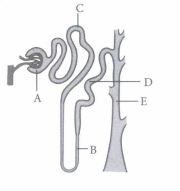
(I) The site of ultrafiltration
(II) Collect the urine and make it more concentrated
(III) The main site for the reabsorption of glucose and amino acids
(IV) Largely responsible for the maintenance of blood pH
| (a) (I)-A, (II)-E, (lII)-C, (IV)-D | (b) (I)-A, (lI)-B, (lII)-C, (lV)-D |
| (c) (I)-B, (II)-A, (lII)-C, (IV)-E | (d) (I)-E, (lI)-B, (lII)-D, (lV)-A |
1.
(b)
Blood is transferred to lungs for oxygenation and is pumped into various organs simultaneously
2.
(c)
energy and starch
3.
(d)
Pencil
4.
(c)
(ii) and (iii)
5.
(d)
water content in the guard cells
6.
(d)
Pisces only
7.
(d)
Glucose \(\overset { Cytoptasm }{ \longrightarrow } \) pyruate+energy \(\overset { mitochondria }{ \longrightarrow } \) CO2+H2O+Energy
8.
It is the physical, chemical and biological conditions of a particular area or the whole world, as the case may be.
9.
(i) Small intestine.
(ii) Large intestine
10.
An autograph is an organism which prepares its own food, while a heterotroph takes food from another organism. Autotrophs do not show locomotion because they don't need to move in search of food. On the other hand, most of the heterotrophs show locomotion because they need to move in search of food.
11.
Most of the carbon dioxide released during respiration exits from the plant cells through various openings. The plant cells through various openings. The carbon dioxide, required for photosynthesis is taken through stomata. So, even if a plant keeps on taking in oxygen and releasing carbon dioxide during the day, it does not mean that no photosynthesis is happening in the plant.
12.
Ozone is present in the stratosphere. It protects the earth from harmful ultraviolet radiations. UV ray causes various diseases to organisms e.g. skin cancer, cataract in human beings.
Ozone layer is depleting because of chlorides and fluorides. They act on ozone molecules and deplete it. Chlorides, fluorides are present in CFC's which are used in refrigerants and fire extinguishers.
CFC \(\longrightarrow \) Chlorofluorocarbon
13.
(i) Digestive enzymes - Foods need to be broken into their small or simpler molecules so that they can be absorbed into the bloodstream. However, the physical breakdown of food is not enough. Enzymes are hence needed for the chemical breakdown of food and speeding up the digestive process. The products of digestion should be smaller enough to be absorbed.
(ii) Hydrochloric acid helps to kill the germs which might have entered into the system through food. It creates acidic medium for the pepsin to act on food to break down proteins.
(iii) Villi are finger-like projections in the small intestine. They help to increase the surface area for absorption of the digested food. Villi are richly supplied with blood vessel which help to absorb digested food from the bloodstream.
14.
(i)The glottis is gaurded by epiglottis because it prevents the entry of food in wind pipe. If the food enters wind pipe, then it chokes it, leading to the death of the person.
(ii)The lung alveoli are covered with blood vessels because the oxygen that we inhale dissolves in the blood, present in these blood capillaries only, as it reaches the lungs.
(iii)The wall of trachea is supported by cartilage rings because these rings prevent the air passage from collapsing.
15.
(a) Functions of blood:
(i) Plasma transports food, carbon dioxide and nitrogenous waste in dissolved form.
(ii) Red blood cells carry oxygen to each and every cells.
(iii) White blood cells act as soldiers of our body and kill germs.
(iv) Platelets help in blood clotting, plugs the leakage. (v) It maintains our body temperature.
(b) Fishes have only two chambers in their hearts, the blood is pumped to the gills for getting oxygenated and from there it passes directly to rest of the body. Thus, the blood goes only once through the heart during one cycle of passage through the body.
16.
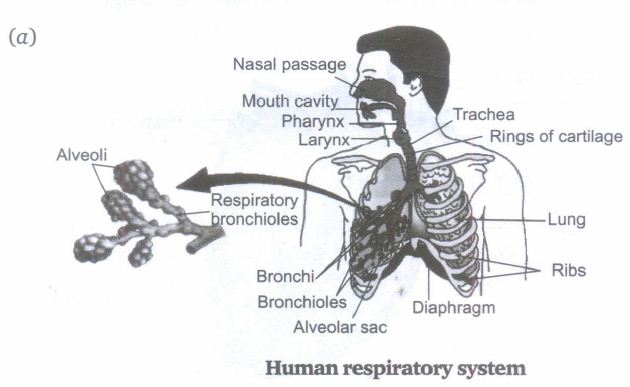
(b) Lungs have bronchioles (small tubes) coming from the bronchi. The bronchioles at the terminals form a balloon like structure called alveoli which increases the surface area for exchange of gases and is richly supplied with blood capillaries.
17.
(b) Both A and R are true, but R is not the correct explanation of A.
The waste we generate daily may be biodegradable like fruit peel, vegetable waste, etc. and can be decomposed by decomposers or it can be non-biodegradable like plastics, glass, etc. Non-biodegradable wastes cannot be broken down by decomposers and tend to pile up and cause pollution.
18.
(c) : Landfills are low lying areas of ground where waste is dumped and covered with soil to the level of ground.
19.
(i) (b):Nitrogenous waste substances such as ammonia, urea or uric acid are produced during protein metabolism. Ammonia is the most toxic, followed by urea and uric acid. Uric acid is least toxic.
(ii) (c)
(iii) (b): Urea is a nitrogenous waste formed as a result of metabolism of various food/beverages in the body and is excreted in the urine. So,if a person is not taking food/beverages he will have less urea in his urine.
(iv) (c)
(v) (a): Malpighian corpuscle (A) is the site of ultrafiltration. A considerable amount of water is reabsorbed in the collecting duct (E) under the influence of ADH. Proximal convoluted tubule (C) is the main site for the reabsorption of glucose and amino acids. In distal convoluted tubule (D), bothhydrogen ions and ammonium ions are secreted, thus it maintains blood pH.

10th Standard CBSE Syllabus & Materials
10th Standard CBSE
CBSE 10th Social Science PS - Federalism - New Model Questions Papers Study Material - QB365 Set A
NEW10th Standard CBSE
CBSE 10th Social Science PS - Power Sharing - New Model Questions Papers Study Material - QB365 Set A
NEW10th Standard CBSE
CBSE 10th Social Science GEO - Manufacturing Industries - New Model Questions Papers Study Material - QB365 Set A
NEW10th Standard CBSE
CBSE 10th Social Science GEO - Minerals and Energy Resources - New Model Questions Papers Study Material - QB365 Set A



NCERT Books

Syllabus

Exam Pattern

Sample Question Papers

Previous year Question Papers

Important Notes

MCQ Practice test

NCERT Exemplers

Case study Questions

Image Based Questions

Passage based Questions

HOT Questions

Value Based Questions

Model Questions Papers
NCERT ( Book Back ) Questions

Assertion and Reason
Important Questions And Answers

CBSE 10th Standard CBSE Subjects
CBSE Standards



