
 100% FREE ACCESS
10th Standard CBSE Syllabus & Materials
10th Standard CBSE
CBSE 10th Social Science ECO - Globalisation and the Indian Economy - New Model Questions Papers Study Material - QB365 Set A
NEW10th Standard CBSE
CBSE 10th Social Science ECO - Money and Credit - New Model Questions Papers Study Material - QB365 Set A
NEW10th Standard CBSE
CBSE 10th Social Science ECO - Sectors of the Indian Economy - New Model Questions Papers Study Material - QB365 Set A
NEW10th Standard CBSE
CBSE 10th Social Science ECO - Development - New Model Questions Papers Study Material - QB365 Set A
NEW10th Standard CBSE
CBSE 10th Social Science PS - Outcomes of Democracy - New Model Questions Papers Study Material - QB365 Set A
NEW10th Standard CBSE
CBSE 10th Social Science PS - Gender, Religion and Caste - New Model Questions Papers Study Material - QB365 Set A

Published on: 22/10/2025
Download CBSE Class 10th Standard CBSE Science question papers, sample papers, important questions, and previous year solved papers in PDF format. Get free study materials, NCERT solutions, and exam preparation resources for Class 10th Standard CBSE Science
Questions + Answers key
Take MCQ Science Test
1.
The function of the lining of mucus in the nasal passage of human beings is to
increase the temperature of inhaled air
move the air in and out
filter the air that we breathe in
absorb oxygen from the air
2.
In human alimentary canal, the specific enzyme/ juice secreted in locations (i), (ii) and (iii) are
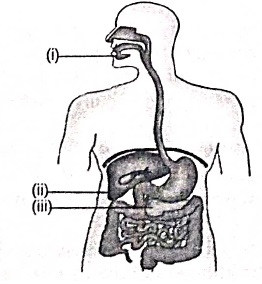
(i) Amylase (ii) Pepsin (ii) Bile
(i) Amylase (i) Bile (ii) Trypsin
(i) Lipase (ii) Amylase (iii) Pepsin
(i) Trypsin (ii) Bile (i) Amylase
3.
Rhythmic movement of muscles in the lining of gut are known a
Contracting movements
Dilating movements
Peristaltic movements
None of these
4.
Temporary finger-like extension of amoeba are called
Cell membrane
Cell wall
Pseudopodia
Cilia
5.
In the experiment, CO2 is essential for photosynthesis, KOH is kept
To seal the chamber
To absorb CO2
To support the plant while CO2 is absent
Both (b) and (c)
6.
Amphibians have
1-chambered heart
2-chambered heart
3-chambered heart
4-chambered heart
7.
Carbohydrate in humans is stored in the form of
Glycogen
Starch
Glucose
Maltose
8.
Which organelle of the cell is known as powerhouse?
ATP
Golgi bodies
Mitochondria
Nucleus
9.
Choose the correct path of urine in our body
kidney \(\rightarrow\) ureter \(\rightarrow\) urethra \(\rightarrow\) urinary bladder
kidney \(\rightarrow\) urinary bladder \(\rightarrow\) urethra \(\rightarrow\) ureter
kidney \(\rightarrow\) ureter \(\rightarrow\) urinary bladder \(\rightarrow\) urethra
urinary bladder \(\rightarrow\) kidney \(\rightarrow\) ureter \(\rightarrow\) urethra
10.
Lack of oxygen in muscles often leads to cramps among cricketers. This results due to
Conversion of pyruvate to ethanol
Conversion of pyruvate to glucose
Non conversion of glucose to pyruvate
Conversion of pyruvate to lactic acid
11.
The filtration units of kidneys are called
Ureter
Urethra
Neurons
Nephrons
12.
What prevents backflow of blood inside the heart during contraction?
Valves in heart
Thick muscular walls of venticles
Thin walls of atria
All of the above
13.
During respiration exchange of gases take place in
Trachea and larynx
Alveoli of lungs
Alveoli and throat
Throat and larynx
14.
Which is the correct sequence of air passage during inhalation?
Nostrils \(\longrightarrow\) larynx \(\longrightarrow\) pharynx \(\longrightarrow\) trachea \(\longrightarrow\) lungs
Nasal passage \(\longrightarrow\) trachea \(\longrightarrow\) pharynx \(\longrightarrow\) larynx \(\longrightarrow\) alveoli
Larynx \(\longrightarrow\) nostrils \(\longrightarrow\) pharynx \(\longrightarrow\) lungs
Nostrils \(\longrightarrow\) pharynx \(\longrightarrow\) larynx \(\longrightarrow\) trachea \(\longrightarrow\) alveoli
15.
The correct sequence of anaerobic reactions in yeast is
Glucose \(\overset { Cytoptasm }{ \longrightarrow } \) Pyruvate \(\overset { mitochondria }{ \longrightarrow } \) Ethanol+Carbon dioxide
Glucose \(\overset { Cytoptasm }{ \longrightarrow } \)Pyruvate \(\overset { Cytoplasm }{ \longrightarrow } \)
Glucose \(\overset { Cytoptasm }{ \longrightarrow } \)Pyruvate \(\overset { mitochondria }{ \longrightarrow } \) Lactic acid
Glucose \(\overset { Cytoptasm }{ \longrightarrow } \) Pyruvate \(\overset { Cytoplasm }{ \longrightarrow } \) Ethanol+ Carbon dioxide
16.
In which part of the alimentary canal food is finally digested?
Stomach
Mouth cavity
Large intestine
Small intestine
17.
Which part of alimentary canal receives bile from the liver?
Stomach
Small intestine
Large intestine
Oesophagus
18.
Which is the correct sequence of parts in human alimentary canal?
Mouth \(\longrightarrow\)Stomach\(\longrightarrow\)Small intestine \(\longrightarrow\) Oesophagus \(\longrightarrow\) large intestine
Mouth \(\longrightarrow\) oesophagus \(\longrightarrow\) stomach \(\longrightarrow\) large intestine \(\longrightarrow\) small intestine
Mouth \(\longrightarrow\) stomach \(\longrightarrow\) oesophagus \(\longrightarrow\) small intestine \(\longrightarrow\) large intestine
Mouth \(\longrightarrow\) oesophagus \(\longrightarrow\) stomach \(\longrightarrow\)small intestine \(\longrightarrow\) large intestine
19.
In which of the following groups of organisms, food material is broken down outside the body and absorbed?
Mushroom, green plants, Amoeba
Yeast, mushroom, bread mould
Paramecium, Amoeba, Cuscuta
Cuscuta, lice, tapeworm
20.
The breakdown of pyruvate to give carbon dioxide, water and energy takes place in
Cytoplasm
Mitochondria
Chloroplast
Nucleus
21.
The kidneys in human beings are a part of the system for
Nutrition
Respiration
Excretion
Transportation
22.
What are the different ways in which glucose is oxidised to provide energy in various organisms?
23.
How are water and minerals transported in plants?
24.
Describe the structure and functioning of nephrons
25.
Describe double circulation in human beings. Why is it necessary?
26.
Write correct sequence in four steps about the method for the preparation of temporary mount of a stained leaf peel.
27.
Write two important functions of transpiration in plants .
28.
What is breathing?
29.
Name the correct substrates for the following enzymes
(i)Trypsin (ii)Amylase
(iii)Pepsin (iv)Lipase
30.
Name the energy currency in the living organisms.When and where is it produced?
31.
What are the adaptations of leaf for photosynthesis?
32.
Differentiate between an autotroph and a heterotroph.
33.
Write three types of blood vessels. Give one important feature of each.
34.
Explain breathing mechanism
35.
Draw a diagram of open and closed stomata
36.
Why is it necessary to separate oxygenated and deoxygenated blood in mammals and birds?
37.
Name the constituents of blood.Why white blood corpuscles are called 'soldiers of the body'?
38.
Give reasons for the following:
(i)The glottis is guarded by epiglottis
(ii)The lung alveoli are covered with blood capillaries.
(iii)The wall of trachea is supported by cartilage rings.
1.
(c)
filter the air that we breathe in
2.
(a)
(i) Amylase (ii) Pepsin (ii) Bile
3.
(c)
Peristaltic movements
4.
(c)
Pseudopodia
5.
(b)
To absorb CO2
6.
(b)
2-chambered heart
7.
(a)
Glycogen
8.
(c)
Mitochondria
9.
(c)
kidney \(\rightarrow\) ureter \(\rightarrow\) urinary bladder \(\rightarrow\) urethra
10.
(d)
Conversion of pyruvate to lactic acid
11.
(d)
Nephrons
12.
(a)
Valves in heart
13.
(b)
Alveoli of lungs
14.
(d)
Nostrils \(\longrightarrow\) pharynx \(\longrightarrow\) larynx \(\longrightarrow\) trachea \(\longrightarrow\) alveoli
15.
(d)
Glucose \(\overset { Cytoptasm }{ \longrightarrow } \) Pyruvate \(\overset { Cytoplasm }{ \longrightarrow } \) Ethanol+ Carbon dioxide
16.
(d)
Small intestine
17.
(b)
Small intestine
18.
(d)
Mouth \(\longrightarrow\) oesophagus \(\longrightarrow\) stomach \(\longrightarrow\)small intestine \(\longrightarrow\) large intestine
19.
(b)
Yeast, mushroom, bread mould
20.
(b)
Mitochondria
21.
(c)
Excretion
22.
The two ways in which glucose is oxidized to provide energy in diverse organisms are listed below.
1. Aerobic respiration
2. Anaerobic respiration
Aerobic respiration : It occurs in the presence of oxygen, respiration occurs, and the products are carbon dioxide, energy, and water.
Glucose + Oxygen \(\rightarrow\) Carbon dioxide + Water + Energy
- \(\mathrm{C}_6 \mathrm{H}_{12} \mathrm{O}_6(\mathrm{l})+6 \mathrm{O}_2(\mathrm{~g}) \rightarrow 6 \mathrm{CO}_2(\mathrm{~g})+6 \mathrm{H}_2 \mathrm{O}(\mathrm{l})+\) Energy
Anaerobic respiration - It occurs in the absence of oxygen, respiration occurs, and the products generated are lactic acid or ethanol and energy.
Glucose \(\rightarrow\) Alcohol + Carbon dioxide + Energy
Glucose \(\rightarrow\) Lactic acid + Energy
- \(\mathrm{C}_6 \mathrm{H}_{12} \mathrm{O}_6(\mathrm{l}) \rightarrow 2 \mathrm{C}_3 \mathrm{H}_6 \mathrm{O}_3(\mathrm{l})+\) Energy
Differences between Aerobic and Anaerobic respiration:
| Aerobic Respiration | Anaerobic Respiration |
| When this type of respiration occurs, oxygen is present. | When this type of respiration occurs, oxygen is not present. |
| This type of respiration involves the exchange of gases. | This type of respiration do not involve the exchange of gases. |
| It may be found in the cytoplasm and the mitochondria. | It is found only in the cytoplasm. |
| Glucose degrades to carbon dioxide and water. | Glucose is broken down into ethanol, carbon dioxide, and energy. |
| This type of respiration is seen in all higher creatures, including mammals. | This kind is used by lower organisms such as bacteria and yeast. It occurs during excessive activity in other creatures. |
23.
Water and minerals are transported through xylem in plants. The cells in roots that are in contact wih soil actively take up ions. creating a difference in conentration of ions between the cell sap of roots and soil water.
Water moves into the roots to eliminate this diference of concentration forming a steady movement of water in the root xylem. This creates a column of water that is steadily pushed upwards. Loss of water from leaves creates a suction that pulls water from the xylem of the roots to the aerial parts of the body.
24.
Structure of nephron Nephron is the basic filtering unit found in kidney. It is a long coiled tubule whose one end is connected to the double walled cup-shaped structure called Bowman's capsule and the other end to a urine collecting duct. Bowiman's capsule contains a bundle of blood capillaries, known as glomerulus that is followed by the tubular part of nephron, which forms loops at some places. For figure refer to "Structure of a nephron" on.
Functioning of nephron
(i) Glomerulus filters the blood passing through it.
(ii) It also ensures to remove only harmful substances from the body that includes nitrogenous materials.
(iii) The useful substances like glucose, amino acids, salts and a major amount of water are selectively reabsorbed by the tubular part of nephron.
(iv) Some substances like K+ are actively secreted into the urine through the tubule.
(v) The collecting duct collects the urine and passes it to the ureter.
25.
During double circulation in human beings, blood passes the through heart twice for completing one cycle of circulation.
The double circulation includes the following processes
(i) Pulmonary circulation In this circulation, the deoxygenated blood is pushed by right ventricle to the lungs for oxygenation through pulmonary artery. This oxygenated blood is then brought back to the left atrium of the heart through pulmonary veins.
(ii) Systemic circulation In this circulation, oxygenated blood brought to left atrium goes to the left ventricle. It is then passed on to different body parts of body through aorta.
Such separation allows a highly efficient supply of oxygen to the body. This is usefull in animals that have high energy needs, such as birds and mammals, which constantly, use energy to maintain their body temperature.
26.
(i) Take a leaf and fold it to remove the lower surface peel with the forceps.
(ii) Keep the peel in a watch glass containing dilute safranin for staining.
(iii) Place the leaf on clean glass slide, add a drop of glycerin and gently place a cover slip over it.
(iv) Remove the extra stain with the blotting paper and observe it under a microscope.
27.
Transpiration is loss of water from stomatal pores. It regulates the temperature and also causes the suction pull due to which upward movement of water and minerals take place.
28.
Breathing is the process of taking in oxygen (inhalation) and giving out carbon dioxide (exhalation)
29.
(i)Protein
(ii)Starch
(iii)Protein
(iv)Fats
30.
Adenosine triphosphate (ATP) produced during respiration in living organisms and also during photosynthesis in plants.
31.
(i)Leaves provide large surface area for maximum light absorption
(ii)Leaves are arranged at right angles to the light source in a way that causes overlapping
(iii)The extensive network of veins enables quick transport of substances to and from the mesophyll cells.
(iv)Presence of numerous stomata for gaseous exchange.
(v)The chloroplasts are more in number on the upper surface of leaves.
32.
An autograph is an organism which prepares its own food, while a heterotroph takes food from another organism. Autotrophs do not show locomotion because they don't need to move in search of food. On the other hand, most of the heterotrophs show locomotion because they need to move in search of food.
33.
Three types of blood vessels are:
1. Arteries - Arteries carry the oxygenated blood away from the heart to the various organs of the body.
2. Veins - Veins carry deoxygenated blood from different organs of the body back to the heart.
3. Capillaries - Capillaries are the smallest vessels where exchange of material between the blood and surrounding cells takes place.
34.
The cartilaginous diaphragm when contracts, increases the surface area for lungs which spreads thereby reducing the air pressure in it. The pressure of air at the nostrils is more and hence the air flows from higher pressure area to lower pressure area i.e. lungs. This is called inhalation.
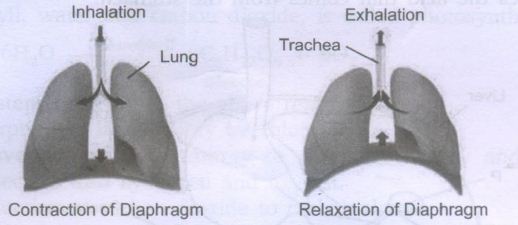
When the diaphragm relaxes, it pushes the lungs thereby increasing the pressure on them and the surface area reduces and hence the pressure of air in the lungs is more which is forced/given out from the nostrils. This is called exhalation.
35.
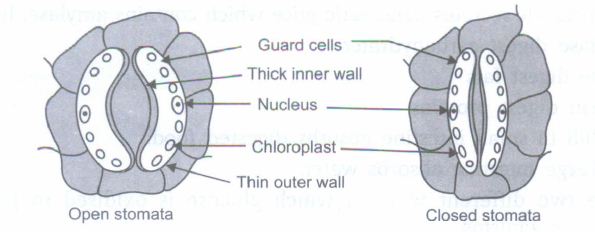
36.
Mammals and birds are warm-blooded animals, so they constantly need energy in order to maintain their body temperature. Due to this high energy demand, they require more oxygen. Thus, it is important that their Oxygenated blood should not get mixed up with deoxygenated blood in order to make circulatory system much more efficient.
37.
The different constituents of blood are plasma (the fluid part of the bloo(d) and blood corpuscles consisting of RBCs, WBCs, and platelets)
WBCs are known as the soldiers of the body because they fight against the pathogenes that invade our body, thus preventing the occurence of diseases.
38.
(i)The glottis is gaurded by epiglottis because it prevents the entry of food in wind pipe. If the food enters wind pipe, then it chokes it, leading to the death of the person.
(ii)The lung alveoli are covered with blood vessels because the oxygen that we inhale dissolves in the blood, present in these blood capillaries only, as it reaches the lungs.
(iii)The wall of trachea is supported by cartilage rings because these rings prevent the air passage from collapsing.

10th Standard CBSE Syllabus & Materials
10th Standard CBSE
CBSE 10th Social Science PS - Federalism - New Model Questions Papers Study Material - QB365 Set A
NEW10th Standard CBSE
CBSE 10th Social Science PS - Power Sharing - New Model Questions Papers Study Material - QB365 Set A
NEW10th Standard CBSE
CBSE 10th Social Science GEO - Manufacturing Industries - New Model Questions Papers Study Material - QB365 Set A
NEW10th Standard CBSE
CBSE 10th Social Science GEO - Minerals and Energy Resources - New Model Questions Papers Study Material - QB365 Set A



NCERT Books

Syllabus

Exam Pattern

Sample Question Papers

Previous year Question Papers

Important Notes

MCQ Practice test

NCERT Exemplers

Case study Questions

Image Based Questions

Passage based Questions

HOT Questions

Value Based Questions

Model Questions Papers
NCERT ( Book Back ) Questions

Assertion and Reason
Important Questions And Answers

CBSE 10th Standard CBSE Subjects
CBSE Standards



