
 100% FREE ACCESS
10th Standard CBSE Syllabus & Materials
10th Standard CBSE
CBSE 10th Social Science ECO - Globalisation and the Indian Economy - New Model Questions Papers Study Material - QB365 Set A
NEW10th Standard CBSE
CBSE 10th Social Science ECO - Money and Credit - New Model Questions Papers Study Material - QB365 Set A
NEW10th Standard CBSE
CBSE 10th Social Science ECO - Sectors of the Indian Economy - New Model Questions Papers Study Material - QB365 Set A
NEW10th Standard CBSE
CBSE 10th Social Science ECO - Development - New Model Questions Papers Study Material - QB365 Set A
NEW10th Standard CBSE
CBSE 10th Social Science PS - Outcomes of Democracy - New Model Questions Papers Study Material - QB365 Set A
NEW10th Standard CBSE
CBSE 10th Social Science PS - Gender, Religion and Caste - New Model Questions Papers Study Material - QB365 Set A

Published on: 22/10/2025
Download CBSE Class 10th Standard CBSE Science question papers, sample papers, important questions, and previous year solved papers in PDF format. Get free study materials, NCERT solutions, and exam preparation resources for Class 10th Standard CBSE Science
Questions + Answers key
Take MCQ Science Test
1.
Which one of the following statements related to capillaries is correct?
These act as connective link between arteries and veins
These are deeply penetrated inside the tissues
These help in exchange of materials between blood and surrounding coils
All of the above
2.
Which human-made material cannot be broken down by the action of bacteria?
human flesh
flesh of dead animal
vegetable peels
plastic
3.
A section of DNA providing information for one protein is called
Nucleus
Chromosomes
Trait
Gene
4.
What are the functions performed by the testis in human males
Production of gametes-eggs and secretion of sex hormones-estrogen
Production of gametes-sperms and secretion of sex hormones-testosterone
Production of gametes-sperms and secretion of sex hormones-estrogen
None of the above
5.
Depletion of ozone is mainly due to
Chlorofluorocarbon compounds
Carbon monoxide
Methane
Pesticides
6.
In which part of the alimentary canal food is finally digested?
Stomach
Mouth cavity
Large intestine
Small intestine
7.
Which of the following statements are true?
(i) Sudden action in response to something in the environment is called reflex action
(ii) Sensory neurons carry signals from spinal cord to muscles
(iii) Motor neurons carry signals from receptors to spinal cord
(iv) Impulse from a receptor to a muscle or a gland is called reflex arc
(i) and (ii)
(i) and (iii)
(i) and (iv)
(i), (ii) and (iii)
8.
Mention the significance of food web.
9.
What is the main difference between sperms and eggs of humans? Write the importance of this difference.
10.
Mala is four-month pregnant and is worried whether the child is male or female. One day she reads an advertisement regarding a medicine which of taken for 3 months results in birth of male child. What should she do?
(a) Get the medicine and take it regularly.
(b) Visit a doctor and discuss the problem with him/her.
(c) What, in your opinion, are the chances of having a male child?
11.
What are gustatory receptors?
12.
Given below is a diagram of bisexual flower.
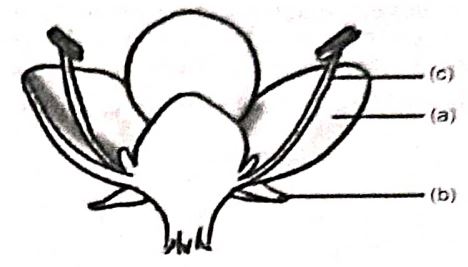
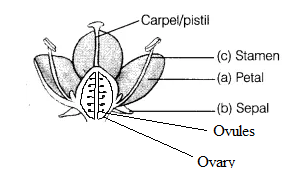
(i) Draw the missing parts of a flower.
(ii) Explain with help of a diagram, how the male germ cells reaches the female germ cells present in the ovary?
(iii) Justify the statement "Pollination may occur without fertilisation, but fertilisation will not take place without pollination."
13.
Draw a diagram of a human female reproductive system and label the part
(i) that produces egg
(ii) where fusion of egg and sperm take place
(iii) where zygote is implanted
What happens to human egg when it is not fertilised?
14.
(i) State the role played by the following in the process of digestion.
(a) Enzyme trypsin
(b) Enzyme lipase
(ii) List two functions of finger-like projections present in the small intestine.
15.
What evidence do we have for the origin of life from inanimate matter?
16.
Assertion: A food chain comprises of producers and consumers.
Reason: Consumers can be herbivores, carnivores and omnivores.
Codes
(a) Both A and R are true and R is correct explanation of the assertion.
(b) Both A and R are true but R is not the correct explanation of the assertion.
(c) A is true but R is false.
(d) A is false but R is true
17.
Assertion: Darwin's theory of evolution tells us how life evolved from simple to more complex forms.
Reason: Mendel's experiments give us the mechanism for the inheritance of traits from one generation to the next.
Codes
(a) If both assertion and reason are true and the reason is correct explanation of assertion.
(b) If both assertion and reason are true but reason is not a correct explanation of assertion.
(c) If assertion is true and reason is false.
(d) If both assertion and reason are false.
18.
Given are the sections of two pipes, A and B. If you need to represent blood vessels with these, which of the pipes would correspond to the artery and which one to a vein. Identify it and answer the following questions.
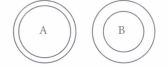
(i) B is best defined as the vessel which
(a) always supply oxygenated blood to the different organs
(b) always carry blood away from the heart to different organs
(c) always break up into capillaries that reunite to form a vein
(d) always carry blood from one visceral organ to another visceral organ.
(ii) In A, valves are present to check backward flow of blood flowing at
| (a) atmospheric pressure | (c) low pressure |
| (b) high pressure | (d) all of these |
(iii) Which of the following statements is correct regarding A?
(a) Carries blood from an organ towards the heart
(b) Always carry oxygenated blood with single exception
(c) Carries blood from heart towards the organ
(d) All of these
(iv) Which of the following statements is incorrect?
(a) A has typically larger lumen than B.
(b) Walls of B are elastic enabling them to stretch and shrink during changes in blood pressure
(c) Flow of blood is slower in A than in B
(d) None of these
(v) Blood pressure in the pulmonary artery is
| (a) more than that of pulmonary vein | (b) less than that in the vena cava |
| (c) same as that in aorta | (d) less than pulmonary vein. |
1.
(d)
All of the above
2.
(d)
plastic
3.
(d)
Gene
4.
(b)
Production of gametes-sperms and secretion of sex hormones-testosterone
5.
(a)
Chlorofluorocarbon compounds
6.
(d)
Small intestine
7.
(c)
(i) and (iv)
8.
(1) It provides stability to the ecosystem.
(2) It allows endangered species to grow in large numbers.
(3) It does not allow any population to starve even when the lower trophic level decreases in number.
(4) It checks the over-population of a particular species.
9.
The main difference lies in the difference in the sex chromosome of sperm (male gamete) and egg (female gamete). The main difference between sperms and eggs of humans is that half of the sperms of a male (father) will have X chromosomes and the other half will have Y chromosomes. All the eggs of female (mother) will have only X chromosomes.
Importance.
(a) If the father contributes X chromosome, then the baby born will be a girl.
(b) If the father contributes Y chromosome, then the baby born will be a boy. Thus, the sperm determines the sex of a child.
10.
(a) No, she should not take the medicine.
(b) Of course she should visit a doctor to get information.
(c) She is having 50% chances of having a male child as 50% sperms carry Y chromosome and 50% X chromosome.
11.
The receptors present in our tongue which detect the taste are called gustatory receptors.
12.
(i)
13.
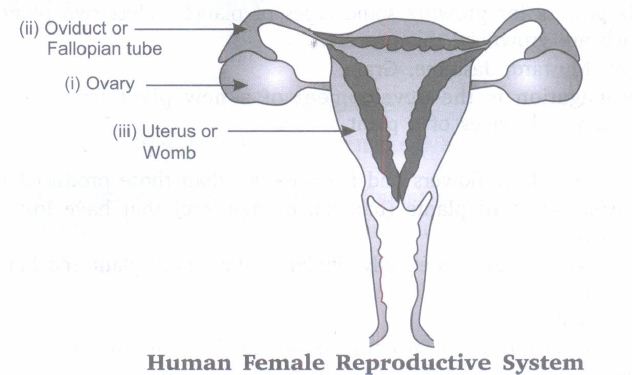
If the egg is not fertilised, the thick and nourishing lining of the uterus breaks and comes out through vagina as blood.
14.
(i) (a) Trypsin It digests proteins in the small intestine.
(b) Lipase It digests lipids into glycerol and fatty acids.
(ii) The finger-like projections present in the small intestine increases the surface area for absorption. These villi are richly supplied with blood vessels which take the absorbed food to each and every cell of the body.
15.
Miller and Urey in 1953 assembled an atmosphere similar to that thought to exist at early period (Gases like ammonia, methane, hydrogen sulphide) over earth. This was maintained at a temperature just below 100°C and sparks were passed through the mixture of gases to simulate lighting. At the end of a week 15% of the carbon (from .methane) had been converted to simple compounds of carbon including amino acids 'Which make up protein molecules. Presence of protein cell membrane correlates with above experiment. This shows that life originated from inanimate matter.
16.
(b): A food chain always starts with producers or green plants who synthesise food. All consumers depend on green plants for food and energy directly or indirectly.
17.
(b) If both assertion and reason are true but reason is not a correct explanation of assertion.
18.
(i) (b): In the given figures B represents artery that carry blood away from the heart to different organs.
(ii) (c): In the given figures, A represents vein. Veins bring blood from different body parts to the heart. The flow of blood in veins is not so fast because the blood in veins is under low pressure. Veins possess valves which prevent backward flow of blood.
(iii) (a): Veins carry deoxygenated blood with single exception, i.e., pulmonary vein. Arteries carry blood from heart towards the organ.
(iv) (d)
(v) (a)

10th Standard CBSE Syllabus & Materials
10th Standard CBSE
CBSE 10th Social Science PS - Federalism - New Model Questions Papers Study Material - QB365 Set A
NEW10th Standard CBSE
CBSE 10th Social Science PS - Power Sharing - New Model Questions Papers Study Material - QB365 Set A
NEW10th Standard CBSE
CBSE 10th Social Science GEO - Manufacturing Industries - New Model Questions Papers Study Material - QB365 Set A
NEW10th Standard CBSE
CBSE 10th Social Science GEO - Minerals and Energy Resources - New Model Questions Papers Study Material - QB365 Set A



NCERT Books

Syllabus

Exam Pattern

Sample Question Papers

Previous year Question Papers

Important Notes

MCQ Practice test

NCERT Exemplers

Case study Questions

Image Based Questions

Passage based Questions

HOT Questions

Value Based Questions

Model Questions Papers
NCERT ( Book Back ) Questions

Assertion and Reason
Important Questions And Answers

CBSE 10th Standard CBSE Subjects
CBSE Standards



