
 100% FREE ACCESS
10th Standard CBSE Syllabus & Materials
10th Standard CBSE
CBSE 10th Social Science ECO - Globalisation and the Indian Economy - New Model Questions Papers Study Material - QB365 Set A
NEW10th Standard CBSE
CBSE 10th Social Science ECO - Money and Credit - New Model Questions Papers Study Material - QB365 Set A
NEW10th Standard CBSE
CBSE 10th Social Science ECO - Sectors of the Indian Economy - New Model Questions Papers Study Material - QB365 Set A
NEW10th Standard CBSE
CBSE 10th Social Science ECO - Development - New Model Questions Papers Study Material - QB365 Set A
NEW10th Standard CBSE
CBSE 10th Social Science PS - Outcomes of Democracy - New Model Questions Papers Study Material - QB365 Set A
NEW10th Standard CBSE
CBSE 10th Social Science PS - Gender, Religion and Caste - New Model Questions Papers Study Material - QB365 Set A

Published on: 26/10/2025
Download CBSE Class 10th Standard CBSE Science question papers, sample papers, important questions, and previous year solved papers in PDF format. Get free study materials, NCERT solutions, and exam preparation resources for Class 10th Standard CBSE Science
Questions + Answers key
Take MCQ Science Test
1.
In the given diagram, A, B, C and D respectively are
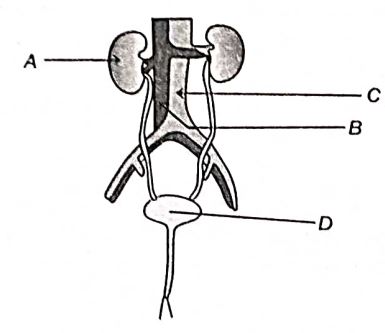
A - Left kidney; B - Aorta; C - Vena cava; D - Urethra
A - Left kidney; B - Vena cava; C - Aorta; D - Urinary bladder
A - Right kidney; B - Aorta; C - Ureter; D - Urethra
A - Right kidney; B - Vena cava: C - Aorta; D - Urinary bladder
2.
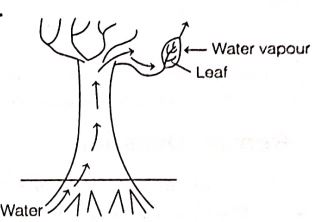
Observe the following diagram and identify the process and its significance from the following options.
Evaporation maintains water contents in the leaf cells
Transpiration creates a suction force which pulls water inside the plant
Excretion helps in excreting out wastewater from the plant
Translocation helps in transporting materials from one cell to another
3.
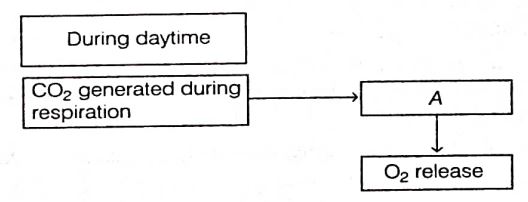
Observe the given flowchart and identify the blank A from the given options.
Respiration
Photosynthesis
Transpiration
Fermentation
4.
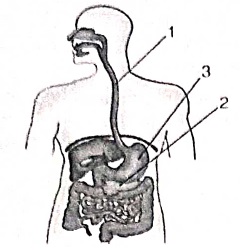
Observe the diagram of human digestive system. Which of the following correctly represents the organ labelled as 2?
Secretes bile juice, which acts on fat molecule
Secretes pancreatic juice, which contains enzymes like amylase, trypsin, etc.
Secretes intestinal juice, which contain amylolytic, proteolytic and lipolytic enzymes
Release digestive juice which containing HCl, pepsin mucus, etc.
5.
Separation of right and left side of the heart is to
Ensure proper and efficient working of heart
Avoid any blockage
Allow highly efficient supply of oxygen
All of these
6.
Proteins after digestion are converted into
Carbohydrates
Small globules
Amino acids
Starch
7.
Oxygen liberated during photosynthesis comes from
Water
Chlorophyll
Carbon dioxide
Glucose
8.
When air is blown from mouth into a test-tube containing lime water, the lime water turned milky due to the presence of
oxygen
carbon dioxide
nitrogen
water vapour
9.
Which part of alimentary canal receives bile from the liver?
Stomach
Small intestine
Large intestine
Oesophagus
10.
Select the correct statement
Heterotrophs do not synthesise their own food
Heterotrophs utilise solar energy for photosynthesis
Heterotrophs synthesise their own food
Heterotrophs are capable of converting carbon dioxide and water into carbohydrates
11.
Write one feature which is common to each of the following pairs of terms:
(i) glycogen and starch
(ii) chlorophyll and haemoglobin
(iii) gills and lungs
(iv) arteries and veins
12.
Why are the rings of cartilage present in air tube-Trachea?
13.
What will happen if platelets were absent in the blood?
14.
What will happen if mucus is not secreted by the gastric glands?
15.
Differentiate between an artery and vein.
16.
Out of a goat and a tiger, which one will have a longer small intestine? Justify your answer.
17.
(i) With the help of an activity, explain the action of saliva on the food we eat.
(ii) Why is bile juice important in the process of digestion?
18.
Name the constituents of blood.Why white blood corpuscles are called 'soldiers of the body'?
19.
How are oxygen and carbon dioxide transported in human beings? How are lungs designed to maximize the area for exchange of gases?
20.
Give reasons
(i) Ventricles have thicker muscular walls than atria.
(ii) Transport system in plants is slow.
(iii) Circulation of blood in aquatic vertebrates differs from that in terrestrial vertebrates.
(iv) During the daytime, water and minerals travel faster through xylem as compared to the night.
(v) Veins have valves whereas arteries do not.
21.
What are the different ways in which glucose is oxidised to provide energy in various organisms?
1.
(d)
A - Right kidney; B - Vena cava: C - Aorta; D - Urinary bladder
2.
(b)
Transpiration creates a suction force which pulls water inside the plant
3.
(b)
Photosynthesis
4.
(b)
Secretes pancreatic juice, which contains enzymes like amylase, trypsin, etc.
5.
(c)
Allow highly efficient supply of oxygen
6.
(c)
Amino acids
7.
(a)
Water
8.
(b)
carbon dioxide
9.
(b)
Small intestine
10.
(a)
Heterotrophs do not synthesise their own food
11.
(i) glycogen and starch-both are carbohydrates and stored food products.v
(ii) chlorophyll and haemoglobin-both are pigments
(iii) gills and lungs-both are respiratory organs
(iv) arteries and veins-both are blood vessels
12.
Rings of cartilage prevents the trachea from collapsing
13.
If platelets are not present in the blood, then clotting at the site of injury will not take place. This will result in continuous bleeding and could be fatal for the organism.
14.
Gastric glands in stomach release hydrochloric acid, enzyme pepsin and mucus. Mucus protects the inner lining of stomach from the action of hydrochloric acid and enzyme pepsin. If muscus is not released, it will lead to erosion of inner lining of stomach, leading to acidity and ulcers.
15.
| S.No | Arteries | Veins |
|---|---|---|
| 1 | Have thick elastic, muscular walls. | Have thin, non-elastic walls. |
| 2 | Lumen is narrow | Lumen is wide |
| 3 | Carry blood from heart to all body parts. | Carry blood from all body parts to heart |
| 4 | Carry oxygenated blood (except pulmonary artery) | Carry deoxygenated blood (except pulmonary vein) |
16.
Cellulose forms the largest part of the herbivore's food. Digestion of cellulose takes longer time because the enzymes for its digestion are produced by the ruminant bacteria that live in the gut of the herbivores. Long length of the small intestine ensures that the food stays for a longer duration and proper digestion is possible. In the case of carnivores, cellulose is not present in the diet, thus the length of the small intestine is smaller.
17.
(i) Aim: To show the action of saliva on the food we eat.
Materials Required: Starch solution, test tubes, iodine solutions, saliva and dropper.
Procedure
Take 1 mL starch solution in two test tubes marked as A and B.
Now, add 1 mL saliva to test tube A only and leave both test tubes undisturbed for 20-30 min.
After 30 min add few drops of dilute iodine solution in both the test tubes. And observe the change.
Observation In test tube B, the solution turns into blue black colour whereas in test tube A, the solution remains the same.
Conclusion The iodine solution gives blue colour in the presence of starch, but here in test tube A saliva was also present, which contains starch digesting enzyme amylase. Due to addition of saliva, the starch breaks down into glucose. Therefore, the blue colour does not show in test tube A.
(ii) Large fat globules are broken down into small uniformly distributed fat particles by the action of bile salts present in bile juice. This is called emulsification of fat. This facilitates the action of pancreatic enzymes.
18.
The different constituents of blood are plasma (the fluid part of the bloo(d) and blood corpuscles consisting of RBCs, WBCs, and platelets)
WBCs are known as the soldiers of the body because they fight against the pathogenes that invade our body, thus preventing the occurence of diseases.
19.
(i) Oxygen enters the human body through the nasal passage and reaches the lungs.
(ii) Numerous alveoli are present in the lungs. These alveoli are surrounded by many blood capillaries. From the alveoli, 02 is taken up by the red blood cells present in the blood capillaries.
(iii) Similarly, the CO2 from the various tissues is transported to the alveoli.
(iv) This CO2 is then released through the nasal passage during exhalation. Alveoli are the sites of exchange of gases. Each lung contains 300- 350 million alveoli.
These alveoli increase the surface area for gaseous exchange, making the process of respiration more efficient.
20.
(i) Ventricles have to pump blood out of the heart into various organs of the body, therefore they have thicker muscular walls than atria.
(ii) Plants do not move and have a large proportion of dead cells in many tissues. As a result, plants have low energy needs and therefore transport system in plants is slow.
(iii) Circulation of blood in aquatic vertebrates such as fishes differs from that in terrestrial vertebrates as fishes have two-chambered heart. The blood is pumped to the gills for oxygenation and is then transported to the rest of the body.
On the other hand, most terrestrial vertebrates have lungs for oxygenation of blood. The deoxygenated blood is transported to heart from where it is transported to lungs for oxygenation and is then distributed to all body parts.
(iv) During daytime, due to transpiration pull, more water is absorbed by roots that is why absorption is faster in daytime.
(v) Veins have valves whereas arteries do not because valves have to prevents the back flow of blood as blood flows in them at low pressure.
21.
The two ways in which glucose is oxidized to provide energy in diverse organisms are listed below.
1. Aerobic respiration
2. Anaerobic respiration
Aerobic respiration : It occurs in the presence of oxygen, respiration occurs, and the products are carbon dioxide, energy, and water.
Glucose + Oxygen \(\rightarrow\) Carbon dioxide + Water + Energy
- \(\mathrm{C}_6 \mathrm{H}_{12} \mathrm{O}_6(\mathrm{l})+6 \mathrm{O}_2(\mathrm{~g}) \rightarrow 6 \mathrm{CO}_2(\mathrm{~g})+6 \mathrm{H}_2 \mathrm{O}(\mathrm{l})+\) Energy
Anaerobic respiration - It occurs in the absence of oxygen, respiration occurs, and the products generated are lactic acid or ethanol and energy.
Glucose \(\rightarrow\) Alcohol + Carbon dioxide + Energy
Glucose \(\rightarrow\) Lactic acid + Energy
- \(\mathrm{C}_6 \mathrm{H}_{12} \mathrm{O}_6(\mathrm{l}) \rightarrow 2 \mathrm{C}_3 \mathrm{H}_6 \mathrm{O}_3(\mathrm{l})+\) Energy
Differences between Aerobic and Anaerobic respiration:
| Aerobic Respiration | Anaerobic Respiration |
| When this type of respiration occurs, oxygen is present. | When this type of respiration occurs, oxygen is not present. |
| This type of respiration involves the exchange of gases. | This type of respiration do not involve the exchange of gases. |
| It may be found in the cytoplasm and the mitochondria. | It is found only in the cytoplasm. |
| Glucose degrades to carbon dioxide and water. | Glucose is broken down into ethanol, carbon dioxide, and energy. |
| This type of respiration is seen in all higher creatures, including mammals. | This kind is used by lower organisms such as bacteria and yeast. It occurs during excessive activity in other creatures. |

10th Standard CBSE Syllabus & Materials
10th Standard CBSE
CBSE 10th Social Science PS - Federalism - New Model Questions Papers Study Material - QB365 Set A
NEW10th Standard CBSE
CBSE 10th Social Science PS - Power Sharing - New Model Questions Papers Study Material - QB365 Set A
NEW10th Standard CBSE
CBSE 10th Social Science GEO - Manufacturing Industries - New Model Questions Papers Study Material - QB365 Set A
NEW10th Standard CBSE
CBSE 10th Social Science GEO - Minerals and Energy Resources - New Model Questions Papers Study Material - QB365 Set A



NCERT Books

Syllabus

Exam Pattern

Sample Question Papers

Previous year Question Papers

Important Notes

MCQ Practice test

NCERT Exemplers

Case study Questions

Image Based Questions

Passage based Questions

HOT Questions

Value Based Questions

Model Questions Papers
NCERT ( Book Back ) Questions

Assertion and Reason
Important Questions And Answers

CBSE 10th Standard CBSE Subjects
CBSE Standards



