
 100% FREE ACCESS
10th Standard CBSE Syllabus & Materials
10th Standard CBSE
CBSE 10th Social Science ECO - Globalisation and the Indian Economy - New Model Questions Papers Study Material - QB365 Set A
NEW10th Standard CBSE
CBSE 10th Social Science ECO - Money and Credit - New Model Questions Papers Study Material - QB365 Set A
NEW10th Standard CBSE
CBSE 10th Social Science ECO - Sectors of the Indian Economy - New Model Questions Papers Study Material - QB365 Set A
NEW10th Standard CBSE
CBSE 10th Social Science ECO - Development - New Model Questions Papers Study Material - QB365 Set A
NEW10th Standard CBSE
CBSE 10th Social Science PS - Outcomes of Democracy - New Model Questions Papers Study Material - QB365 Set A
NEW10th Standard CBSE
CBSE 10th Social Science PS - Gender, Religion and Caste - New Model Questions Papers Study Material - QB365 Set A

Published on: 26/10/2025
Download CBSE Class 10th Standard CBSE Science question papers, sample papers, important questions, and previous year solved papers in PDF format. Get free study materials, NCERT solutions, and exam preparation resources for Class 10th Standard CBSE Science
Questions + Answers key
Take MCQ Science Test
1.
As compared to terrestrial organisms, the rate of breathing in aquatic organisms is
faster because they need more oxygen for their survival
faster because the amount of dissolved oxygen in water is fairly low
slower because the amount of dissolved oxygen in water is fairly low
slower because the capacity of water of dissolving atmospheric air is limited
2.
Which one of the following event in the mouth cavity would be affected if the enzyme salivary amylase is lacking in the saliva?
Breakdown of starch into sugar
Breakdown of proteins into amino acid
Absorbtion of vitamins
Breakdown of fats into fatty acids and glucose
3.
In the given transverse sectlon of the leaf, identify the layer of cells where maximum photosynthesis occurs.
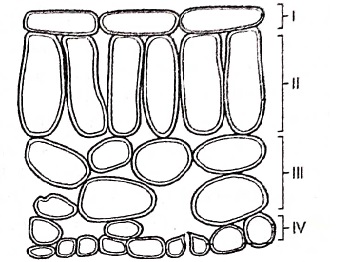
I, II
II, III
III,IV
I, IV
4.
Before carrying out the test for the presence of starch in a leaf on exposure to sunlight, the leaf is put into alcohol in a beaker and boiled over a water bath. This step is carried out to
extract starch
dissolve chlorophyll
allow water to move into a leaf
make membranes of leaf cells more permeable.
5.
Lack of oxygen in muscles often leads to cramps among cricketers. This results due to
Conversion of pyruvate to ethanol
Conversion of pyruvate to glucose
Non conversion of glucose to pyruvate
Conversion of pyruvate to lactic acid
6.
Arrange the organs of the human respiratory system in a proper logical sequence
Bronchi, lungs, nose, trachea, pharynx
7.
What is the mode of nutrition in human beings?
8.
Give the characteristics of any respiratory surface
9.
Name the components of blood
10.
What is the range of pH in small intestine and stomach respectively?
11.
Which product are formed during respiration in our muscles when there is less supply of oxygen?
12.
What is the impact of leakage or loss of blood upon the pressure?
13.
Differentiate between an artery and vein.
14.
Why do fishes die when taken out of water?
15.
If a plant is releasing carbon dioxide and taking in oxygen during the day, does it mean that there is no photosynthesis occurring? Justify your answer.
1.
(b)
faster because the amount of dissolved oxygen in water is fairly low
2.
(a)
Breakdown of starch into sugar
3.
(b)
II, III
4.
(b)
dissolve chlorophyll
5.
(d)
Conversion of pyruvate to lactic acid
6.
The correct sequence of human respiratory system is Nose, pharynx, larynx, trachea, bronchi, lungs.
7.
Holozoic mode of nutrition i.e., heterotrophic in nature.
8.
Any respiratory surface e.g. gills, skin, or alveoli must have the following features:
(i) It should be thin.
(ii) It should be moist.
(iii) The surface area should be large.
(iv) It should be richly supplied with blood vessels. These features will ensure quick diffusion of gases
9.
Plasma-It is the fluid in which other cells are suspended.
R.B.C .-Red blood cells contain haemoglobin which is responsible to carry oxygen.
W.B.C.- White blood cells helps in killing germ.
Platelets-Helps in blood clotting during some injury.
10.
pH in small intestine is greater then 7 (basic or alkaline).
pH in stomach is less than 7 (acidic medium).
11.
The end product of anaerobic respiration is lactic acid instead of carbon dioxide and water. This process occurs in oxygen debt. Hence, the amount of oxygen required to oxidize lactic acid to carbon dioxide and water is not present.
12.
Blood flow will increase upon the pressure of blood in the blood vessels. The oxygenated blood flowing through the artery doesnot have any impact as the arteries are thick walled, highly elastic blood vessels having narrow lumen and no valves.
13.
| S.No | Arteries | Veins |
|---|---|---|
| 1 | Have thick elastic, muscular walls. | Have thin, non-elastic walls. |
| 2 | Lumen is narrow | Lumen is wide |
| 3 | Carry blood from heart to all body parts. | Carry blood from all body parts to heart |
| 4 | Carry oxygenated blood (except pulmonary artery) | Carry deoxygenated blood (except pulmonary vein) |
14.
Fishes are able to taken oxygen which is dissolved in water, through their gills.The gills of a fish are not equipped to take in oxygen from air.Hence, when a fish is taken out of water, it is unable to inhale oxygen rich air and so dies quickly.
15.
Most of the carbon dioxide released during respiration exits from the plant cells through various openings. The plant cells through various openings. The carbon dioxide, required for photosynthesis is taken through stomata. So, even if a plant keeps on taking in oxygen and releasing carbon dioxide during the day, it does not mean that no photosynthesis is happening in the plant.

10th Standard CBSE Syllabus & Materials
10th Standard CBSE
CBSE 10th Social Science PS - Federalism - New Model Questions Papers Study Material - QB365 Set A
NEW10th Standard CBSE
CBSE 10th Social Science PS - Power Sharing - New Model Questions Papers Study Material - QB365 Set A
NEW10th Standard CBSE
CBSE 10th Social Science GEO - Manufacturing Industries - New Model Questions Papers Study Material - QB365 Set A
NEW10th Standard CBSE
CBSE 10th Social Science GEO - Minerals and Energy Resources - New Model Questions Papers Study Material - QB365 Set A



NCERT Books

Syllabus

Exam Pattern

Sample Question Papers

Previous year Question Papers

Important Notes

MCQ Practice test

NCERT Exemplers

Case study Questions

Image Based Questions

Passage based Questions

HOT Questions

Value Based Questions

Model Questions Papers
NCERT ( Book Back ) Questions

Assertion and Reason
Important Questions And Answers

CBSE 10th Standard CBSE Subjects
CBSE Standards



