
 100% FREE ACCESS
10th Standard CBSE Syllabus & Materials
10th Standard CBSE
CBSE 10th Social Science ECO - Globalisation and the Indian Economy - New Model Questions Papers Study Material - QB365 Set A
NEW10th Standard CBSE
CBSE 10th Social Science ECO - Money and Credit - New Model Questions Papers Study Material - QB365 Set A
NEW10th Standard CBSE
CBSE 10th Social Science ECO - Sectors of the Indian Economy - New Model Questions Papers Study Material - QB365 Set A
NEW10th Standard CBSE
CBSE 10th Social Science ECO - Development - New Model Questions Papers Study Material - QB365 Set A
NEW10th Standard CBSE
CBSE 10th Social Science PS - Outcomes of Democracy - New Model Questions Papers Study Material - QB365 Set A
NEW10th Standard CBSE
CBSE 10th Social Science PS - Gender, Religion and Caste - New Model Questions Papers Study Material - QB365 Set A

Published on: 26/10/2025
Download CBSE Class 10th Standard CBSE Science question papers, sample papers, important questions, and previous year solved papers in PDF format. Get free study materials, NCERT solutions, and exam preparation resources for Class 10th Standard CBSE Science
Questions + Answers key
Take MCQ Science Test
1.
How is oxygen and carbon dioxide transported in human beings?
2.
Name the components of xylem and phloem.
3.
Why are the walls of ventricles thicker and more muscular than the walls of atria?
4.
Write two important functions of transpiration in plants .
5.
How do leaves of plants help in excretion?
6.
Why is transpiration important for plants?
7.
Why and how does water enter continuous into the root xylem?
8.
What will happen if platelets were absent in the blood?
9.
Why do veins have thin walls as compared to arteries?
10.
Why is blood circulation in human heart called double circulation?
11.
Differentiate between an artery and vein.
12.
What do the following transport?
(a)Xylem
(b)Phloem
(c)Pulmonary vein
(d)Pulmonary artery
13.
Why is it necessary to separate oxygenated and deoxygenated blood in mammals and birds?
14.
Name the constituents of blood.Why white blood corpuscles are called 'soldiers of the body'?
15.
The human heart is a muscular organ made up of cardiac muscles. It is a four- chambered organ to prevent intermixing of oxygenated and de-oxygenated blood. A thick wall muscle called septum that separates the two sides left and right of the heart. Look at the picture.
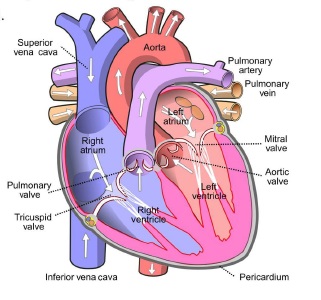
(i) The upper two chambers and lower two chambers are called :
| (a) Ventricles and auricles respectively | (b) Auricles and ventricles respectively |
| (c) Ventricles and valves respectively | (d) Arteries and veins respectively |
(ii) The artery which carries de-oxygenated blood from the heart into lungs is called :
| (a) Pulmonary artery | (b) Hepatic artery | (c) Renal artery | d) All arteries |
(iii) Pulmonary vein brings :
(a) oxygenated blood from the lungs to the heart
(b) de-oxygenated blood from the heart to the lungs
(c) oxygenated blood from the heart to the lungs
(d) de-oxygenated blood from the lungs to the heart
(iv) Tricuspid valve is found between :
| (a) right auricle and right ventricle | (b) left auricle and left ventricle |
| (c) right auricle and left ventricle | (d) left auricle and right ventricle |
(v) The de-oxygenated blood from the body organs first enters :
(a) into right atrium of the heart through vena cava.
(b) into left atrium of the heart through vena cava.
(c) into right ventricle of the heart through vena cava.
(d) into right atrium of the heart through aorta.
16.
The tubes – blood vessels - Arteries are the vessels which carry blood away from the heart to various organs of the body. Since the blood emerges from the heart under high pressure, the arteries have thick, elastic walls. Veins collect the blood from different organs and bring it back to the heart. They do not need thick walls because the blood is no longer under pressure, instead they have valves that ensure that the blood flows only in one direction. On reaching an organ or tissue, the artery divides into smaller and smaller vessels to bring the blood in contact with all the individual cells. The smallest vessels have walls which are one-cell thick and are called capillaries. Exchange of material between the blood and surrounding cells takes place across this thin wall. The capillaries then join together to form veins that convey the blood away from the organ or tissue.
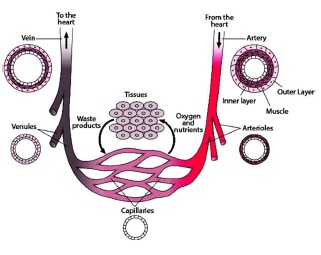
(i) A blood vessel which carries blood back to the heart is :
| (a) artery | (b) vein | (c) capillary | (d) platelet |
(ii) The blood vessel which carries oxygenated blood from the lungs to the heart is :
| (a) main artery | (b) pulmonary artery | (c) main vein | (d) pulmonary vein |
(iii) The smaller vessels in which arteries are divided after entering the body organs are called
| (a) cytokinesis | (b) granum | (c) centrioles | (d) arterioles |
(iv) After entering into the tissues, the arteries are divided into
| (a) aorta | (b) atrium | (c) capillaries | (d) veins |
(v) The blood vessels in which there are no valves includes
| (a) veins and capillaries | (b) capillaries and arteries |
| (c) arteries and nerves | (d) veins and arteries |
17.
Each capillary cluster in the kidney is associated with the cup- shaped end of a tube that collects the filtered urine (see adjoining figure). Each kidney has large numbers of these filtration units called nephrons packed close together. Some substances in the initial filtrate, such as glucose, amino acids, salts and a major amount of water, are selectively re-absorbed as the urine flows along the tube. The amount of water reabsorbed depends on how much excess water there is in the body, and on how much of dissolved waste there is to be excreted. The urine forming in each kidney eventually enters a long tube, the ureter, which connects the kidneys with the urinary bladder. Urine is stored in the urinary bladder until the pressure of the expanded bladder leads to the urge to pass it out through the urethra. The bladder is muscular, so it is under nervous control, as we have discussed elsewhere. As a result, we can usually control the urge to urinate.
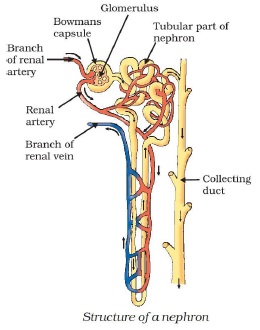
(i) Which of the following is the correct path taken by urine in our body ?
(a) kidney → ureter → urethra → bladder
(b) kidney → bladder → urethra → ureter
(c) kidney → ureter → bladder → urethra
(d) bladder → kidney → ureter → urethra
(ii) The excretory unit in the human excretory system is called :
| (a) nephron | (b) neuron | (c) nephridia | (d) kidneyon |
(iii) The substance which is not reabsorbed into the blood capillaries surrounding the tubule of a nephron is mainly
| (a) glucose | (b) amino acid | (c) urea | (d) water |
(iv) The procedure of cleaning the blood of a person by using a kidney machine is known as :
| (a) ketolysis | (b) hydrolysis | (c) dialysis | (d) photolysis |
(v) The kidneys in human beings are a part of the system for
| (a) nutrition | (b) respiration. | .(c) excretion. | (d) transportation |
18.
Transpiration is the evaporative loss of water by plants. It occurs mainly through the stoma in the leaves. Besides the loss of water vapour in transpiration, exchange of oxygen and carbon dioxide in the leaf also occurs through pores called stomata. Normally stomata remain open in the day time and close during the night
(i) Which of the following will not directly affect transpiration?
| (a) Temperature | (b) Light |
| (c) Wind speed | (d) Chlorophyll content of leaves |
(ii) Water vapour comes out from the plant leaf through the stomatal opening. Through the same stomatal opening, carbon dioxide diffuses into the plant during photosynthesis. Reason out the above statements . using one of following options.
(a) The above processes happen only during night time.
(b) One process occurs during day time and the other at night.
(c) Both processes cannot happen Simultaneously.
(d) Both processes can happen together at day time.
(iii) Which of the following statements is not true for stomatal apparatus?
(a) Guard cells invariably possess chloroplasts and mitochondria.
(b) Guard cells are always surrounded by subsidiary cells.
(c) Stomata are involved in gaseous exchange.
(d) Inner wall of guard cells are thick.
(iv) Which of the following is not a purpose of transpiration?
(a) Helps in absorption and transport in plants
(b) Prevents loss of water
(c) Maintains shape and structure of plants by keeping the cells turgid
(d) Supplies water for photosynthesis
(v) Refer to the given graphs regarding factors affecting transpiration rate and select the correct option.
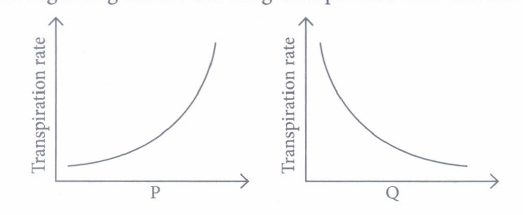
(a) P-Atmospheric temperature; Q-Atmospheric pressure
(b) P-Relative humidity; Q-Atmospheric temperature
(c) P-Air movement; Q-Light
(d) P-Atmospheric pressure; Q-Relative humidity
19.
Double circulation is a type of circulating system in which the blood passes through the heart twice before completing a full circuit of the body. Blood is pumped from the heart to the lungs and returns to the heart before being distributed to other organs and tissues of the body.
(i) The figure shows blood circulation in humans with labels A to D. Select the option which gives correct identification of label and functions of the part.
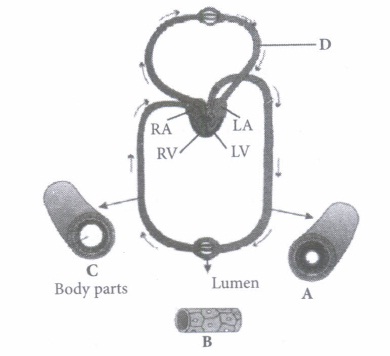
(a) B - Capillary- Thin without muscle layer and wall two cell layers thick
(b) C - Vein-Thin walled and blood flows in jerks/spurts
(c) D - Pulmonary vein-Takes oxygenated blood to heart, PO2 = 95 mm Hg
(d) A - Artery-Thick walled and blood flows evenly
(ii) Incomplete double circulation is seen in
| (a) mammals | (b) pisces | (c) aves | (d) amphibians. |
(iii) Which of the following animals shows double circulatory pathway?
| (a) Snake | (b) Frog | (c) Eel | (d) Whale |
(iv) The given figure is of circulatory system. Identify the labelled parts (A-D) from the list (I-VII).
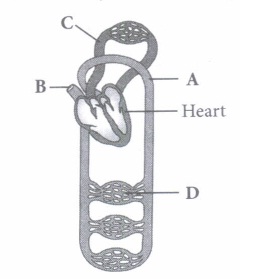
(I) Pulmonary circulation (II) Systemic circulation (III) Superior vena cava (IV) Inferior vena cava
(V) Aorta (VI) Veins and venules (VII)Arterioles and capillaries
| (a) A-(V), B-(lII), C-(I), D-(VII) | (b) A-(VII), B-(IV), C-(I), D-(VI) |
| (c) A-(V), B-(III), C-(lI), D-(VII) | (d) A-(VII), B-(V), C- (I), D-(VI) |
(v) Select the option which properly represents pulmonary circulation in humans.
\(\text { (a) Left auricle } \frac{\text { Deoxygenated }}{\text { blood }}{\longrightarrow} \text { Lungs } \frac{\text { Oxygenated }}{\text { blood }} \text { Right ventricle }\)
\(\text { (b) Left auricle } \frac{\text { Oxygenated }}{\text { blood }}{\longrightarrow} \text { Lungs } \frac{\text { Deoxygenated }}{\text { blood }}{\longrightarrow} \text { Right ventricle }\)
\(\text { (c) Right ventricle } \frac{\text { Deoxygenated }}{\text { blood }}{\longrightarrow} \text { Lungs } \frac{\text { Oxygenated }}{\text { blood }} \rightarrow \text { Left auricle }\)
\(\text { (d) Right ventricle } \frac{\text { Oxygenated }}{\text { blood }}>\text { Lungs } \frac{\text { Deoxygenated }}{\text { blood }} \gg \text { Left auricle }\)
1.
When we inhale air, oxygen reaches the alveoli in lungs, which are surrounded by thin capillaries. These capillaries carry blood in them. The oxygen diffuses from the alveoli walls into the blood capillaries. This blood travels through the body. Haemoglobin binds with oxygen and carries it along with blood.
Carbon dioxide is produced as a waste product during respiration in the cells of tissues. CO2 is more soluble in water. Hence, it is mosty transported in the dissolved form in our blood plasm. From blood, CO2 is diffuses into the lungs through alveoli and then expelled out through nostrils.
2.
Xylem- Tracheids, vessels, Xylem parenchyma and Xylem fibres
3.
Ventricles have to apply lot of pressure and push the blood out of the heart to reach all the body cells. Hence its walls are thicker and muscular as compared to the walls of atria.
4.
Transpiration is loss of water from stomatal pores. It regulates the temperature and also causes the suction pull due to which upward movement of water and minerals take place.
5.
Many plants store waste materials in the vacuoles of mesophyll cells and epidermal cells.When o;d leaves fall, the waste materials are excreted along with leaves.
6.
Transpiration is important because
(i)it helps in absorption and upward movement of water and minerals from roots to leaves
(ii)it prevents the plant parts from heating up.
7.
Plants require water to carry out photosynthesis and other processes. Cells of roots are in close contact with soil and so they actively take up ions. The ion-concentration increases inside the root and hence, osmotic pressure increases resulting in the movement of water from soil into the roots and this process occurs continuously.
However, this pressure by itself is unable to move water to the highest points of plant body. For this, plants use another strategy known as transpiration.
Evaporation of water molecules from the cells of leaf creates a suction which pulls water from the xylem of roots to leaves.
The continuous flow of water in root xylem is due to transpirational pull.
The water which is lost through the stomata is replaced by water from the xylem vessels.
Thus, transpiration helps in absorption and upward movement of water and minerals dissolved in soil from roots to leaves.
8.
If platelets are not present in the blood, then clotting at the site of injury will not take place. This will result in continuous bleeding and could be fatal for the organism.
9.
Arteries carry blood from the heart to various organs of the body under high pressure so they have thick and elastic walls. Veins collect the blood from different organs and bring it back to the heart. The blood is no longer under pressure so the walls are thin valves to ensure that blood flows only in one direction.
10.
The blood circulation in human heart is called double circulation because the blood passes through the heart twice in one complete cycle of the body-once through the right half in the form of deoxygenated blood and once through the left half in the form of oxygenated blood.
11.
| S.No | Arteries | Veins |
|---|---|---|
| 1 | Have thick elastic, muscular walls. | Have thin, non-elastic walls. |
| 2 | Lumen is narrow | Lumen is wide |
| 3 | Carry blood from heart to all body parts. | Carry blood from all body parts to heart |
| 4 | Carry oxygenated blood (except pulmonary artery) | Carry deoxygenated blood (except pulmonary vein) |
12.
(a)Xylem- Transports water and dissolved minerals in plants.
(b)Phloem-Transport prepared food in plants.
(c)Pulmonary vein-Transports oxygenated blood from lungs to left ventricles of heart.
(d)Pulmonary artery -Transports deoxygenated blood from body to right ventricles.
13.
Mammals and birds are warm-blooded animals, so they constantly need energy in order to maintain their body temperature. Due to this high energy demand, they require more oxygen. Thus, it is important that their Oxygenated blood should not get mixed up with deoxygenated blood in order to make circulatory system much more efficient.
14.
The different constituents of blood are plasma (the fluid part of the bloo(d) and blood corpuscles consisting of RBCs, WBCs, and platelets)
WBCs are known as the soldiers of the body because they fight against the pathogenes that invade our body, thus preventing the occurence of diseases.
15.
(i) (b) Auricles and ventricles respectively
(ii) (a) Pulmonary artery
(iii) (a) oxygenated blood from the lungs to the heart
(iv) (a) right auricle and right ventricle
(v) (a) into right atrium of the heart through vena cava.
16.
(i) (b) vein
(ii) (d) pulmonary vein
(iii) (d) arterioles
(iv) (c) capillaries
(v) (b) capillaries and arteries
17.
(i) (c) kidney → ureter → bladder → urethra
(ii) (a) nephron
(iii) (c) urea
(iv) (c) dialysis
(v) (c) excretion.
18.
(i) (d)
(ii) (d)
(iii) (b): The epidermal surface of the leaf exhibits a large number of minute openings called stomata. The stomata are bordered by two specialized epidermal cells - the guard cells which in some cases are accompanied by subsidiary cells. The walls of guard cells are unevenly thickened. Each guard cell has thick, inelastic inner wall and thin, elastic outer wall. Stomatal aperture is present in between the guard cells. Guard cells are not always surrounded by accessory cells or subsidiary cells.
(iv) (b)
(v) (a)
19.
(i) (c): A- Artery: Carries blood from heart to different body parts. It is thick-walled and elastic. It acts as a "pressure reservoir" for maintaining the blood flow. B - Capillary : Nutrients, hormones, gases, etc. can diffuse into tissue cells through capillaries and vice versa. It is thin-walled, and only one cell layer thick resting on basement membrane. C - Vein: Brings blood from different body parts to the heart. It is thin-walled and act as low-resistance conduct for blood flow. D - Pulmonary vein: Two pulmonary veins from each lung transport the oxygenated blood to the left atrium.
(ii) (d): In amphibians, the left atrium receives oxygenated blood from the gills/lungs/skin and the right atrium gets the deoxygenated blood from other body parts. However, they get mixed up in the single ventricle which pumps out mixed blood i.e., incomplete double circulation
(iii) (d): Whale is a mammal and in mammals, two separate circulatory pathways are found - systemic circulation and pulmonary circulation. Oxygenated and deoxygenated bloods received by the left and right atria respectively pass on to the left and right ventricles. Thus, oxygenated and deoxygenated bloods are not mixed. This is referred to as double circulation.
(iv) (a)
(v) (c): Pulmonary circulation is the movement of blood between heart and lungs. During this pathway deoxygenated blood entering the right atrium, moves into the right ventricle. From here it moves through the pulmonary arch into the lungs for oxygenation. Then from lungs the oxygenated blood moves into the left atrium through pulmonary veins.

10th Standard CBSE Syllabus & Materials
10th Standard CBSE
CBSE 10th Social Science PS - Federalism - New Model Questions Papers Study Material - QB365 Set A
NEW10th Standard CBSE
CBSE 10th Social Science PS - Power Sharing - New Model Questions Papers Study Material - QB365 Set A
NEW10th Standard CBSE
CBSE 10th Social Science GEO - Manufacturing Industries - New Model Questions Papers Study Material - QB365 Set A
NEW10th Standard CBSE
CBSE 10th Social Science GEO - Minerals and Energy Resources - New Model Questions Papers Study Material - QB365 Set A



NCERT Books

Syllabus

Exam Pattern

Sample Question Papers

Previous year Question Papers

Important Notes

MCQ Practice test

NCERT Exemplers

Case study Questions

Image Based Questions

Passage based Questions

HOT Questions

Value Based Questions

Model Questions Papers
NCERT ( Book Back ) Questions

Assertion and Reason
Important Questions And Answers

CBSE 10th Standard CBSE Subjects
CBSE Standards



