
 100% FREE ACCESS
10th Standard CBSE Syllabus & Materials
10th Standard CBSE
CBSE 10th Social Science ECO - Globalisation and the Indian Economy - New Model Questions Papers Study Material - QB365 Set A
NEW10th Standard CBSE
CBSE 10th Social Science ECO - Money and Credit - New Model Questions Papers Study Material - QB365 Set A
NEW10th Standard CBSE
CBSE 10th Social Science ECO - Sectors of the Indian Economy - New Model Questions Papers Study Material - QB365 Set A
NEW10th Standard CBSE
CBSE 10th Social Science ECO - Development - New Model Questions Papers Study Material - QB365 Set A
NEW10th Standard CBSE
CBSE 10th Social Science PS - Outcomes of Democracy - New Model Questions Papers Study Material - QB365 Set A
NEW10th Standard CBSE
CBSE 10th Social Science PS - Gender, Religion and Caste - New Model Questions Papers Study Material - QB365 Set A

Published on: 20/10/2025
Download CBSE Class 10th Standard CBSE Science question papers, sample papers, important questions, and previous year solved papers in PDF format. Get free study materials, NCERT solutions, and exam preparation resources for Class 10th Standard CBSE Science
Questions + Answers key
Take MCQ Science Test
1.
The transport of soluble products of photosynthesis is known as
Evaporation
Translocation
Transpiration
Conductions
2.
One cell-thick vessels are called
Arteries
Veins
Capillaries
Pulmonary artery
3.
III human beings respiratory pigment is
Chlorophyll
Water
Blood
Haemoglobin
4.
In the experiment, CO2 is essential for photosynthesis, KOH is kept
To seal the chamber
To absorb CO2
To support the plant while CO2 is absent
Both (b) and (c)
5.
Function of chlorophyll in photosynthesis is
Absorbing light energy
Breaking down H2O molecule
No function
Reduction of CO2
6.
Deoxygenated blood enters the heart through
Right ventricle
Right atrium
Light ventricle
Left atrium
7.
Lack of oxygen in muscles often leads to cramps among cricketers. This results due to
Conversion of pyruvate to ethanol
Conversion of pyruvate to glucose
Non conversion of glucose to pyruvate
Conversion of pyruvate to lactic acid
8.
Opening and closing of the stomatal pore depends upon
atmospheric temperature
oxygen concentration around stomata
carbon dioxide concentration around stomata
water content in the guard cells
9.
The internal (cellular) energy reserve in autotrophs is
Glycogen
Protein
Starch
Fatty acid
10.
The filtration units of kidneys are called
Ureter
Urethra
Neurons
Nephrons
11.
What prevents backflow of blood inside the heart during contraction?
Valves in heart
Thick muscular walls of venticles
Thin walls of atria
All of the above
12.
During respiration exchange of gases take place in
Trachea and larynx
Alveoli of lungs
Alveoli and throat
Throat and larynx
13.
When air is blown from mouth into a test-tube containing lime water, the lime water turned milky due to the presence of
oxygen
carbon dioxide
nitrogen
water vapour
14.
A few drops of iodine solution were added to rice water. The solution turned blue-black in colour. This indicates that rice water contains
Complex proteins
simple proteins
fats
Starch
15.
Which part of alimentary canal receives bile from the liver?
Stomach
Small intestine
Large intestine
Oesophagus
16.
The inner lining of stomach is protected by one of the following from hydrochloric acid. Choose the correct one.
Pepsin
Mucus
Salivary amylase
Oesophagus
17.
In salivary amylase is lacking in the saliva which of the following events in the mouth cavity will be affected?
Proteins breaking down into amino acids
Starch breaking down into sugars
Fats breaking down into fatty acids and glycerol
Absorption of vitamins
18.
Which is the correct sequence of parts in human alimentary canal?
Mouth \(\longrightarrow\)Stomach\(\longrightarrow\)Small intestine \(\longrightarrow\) Oesophagus \(\longrightarrow\) large intestine
Mouth \(\longrightarrow\) oesophagus \(\longrightarrow\) stomach \(\longrightarrow\) large intestine \(\longrightarrow\) small intestine
Mouth \(\longrightarrow\) stomach \(\longrightarrow\) oesophagus \(\longrightarrow\) small intestine \(\longrightarrow\) large intestine
Mouth \(\longrightarrow\) oesophagus \(\longrightarrow\) stomach \(\longrightarrow\)small intestine \(\longrightarrow\) large intestine
19.
The breakdown of pyruvate to give carbon dioxide, water and energy takes place in
Cytoplasm
Mitochondria
Chloroplast
Nucleus
20.
The xylem in plants is responsible for
Transport of water
Transport of food
Transport of amino acids
Transport of oxygen
21.
Give the role of the following in plants and animals:
(a) Guard cells
(b) Tracheids and vessels
(c) Lymph
(d) Phloem
(e) Bio-catalyst
22.
(a) What is the role of HCl in our stomach?
(b) What is emulsification of fats?
(c) Which protein digesting enzyme is present in pancreactic juice?
23.
What will happen if platelets were absent in the blood?
24.
Name the correct substrates for the following enzymes
(i)Trypsin (ii)Amylase
(iii)Pepsin (iv)Lipase
25.
Why is the rate of breathing in aquatic organism much faster than in terrestrial organisms?
26.
Differentiate between an artery and vein.
27.
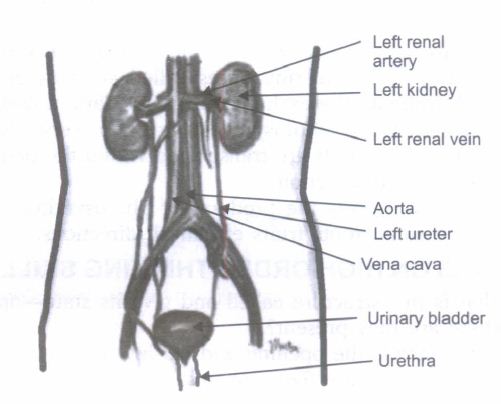
Name the excretory organs of the human excretory system. Show all the organs with a labelled diagram.
28.
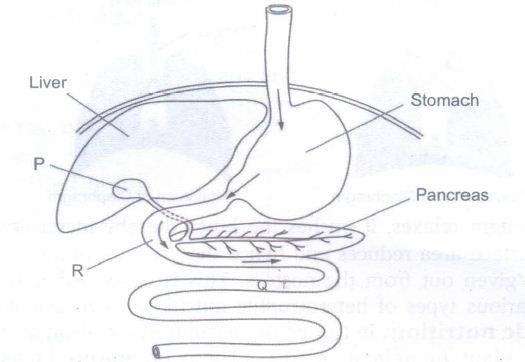
Label p, Q and R in the alimentary canal above and state the function of each. Explain what happens to fat at R.
29.
Name the constituents of blood.Why white blood corpuscles are called 'soldiers of the body'?
30.
Give reasons for the following:
(i)The glottis is guarded by epiglottis
(ii)The lung alveoli are covered with blood capillaries.
(iii)The wall of trachea is supported by cartilage rings.
31.
Give reasons
(i) Ventricles have thicker muscular walls than atria.
(ii) Transport system in plants is slow.
(iii) Circulation of blood in aquatic vertebrates differs from that in terrestrial vertebrates.
(iv) During the daytime, water and minerals travel faster through xylem as compared to the night.
(v) Veins have valves whereas arteries do not.
32.
(a) Explain, how urine is produced in human body?
(b) What are the excretory wastes in plants?
33.
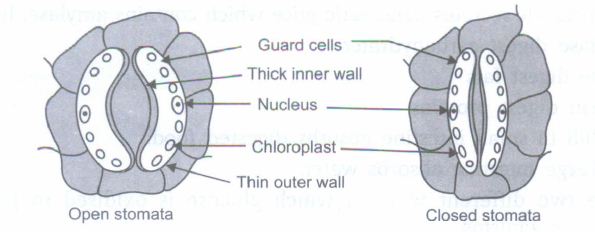
What are stomata? Draw a labelled diagram of stomata. Write two functions of stomata
34.
Assertion (A) Left atrium receives oxygenated blood from pulmonary vein.
Reason (R) Right atrium transfers deoxygenated blood to the right ventricle, which pumps it to the lungs for oxygenation.
(a) Both A and R are true and R is the correct explanation of A
(b) Both A and R are true, but R is not the correct explanation of A
(c) A is true, but R is false
(d) A is false, but R is true
35.
Assertion (A) The inner walls of the small intestine have finger-like projections called villi which are rich in blood.
Reason (R) These villi have a large surface area to help the small intestine in completing the digestion of food.
(a) If both A and R are true and R is the correct explanation of A
(b) If both A and R are true, but R is not the correct explanation of A
(c) If A is true, but R is false
(d) If A is false, but R is true
36.
Assertion: Ureters are the tubes which carry urine from kidneys to the bladder.
Reason: Urine is stored in the urethra.
Codes
(a) Both A and R are true and R is correct explanation of the assertion.
(b) Both A and R are true but R is not the correct explanation of the assertion.
(c) A is true but R is false.
(d) A is false but R is true.
37.
Assertion: Oxygen is more readily soluble in water than carbon dioxide.
Reason: Hence it gets transported easily through blood.
Codes
(a) If both assertion and reason are true and the reason is correct explanation of assertion.
(b) If both assertion and reason are true but reason is not a correct explanation of assertion.
(c) If assertion is true and reason is false.
(d) If both assertion and reason are false.
1.
(b)
Translocation
2.
(c)
Capillaries
3.
(d)
Haemoglobin
4.
(b)
To absorb CO2
5.
(a)
Absorbing light energy
6.
(b)
Right atrium
7.
(d)
Conversion of pyruvate to lactic acid
8.
(d)
water content in the guard cells
9.
(c)
Starch
10.
(d)
Nephrons
11.
(a)
Valves in heart
12.
(b)
Alveoli of lungs
13.
(b)
carbon dioxide
14.
(d)
Starch
15.
(b)
Small intestine
16.
(b)
Mucus
17.
(b)
Starch breaking down into sugars
18.
(d)
Mouth \(\longrightarrow\) oesophagus \(\longrightarrow\) stomach \(\longrightarrow\)small intestine \(\longrightarrow\) large intestine
19.
(b)
Mitochondria
20.
(a)
Transport of water
21.
(a) Stomatal opening
(b) Transport of water
(c) Fat transport
(d) Transport of food
(e) Speeding up digestive process
22.
(a) The HCl provides acidic medium for the action of enzyme pepsin to act and break down the proteins. It kills the germs, microbes and pathogens that enter the stomach.
(b) The breaking down of big fat globules into the smaller ones is called emulsification of fats.
(c) Trypsin
23.
If platelets are not present in the blood, then clotting at the site of injury will not take place. This will result in continuous bleeding and could be fatal for the organism.
24.
(i)Protein
(ii)Starch
(iii)Protein
(iv)Fats
25.
Aquatic organisms like fishes obtain oxygen from water present in dissolved state through their gills. Since the amount of dissolved oxygen is fairly low compared to the amount of oxygen in the air, the rate of breathing in aquatic organisms is much faster than that seen in terrestrial organisms.
26.
| S.No | Arteries | Veins |
|---|---|---|
| 1 | Have thick elastic, muscular walls. | Have thin, non-elastic walls. |
| 2 | Lumen is narrow | Lumen is wide |
| 3 | Carry blood from heart to all body parts. | Carry blood from all body parts to heart |
| 4 | Carry oxygenated blood (except pulmonary artery) | Carry deoxygenated blood (except pulmonary vein) |
27.
ExcretoryOrgan
(i) A pair of kidneys
(ii) A pair of ureter
(iii) A urinary bladder
(iv) A urethra
28.
1. P is gall bladder, it stores the bile secreted by liver.
2. R is small intestine and helps in the complete digestion of food where pancreatic enzymes are released.
3. Q is the lower part of the small intestine where the absorption of digested food takes place.
4. At R the fat is emulsified and the big fat globule is broken down into the small ones.
29.
The different constituents of blood are plasma (the fluid part of the bloo(d) and blood corpuscles consisting of RBCs, WBCs, and platelets)
WBCs are known as the soldiers of the body because they fight against the pathogenes that invade our body, thus preventing the occurence of diseases.
30.
(i)The glottis is gaurded by epiglottis because it prevents the entry of food in wind pipe. If the food enters wind pipe, then it chokes it, leading to the death of the person.
(ii)The lung alveoli are covered with blood vessels because the oxygen that we inhale dissolves in the blood, present in these blood capillaries only, as it reaches the lungs.
(iii)The wall of trachea is supported by cartilage rings because these rings prevent the air passage from collapsing.
31.
(i) Ventricles have to pump blood out of the heart into various organs of the body, therefore they have thicker muscular walls than atria.
(ii) Plants do not move and have a large proportion of dead cells in many tissues. As a result, plants have low energy needs and therefore transport system in plants is slow.
(iii) Circulation of blood in aquatic vertebrates such as fishes differs from that in terrestrial vertebrates as fishes have two-chambered heart. The blood is pumped to the gills for oxygenation and is then transported to the rest of the body.
On the other hand, most terrestrial vertebrates have lungs for oxygenation of blood. The deoxygenated blood is transported to heart from where it is transported to lungs for oxygenation and is then distributed to all body parts.
(iv) During daytime, due to transpiration pull, more water is absorbed by roots that is why absorption is faster in daytime.
(v) Veins have valves whereas arteries do not because valves have to prevents the back flow of blood as blood flows in them at low pressure.
32.
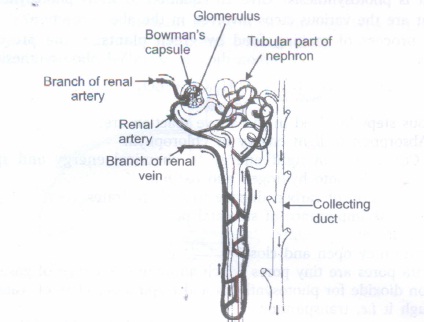
(a) Renal artery carrying all the impurities in blood reaches kidney. In kidney, there are small functional units called nephron which receives this blood and the impurities along with water is squeezed out in Bowman's capsule. It is due to the glomerulus i.e., the coiled structure of afferent renal artery. The water and impurities are collected in a tubule which enters the ureter. After filtration, reabsorbtion of required, useful products takes place before it enters the ureter. Finally ureter receives the urine, with lot of urea in water and is collected in urinary bladder.
Excretory wastes in plants:
(i) The waste product of photosynthesis is oxygen and the waste product of respiration is carbon dioxide.
(ii) Excess of water is lost by transpiration.
(iii) Plants store waste material in leaves which are then shed.
(iv) Plants have tissues made up of dead cells where waste products can be stored, e.g. gums, resin in old xylem.
(v) Waste products can also be stored in cellular vacuoles.
(vi) Plants also excrete some waste substances into the soil around them.
33.
Stomata are small pores present on the leaves underside.
Two functions of stomata:
(i) Allows the exchange of gases, O2 and CO2.
(ii) It helps in losing extra water by transpiration and creates suction pull which helps the water to rise in xylem.
34.
(a) Both A and R are true and R is the correct explanation of A
35.
(c) A is true, but R is false. R can be corrected as The inner walls of the small intestine have finger-like projections called villi which are rich in blood supply. These villi increases the surface area for absorption.
36.
(c): The bladder is a bag which stores urine till the time we go to toilet. The urine collected in the bladder is passed out from the body through the urethra.
37.
(d) If both assertion and reason are false.

10th Standard CBSE Syllabus & Materials
10th Standard CBSE
CBSE 10th Social Science PS - Federalism - New Model Questions Papers Study Material - QB365 Set A
NEW10th Standard CBSE
CBSE 10th Social Science PS - Power Sharing - New Model Questions Papers Study Material - QB365 Set A
NEW10th Standard CBSE
CBSE 10th Social Science GEO - Manufacturing Industries - New Model Questions Papers Study Material - QB365 Set A
NEW10th Standard CBSE
CBSE 10th Social Science GEO - Minerals and Energy Resources - New Model Questions Papers Study Material - QB365 Set A



NCERT Books

Syllabus

Exam Pattern

Sample Question Papers

Previous year Question Papers

Important Notes

MCQ Practice test

NCERT Exemplers

Case study Questions

Image Based Questions

Passage based Questions

HOT Questions

Value Based Questions

Model Questions Papers
NCERT ( Book Back ) Questions

Assertion and Reason
Important Questions And Answers

CBSE 10th Standard CBSE Subjects
CBSE Standards



