
 100% FREE ACCESS
10th Standard CBSE Syllabus & Materials
10th Standard CBSE
CBSE 10th Social Science ECO - Globalisation and the Indian Economy - New Model Questions Papers Study Material - QB365 Set A
NEW10th Standard CBSE
CBSE 10th Social Science ECO - Money and Credit - New Model Questions Papers Study Material - QB365 Set A
NEW10th Standard CBSE
CBSE 10th Social Science ECO - Sectors of the Indian Economy - New Model Questions Papers Study Material - QB365 Set A
NEW10th Standard CBSE
CBSE 10th Social Science ECO - Development - New Model Questions Papers Study Material - QB365 Set A
NEW10th Standard CBSE
CBSE 10th Social Science PS - Outcomes of Democracy - New Model Questions Papers Study Material - QB365 Set A
NEW10th Standard CBSE
CBSE 10th Social Science PS - Gender, Religion and Caste - New Model Questions Papers Study Material - QB365 Set A

Published on: 26/10/2025
Download CBSE Class 10th Standard CBSE Science question papers, sample papers, important questions, and previous year solved papers in PDF format. Get free study materials, NCERT solutions, and exam preparation resources for Class 10th Standard CBSE Science
Questions + Answers key
Take MCQ Science Test
1.
If the image formed by a lens for all positions of the object placed in front of it is always virtual, erect and diminished, state the type of the lens. Draw a ray diagram in support of your answer. If the numerical value of focal length of such a lens is 20 cm, find its power in new cartesian sign conventions.
2.
Name the type of reaction for the following:
(i) Vegetable matter changing into compost.
(ii) Burning of natural gas.
(iii) Adding water to quick lime to form slaked lime
3.
A concave mirror produces three times magnified (enlarged) real image of object placed at 10 cm in front of it. Where is the image located?
4.
Write the functions of the following in the digestive process:
(i)Bile
(ii)Bicarbonate secreted by the duodenum
(iii)Pancreatic amylase
5.
What are outside raw materials used for by an organism?
6.
Write the balanced chemical equation for the following and identify the type of reaction in each case.
(a) Potassium bromide(aq) + Barium Iodide(aq) \(\rightarrow\) Potassium iodide(aq) + Barium bromide(s)
(b) Zinc carbonate(s) → Zinc oxide(s) + Carbon dioxide(g)
(c) Hydrogen(g) + Chlorine(g) → Hydrogen chloride(g)
(d) Magnesium(s) + Hydrochloric acid(aq) → Magnesium chloride(aq) + Hydrogen(g)
7.
What is the difference between displacement and double displacement reactions? Write equations for these reactions.
8.
(i) "The refractive index of diamond is 2.42." What is the meaning of this statement?
(ii) Name a liquid whose mass density is less than that of water but it is optically denser then water.
9.
Name a mirror that can give an erect and enlarged image of an object.
10.
Where do plants get each of the raw materials required for photosynthesis?
11.
Complete the missing components/variables given as x and y in the following reactions:
(a) Pb(NO3)2(aq) + 2KI(aq) \(\rightarrow\) PbI4(x) + 2KNO3(y)
(b) Cu(s) + 2AgNO3(aq) \(\rightarrow\) Cu(NO3)2(aq) + X(s)
(c) Zn(s) + H2SO4(aq) \(\rightarrow\) ZnSO4(x) + H2(y)
(d) CaCO3(s) \(\overset { x }{ \rightarrow } \) CaO(s) + CO2(g)
12.
(a) Write one example for each of decomposition reaction carried out with help of
(i) Electricity (ii) Heat (iii) Light
(b) Which of the following statements is correct and why copper can displace silver from silver nitrate and silver can displace copper from copper sulphate solution.
13.
State the laws of refraction of light. If the speed of light in vacuum is \({ 3\times 10 }^{ 8 }\) ms-1 , find the speed of light in a medium of absolute refractive index 1.5.
14.
Explain the process of 'photosynthesis' in plants.List four factors which influence this process and describe how each of them affects the rate of the photosynthesis process.
15.
Choose the correct statement
The wall of the stomach absorb most of the water from digested food
Colon is the largest part of small intestine
All end products of digestion are insoluble in water
The small intestine is the main region for the absorption of food.
16.
If the power of a lens is -4.0 D, then it means that the lens is a
concave lens of focal length -50 m
convex lens of focal length + 50 cm
concave lens of focal length - 25 cm
convex lens of focal length - 25 m
17.
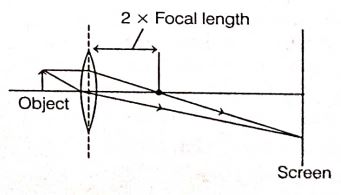
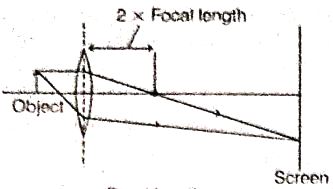
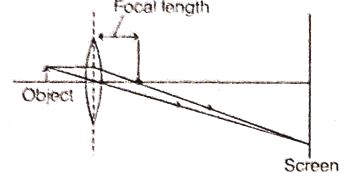
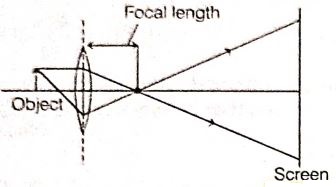
Which diagram shows image formation of an object on a screen by a converging lens?
18.
Proteins after digestion are converted into
Carbohydrates
Small globules
Amino acids
Starch
19.
As seen in the figure, two nails are carefully dipped in copper sulphate solution with the help of threads. What will happen when the nails are removed after half an hour?
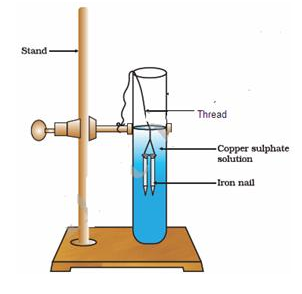
No change is observed
Nails turn blue in colour
Nails turn green in colour
Nails turn brown in colour
20.
Marble's popularity began in ancient Rome and Greece, where white and off-white marble were used to construct a variety of structures, from hand-held sculptures to massive pillars and buildings.
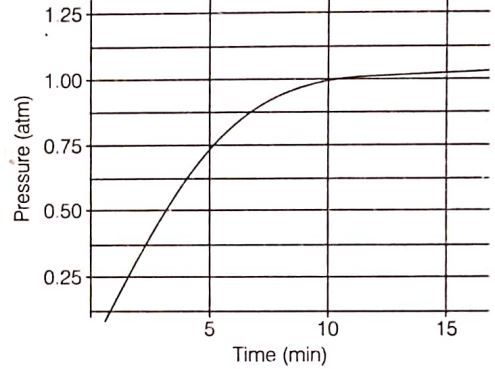
(i) A student added 10 g of calcium carbonate in a rigid container, secured it tightly and started to heat it. After some time, an increase in pressure was observed, the pressure reading was then noted at intervals of 5 min and plotted against time, in a graph as shown below. During which time interval did maximum decomposition took place?
(ii) Calcium oxide can be reduced to calcium, by heating with sodium metal. Which compound would act as an oxidising agent in the given process and why?
(iii) Gas obtained in (i) is a reactant for a very important biochemical process which occurs in the presence of sunlight. ldentify the name of the process.
(iii) Marble statues are corroded or stained when they repeatedly come in contact with polluted rain water. What could be the main reason? Write the chemical decomposition of calcium carbonate.
21.
The food which is prepared by the process of photosynthesis in the leaves of a plant has to be transported to other parts like stem, roots, branches etc. Therefore this food is transported to other parts of the plant through a kind of tubes called phloem. The transport of food from leaves to other parts of a plant is called translocation. The food made by the leaves is in the form of simple sugar. Phloem is present in all the parts of a plant. Phloem is a long tube made of many living cells joined end to end. The living cells of phloem are called sieve tubes.
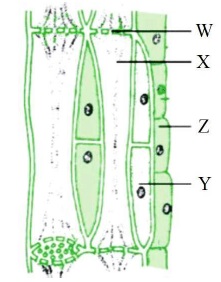
(i) Identify the correct pair of labelled parts with the help of this figure.
(a) W – Sieve plate, Y – Companion cell
(b) X – Sieve plate, Z – Companion cell
(c) Y – Sieve tubes, Z – Sieve plate
(d) X – Companion cell, Y – Phloem parenchyma
(ii) Name the labelled part which contains cytoplasm but no nucleus.
| (a) Sieve tube | (b) Companion cell |
| (c) Phloem parenchyma | (d) Sieve plate |
(iii) In which direction phloem translocates the food?
| (a) Upward | (b) Downward |
| (c) Backward | (d) Either (a) or (b) |
(iv) The phloem tissue in plants is responsible for the transport of
| (a) amino acids | (b) hormones | (c) sugar | (d) all of these. |
(v) Which of the following is not a part of phloem?
| (a) Companion cells | (b) Tracheids | (c) Sieve plate | (d) Sieve tube |
22.
The lenses forms different types of images when object placed at different locations. When a ray is incident parallel to the principal axis, then after refraction, it passes through the focus or appears to come from the focus. When a ray goes through the optical centre of the lens, it passes without any deviation.
If the object is placed between focus and optical center of the convex lens, erect and magnified image is formed. As the object is brought closer to the convex lens from infinity to focus, the image moves away from the convex lens from focus to infinity. Also the size of image goes on increasing and the image is always real and inverted. A concave lens always gives a virtual, erect and diminished image irrespective to the position of the object.
(i) The location of image formed by a convex lens when the object is placed at infinity is
| (a) at focus | (b) at 2F |
| (c) at optical center | (d) between F and 2F |
(ii) When the object is placed at the focus of concave lens, the image formed is
| (a) real and smaller | (b) virtual and inverted |
| (c) virtual and smaller | (d) real and erect |
(iii) The size of image formed by a convex lens when the object is placed at the focus of convex lens is
| (a) small | (b) point in size |
| (c) highly magnified | (d) same as that of object |
(iv) When the object is placed at 2F in front of convex lens, the location of image is
| (a) at F | (b) at 2 F on the other side |
| (c) at infinity | (d) between F and optical center |
1.
Diverging lens / concave lens
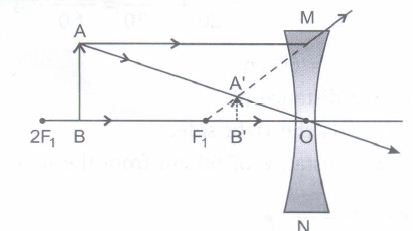
Focal length = -20 cm (lens is concave, hence f is -ve)
Power = P = 1/f = 100/ -20 cm = -5D.
2.
(i) Vegetable matter changing into compost is exothermic and decomposition reaction.
(ii) Burning of natural gas is exothermic reaction.
(iii) Adding water to quick lime to form slaked lime is combination reaction and exothermic in nature.
3.
Real image is inverted. So, magnification is negative
Thus, m=-3=\(\frac{Image \quad size}{Object \quad size}\)
\(=\frac{h_{i}}{h_{o}}=-\frac{v}{u}\)
[where, v = image distance and u = object distance]
\(\Rightarrow -3=\frac{-(v)}{(-10)}\) [\(\because\) object is placed in front of mirror]
\(\Rightarrow -3=\frac{v}{10}\)
Image distance, v = -30 cm
Negative sign shows that image is real, so it will be formed in front of the mirror.
4.
(i)Bile is helpful in the emulsification of fats i.e., the breaking down of large fat droplets into smaller fat globules, which the pancreatic enzymes can act upon.
(ii)The pancreatic juice contains enzymes that require an alkaline medium to act. The bicarbonate secreted by the duodenum provides this alkaline medium.
(iii)The function of pancreatic amylase is to convert complex carbohydrates into glucose, which is absorbed in the blood.
5.
Carbon based molecules, i.e. food is used by body to meet its energy nced. Oxygen is used to oxidise food which release energy. Water is requircd for operating most of the functions inside the body. So, food, water and oxygen are the basic raw materials used by an organism.
6.
(a) 2KBr(aq) + BaI2(aq) \(\rightarrow\) 2KI + (aq) + BaBr2(s)
Type: Double displacement reaction
(b) ZnCO3(s) \(\overset{\Delta }{\rightarrow}\) ZnO(s)+CO2(g)
Type: Thermal decomposition reaction
(c) H2(g)+Cl2(g)\(\rightarrow\) 2HCl(g)
Type: Combination reaction
(d) Mg(s)+2HCl(aq)\(\rightarrow\)MgCl2(aq)+H2(g)
Type: Displacement reaction
7.
In a displacement reaction, a more reactive element displaces a less reactive element from its salt solution. But in a double displacement reaction, two atoms or groups from different compounds displace each other. Chemical equation for single displacement,
Zn(s) + CuSO4(aq) \( \longrightarrow \) ZnSO4(aq) + Cu(s)
Here, Zn displaces Cu from its salt solution (CuSO4).
Chemical equation for double displacement,
BaCl2(aq) + K2SO4(aq) \( \longrightarrow \) BaSO4 (s) + 2KCl(aq)
Here, Ba and K displace each other.
8.
(a) This means that the ratio of speed of light in air and the speed of light in diamond
is equal to 2.42
(b) Kerosene
9.
Concave mirror can give erect and enlarged image of an object.
10.
The raw materials for photosynthesis are carbon dioxide and water. These are taken up by the plants in the following ways
(i) CO2 is taken up through the stomata from the atmosphere in case of land plants, while the aquatic plants take up CO2 dissolved in water.
(ii) Water is taken up or is absorbed by the roots through the process of osmosis and is transported to the leaves containing photosynthetic cells by the xylem vessels.
11.
(a) Pb(NO3)2(aq) + 2KI(aq) \(\rightarrow\) PbI2(s) + 2KNO3(aq)
(b) Cu(s) + 2AgNO3(aq) \(\rightarrow\) Cu(NO3)2(aq) + 2Ag(s)
(c) Zn(s) + H2SO4(aq) \(\rightarrow\) ZnSO4(aq) + H2(g)
(d) CaCO3(s) \(\overset { Heat }{ \rightarrow } \) CaO(s) + CO2(g)
12.
(a) (i) 2H2O\(\overset { electricity }{ \longrightarrow } \) 2H2(g) + O2
(ii) CaCO3 \(\overset { heat }{ \longrightarrow } \) CaO + CO2
(iii) 2AgBr \(\overset { sunlight }{ \longrightarrow } \) 2Ag + Br2
(b) Copper can displace silver from AgN03 because copper is more reactive than Ag
Cu + 2AgNO3(ag) \(\longrightarrow \) Cu(NO3)2(aq) + 2Ag(s)
13.
(1) The incident, the refracted ray and the normal at the point of incidence. all lie in the same plane.
(2) The second law of refraction is called Snell's law of refraction. According to Snell's law. "The ratio of sine of angle of incidence to the sine of angle of refraction is a constant for a given pair of mediums"
-S.png)
\(\frac { sin\ \ i }{ sin \ r } =n(constant)\)
\(\frac { Speed \ of \ light \ in \ vacuum }{ Speed \ of \ light \ in \ medium } =\)
Refractive index of the medium
\(\Rightarrow \frac { 3\times { 10 }^{ 8 }m/s }{ x } =1.5\)
\(\Rightarrow \frac { 3\times { 10 }^{ 8 } }{ 1.5 } =2\times { 10 }^{ 8 }m/s\)
∴ Speed of lightin the medium = 2 x 10⁸ m/s
14.
Photosynthesis is the process by which plant cells prepare food (carbohydrates) from inorganic raw materials such as carbon dioxide and water in presence of sunlight and chlorophyll.
\({ 6CO }_{ 2 }+{ 6H }_{ 2 }O\xrightarrow [ Chlorophyll ]{ Sunlight } { C }_{ 6 }{ H }_{ 12 }{ O }_{ 6 }+{ 6O }_{ 2 }\)
The process of photosynthesis takes place in two phases:
Light reaction - It requires light which is absorbed by chlorophyll molecules to split water molecules into hydrogen and oxygen. ATP and NADPH2 are produced during this phase and it occurs in the thylakoid membrane of the chloroplasts.
Dark reaction - It does not require light energy and it occurs in the stroma of chloroplasts, In this phase, the ATP and NADPH2 formed during light reaction are utilised and CO2 is reduced to form carbohydrates.
The four factors affecting the rate of photosynthesis are:
(i) Sunlight - Sunlight provides the energy required for the preparation of food by plants. In the absence of sunlight, photosynthesis cannot take place.
(ii) Carbon dioxide - Carbon dioxide acts as the substrate for photosynthesis. During this process, carbon dioxide and water are converted into carbohydrates.
(iii) Water - During photosynthesis, water is photolysed into oxygen and hydrogen and it provides the energy for photosynthesis.
(iv) Chlorophyll - Chlorophyll is the green pigment present in the leaves which absorbs sunlight
15.
(d)
The small intestine is the main region for the absorption of food.
16.
(c)
concave lens of focal length - 25 cm
17.
(c)
18.
(c)
Amino acids
19.
20.
(i) The pressure reading was noted at intervals of 5 min and plotted against time of the reaction which involved:
\(\mathrm{CaCO}_3 \xrightarrow{\Delta} \mathrm{CaO}+\mathrm{CO}_2 \uparrow\)
Formation of CO2 gas increases pressure and is maximum in (0-5) min graph as shown sharp curve in (0-5) min.
(ii) Calcium oxide can be reduced to calcium by heating with sodium metal and calcium oxide acts as an oxidising agent because it oxidises other substance, i.e. sodium and itself gets reduced.
(iii) CO2 gas is a reactant for a very important biochemical process which occurs in the presence of sunlight, the name of the process is photosynthesis.
The reactants for photosynthesis are light energy, water, carbon dioxide and chlorophyll, while the products are glucose, oxygen and water.
Or
Marble statues are corroded or stained when they repeatedly come in contact with polluted rain water. Polluted rain water is acidic in nature hence, it reacts with calcium carbonate.
CaCO3(s) + H2SO4(aq) \(\rightarrow\) CaSO4(s) + CO2(g) + H2O
The decomposition of calcium carbonate is as follows
\(\mathrm{CaCO}_3(\mathrm{~s}) \xrightarrow{\Delta} \mathrm{CaO}(\mathrm{s})+\mathrm{CO}_2(\mathrm{~g})\)
21.
(i) (a) W – Sieve plate, Y – Companion cell
The given figure is Lateral Section of phloem in which W represents sieve plate,
X represents sieve tubes,
Y represents companion cell and Z represents phloem parenchyma.
(ii) (a) Sieve tube
Sieve tubes (X) are living cells which contain cytoplasm but no nucleus.
(iii) (d) Either (a) or (b)
The movement of food in phloem can be upward or downward depending on the needs of the plant.
(iv) (d) all of these.
The phloem translocates the food (sugar) made in the leaves. Besides food molecules, phloem also transports amino acids, hormones synthesised in shoot tips and root tips and other metabolites.
(v) (b) Tracheids
Components of phloem are sieve tubes, companion cells, phloem parenchyma and sieve plates. Tracheids are constituent of xylem tissue.
22.
(i) (a): When an object is placed at infinity of convex lens, image will be formed at focus F.
(ii) (b): Virtual and inverted image is formed, when object is placed at focus of the concave lens.
(iii) (c) : When object is placed at focus of a convex lens, highly enlarged or magnified image is formed.
(iv) (b): When an object is placed at distance 2F in front of a convex lens, then the image formed is at a distance 2F on the other of the lens.
(v) (a): Image if formed between focus and optical centre when the object is placed anywhere between optical centre and infinity.

10th Standard CBSE Syllabus & Materials
10th Standard CBSE
CBSE 10th Social Science PS - Federalism - New Model Questions Papers Study Material - QB365 Set A
NEW10th Standard CBSE
CBSE 10th Social Science PS - Power Sharing - New Model Questions Papers Study Material - QB365 Set A
NEW10th Standard CBSE
CBSE 10th Social Science GEO - Manufacturing Industries - New Model Questions Papers Study Material - QB365 Set A
NEW10th Standard CBSE
CBSE 10th Social Science GEO - Minerals and Energy Resources - New Model Questions Papers Study Material - QB365 Set A



NCERT Books

Syllabus

Exam Pattern

Sample Question Papers

Previous year Question Papers

Important Notes

MCQ Practice test

NCERT Exemplers

Case study Questions

Image Based Questions

Passage based Questions

HOT Questions

Value Based Questions

Model Questions Papers
NCERT ( Book Back ) Questions

Assertion and Reason
Important Questions And Answers

CBSE 10th Standard CBSE Subjects
CBSE Standards



