
 100% FREE ACCESS
10th Standard CBSE Syllabus & Materials
10th Standard CBSE
CBSE 10th Social Science ECO - Globalisation and the Indian Economy - New Model Questions Papers Study Material - QB365 Set A
NEW10th Standard CBSE
CBSE 10th Social Science ECO - Money and Credit - New Model Questions Papers Study Material - QB365 Set A
NEW10th Standard CBSE
CBSE 10th Social Science ECO - Sectors of the Indian Economy - New Model Questions Papers Study Material - QB365 Set A
NEW10th Standard CBSE
CBSE 10th Social Science ECO - Development - New Model Questions Papers Study Material - QB365 Set A
NEW10th Standard CBSE
CBSE 10th Social Science PS - Outcomes of Democracy - New Model Questions Papers Study Material - QB365 Set A
NEW10th Standard CBSE
CBSE 10th Social Science PS - Gender, Religion and Caste - New Model Questions Papers Study Material - QB365 Set A

Published on: 26/10/2025
Download CBSE Class 10th Standard CBSE Science question papers, sample papers, important questions, and previous year solved papers in PDF format. Get free study materials, NCERT solutions, and exam preparation resources for Class 10th Standard CBSE Science
Questions + Answers key
Take MCQ Science Test
1.
Arun took a pale green substance X in a test tube, and heated it over a flame. He observed a color change along with evolution of two gases with the smell of burning sulphur
(a) Identify X.
(b) Identify the product formed.
(c) Write the equation.
(d) Identify the type of chemical reaction.
2.
Name the gas which is liberated when an acid reacts with a metal. Illustrate with an example. How will you test the presence of this gas?
3.
If a harmful chemical enters a food chain consisting of snacks, grasshoppers, plants and frogs, which one of the organisms is likely to have a maximum concentration of harmful chemicals in its body?
4.
Name the type of mirrors used in the design of solar furnaces. Explain how high temperature is achieved by this device.
5.
What is the function of optic nerve in the human eye?
6.
In a food chain, 10,000 joules of energy is available to the producer. How much energy will be available to the secondary consumer to transfer it to the tertiary consumer?
7.
What happened when Mendel crossed two traits of a character in a pea plant?
8.
Does genetic combination of mother play a significant role in determining the sex of new born baby?
9.
Name the factors on which force produced due to magnetic field depends.
10.
Give the formulae of the stable binary compounds that would be formed by the combination of following pairs of elements.
(a) Mg and N2
(b) Li and O2
(c) Al and Cl2
(d) K and O2
11.
Name two energy sources that you would consider to be renewable. Give reasons for your choices.
12.
Name one endocrine gland which performs dual function.
13.
Draw a schematic diagram of a circuit consisting of a battery of three cells of 2V each, a 5\(\Omega \) resistor, an 8\(\Omega \) resistor, and a 12\(\Omega \) resistor and a plug key, all connected in series. Now, connect the ammeter to measure the current through the resistors and a voltmeter to measure the potential difference to measure the current through the resistors and a voltmeter to measure the potential difference across the 12\(\Omega \) resistors. What would be the readings in the ammeter and the voltmeter?
14.
(i) Define universal indicator. For what purpose it is used?
(ii) Two solutions A and B have pH values of 3.0 and 9.5 respectively. Which of these will turn litmus solution from blue to red and which will turn phenolphthalein from colourless to pink?
(iii) Water is a neutral substance. What colour will you get when you add a few drops of the universal indicator to a test tube containing distilled water?
15.
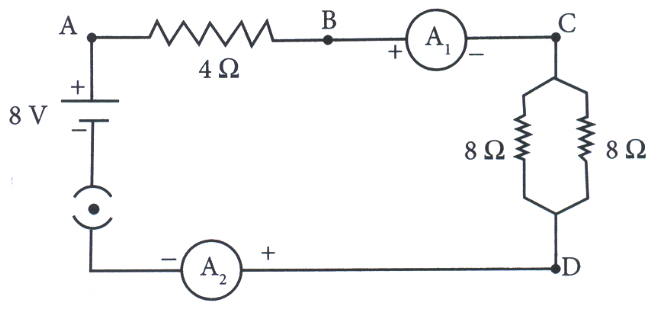
Find out the following in the electric circuit given in Figure
(a) Effective resistance of two 8 \(\Omega\) resistors in the combination
(b)Current flowing through 4 \(\Omega\) resistor
(c) Potential difference across 8 \(\Omega\) resistance
(d) Power dissipated in 4 \(\Omega\) resistor
(e) Difference in ammeter readings, if any.
16.
(a) What is an ecosystem? List its two main components.
(b) We do not clean ponds or lakes, but an aquarium needs to be cleaned regularly. Explain.
17.
Differentiate between inherited and acquired characters. Give one example for each type.
18.
(a) What is meant by a magnetic field?
(b) How is the direction of magnetic field at a point determined?
(c) Describe an activity to demonstrate the direction of the magnetic field generated around a current carrying conductor.
(d) What is the direction of magnetic field at the centre of a current carrying circular loop?
19.
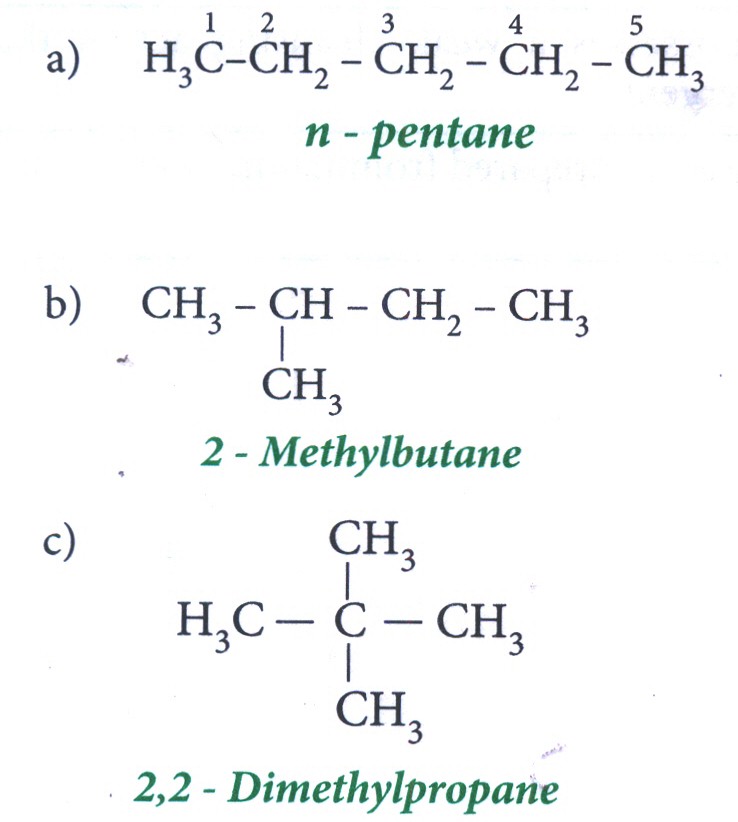
How many structural isomers can you draw for pentane?
20.
What are reflex actions? Give two examples. Explain a reflex arc.
21.
Write the balanced chemical equation for the following reactions:
(i) When copper is heated in air.
(ii) When aluminum is heated in air.
(iii) Aluminium oxide reacts with sodium hydroxide.
22.
Distinguish between permanent magnet and electromagnet.
23.
Give reasons for the following:
(i)The glottis is guarded by epiglottis
(ii)The lung alveoli are covered with blood capillaries.
(iii)The wall of trachea is supported by cartilage rings.
24.
(a) State one limitation of solar energy available from solar cells.
(b) What is the minimum wind velocity required to obtain useful energy with a windmill?
(c) Define the term 'nuclear fission'.
25.
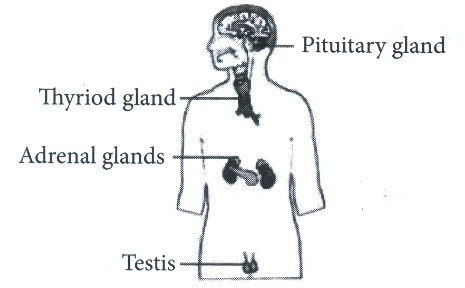
Draw a diagram showing endocrine glands in a male body. Label the following glands on it:
(i) Pituitary
(ii) Thyroid
(iii) Adrenal
(iv) Testes
26.
Write an advantage of giving the control of water management to the residents of the area?
27.
State modern periodic law of classification of elements.
28.
Which one of the following is a renewable resource?
Natural gas, Petrroleum, Ground water, Coal
29.
Suggest a few useful ways of utilising waste water.
30.
Give an account of the process adopted by Mendeleev for the classification of elements. How did he arrive at "Periodic Law"?
1.
Galvanisation
2.
Hydrogen gas.
When zinc reacts with the dilute hydrochloric acid, Colour less gas with pop up sound is evolved.
2HCl+Zn\(\rightarrow\)ZnCl2+H2
3.
Snakes will have maximum concentration of harmful chemicals in its body.
4.
Concave mirror.
When a solar furnace is placed at the focus of a large concave mirror, it focusses a parallel beam of light on the furnace, as a parallel beam of light on the furnace, as a result a temperature is achieved after some time.
5.
It carries image formed on the retina to brain in the for of electrical signals
6.
10 J.
7.
Only dominant trait appeared in F1 generation.
8.
No, the genetic combination of mother does not play any significant role in determining the sex of a newborn. This is because the female cell carries two X-chromosomes XX). While the male cell carries one X and one Y-chromosome. The fusion of X-chromosome (of male sperm cell) with X-chromosome (of female egg) produces a female child, while the fusion of Y-chromosome (of male sperm cell) with X-chromosome (of female egg) produces a male child. Therefore, it is the contribution of father which determines the sex of a newborn.
9.
The factors on which force produced due to magnetic field depends are:
(i) length of the conductor.
(ii) the amount of current flowing.
(iii) The strength of magnetic field.
(iv) direction of current and magnetic field.
If are at right angles, then maximum amount of force will be produced.
10.
(a) Mg3N2
(b) Li2O
(c) AICl3
(d) K2O
11.
Biomass energy and water energy. Biomass can be managed by replacing trees and water on Earth can be used again and again.
12.
Pancreas. It secretes hormones and digestive enzymes.
13.
Equivalent resistance of the circuit,
R = R1 + R2 + R3 = 5 + 8 + 12 = 25 \(\Omega\)
[\(\because\) R1, R2 and R3 are connected in series]
In series combination, current flowing through all the resistances is same and equal to the total current flowing through the circuit.
\(\therefore\) Current in the resistors, \(I=\frac{V}{R}=\frac{6}{25}=0.24 \mathrm{~A}\)
\(\therefore\) Ammeter reading = 0.24 A
Potential across 12 \(\Omega\) resistance,
V = IR = 0.24 \(\times\) 12 = 2.88 V
\(\therefore\) Voltmeter reading is 288 V.
14.
(i) Universal indicator is a mixture of many different indications (or dyes) which give different colours at different pH values of the entire pH scale. The colour produced by the universal indicator is used to find the pH value of acid or base by matching the colour with the colours on pH colour chart.
(ii) Solution A is acidic and will turn litmus solution from blue to red.
Solution B is basic and will turn phenolphthalein from colourless to pink.
(iii) Green colour will be obtained.
15.
(a) Since two \(8\Omega \) resistors are in parallel, their effective resistance (\({ R }_{ P }\)) is given by,
\(\frac { 1 }{ { R }_{ P } } =\frac { 1 }{ 8 } +\frac { 1 }{ 8 } +\frac { 1 }{ 4 } \) or \({ R }_{ P }=4\Omega \)
(b) Total resistance in the circuit
\(R=4\Omega +{ R }_{ P }=4\Omega +4\Omega =84\Omega \)
Current through the electric circuit
\(I=\frac { V }{ R } =\frac { 8V }{ 8\Omega } =1A\)
(c) The potential difference \(4\Omega \) resistor V
I \(=IR=1\times 4=4V\)
(d) Power dissipated in \(4\Omega \) resistor P=\({ (I) }^{ 2 }\)
\(R={ (1) }^{ 2 }(4)=4W\)
(e) There is no difference in the readings of ammeters \({ A }_{ 1 }\) and \({ A }_{ 2 }\) as same current flows through all elements in a series circuit.
16.
(a) An ecosystem is a self-contained unit of living things (plants, animals and decomposers) and their non-living environment (soil, air and water). An ecosystem needs only the input of sunlight energy for its functioning. The two main components of an ecosystem are,:
(i) Abiotic components it includes all non-living components like soil, water, air temperature, light, pressure, etc.
(ii) Biotic component, it includes all living components like plants, animals, decomposers, etc.
(b) A pond is a self sufficient or independent unit in nature. It contains all the components of the ecosystem. In this ecosystem, producers (hydrophytes) trap the solar energy and then provide the basic food or energy for all other life in the pond. When the producers and consumers die, the decomposers present in the pond act on their dead bodies to return the various elements back to the nutrient pool. On the other hand, in an aquarium there are not any producers and nutrient pool to trap solar energy, therefore the fishes living in an aquarium need to be nourished.
Moreover due to absence of decomposers the excreta of the fishes cannot be decomposed. Therefore the aquarium needs to be cleaned regularly.
17.
The traits developed in an individual during its life time due to the effect of environmental factors are called acquired traits. These traits are also called somatic variations as they affect the structure and functioning of cells, tissues and organs without influencing the genetic material. Example - colour of seeds, colour of eyes.
A trait which is caused by a change in its gene or DNA is called an inherited trait. In other words, the traits which are passed from parents to their offspring generation after generation are called inherited traits. Example - loss of a finger in an accident.
18.
(a) Magnetic field is the region around a magnet in which a magnetic material experiences a force because of that magnet.
(b) The direction of magnetic field at a point is determined by using a magnetic compass. The direction along which the needle of a magnetic compass gets aligned indicates the direction of the magnetic field.
(c) A straight thick conducting wire is inserted normally through centre of a plane paper. Now, electric current is passed through the wire. When a small magnetic compass is placed on the paper, the magnetic needle of the compass gets aligned along a particular direction. The positions of the North Pole and South Pole are marked on the paper. Now, the magnetic needle is shifted to a new position such that its South Pole occupies the position previously occupied by its North Pole. Again, the positions of the North Pole and South Pole are marked. These steps are repeated over and over again and the marked points are joined to obtain the direction of the magnetic field generated by the current-carrying straight wire.
(d) The direction of magnetic field at the centre of a current of a current carrying loop is normal to the plane formed by the loop.
19.
20.
Reflex action is a special case of involuntary movement involuntary organs. When a voluntary organ is in the vicinity of a sudden danger, it is immediately pulled away from the danger to save itself. For example; when your hand touches a very hot electric iron, you move away your hand in a jerk. All of this happens in flash and your hand is saved from the imminent injury. This is an example of reflex action.
Reflex Arc: The path through which nerves signals; involved in a reflex action; travel is called the reflex arc. The following flow chart shows the flow of signal in a reflex arc. Receptor \(\rightarrow\) Sensory Neuron\(\rightarrow\) Relayneuron \(\rightarrow\) Motor neuron \(\rightarrow\) Effector (muscle) The receptor is the organ which comes in the danger zone. The sensory neurons pick signals from the receptor and send them to the relay neuron. The relay neuron is present in the spinal cord. The spinal cord sends signals to the effector via the motor neuron. The effector comes in action moves the receptor away from the danger.
21.
(i) 2Cu + O2 \(\longrightarrow \) 2CuO
(ii) 4A1 + 3O2 \(\longrightarrow \) 2A12O3
(iii) A12O3 + 2NaOH\(\longrightarrow \)2NaA1O2 + H2O
22.
| Electromagnet | Permanent Magnet |
| 1. It is temporary magnet and can be demagnetized | 1. It is a permanent magnet and cannot be demagnetized |
| 2. Magnetic strength can be changed. | 2. its strength is fixed. |
| 3. Its polarity can also be changed. | 3. Its polarity is fixed. |
| 4. It is prepared from soft iron. | 4. It is prepared from hard steel. |
23.
(i)The glottis is gaurded by epiglottis because it prevents the entry of food in wind pipe. If the food enters wind pipe, then it chokes it, leading to the death of the person.
(ii)The lung alveoli are covered with blood vessels because the oxygen that we inhale dissolves in the blood, present in these blood capillaries only, as it reaches the lungs.
(iii)The wall of trachea is supported by cartilage rings because these rings prevent the air passage from collapsing.
24.
(a) The solar cells are costly and hence the energy available from them expensive.
(b) 15 km/h is the minimum wind velocity required to obtain useful energy with a windmill.
(c) Nuclear fission is the process in which a radioactive atom splits up into smaller nuclei when struck with low energy neutrons.
25.
26.
()
By giving the control of water management to the residents of the area ensures mismanagement and over exploitation is reduced.
27.
()
Modern periodic law states "that the properties of elements are a period function of the atomic numbers"
28.
()
Among natural gas, petroleum, ground water and coal, only ground water is a renewable resource. It returns in the water cycle.
29.
(a) recharging the ground water
(b) can be used for irrigation
(c) treated municipal water can be used for washing cars, watering the gardens
(d) certain pollutants in sewage water can be become fertiliser for various crops.
30.
When the various elements were arranged in order of their increasing atomic masses, elements having similar properties fell under on another in the same vertical column called the group. He further observed that repetition of elements with similar physical and chemical properties occurred after certain regular intervals. On the basis of these observations, Mendeleev proposed his periodic law which states that the physical and chemical properties of elements are a periodic function of their atomic masses.

10th Standard CBSE Syllabus & Materials
10th Standard CBSE
CBSE 10th Social Science PS - Federalism - New Model Questions Papers Study Material - QB365 Set A
NEW10th Standard CBSE
CBSE 10th Social Science PS - Power Sharing - New Model Questions Papers Study Material - QB365 Set A
NEW10th Standard CBSE
CBSE 10th Social Science GEO - Manufacturing Industries - New Model Questions Papers Study Material - QB365 Set A
NEW10th Standard CBSE
CBSE 10th Social Science GEO - Minerals and Energy Resources - New Model Questions Papers Study Material - QB365 Set A



NCERT Books

Syllabus

Exam Pattern

Sample Question Papers

Previous year Question Papers

Important Notes

MCQ Practice test

NCERT Exemplers

Case study Questions

Image Based Questions

Passage based Questions

HOT Questions

Value Based Questions

Model Questions Papers
NCERT ( Book Back ) Questions

Assertion and Reason
Important Questions And Answers

CBSE 10th Standard CBSE Subjects
CBSE Standards



