
 100% FREE ACCESS
10th Standard CBSE Syllabus & Materials
10th Standard CBSE
CBSE 10th Social Science ECO - Globalisation and the Indian Economy - New Model Questions Papers Study Material - QB365 Set A
NEW10th Standard CBSE
CBSE 10th Social Science ECO - Money and Credit - New Model Questions Papers Study Material - QB365 Set A
NEW10th Standard CBSE
CBSE 10th Social Science ECO - Sectors of the Indian Economy - New Model Questions Papers Study Material - QB365 Set A
NEW10th Standard CBSE
CBSE 10th Social Science ECO - Development - New Model Questions Papers Study Material - QB365 Set A
NEW10th Standard CBSE
CBSE 10th Social Science PS - Outcomes of Democracy - New Model Questions Papers Study Material - QB365 Set A
NEW10th Standard CBSE
CBSE 10th Social Science PS - Gender, Religion and Caste - New Model Questions Papers Study Material - QB365 Set A

Published on: 26/10/2025
Download CBSE Class 10th Standard CBSE Science question papers, sample papers, important questions, and previous year solved papers in PDF format. Get free study materials, NCERT solutions, and exam preparation resources for Class 10th Standard CBSE Science
Questions + Answers key
Take MCQ Science Test
1.
Write the chemical formula of baking soda. How is baking soda prepared? Write the reaction which takes place when it is heated during cooking.
2.
Identify and name the functional groups present in the following compounds.
-q.jpg)
-q.jpg)
3.
What are non-renewable resources of energy? Give two examples of such resources.
4.
Define, 'refractive index of a transparent medium,' What is its unit? Which has a higher refractive index? glass or water?
5.
What is the least distance of distinct vision of a normal human eye?
6.
List in tabular form, two distinguishing features between acquired trait and inherited trait.
7.
Explain why the planets do not twinkle.
8.
What is the harm of clay cups?
9.
Why males are called heterogametic?
10.
How do organisms, whether reproduced asexually or sexually maintain a constant chromosome number through several generation? Explain with the help of suitable example.
11.
Give reasons for the appearance of new combinations of characters in the F2 progeny.
12.
What are the functions of gastric glands present in the wall of the stomach?
13.
Energy can neither be created nor destroyed. Then why is there so must about energy crisis?
14.
Name the hormone secreted by thyroid gland.
15.
Name two metals which will displace hydrogen from dilute acids, and two metals which will not.
16.
Name the gas which burns with pop sound.
17.
(a) Give Arrhenius definition of an acid and a base.
(b) Choose strong acid and strong base from the following:
\(CH_3COOH,\ NH_4OH,\ KOH,\ HCl\)
18.
(i) Define universal indicator. For what purpose it is used?
(ii) Two solutions A and B have pH values of 3.0 and 9.5 respectively. Which of these will turn litmus solution from blue to red and which will turn phenolphthalein from colourless to pink?
(iii) Water is a neutral substance. What colour will you get when you add a few drops of the universal indicator to a test tube containing distilled water?
19.
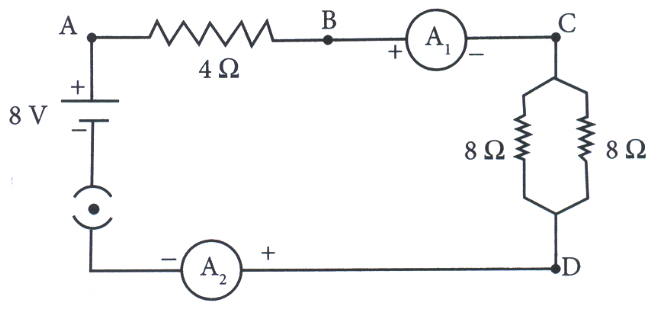
Find out the following in the electric circuit given in Figure
(a) Effective resistance of two 8 \(\Omega\) resistors in the combination
(b)Current flowing through 4 \(\Omega\) resistor
(c) Potential difference across 8 \(\Omega\) resistance
(d) Power dissipated in 4 \(\Omega\) resistor
(e) Difference in ammeter readings, if any.
20.
What are the different types of consumers? Explain with examples.
21.
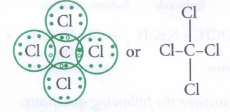
a) Write the formula and draw electron dot structure of carbon tetrachloride?
b) What is saponification? Write the reaction involved in this process.
22.
Explain the important of soil for plant growth.
23.
Name various plant hormones. Also give their physiological effects on plant growth and development.
24.
Write an advantage of giving the control of water management to the residents of the area?
25.
Why was the system of classification of elements into triads not found suitable?
26.
What is renewable source of energy?
27.
Write one example of each of the following:
(i) Most malleable metal and most ductile metal.
(ii) The best conductor of heat and the poorest conductor of heat.
(iii) A metal with highest melting point and a metal with lowest melting point.
28.
Give reasons for the following:
(i)The glottis is guarded by epiglottis
(ii)The lung alveoli are covered with blood capillaries.
(iii)The wall of trachea is supported by cartilage rings.
29.
(a) Why is the Solar Cooker box covered with a plane glass plate?
(b) Why is energy of water flowering in a river considered to be an indirect form of solar energy?
(c) How is the fission of nucleus brought about?
30.
Why are the Arabari forests of Bengal known to be a good example of conserved forest?
31.
An element A which is a yellow solid at room temperature shows catenation and allotropy. A forms two oxides which are also formed during the thermal decomposition of ferrous sulphate crystals and are the major air pollutants.
(a) Identify the element A
(b) Write the electronic configuration of A
(c) Write the balanced chemical equation for the thermal decomposition of ferrous sulphate crystals?
(d) What would be the nature (acidic/ basic ) of oxides formed?
(e) Locate the Position of the element in the Modern Periodic Table.
1.
The chemical formula of baking soda is NaHC03.It is prepared by using sodium chloride.
\(NaCl + H_2O + CO_2 + NH_3 \longrightarrow NH_4Cl +NaHCO_3\)
On heating
\(2NaHCo_3 \xrightarrow{Heat} Na_2CO_3 + H_2O + CO_2\)
2.
-s.jpg)
-s.jpg)
3.
Sources which are not available again and are getting exhausted and are called non-renewable sources of energy, e.g. coal, petroleum.
4.
(i) The light bending ability of a transparent medium is called the refractive index of that medium.
(ii) The ratio of speed of light in a medium is called the refractive index of that medium. Refractive index (of a medium) = Speed of light in vacuum / Speed of light in medium.
(iii) Since refractive index is a ratio of two similar quantities therefore it has no units.
(iv) The refractive index of glass is more than water.
5.
25cm
6.
| S.No | Acquired Trait | Inherited |
| 1 | It is a trait of an organism which is not inherited but develops in response to the environment. |
It is a trait of an organism which is inherited and caused by change in its genes or DNA. |
| 2 | It cannot be passed to next generation. | It can be passed to next generations. |
| 3. | It cannot direct evolution. | It can direct evolution. |
| 4 | Example - cut tail of a mouse. | Example red colour of beetles. |
7.
Planets are very close to the earth as compared to the stars. They also act as extended source of light. The total variation in the amount of light entering our eyes from all the individual point sized sources will average out to zero, which nullify the twinkling effect of each other. So, planets do not twinkle.
8.
Making kulhads on large scales leads to the loss of top soil.
9.
The male has both X and Y chromosomes, so they are heterogametic.
10.
1. When organisms reproduce asexually, only mitotic divisions are involved and the chromosome number remains the same. During asexual reproduction the DNA. (in the chromosomes) of the cells involved are copied and then equally divided among the two daughter cells formed. Thus, chromosome number remains unchanged.
2. In sexual reproduction, organisms produce gametes through a special type of division, meiosis-reductional division, in which the original number of chromosomes becomes half. These two gametes combine to form the zygote and the original number of chromosomes is restored. In sexual reproduction specialized cells/germ cells with only half the number of chromosomes are formed. When these germ cells from two individuals combine to form a new individual, the original chromosome number is restored.
3. Example: In humans, the parents father and mother each have 46 or 23 pairs of chromosomes. In the gametes - the sperm has half the number of chromosomes i.e., 23and the egg also has 23 chromosomes, when the sperm and the egg fuse, the zygote has 46 or 23 pairs of chromosomes. Thus, the chromosome number remains constant.
11.
Since the traits inherit independently there is appearance of new combinations of characters in F2 progeny.
12.
The stomach wall has gastric glands that secrete gastric juice which contains.
(i) Hydrochloric acid which makes the medium acidic facilitating the action of enzyme pepsin. It also kills bacteria that may enter the stomach with the food.
(ii) Mucus helps to protect stomach wall from the action of hydrochloric acid.
(iii) Enzyme pepsin begins the digestion of proteins present in the food.
13.
Yes. It is true that energy can neither be created nor destroyed and one form of energy is converted into another form. But the energy in the usable form is dissipated to the surrounding in the less usable form.
14.
Thyroxine is the hormone secreted by the thyroid gland. This hormone regulates the metabolism of carbohydrates, fats and proteins. By regulating the metabolism it helps in optimum growth and development of the body.
15.
Zinc and magnesium displace H2 from dilute acids while copper and silver do not.
16.
Hydrogen gas.
17.
(a) According to Arrhenius theory, acids are substances that produce H+ ions when mixed with water. On the other hand, based are substances that produce OH- ions when mixed with water.
(b) NH4OH is a weak base and HCl is a strong acid.
18.
(i) Universal indicator is a mixture of many different indications (or dyes) which give different colours at different pH values of the entire pH scale. The colour produced by the universal indicator is used to find the pH value of acid or base by matching the colour with the colours on pH colour chart.
(ii) Solution A is acidic and will turn litmus solution from blue to red.
Solution B is basic and will turn phenolphthalein from colourless to pink.
(iii) Green colour will be obtained.
19.
(a) Since two \(8\Omega \) resistors are in parallel, their effective resistance (\({ R }_{ P }\)) is given by,
\(\frac { 1 }{ { R }_{ P } } =\frac { 1 }{ 8 } +\frac { 1 }{ 8 } +\frac { 1 }{ 4 } \) or \({ R }_{ P }=4\Omega \)
(b) Total resistance in the circuit
\(R=4\Omega +{ R }_{ P }=4\Omega +4\Omega =84\Omega \)
Current through the electric circuit
\(I=\frac { V }{ R } =\frac { 8V }{ 8\Omega } =1A\)
(c) The potential difference \(4\Omega \) resistor V
I \(=IR=1\times 4=4V\)
(d) Power dissipated in \(4\Omega \) resistor P=\({ (I) }^{ 2 }\)
\(R={ (1) }^{ 2 }(4)=4W\)
(e) There is no difference in the readings of ammeters \({ A }_{ 1 }\) and \({ A }_{ 2 }\) as same current flows through all elements in a series circuit.
20.
(i) Primary Consumer: The primary consumers obtain their food directly from the producers i.e., plants. The primary consumers are the first order consumer which includes the animals eating plants or plant products. They are called herbivores. Examples - In terrestrial ecosystem, it includes cow, deer, goat, camel, rabbit, hare, horse, ox, elephant etc., and the common herbivores in the aquatic ecosystems include snails, mosquito, larvae, tadpoles etc. (ii) Secondary Consumer: The secondary consumers are the second order consumers which include animals feeding on only the flesh of other animals usually the herbivores. These are called primary carnivores or secondary consumer. Examples - In terrestrial ecosystem it includes frog, kingfisher, lizard, fox, etc., and in the aquatic ecosystems, it includes water bugs, water beetles, small fish etc.
(iii) Tertiary Consumer: The tertiary consumers are the third order consumers which include large animals feeding on the secondary consumers. These are called secondary carnivores. Examples - In terrestrial ecosystem, it includes wolves, snakes, etc., and in the aquatic ecosystems include water birds, large fishes etc.
(iv) Quaternary Consumer: The quaternary consumers are the fourth order consumers which feed on the tertiary consumers. These are called tertiary carnivores. The quaternary consumers are not eaten by other animals and so are called top carnivores. Examples - In the terrestrial ecosystems, it includes tiger, lion, eagles, hawks etc., and in the aquatic ecosystems, it includes crocodiles, sharks and other big fishes etc.
21.
\(\underset{Carbon}{C}+\underset{Chlorine}{2Cl_2}\xrightarrow{Heat}\underset{Carbon\ tetrachloridse}{CCl_4}\)
Its electron dot structure and structural formulae are:
b) Saponification - Alkaline hydrolysis of an ester to give the salt of the corresponding
acid and the alcohol is called saponification. It is reverse of esterification reaction.
For example.
\(\underset{Ester}{CH_3COOC_2H_5}+\underset{sodium\ hydroxide}{NaOH}\xrightarrow{Heat}\underset{Sodium\ acetate}{CH_3COONa}+\underset{Ethanol}{CH_3CH_2OH}\)
Dehydration means removal of a molecule of water. When ethanol is heated with
conc. H2SO4 at 443 K, it undergoes dehydration to form ethene.
\(\underset{Ethanol}{CH_3CH_2OH}\xrightarrow{Conc. H_2SO_4,443K}\underset{Ethene}{CH_2=CH_2+H_2O}\)
22.
(i)Anchoring the plant
(ii)Source of water and minerals
(iii)Availability of oxygen for respiration of root cells
(iv)Symbiotic association with microbes.
23.
Various plant hormones and their effects are as follows:
(i) Auxin : Promotes cell elongation and thus promotes growth of a plant part.
(ii) Gibberellins : Promotes growth.
(iii) Cytokinin : Promotes cell division and thus promotes growth.
(iv) Abscissic acid : Inhibits growth and is responsible for shedding or older parts.
24.
()
By giving the control of water management to the residents of the area ensures mismanagement and over exploitation is reduced.
25.
()
It is because all the elements discovered at that time could not be classified into triads.
26.
()
A source of energy that can be obtained on a regular basis even after using it continuously is called renewable source of energy like solar, wind and water energy.
27.
(i) Gold and silver are most malleable metal and most ductile metal,
(ii) Silver is the best conductor of heat and lead is the poorest conductor of heat.
(iii) Metal with highest melting point - Tungsten, iron. Metal with lowest melting point - Gallium, Cesium.
28.
(i)The glottis is gaurded by epiglottis because it prevents the entry of food in wind pipe. If the food enters wind pipe, then it chokes it, leading to the death of the person.
(ii)The lung alveoli are covered with blood vessels because the oxygen that we inhale dissolves in the blood, present in these blood capillaries only, as it reaches the lungs.
(iii)The wall of trachea is supported by cartilage rings because these rings prevent the air passage from collapsing.
29.
(a) The solar cooker box is covered with a plane glass plate so as to prevent heat from escaping.
(b) Sun is said to be the ultimate and the original source for most of the energy present on the earth. When sun rays fall on oceans and other water bodies, the water present in the water bodies gets evaporated and rises up in the atmosphere. In the upper part of the atmosphere, this water vapour gets condensed and forms douds, which give rain on the high lands. Therefore, the rain water runs over the Sand surface towards the large water bodies. This running water over the land surfaces is called river. Therefore, the energy of running water actually originates from the solar energy. This is why solar energy of water flowing in a river is considered to be an indirect form of solar energy.
(c) The fission of nucleus is brought about by splitting the nucleus of heavy atoms, such as uranium or plutonium, with low-energy neutron bombardment.
30.
The forest department developed a strategy in which the villagers were involved in the protection of the forest. In return for the labour, the villagers were paid and also had some benefit in harvesting operations. They were allowed to collect wood and fodder on payment of nominal fee. In this way, by the active and willing participation of the local people, the sal forests of Arabari were conserved.
31.
(a) The element A which is a yellow solid at room temperature and shows catenation and allotropy is sulphur (S).
(b) The atomic number of sulphur is 16. Therefore, its electronic configuration is 2, 8, 6.
(c) \(\underset { Ferroussulphate }{ { 2FeSO }_{ 4 } } \underrightarrow { Heat } \underset { Ferricoxide }{ { Fe }_{ 2 }{ O }_{ 3 } } +\underset { Sulphurdioxide }{ { SO }_{ 2 } } +\underset { Sulphurtrioxide }{ { SO }_{ 3 } } \)
Both SO2 and SO3 are major air pollutions.
(d) Since sulphur is a non-metal, therefore both S02 and S03 are acidic oxide since they dissolve in water to form the corresponding acids.
\(\underset { Sulphurdioxide }{ { SO }_{ 2 } } +\underset { Water }{ { H }_{ 2 }O } \rightarrow \underset { Sulphurousacid }{ { H }_{ 2 }{ SO }_{ 3 } } \\ \underset { Ferroustrioxide }{ { SO }_{ 3 } } +\underset { Water }{ { H }_{ 2 }O } \rightarrow \underset { Sulphuricacid }{ { H }_{ 2 }{ SO }_{ 4 } } \)
(e) Since sulphur contains six valence electrons, therefore it lies in group 6 + 10 = 16.Further, since atomic number of sulphur (S) is 16. It lies in the 3rd period.

10th Standard CBSE Syllabus & Materials
10th Standard CBSE
CBSE 10th Social Science PS - Federalism - New Model Questions Papers Study Material - QB365 Set A
NEW10th Standard CBSE
CBSE 10th Social Science PS - Power Sharing - New Model Questions Papers Study Material - QB365 Set A
NEW10th Standard CBSE
CBSE 10th Social Science GEO - Manufacturing Industries - New Model Questions Papers Study Material - QB365 Set A
NEW10th Standard CBSE
CBSE 10th Social Science GEO - Minerals and Energy Resources - New Model Questions Papers Study Material - QB365 Set A



NCERT Books

Syllabus

Exam Pattern

Sample Question Papers

Previous year Question Papers

Important Notes

MCQ Practice test

NCERT Exemplers

Case study Questions

Image Based Questions

Passage based Questions

HOT Questions

Value Based Questions

Model Questions Papers
NCERT ( Book Back ) Questions

Assertion and Reason
Important Questions And Answers

CBSE 10th Standard CBSE Subjects
CBSE Standards



