
 100% FREE ACCESS
10th Standard CBSE Syllabus & Materials
10th Standard CBSE
CBSE 10th Social Science ECO - Globalisation and the Indian Economy - New Model Questions Papers Study Material - QB365 Set A
NEW10th Standard CBSE
CBSE 10th Social Science ECO - Money and Credit - New Model Questions Papers Study Material - QB365 Set A
NEW10th Standard CBSE
CBSE 10th Social Science ECO - Sectors of the Indian Economy - New Model Questions Papers Study Material - QB365 Set A
NEW10th Standard CBSE
CBSE 10th Social Science ECO - Development - New Model Questions Papers Study Material - QB365 Set A
NEW10th Standard CBSE
CBSE 10th Social Science PS - Outcomes of Democracy - New Model Questions Papers Study Material - QB365 Set A
NEW10th Standard CBSE
CBSE 10th Social Science PS - Gender, Religion and Caste - New Model Questions Papers Study Material - QB365 Set A

Published on: 20/10/2025
Download CBSE Class 10th Standard CBSE Science question papers, sample papers, important questions, and previous year solved papers in PDF format. Get free study materials, NCERT solutions, and exam preparation resources for Class 10th Standard CBSE Science
Questions + Answers key
Take MCQ Science Test
1.
In all the electrical appliances, the switches are put in the
live wire
earth wire
neutral wire
none of the above
2.
No force acts on a current carrying conductor when it is placed
perpendicular to the magnetic field
parallel to the magnetic field
far away from the magnetic field
inside a magnetic field.
3.
The right-hand thumb rule is stated by
Oersted
Maxwell
Fleming
none of the above
4.
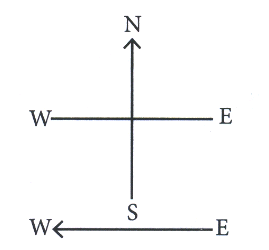
A constant current flows in a horizontal wire in the plane of the paper from east to west as shown in the figure. The direction of the magnetic field will be north to south at a point
Directly above the wire
directly below the wire
At a point located in the plane of the paper, on the north side of the wire
At a point located in the plane of the paper, on the south side of the wire.
5.
The most important safety method used for protecting home appliances from short circuiting or overloading is
Earthing
Use of fuse
Use of stabilisers
Use of electric meter.
6.
At the time of short circuit, the current in the circuit
reduces substantially
does not change
increases heavily
vary continuously
7.
The phenomenon of electromagnetic induction is
the process of charging a body.
the process of generating magnetic field due to a current passing through a coil.
producing induced current in a coil due to relative motion between a magnet and the coil.
the process of rotating a coil of an electric motor.
8.
A rectangular coil of copper wire is rotated in a magnetic field. The direction of the induced current changes once in each
Two revolutions
One revolution
Half revolution
One-fourth revolution
9.
A positively charged particle (alpha-particle) projected towards west is deflected towards north by a magnetic field. The direction of magnetic field is
towards south
towards east
downward
upward
10.
The magnetic field inside a long straight current carrying solenoid
is zero
decrease as we move towards its end
increases as we move towards its end
is the same at all points.
11.
What precaution should be taken to avoid the overloading of domestic electric circuits?
12.
AB is a current carrying conductor in the plane of the paper as shown in figure. What are the directions of magnetic fields produced by it at points P and Q?
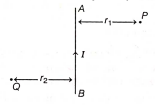
Given r1 > r2, where will the strength of the magnetic field be larger?
13.
Draw magnetic field through and around a solenoid carrying electric current
14.
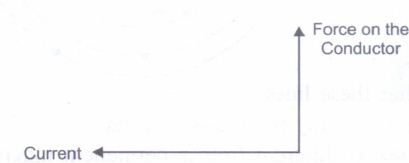
State the direction of magnetic field in the following case.
15.
Explain briefly the term overloading
16.
What is an earth wire?
17.
What are the two most commonly used domestic circuit?
18.
On what factor does strength of magnetic field of a solenoid depend?
19.
Name and state rule used to determine force on current-carrying conductor in a magnetic field.
20.
What is an electromagnet?
21.
Assertion: The direction of force is given by Fleming's left hand rule.
Reason : A magnetic field exert a force on a moving charge in the same direction as the direction of field itself.
Codes
(a) Both A and R are true, and R is correct explanation of the assertion.
(b) Both A and R are true, but R is not the correct explanation of the assertion.
(c) A is true, but R is false.
(d) A is false, but R is true.
22.
Assertion: Force experienced by moving charge will be maximum if direction of velocity of charge is parallel to applied magnetic field.
Reason: Force on moving charge is depends on direction of applied magnetic field.
Codes
(a) Both A and R are true, and R is correct explanation of the assertion.
(b) Both A and R are true, but R is not the correct explanation of the assertion.
(c) A is true, but R is false.
(d) A is false, but R is true.
1.
(c)
neutral wire
2.
(b)
parallel to the magnetic field
3.
(b)
Maxwell
4.
(b)
directly below the wire
5.
(b)
Use of fuse
6.
(c)
increases heavily
7.
(c)
producing induced current in a coil due to relative motion between a magnet and the coil.
8.
(c)
Half revolution
9.
(d)
upward
10.
(d)
is the same at all points.
11.
The following precautions should be taken to avoid the overloading of domestic electric circuits as given below:
(i) The circuits should be of proper current rating and appliances should be connected accordingly.
(ii) Wires should be checked from time-to-time and those wires whose insulation is worn, should be immediately replaced.
(ii) Connection of too many appliances in a single socket must be avoided.
12.
According to the right hand thumb rule, magnetic field at P is into the plane of paper and at Q, it is out of the plane of paper.
The strength of the magnetic field at Q will be larger as strength of the field ∝ 1/r(distance).
13.
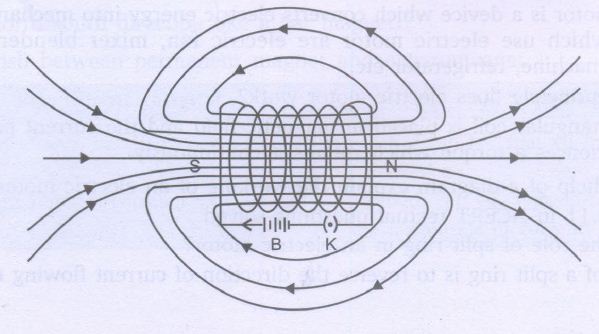
Coiled loop of wire is - solenoid
B - battery South and North pole - Sand N
14.
Perpendicular to the plane of paper in the outward direction by using Fleming's left hand rule
15.
When the total current drawn by all the appliances at a particular time exceeds the bearing capacity of that wire, the wires of the domestic wiring gets heated this is called overloading.
16.
An earth wire is connected to the metallic body of the appliances. This provides a low resistance conducting path for current and any leakage is safely conducted to earth reducing the severity of electric shock.
17.
5 A for low power rating appliances .
15 A for high power rating appliances.
18.
Strength of magnetic field of a solenoid is proportional to number of turns of coil and magnitude of current.
19.
Force on a current carrying conductor which is placed perpendicular to the direction of magnetic field is given by Fleming's Left Hand Rule.
According to this rule, stretch the thumb, fore-finger, and the middle finger of the left hand such that they are mutually perpendicular. If the fore-finger points in the direction of magnetic fields and middle finger in the direction of current, then the thumb will point in the direction of motion or force acting on the conductor.
20.
A magnet formed temporarily due to the magnetic field of a current is called an electromagnet.
21.
(c): According to Fleming's left hand rule, the direction of the magnetic force on a moving charge is always perpendicular to the magnetic field.
22.
(d): Force on moving charge will be maximum if direction of velocity of charge is perpendicular to direction of magnetic field.

10th Standard CBSE Syllabus & Materials
10th Standard CBSE
CBSE 10th Social Science PS - Federalism - New Model Questions Papers Study Material - QB365 Set A
NEW10th Standard CBSE
CBSE 10th Social Science PS - Power Sharing - New Model Questions Papers Study Material - QB365 Set A
NEW10th Standard CBSE
CBSE 10th Social Science GEO - Manufacturing Industries - New Model Questions Papers Study Material - QB365 Set A
NEW10th Standard CBSE
CBSE 10th Social Science GEO - Minerals and Energy Resources - New Model Questions Papers Study Material - QB365 Set A



NCERT Books

Syllabus

Exam Pattern

Sample Question Papers

Previous year Question Papers

Important Notes

MCQ Practice test

NCERT Exemplers

Case study Questions

Image Based Questions

Passage based Questions

HOT Questions

Value Based Questions

Model Questions Papers
NCERT ( Book Back ) Questions

Assertion and Reason
Important Questions And Answers

CBSE 10th Standard CBSE Subjects
CBSE Standards



