
 100% FREE ACCESS
10th Standard CBSE Syllabus & Materials
10th Standard CBSE
CBSE 10th Social Science ECO - Globalisation and the Indian Economy - New Model Questions Papers Study Material - QB365 Set A
NEW10th Standard CBSE
CBSE 10th Social Science ECO - Money and Credit - New Model Questions Papers Study Material - QB365 Set A
NEW10th Standard CBSE
CBSE 10th Social Science ECO - Sectors of the Indian Economy - New Model Questions Papers Study Material - QB365 Set A
NEW10th Standard CBSE
CBSE 10th Social Science ECO - Development - New Model Questions Papers Study Material - QB365 Set A
NEW10th Standard CBSE
CBSE 10th Social Science PS - Outcomes of Democracy - New Model Questions Papers Study Material - QB365 Set A
NEW10th Standard CBSE
CBSE 10th Social Science PS - Gender, Religion and Caste - New Model Questions Papers Study Material - QB365 Set A

Published on: 22/10/2025
Download CBSE Class 10th Standard CBSE Science question papers, sample papers, important questions, and previous year solved papers in PDF format. Get free study materials, NCERT solutions, and exam preparation resources for Class 10th Standard CBSE Science
Questions + Answers key
Take MCQ Science Test
1.
Which of the following reaction shows that the given oxide is amphoteric in nature?
\(2 \mathrm{Zn}+\mathrm{O}_2 \xrightarrow{\Delta} 2 \mathrm{ZnO}\)
\(\mathrm{ZnO}+\mathrm{H}_2 \mathrm{SO}_4 \longrightarrow \mathrm{ZnSO}_4+\mathrm{H}_2 \mathrm{O}(l)\)
\(\mathrm{ZnO}+2 \mathrm{NaOH} \longrightarrow \mathrm{Na}_2 \mathrm{ZnO}_2+\mathrm{H}_2 \mathrm{O}(l)\)
(b) and (c) together
2.
The following illustration represents the
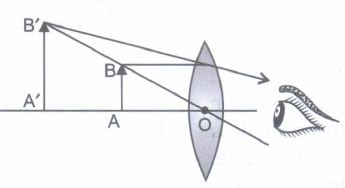
Correction of eye defect
working of a simple microscope
both (a) and (b)
none of the above
3.
The coloured light that refracts most while passing through a prism is
Yellow
Violet
Blue
Red
4.
When iron fillings are heated in a stream of dry hydrogen chloride the compound formed is FeClx where X is
1
2
3
4
5.
Which of the following phenomena contributes significantly to the reddish appearance of the sun at sunrise or sunset?
Dispersion of light
Scattering of light
Total internal reflection of light
Reflection of light from the earth
6.
At noon the sun appears white as
light is least scattered
all the colours of the white light are scattered away
blue colour is scattered the most
red colour is scattered the most
7.
A student sitting on the bench can read the letters written on the blackboard but is not able to read the letters written in his text book. Which of the following statement is correct?
The near point of his eyes has receded away
The near point of his eyes has come closer to him
The far point of his eyes has come closer him
The far point of his eyes has receded away
8.
The human eye can focus objects at different distances by adjusting the focal length of the eye lens. This is due to
Presbyopia
Accommodation
Near sightedness
Far sightedness
9.
Which among the following statements is incorrect for magnesium metal?
It burns in oxygen with a dazzling white flame.
It reacts with cold water to form magnesium oxide and evolves hydrogen gas
It reacts with hot water to form magnesium hydroxide and evolves hydrogen gas.
It reacts with steam to form magnesium hydroxide and evolves hydrogen gas.
10.
Galvanisation is a method of protecting iron from rusting by coating with a thin layer of
Gallium
Aluminium
Zinc
Silver
11.
Which of the following properly is generally not shown by metals?
Electrical conduction
Sonorous in nature
Dullness
Ductility
12.
Which of the following pairs will give displacement reactions?
NaCl solution and copper metal
MgCl2 solution and aluminium metal
FeSO4 solution and silver metal
AgNO3 solution and copper metal
13.
What are such metals called, which are soft, can be cut with knife, low densities and low melting point?
14.
Name two meta Is which are best conductors of heat.
15.
Name two metals which are found in nature in the free state.
16.
17.
Draw ray diagram each showing (i)myopic eye and (ii) hypermetropic eye.
18.
Why is a normal eye not able to see clearly the objects placed closer than 25 cm?
19.
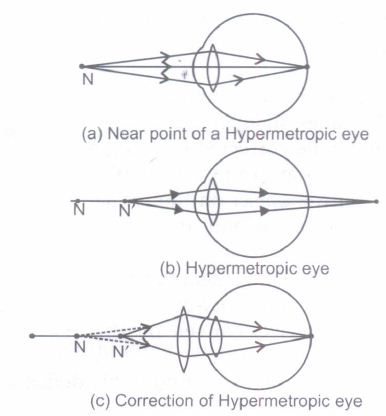
What is hypermetropia? State the two causes of hypermetropia. With the help of ray diagram show:
(i) the eye defect hypermetropia.
(ii) correction of hypermetropia by using a lens.
20.
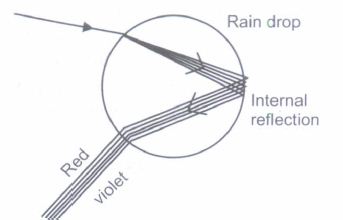
(a) What is meant by dispersion of white light? Describe the formation of rainbow in the sky with the help of a diagram.
(b) What is hypermetropia? Draw ray diagrams to show the image formation of an objects by
(i) hypermetropic eye
(ii) Correction made with a suitable lens for hypermetropic eye.
21.
Suggest a method of reduction for the following metals during their metallurgical processes:
(i) metal 'A ' which is one of the last, second or third position in the reactivity.
(ii) metal 'B' which gives vigorous reaction even with water and air.
(iii) metal 'C' which is kept in the middle of activity series.
22.
Write balanced equations for the reaction of:
(i) aluminium when heated in air. Write the name of the product.
(ii) iron with steam. Name the product obtained.
(iii) calcium with water. Why does calcium start floating in water?
23.
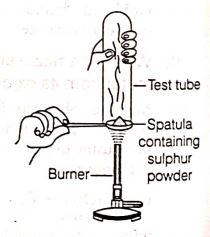
Pratyush took sulphur powder on a spatula and heated it. He collected the gas evolved by inverting a test tube over it as shown in the figure below
(a) What will be the action of gas on
(i) Dry litmus paper?
(ii) Moist litmus paper?
(b) Write a balanced chemical equation for the reaction taking place.
24.
(i) Predict the reaction, if any, between
(a) zinc and silver nitrate solution.
(b) magnesium and iron (II) chloride solution.
(c) copper and magnesium sulphate solution.
Write the equations, with its physical form and symbols, for the reaction.
(ii) A lump of element X can be cut by a knife. During its reaction with water, X floats and melts. What is X? Explain.
25.
Name three refractive defects of vision with the help of diagram. Explain the reasons and correction of these defects.
26.
1) Place a strong source (S) of white light at the focus of a converging lens (L1). This lens provides a parallel beam of light.
2) Allow the light beam to pass through a transparent glass tank (T) containing clear water.
3) Allow the beam of light to pass through a circular hole (c) made in a cardboard.
Obtain a sharp image of the circular hole on a screen (MN) using a second converging lens (L2), as shown in Fig.
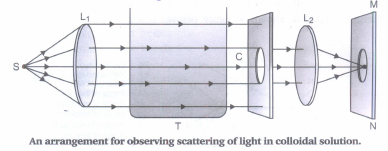
4) Dissolve about 200 g of sodium thiosulphate (hypo) in about 2 L of clean water taken in the tank. Add about 1 to 2 mL of concentrated sulphuric acid to the water. What do you observe?
27.
Assertion: With one eye open we can see things in one dimension.
Reason: By opening two eyes we can see in two dimension.
Codes
(a) If both assertion and reason are true and the reason is correct explanation of assertion.
(b) If both assertion and reason are true but reason is not a correct explanation of assertion.
(c) If assertion is true and reason is false.
(d) If both assertion and reason are false.
28.
Light of all the colour travel at the same speed in vacuum for all wavelengths. But in any transparent medium
(glass or water), the light of different colours travel with different speeds for different wavelength that means
that the refractive index of a particular medium is different for different wavelength. As there is a difference in
their speeds, the light of different colour bend through different angles. The speed of violet colour is maximum and the speed of red colour is minimum in glass so, the red light deviates least and violet colour deviates most.
Hence, higher the wavelength of a colour of light, smaller the refractive index and less is the bending of light.
\(\begin{equation}
\lambda
\end{equation}\)r > \(\begin{equation}
\lambda
\end{equation}\)v and rn < vn, \(\begin{equation}
v=\frac{c}{\lambda} .
\end{equation}\)
(i) Which of the following statements is correct regarding the propagation of light of different colours of white light in air?
(a) Red light moves fastest.
(b) Blue light moves faster than green light.
(c) All the colours of the white light move with the same speed.
(d) Yellow light moves with the mean speed as that of the red and the violet light.
(ii) Which of the following is the correct order of wavelength?
| (a) Red> Green> Yellow | (b) Red> Violet> Green |
| (c) Yellow> Green> Violet | (d) Red> Yellow> Orange |
(iii) Which of the following is the correct order of speed of light in glass?
| (a) Red> Green> Blue | (b) Blue> Green> Red |
| (c) Violet> Red> Green | (d) Green> Red> Blue |
(iv) Which colour which has maximum frequency
| (a) Red | (b) Violet |
| (c) Blue | (d) Green |
(v) Which of the following is the correct order of angle of deviation?
| (a) Red> Green> Blue | (b) Blue> Yellow> Orange |
| (c) Orange> Red> Green | (d) Blue> Green> Violet |
29.
Sample pieces of five metals P, Q, R, S and T are added to the tabulated solutions separately. The results observed are shown in the table given below:
| Metal | Solutions | |||
| CuSO4 | ZnSO4 | FeSO4 |
AgNO3 |
|
| P | No change | No change | No change | A coating on metal |
| Q | Brown coating | ___ | Grey deposit | A coating on metal |
| R | No change | No change | No change | No change |
| S | ___ | No change | No change | Brown deposit |
| T | Brown deposit | New coating | New coating | New coating |
Based on the observations recorded in the table answer the following questions:
(i) Which is the most reactive metal?
| (a) Q | (b) R | (c) S | (d) T |
(ii) Which is the least reactive metal?
| (a) P | (b) R | (c) T | (d) Q |
(iii) Activity series of elements is
| (a) the arrangement of elements in increasing order of reactivity. |
| (b) the arrangement of elements in decreasing order of reactivity. |
| (c) the arrangement of oxides of elements in increasing order of reactivity |
| (d) none of these. |
(iv) Which of the following metal is least reactive?
| (a) Zn | (b) Cu | (c) Ag | (d) Fe |
(v) Decreasing order of reactivity is
| (a) P>Q>R >S>T | (b) Q>T>R>S>P |
| (c) T>Q>S>P>R | (d) S>R>Q>T>P |
1.
(d)
(b) and (c) together
2.
(a)
Correction of eye defect
3.
(b)
Violet
4.
(b)
2
5.
(b)
Scattering of light
6.
(a)
light is least scattered
7.
(a)
The near point of his eyes has receded away
8.
(b)
Accommodation
9.
(b)
It reacts with cold water to form magnesium oxide and evolves hydrogen gas
10.
(c)
Zinc
11.
(c)
Dullness
12.
(d)
AgNO3 solution and copper metal
13.
Alkali metals, e.g., lithium, sodium and potassium.
14.
Silver and Copper are the best conductors of heat.
15.
Gold and platinum are the two metals that are found in nature in free state.
16.
17.
-s.png)
-s.png)
18.
As our eye cannot focus the objects placed closer than 25 cm on the retina. we are unable to see the objects clearly.
19.
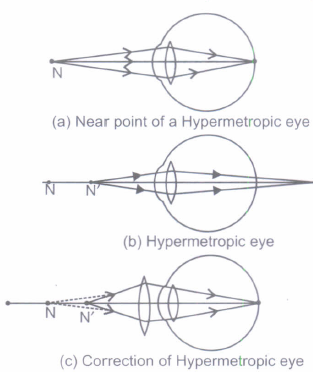
(a) Hypermetropia: It is also called long sightedness. The person with this eye defect can see far off objects but cannot see nearby objects clearly. The image is formed beyond retina.
(b) Two causes
(i) Focal length of the lens increases
(ii) Eye ball becomes smaller
(c) Correction: It can be corrected by using a convex lens. It is a converging lens which shifts the image of the object on the retina.
20.
(a)The splitting of white light into its constituent seven colours is called dispersion of light.
Rainbow formation in the sky: The water droplets suspended in the atmosphere after rain causes the splitting of sunlight by acting as small prism. The light enters the water droplets, refracts, splits, and shows internal reflection. Then again undergoes refraction to give a band of seven colours called rainbow.
(b)Hypermetropia: Also called long-sightedness. Person can see long distant objects but cannot see nearby objects distinctly. This is because the eyeball becomes smaller, focal length increases. It can be corrected by using converging lens called convex lens. Internal reflection AIls.
21.
(i) 'A ' can be obtained by chemical reduction using carbon or carbon monoxide as reducing agent.
(ii) 'B' can be obtained by electrolytic reduction.
(iii) 'C' can be reduced by reducing agent like 'AI'.
22.
(i) 4Al + 3O2 \(\overset { heat }{ \longrightarrow } \) 2Al2O3.
The product formed is aluminium oxide.
(ii) 3Fe + 4H2O (steam) \(\longrightarrow \) Fe3O4 + 4H2
The product obtained is iron (II) iron (III) oxide.
(iii) Ca + 2H2O \(\longrightarrow \) Ca(OH)2+ H2
The bubbles of hydrogen stick to the surface of metal which when moves up takes metal with it and makes it float
23.
(i) (a) No change in colour will take place in case of dry blue litmus.
(b) The moist blue litmus paper will change its colour to red because sulphur is non-metal and non-metal oxides are acidic in nature.
(ii) S(s) + O2(g) \(\rightarrow\) SO2(g)
SO2(g) + H2O(l) \(\rightarrow\) H2SO3 (aq)
Sulphurous acid
24.
(i) (a) Zinc is more reactive than silver. It will displace silver from silver nitrate solution.
Zn(s) + 2AgNO3(aq) \(\rightarrow\) Zn(NO3)2(aq) +2Ag(s)
(b) Magnesium is more reactive than iron. It will displace iron from iron (II) chloride solution.
Mg(s) + FeCI2 (aq) \(\rightarrow\) MgCl2(aq) + Fe(s)
(c) Copper is less reactive than magnesium. It will not displace magnesium from magnesium sulphate solution. Thus, no reaction will take place.
Cu(s) + MgSO4(aq) \(\rightarrow\) No reaction
(ii) X is potassium (K). Potassium being soft can be cut with a knife and being lighter than water floats at the surface. The heat produced during reaction with water will melt it.
25.
The three refractive defects of vision are
(i) Myopia:(a) Myopia or short-sightedness-Eye can see objects at short distance. Inability of the eye in viewing long distant objects. The image falls before retina.
Causes: (i) Elongation of eye ball.
(ii) Excessive curvature in cornea and focal length of lens decreases.
Correction: By using concave lens (diverging lens), which shifts the image to the retina by diverging the rays further.
(b) The near point of human eye is 25 cm which cannot be changed further hence the objects within 10 cm of the eye cannot be viewed (ii) Hypermetropia (iii) Presbyopia
(ii)Hypermetropia: Also called long-sightedness. Person can see long distant objects but cannot see nearby objects distinctly. This is because the eye ball becomes smaller, focal length increases. It can be corrected by using converging lens called convex lens.
(iii)Presbyopia: The person suffering from this disease cannot see nearby as well as far off objects. It is caused due to weakening of ciliary muscles. This defect is caused due to ageing. The lens is not able to change the focal length. It can be corrected by using bi-focal lens.
26.
1. Place a strong source (S) of white light at the focus of a converging lens (Ll). This lens provides a parallel beam of light.
2. Allow the light beam to pass through a transparent glass tank (T) containing clear water.
3. Allow the beam of light to pass through a circular hole (c) made in a cardboard. Obtain a sharp image of the circular hole on a screen (MN) using a second converging lens (L2) , as shown in figure.
4. Dissolve about 200 g of sodium thiosulphate (hypo) in about 2 L of clean water taken in the tank. Add about 1 to 2 mL of concentrated sulphuric acid to the water. What do you observe?
Observation: The beaker appears to give blue light on its sides as the scattering of light
takes place. While the light obtained on the screen is red in colour because all blue light has scattered and red light travels through the beaker, will not get scattered due to small particles in beaker and passes straight and gets collected on the screen.
27.
(d) If both assertion and reason are false.
28.
(i) (c): All the colours of the white light move with the same speed in air.
(ii) (c): The increasing order of wavelength of visible spectrum is
Violet < Indigo < Blue < Green < Yellow < Orange < Red
So, the correct order is
Yellow> Green> Violet
(iii) (b): The more be the wavelength, more be the speed.
(iv) (b): Frequency is inversely proportional to the wavelength. Violet has minimum wavelength among all these colours, so violet has maximum frequency.
(v) (b): The angle of deviation is more for more refractive index.
29.
(i) (d): The most reactive metal is T.
(ii) (b): The least reactive metal is R.
(iii) (b)
(iv) (c)
(v) (c): T> Q> S> P> R

10th Standard CBSE Syllabus & Materials
10th Standard CBSE
CBSE 10th Social Science PS - Federalism - New Model Questions Papers Study Material - QB365 Set A
NEW10th Standard CBSE
CBSE 10th Social Science PS - Power Sharing - New Model Questions Papers Study Material - QB365 Set A
NEW10th Standard CBSE
CBSE 10th Social Science GEO - Manufacturing Industries - New Model Questions Papers Study Material - QB365 Set A
NEW10th Standard CBSE
CBSE 10th Social Science GEO - Minerals and Energy Resources - New Model Questions Papers Study Material - QB365 Set A



NCERT Books

Syllabus

Exam Pattern

Sample Question Papers

Previous year Question Papers

Important Notes

MCQ Practice test

NCERT Exemplers

Case study Questions

Image Based Questions

Passage based Questions

HOT Questions

Value Based Questions

Model Questions Papers
NCERT ( Book Back ) Questions

Assertion and Reason
Important Questions And Answers

CBSE 10th Standard CBSE Subjects
CBSE Standards



