
 100% FREE ACCESS
10th Standard CBSE Syllabus & Materials
10th Standard CBSE
CBSE 10th Social Science ECO - Globalisation and the Indian Economy - New Model Questions Papers Study Material - QB365 Set A
NEW10th Standard CBSE
CBSE 10th Social Science ECO - Money and Credit - New Model Questions Papers Study Material - QB365 Set A
NEW10th Standard CBSE
CBSE 10th Social Science ECO - Sectors of the Indian Economy - New Model Questions Papers Study Material - QB365 Set A
NEW10th Standard CBSE
CBSE 10th Social Science ECO - Development - New Model Questions Papers Study Material - QB365 Set A
NEW10th Standard CBSE
CBSE 10th Social Science PS - Outcomes of Democracy - New Model Questions Papers Study Material - QB365 Set A
NEW10th Standard CBSE
CBSE 10th Social Science PS - Gender, Religion and Caste - New Model Questions Papers Study Material - QB365 Set A

Published on: 22/10/2025
Download CBSE Class 10th Standard CBSE Science question papers, sample papers, important questions, and previous year solved papers in PDF format. Get free study materials, NCERT solutions, and exam preparation resources for Class 10th Standard CBSE Science
Questions + Answers key
Take MCQ Science Test
1.
What is an alloy? State the constituents of solder. Which property of solder makes it suitable for welding electrical wires?
2.
(i) Name the hormones that are released in human males and females when they reach puberty.
(ii) Name a gland associated with brain. Which problem is caused due to the
deficiency of the hormone released by this gland?
3.
Write one example for each of the following tropic movements:
(i) Positive phototropism (ii) Negative phototropism
(iii) Positive--geotropism (ii) Negative geotropism
(iv) Hydrotropism (ii) Chemotropism
4.
X + YSO4 \(\longrightarrow \) XSO4 + Y
Y + XSO4 \(\longrightarrow \) No reaction
Out of the two elements, 'X' and 'Y', which is more reactive and why?
5.
A non-metal X exists in two different forms Y and Z, Y is the hardest natural substance, whereas Z is a good conductor of electricity. Identify X, Y and Z.
6.
Compare and contrast nervous and hormonal mechanisms for control and coordination in animals.
7.
How do auxins promote the growth of a tendril around a support?
8.
Which part of the brain maintains posture and equilibrium of the body?
9.
Which gas is produced when dilute hydrochloric acid is added to a reactive metal? Write the chemical reaction when iron reacts with dilute H2SO4.
10.
Why is sodium kept immersed in kerosene oil?
11.
State the structural and the functional unit of the nervous system. Draw its neat labelled diagram and write two functions.
12.
A man went door to door posing to be a goldsmith. He promised to bring back the glitter of old and dull gold ornaments. An unsuspecting lady gave a set of gold bangles to him which he dipped in a particular solution. The bangles sparkled like new but their weight was reduced drastically. The lady was upset but after a futile argument, the man beat a hasty retreat.
(i) Can you play the detective to find out the nature of the solution he had used?
(ii) What is 24 carat gold?
13.
How does phototropism occur in plants?
14.
Samples of four metals A, B, C and D were taken and added to the following solution one by one. The result obtained have been tabulated as follows :
| Metals | Iron (II) Sulphate | Copper (II) Sulphate | Zinc Sulphate | Silver Nitrate |
| A | No reaction | Displacement | - | - |
| B | Displacement | - | No reaction | - |
| C | No reaction | No reaction | No reaction | Displacement |
| D | No reaction | No reaction | No reaction | No reaction |
Use the given table above to answer the following questions about metals A, B, C and D
(i) Which is the most reactive metal?
(ii) What would you observed if B is added to a solution of copper (II) sulphate?
(iii) Arrange the metals A, B, C and D in the order of decreasing reactivity.
1.
Alloy is a homogeneous mixture of two or more metals. One of them can be a non- metal also. Solder cons its of lead and tin. It has low melting point which makes it suitable for welding electrical wires.
2.
(i) Testes in males produces hormone testosterone. Ovaries in females produces hormone oestrogen
(ii) Pituitary gland present in the brain is responsible for body growth, development of bones and muscles. If the release is in excess it causes gigantism and if it is produced less then it causes dwarfism.
3.
(i) Positive phototropism: Shoots growing towards light.
(ii) Negative phototropism: Roots growing away from light towards ground.
(iii) Positive geotropism: Growth of roots towards earth due to the pull of the earth, i.e. gravity
(iv) Negative geotropism: Shoots growing away from gravity.
(v) Hydrotropism: Roots growing towards the source of water.
(vi) Chemotropism: Growth of pollen tubes towards the ovary
4.
'X' is more reactive than 'Y' because it displaces 'Y' from its salt solution.
5.
X - Carbon; Y - Diamond and Z - Graphite
6.
Comparison between hormonal mechanisms are as follows :
| Basis | Hormonal Mechanism/Endocrine System | Nervous Mechanism |
| Passage of Information | It is through chemicals called hormones. | It is through electrical conduction. |
| Sensory receptors | Absent | Present |
| Rapidly | The system is comparatively slower. | The system is rapid |
| Connection | The system is not connected to target sites directly. | The systern is directly connected to every part under its control. |
| Response | The response is slow and produced by all the cells of target tissues. | The response is quick and limited to those cells that are innervated with nerves. |
| Role in growth and development | The system controls growth and development. | It has little role in growth and development. |
| Components | It consists of glands and their secretions. | It consists of neurons, nerves and nervous organs. |
| Effects | The effect of chemical message lasts for longer period. | The effect of nervous message is for short duration. |
| Action | It is Involuntary. | It can be voluntary or involuntary. |
7.
Auxins promote cell elongation and are present at the shoot tip. When tendril comes in contact with a support, auxin stimulates faster growth of the cells on the opposite sides. Thus, the tendril coils around the support.
8.
Cerebellum is the part of hindbrain that maintains posture and equilibrium of the body.
9.
Hydrogen gas is produced when dilute hydrochloric acid is added to a reactive metal.
Fe(s) + H2SO4 (aq) \(\rightarrow\) FeSO4 (aq) + H2(g)
Iron Dil. Sulphuric acid Ferrous sulphate Hydrogen
10.
Sodium metal being reactive highly reacts so vigorously with oxygen that it catches fire if kept in open air. Therefore, to protect it from accidental fires, sodium is kept immersed in kerosene oil.
11.
The structural and functional unit of the nervous system is called neuron
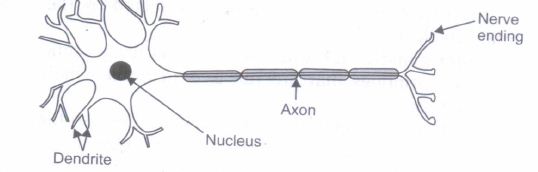
Two functions of neuron: .
(a) Neurons receive signals from a sense organ.
(b) Neurons send signals to a muscle or a gland.
12.
(i) The nature of the solution is acidic. It is a mixture of conc. HNO3, and conc. HCI in the ratio of 1 : 3. It can dissolve gold as it is an oxidising agent.
(ii) Pure gold is 24 carat gold which is very soft.
13.
The directional movement of the plant in response to light is called phototropism. The shoots respond by bending towards light and roots respond by bending away from the light.
This happens as follows:
(i) When sunlight falls straight on the plant, the auxin hormone synthesised at the tip of the stem spreads uniformly down the stem and due to equal concentration of auxin, stem grows straight.
(ii) When sunlight falls on only one side of the plant, the auxin diffuses towards the shady side of shoot. The concentration of auxin stimulates the cells to grow longer. Therefore, the stem appears to bend towards the source of light in the directional movement
14.
(i) B is the most active metal as it displaces iron from its salt solution.
(ii) B will displace Cu from CuSO4 solution because B is more reactive than copper.
(iii) B > A > C > D.

10th Standard CBSE Syllabus & Materials
10th Standard CBSE
CBSE 10th Social Science PS - Federalism - New Model Questions Papers Study Material - QB365 Set A
NEW10th Standard CBSE
CBSE 10th Social Science PS - Power Sharing - New Model Questions Papers Study Material - QB365 Set A
NEW10th Standard CBSE
CBSE 10th Social Science GEO - Manufacturing Industries - New Model Questions Papers Study Material - QB365 Set A
NEW10th Standard CBSE
CBSE 10th Social Science GEO - Minerals and Energy Resources - New Model Questions Papers Study Material - QB365 Set A



NCERT Books

Syllabus

Exam Pattern

Sample Question Papers

Previous year Question Papers

Important Notes

MCQ Practice test

NCERT Exemplers

Case study Questions

Image Based Questions

Passage based Questions

HOT Questions

Value Based Questions

Model Questions Papers
NCERT ( Book Back ) Questions

Assertion and Reason
Important Questions And Answers

CBSE 10th Standard CBSE Subjects
CBSE Standards



