
 100% FREE ACCESS
10th Standard CBSE Syllabus & Materials
10th Standard CBSE
CBSE 10th Social Science ECO - Globalisation and the Indian Economy - New Model Questions Papers Study Material - QB365 Set A
NEW10th Standard CBSE
CBSE 10th Social Science ECO - Money and Credit - New Model Questions Papers Study Material - QB365 Set A
NEW10th Standard CBSE
CBSE 10th Social Science ECO - Sectors of the Indian Economy - New Model Questions Papers Study Material - QB365 Set A
NEW10th Standard CBSE
CBSE 10th Social Science ECO - Development - New Model Questions Papers Study Material - QB365 Set A
NEW10th Standard CBSE
CBSE 10th Social Science PS - Outcomes of Democracy - New Model Questions Papers Study Material - QB365 Set A
NEW10th Standard CBSE
CBSE 10th Social Science PS - Gender, Religion and Caste - New Model Questions Papers Study Material - QB365 Set A

Published on: 22/10/2025
Download CBSE Class 10th Standard CBSE Science question papers, sample papers, important questions, and previous year solved papers in PDF format. Get free study materials, NCERT solutions, and exam preparation resources for Class 10th Standard CBSE Science
Questions + Answers key
Take MCQ Science Test
1.
Shown below is a container that is used in the transportation of goods over long distances.
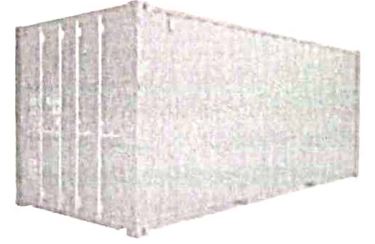
These containers are made of steel. Which property of steel is mainly used to make these containers?
Its ductility
Its malleability
Its metallic lustre
Its electrical conductivity
2.
Pratyush took sulphur powder on a spatula and heated it. He collected the gas evolved by inverting a test tube over it as shown in figure. The gas evolved is
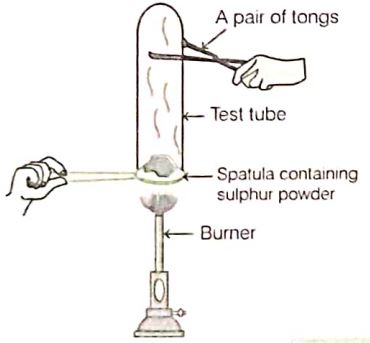
O2
SO2
CO2
H2 and SO2
3.
Listed here is the reactivity of certain metals.
| Metal | Reaction with air | Reaction with water | Reaction with dilute acids |
| Gold | Does not oxidise or burn | No reaction | No reaction |
| Sodium | Burns vigorously to form Oxide | Violent reaction | Violent reaction |
| Zinc | Burns to form oxides | Reacts on heating with water | Reacts to produce hydrogen |
| Platinum | Does not oxidise or burn | No reaction | No reaction |
Which of the above metals are likely to be obtained in their pure states from the Earth's crust?
Only gold
Only sodium
Gold and platinum
Zinc and sodium
4.
Bronze is an alloy of
copper and zinc
aluminum and tin
copper, tin and zinc
copper and tin
5.
A piece of zinc (Zn)-a reactive metal-was dropped into a test tube containing a substance. A zinc salt was formed and hydrogen gas was liberated. This is shown in the equation below.
Zn+ \(\rightarrow\) Zinc salt + H2 gas
Which of the following can be the substance that zinc was dropped into?
P. water
Q. hydrochloric acid
R. a solution of a zinc salt
Only P
Only Q
Only R
Either P or R
6.
Which of the following metals, do not corrode in moist air?
Copper
Iron
Gold
Silver
7.
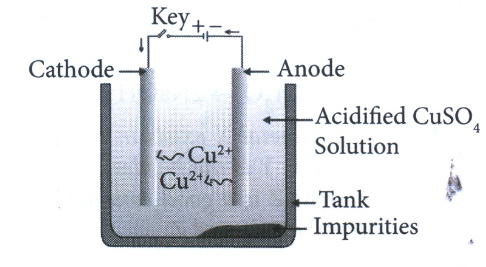
The following diagram shows the electrolytic refining of copper:
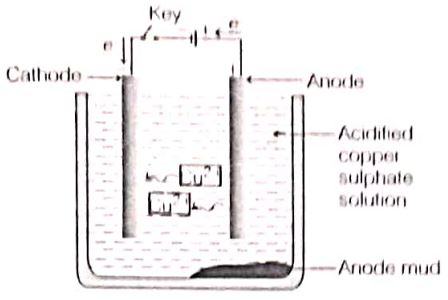
Which of the following statements is Incorrect description of the process?
The impure metal from the anode dissolves into the electrolyte.
The pure metal from the electrolyte is deposited on the cathode.
Insoluble impurities settle down at the bottom of the anode.
On passing the current through the electrolyte, the pure metal from the anode dissolves into the electrolyte
8.
In the given experimental set-up, if the experiment is carried out separately with each of the following solutions the cases in which the bulb will glow is
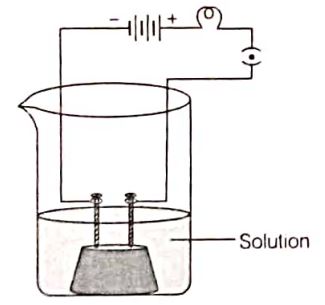
dilute hydrochloric acid
honey
glucose solution
alcohol
9.
During the electrolytic refining of copper, what happens at the anode?
Copper ions gain electrons to become neutral copper atoms.
Neutral copper atoms gain electrons to becomes ions.
Copper ions lose electrons to become neutral atoms.
Neutral copper atoms lose electrons to become ions.
10.
The diagram shows the reaction between metal and dil. acid.
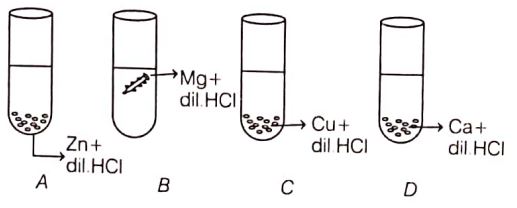
What is the reason for different behaviour of Mg in test tube B?
Mg is lighter element than dil HCI
Mg reacts with dil. HCl to produce H2 gas which helps in floating
Mg reacts with dil HCl to produce N2, gas which helps in floating
Mg reacts with dil HCl to produce CO2 gas which helps in floating
11.
ldentify gas A in the following experiment.
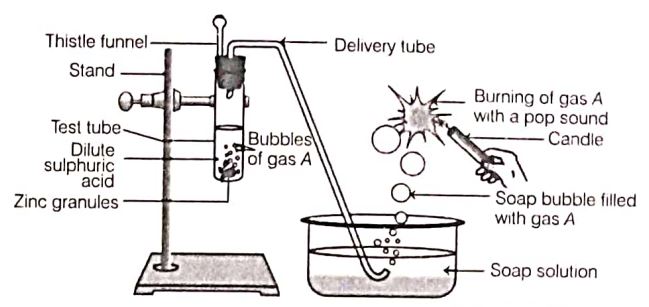
Nitrogen
Hydrogen
Oxygen
Carbon dioxide
12.
An element 'X' reacts with O2 to give a compound with a high melting point. This compound is also soluble in water. The element 'X' is likely to be
iron
calcium
carbon
silicon
13.
Sodium hydroxide is termed an alkali while ferric hydroxide is not because
sodium hydroxide is a strong base, while ferric hydroxide is a weak base.
sodium hydroxide is a base which is soluble in water while ferric hydroxide is also a base but it is not soluble in water.
sodium hydroxide is a strong base while ferric hydroxide is a strong acid.
sodium hydroxide and ferric hydroxide both are strong base but the solubility of sodium hydroxide in water is comparatively higher than that of ferric hydroxide.
14.
A reactive metal (M) is treated with H2SO4 (dil). The gas is evolved and is collected over the water as shown in the figure:
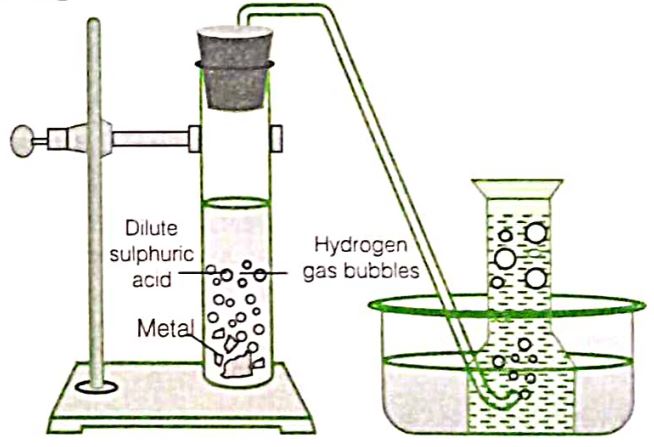
The correct conclusion drawn is
the gas is oxygen.
the gas is lighter than air.
the gas is SO2 and is lighter than air.
the gas is H2 and is heavier than air.
15.
Which of the following reaction shows that the given oxide is amphoteric in nature?
\(2 \mathrm{Zn}+\mathrm{O}_2 \xrightarrow{\Delta} 2 \mathrm{ZnO}\)
\(\mathrm{ZnO}+\mathrm{H}_2 \mathrm{SO}_4 \longrightarrow \mathrm{ZnSO}_4+\mathrm{H}_2 \mathrm{O}(l)\)
\(\mathrm{ZnO}+2 \mathrm{NaOH} \longrightarrow \mathrm{Na}_2 \mathrm{ZnO}_2+\mathrm{H}_2 \mathrm{O}(l)\)
(b) and (c) together
16.
Arrange the following metals in the order of their decreasing reactivity: Fe, Cu, Mg, Ca, Zn,Ag
Ca > Zn > Mg > Cu > Ag > Fe
Ca > Zn > Cu > Mg > Ag > Fe
Ca > Mg > Zn > Fe > Cu > Ag
Ca > Mg > Fe > Zn > Cu > Ag
17.
Identify an ore containing sulphur in it
Siderite
Fluorspar
Iron pyrites
Calamine
18.
Magnesium dissolves in hot water to form
MgO
Mg(OH)2
MgOH
MgO.Mg(OH)2
19.
Which of the following oxides, on reduction with carbon gives metal?
Al2O3
ZnO
MgO
All of these
20.
Cu + 2Ag(NO3)2 \(\longrightarrow \) CU(NO3)2 + 2Ag
Pb + CU(NO3)2 \(\longrightarrow \) Pb(NO3)2 + Cu
Zn + Pb(NO3)2 \(\longrightarrow \) Zn(NO3)2 + Pb
The most reactive metal is
Ag
Pb
Cu
Zn
21.
The method used for reduction of mercuric oxide to mercury is
Heating
Chemical reduction
Calcination
Electrolytic reduction
22.
The process of coating of Zn over Fe is known as
Cathodic protection
Metallurgy
Tinning
Galvanization
23.
The electronic configuration of three element X, Y and Z are
X - 2,8
Y - 2, 8, 6
Z - 2, 8, 1
Which of the following is correct?
X is a metal
Z is a non-metal
Y is a metal
X and Yare non-metal and Z is a metal
24.
5 mL each of cone. HCI, HNO3 and a mixture of cone. HCl (15 mL) and cone. HNO3 (5 mL) were taken in test tubes labelled as A, Band C. A small piece of metal was put in each tube. No change occurred in test tube A and B but the metal got dissolved in test tube C. The metal could be
AI
Au
Cu
Na
25.
Which of the following are not ionic compounds?
CaCl2
MgCl2
NaCl
CCl4
26.
Which of the following will not evolve CO2 upon heating?
CaCO3
MgCO3
ZnCO3
Na2CO3
27.
An aluminium strip is kept immersed in freshly prepared ferrous sulphate solution taken in a test tube, the change observed is that
Green solution slowly turns brown
Lower end of test tube become slightly warm
A colourless gas with the smell of burning sulphur is observed
Light green solution changes to blue.
28.
Which among the following alloys contain non-metal as one of its constituents
Brass
Amalgam
Gun metal
None of these
29.
A student placed an iron nail in copper sulphate solution. He observed the reddish brown coating on the iron nail which is
soft and dull
hard and fading
smooth and shining
rough and granular
30.
During smelting, an additional substance is added which combines with impurities to form a fusible product known as
slag
mud
gangue
flux
31.
Rusting of iron takes place in
ordinary water
distilled water
both ordinary and' distilled water
none of the above
32.
A greenish coating develops on copper utensils due to formation of
CuCO3
Cu(OH)2
Cu(OH)2.CuCO3
CuO
33.
An alloy of Zn and Cu is dissolved in dil. HCl. Hydrogen gas is evolved. In this evolution of gas
only zinc reacts with dil. HCl
only copper reacts with dil. HCl
both zinc and copper react with dil. HCI
only copper reacts with water
34.
The second most abundant metal in the earth's crust is
oxygen
silicon
aluminium
iron
35.
When iron fillings are heated in a stream of dry hydrogen chloride the compound formed is FeClx where X is
1
2
3
4
36.
Which of the following metals is present in the anode mud during the electrolytic refining of copper?
Sodium
Aluminium
Gold
Iron
37.
Which one of the following figures correctly describes the process of electrolytic refining?
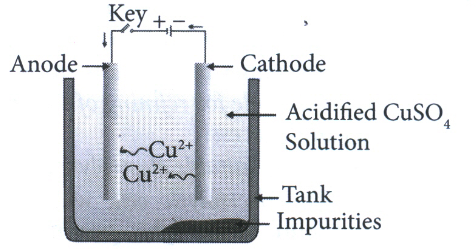
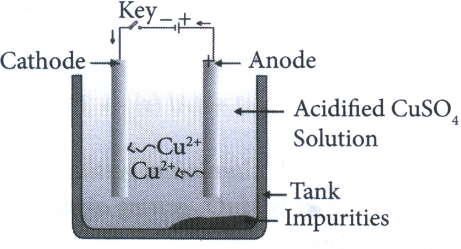
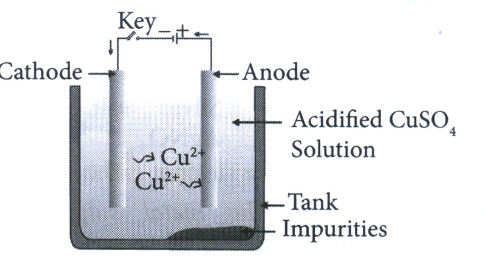
38.
Which of the following can undergo a chemical reaction?
MgSO4 + Fe
ZnSO4 + Fe
MgSO4 + Pb
CuSO4 + Fe
39.
Which of the following non-metals is a liquid?
Carbon
Bromine
Phosphorus
Sulphur
40.
Electrical wires have a coating of an insulating material. The material, generally used is
Sulphur
Graphite
PVC
All can be used
41.
Generally, non-metals are not conductors of electricity. Which of the following is a good conductor of electricity?
Diamond
Graphite
Sulphur
Fullerene
42.
Although metals form basic oxides, which of the following metals form an amphoteric oxide?
Na
Ca
Al
Cu
43.
The electronic configurations of three elements X, Y and Z are X - 2, 8; Y - 2, 8, 7 and Z - 2, 8, 2. Which of the following is correct?
X is a metal
Y is a metal
Z is a non-metal
Y is a non-metal and Z is a metal
44.
Reaction between X and Y, forms compound Z. X loses electron and Y gains electron. Which of the following properties is not shown by Z?
Has high melting point
Has low melting point
Conducts electricity in molten state
Occurs as solid
45.
Which among the following alloys contain mercury as one of its constituents?
Stainless steel
Alnico
Solder
Zinc amalgam
46.
Which among the following statements is incorrect for magnesium metal?
It burns in oxygen with a dazzling white flame.
It reacts with cold water to form magnesium oxide and evolves hydrogen gas
It reacts with hot water to form magnesium hydroxide and evolves hydrogen gas.
It reacts with steam to form magnesium hydroxide and evolves hydrogen gas.
47.
Alloys are homogeneous mixtures of a metal with a metal or nonmetal. Which among the following alloys contain non-metal as one of its constituents?
Brass
Bronze
Amalgam
Steel
48.
An element A is soft and can be cut with a knife. This is very reactive to air and cannot be kept open in air. It reacts vigorously with water. Identify the element from the following
Mg
Na
P
Ca
49.
During electrolytic refining of zinc, it gets
Deposited on cathode
Deposited on anode
Deposited on cathode as well as anode
Remains in the solution
50.
An electrolytic cell consists of
(i) Positively charged cathode
(ii) Negatively charged anode
(iii) Positively charged anode
(iv) Negatively charged cathode
(i) and (ii)
(iii) and (iv)
(i) and (iii)
(ii) and (iv)
51.
An alloy is
An element
A compound
A homogeneous mixture
A heterogeneous mixture
52.
2 ml each of concentrated HCl, HNO3 and a mixture of concentrated HCl and concentrated HNO3 in the ratio of 3 : 1 were taken in test tubes labelled as A, B and C. A small piece of metal was put in each test tube. No change occured in test tubes A and B but the metal got dissolved in test tube C respectively. The metal could be
Al
Au
Cu
Zn
53.
Which one of the following four metals would be displaced from the solution of its salts by other three metals?
Mg
Ag
Zn
Cu
54.
Generally, non-metals are not lustrous. Which of the following nonmetal is lustrous?
Sulphur
Oxygen
Nitrogen
Iodine
55.
Which of the following metals are obtained by electrolysis of their chlorides in molten state?
(i) Na (ii) Ca (iii) Fe (iv) Cu
(i) and (iv)
(iii) and (iv)
(i) and (iii)
(i) and (ii)
56.
Generally, metals are solid in nature. Which one of the following metals is found in liquid state at room temperature?
Na
Fe
Cr
Hg
57.
If copper is kept open in air, it slowly loses its shining brown surface and gains a green coating. It is due to the formation of
CuSO4
CuCO3
Cu(NO3)2
CuO
58.
Stainless steel is very useful material for our life. In stainless steel, iron is mixed with
Ni and Cr
Cu and Cr
Ni and Cu
Cu and Au
59.
Galvanisation is a method of protecting iron from rusting by coating with a thin layer of
Gallium
Aluminium
Zinc
Silver
60.
Silver articles become black on prolonged exposure to air. This is due to the formation of
Ag3N
Ag2O
Ag2S
Ag2S and Ag3N
61.
Metals are refined by using different methods. Which of the following metals are refined by electrolytic refining?
(i) Au (ii) Cu (iii) Na (iv) K
(i) and (ii)
(i) and (iii)
(ii) and (iii)
(iii) and (iv)
62.
Which of the following metals exist in their native state in nature?
(i) Cu (ii) Au (iii) Zn (iv) Ag
(i) and (ii)
(ii) and (iii)
(ii) and (iv)
(iii) and (iv)
63.
Which one of the following properties is not generally exhibited by ionic compounds?
Solubility in water
Electrical conductivity in solid state
High melting and boiling points
Electrical conductivity in molten state
64.
Which of the following are not ionic compounds?
(i) KCl (ii) HCl (iii) CCl4 (iv) NaCl
(i) and (ii)
(ii) and (iii)
(iii) and (iv)
(i) and (iii)
65.
The composition of aqua-regia is
Dil.HCl : Conc.HNO3 [3 : 1]
Conc.HCl : Dil.HNO3 [3 : 1]
Conc.HCl : Conc.HNO3 [3 : 1]
Dil.HCl : Dil.HNO3 [3 : 1]
66.
Generally metals react with acids to give salt and hydrogen gas. Which of the following acids does not give hydrogen gas on reacting with metals (except Mn and Mg)?
H2SO4
HCl
HNO3
All of these
67.
What happens when calcium is treated with water?
(i) It does not react with water.
(ii) It reacts violently with water.
(iii) It reacts less violently with water.
(iv) Bubbles of hydrogen gas formed stick to the surface of calcium.
(i) and (iv)
(ii) and (iii)
(i) and (ii)
(iii) and (iv)
68.
Which of the following oxide(s) of iron would be obtained on prolonged reaction of iron with steam?
FeO
Fe2O3
Fe3O4
Fe2O3 and Fe3O4
69.
Which one of the following metals do not react with cold as well as hot water?
Na
Ca
Mg
Fe
70.
Aluminium is used for making cooking utensils. Which of the following properties of aluminium are responsible for the same?
(i) Good thermal conductivity
(ii) Good electrical conductivity
(iii) Ductility
(iv) High melting point
(i) and (ii)
(i) and (iii)
(ii) and (iii)
(i) and (iv)
71.
The ability of metals to be drawn into thin wire is known as
Ductility
malleability
Sonorousity
conductivity
72.
Which of the following properly is generally not shown by metals?
Electrical conduction
Sonorous in nature
Dullness
Ductility
1.
(b)
Its malleability
2.
(b)
SO2
3.
(c)
Gold and platinum
4.
(d)
copper and tin
5.
(b)
Only Q
6.
(c)
Gold
7.
(a)
The impure metal from the anode dissolves into the electrolyte.
8.
(a)
dilute hydrochloric acid
9.
(d)
Neutral copper atoms lose electrons to become ions.
10.
(b)
Mg reacts with dil. HCl to produce H2 gas which helps in floating
11.
(b)
Hydrogen
12.
(b)
calcium
13.
(b)
sodium hydroxide is a base which is soluble in water while ferric hydroxide is also a base but it is not soluble in water.
14.
(b)
the gas is lighter than air.
15.
(d)
(b) and (c) together
16.
(c)
Ca > Mg > Zn > Fe > Cu > Ag
17.
(c)
Iron pyrites
18.
(b)
Mg(OH)2
19.
(b)
ZnO
20.
(d)
Zn
21.
(a)
Heating
22.
(d)
Galvanization
23.
(d)
X and Yare non-metal and Z is a metal
24.
(b)
Au
25.
(d)
CCl4
26.
(d)
Na2CO3
27.
(a)
Green solution slowly turns brown
28.
(d)
None of these
29.
(d)
rough and granular
30.
(a)
slag
31.
(c)
both ordinary and' distilled water
32.
(b)
Cu(OH)2
33.
(a)
only zinc reacts with dil. HCl
34.
(d)
iron
35.
(b)
2
36.
(d)
Iron
37.
(c)
38.
(d)
CuSO4 + Fe
39.
(b)
Bromine
40.
(c)
PVC
41.
(b)
Graphite
42.
(c)
Al
43.
(d)
Y is a non-metal and Z is a metal
44.
(b)
Has low melting point
45.
(d)
Zinc amalgam
46.
(b)
It reacts with cold water to form magnesium oxide and evolves hydrogen gas
47.
(d)
Steel
48.
(b)
Na
49.
(a)
Deposited on cathode
50.
(b)
(iii) and (iv)
51.
(c)
A homogeneous mixture
52.
(b)
Au
53.
(d)
Cu
54.
(d)
Iodine
55.
(d)
(i) and (ii)
56.
(d)
Hg
57.
(b)
CuCO3
58.
(a)
Ni and Cr
59.
(c)
Zinc
60.
(c)
Ag2S
61.
(a)
(i) and (ii)
62.
(c)
(ii) and (iv)
63.
(b)
Electrical conductivity in solid state
64.
(b)
(ii) and (iii)
65.
(c)
Conc.HCl : Conc.HNO3 [3 : 1]
66.
(c)
HNO3
67.
(d)
(iii) and (iv)
68.
(c)
Fe3O4
69.
(d)
Fe
70.
(d)
(i) and (iv)
71.
(a)
Ductility
72.
(c)
Dullness

10th Standard CBSE Syllabus & Materials
10th Standard CBSE
CBSE 10th Social Science PS - Federalism - New Model Questions Papers Study Material - QB365 Set A
NEW10th Standard CBSE
CBSE 10th Social Science PS - Power Sharing - New Model Questions Papers Study Material - QB365 Set A
NEW10th Standard CBSE
CBSE 10th Social Science GEO - Manufacturing Industries - New Model Questions Papers Study Material - QB365 Set A
NEW10th Standard CBSE
CBSE 10th Social Science GEO - Minerals and Energy Resources - New Model Questions Papers Study Material - QB365 Set A



NCERT Books

Syllabus

Exam Pattern

Sample Question Papers

Previous year Question Papers

Important Notes

MCQ Practice test

NCERT Exemplers

Case study Questions

Image Based Questions

Passage based Questions

HOT Questions

Value Based Questions

Model Questions Papers
NCERT ( Book Back ) Questions

Assertion and Reason
Important Questions And Answers

CBSE 10th Standard CBSE Subjects
CBSE Standards



