
 100% FREE ACCESS
10th Standard CBSE Syllabus & Materials
10th Standard CBSE
CBSE 10th Social Science ECO - Globalisation and the Indian Economy - New Model Questions Papers Study Material - QB365 Set A
NEW10th Standard CBSE
CBSE 10th Social Science ECO - Money and Credit - New Model Questions Papers Study Material - QB365 Set A
NEW10th Standard CBSE
CBSE 10th Social Science ECO - Sectors of the Indian Economy - New Model Questions Papers Study Material - QB365 Set A
NEW10th Standard CBSE
CBSE 10th Social Science ECO - Development - New Model Questions Papers Study Material - QB365 Set A
NEW10th Standard CBSE
CBSE 10th Social Science PS - Outcomes of Democracy - New Model Questions Papers Study Material - QB365 Set A
NEW10th Standard CBSE
CBSE 10th Social Science PS - Gender, Religion and Caste - New Model Questions Papers Study Material - QB365 Set A

Published on: 26/10/2025
Download CBSE Class 10th Standard CBSE Science question papers, sample papers, important questions, and previous year solved papers in PDF format. Get free study materials, NCERT solutions, and exam preparation resources for Class 10th Standard CBSE Science
Questions + Answers key
Take MCQ Science Test
1.
A 2.0 cm tall object is placed perpendicular to the principal axis of a convex lens of focal length 10 cm. The distance of the object from the lens is 15 cm. Find the nature, position and size of the image. Also find its magnification.
2.
Explain the following
(a) Reactivity of Al decreases if it is dipped in HNO3.
(b) Carbon cannot reduce the oxides of Na or Mg
(c) NaCl is not a conductor of electricity in solid state whereas it does conduct electricity in aqueous solution as well as in molten state.
(d) Iron articles are galvanised
(e) Metals like Na, K, Ca and Mg are never found in their free state in nature.
3.
Samples of four metals A, B, C and D were taken and added to the following solution one by one. The result obtained have been tabulated as follows :
| Metals | Iron (II) Sulphate | Copper (II) Sulphate | Zinc Sulphate | Silver Nitrate |
| A | No reaction | Displacement | - | - |
| B | Displacement | - | No reaction | - |
| C | No reaction | No reaction | No reaction | Displacement |
| D | No reaction | No reaction | No reaction | No reaction |
Use the given table above to answer the following questions about metals A, B, C and D
(i) Which is the most reactive metal?
(ii) What would you observed if B is added to a solution of copper (II) sulphate?
(iii) Arrange the metals A, B, C and D in the order of decreasing reactivity.
4.
Under which of the following conditions a concave mirror can form an image larger than the actual object?
When the object is kept at a distance equal to its radius of curvature
When object is kept at a distance less than its focal length
When object is placed between the focus and centre of curvature
When object is kept at a distance greater than its radius of curvature
5.
Where should an object be placed in front of a convex lens to get a real image of the size of the object?
At the principal focus of the lens
At twice the focal length
At infinity
Between the optical centre of the lens and its principal focus
6.
Which one of the following four metals would be displaced from the solution of its salts by other three metals?
Mg
Ag
Zn
Cu
7.
Aluminium is used for making cooking utensils. Which of the following properties of aluminium are responsible for the same?
(i) Good thermal conductivity
(ii) Good electrical conductivity
(iii) Ductility
(iv) High melting point
(i) and (ii)
(i) and (iii)
(ii) and (iii)
(i) and (iv)
8.
Which of the following pairs will give displacement reactions?
NaCl solution and copper metal
MgCl2 solution and aluminium metal
FeSO4 solution and silver metal
AgNO3 solution and copper metal
9.
Name the metal which reacts with a very dilute HNO3 to evolve hydrogen gas.
10.
"A ray of light incident on a rectangular glass slab immersed in any medium emerges parallel to itself." Draw a labelled ray diagram to justify the statement?
11.
State mirror formula. How does of change when object distance u from the mirror is changed?
12.
The following reaction takes place when aluminium powder is heated with MNO2
\({ 3MnO }_{ 2 }+4Al(s)\rightarrow 3Mn(l)+{ 2Al }_{ 2 }{ O }_{ 3 }+Heat\)
(a) Is aluminium getting reduced?
(b) Is MnO2 getting oxidised?
13.
A metal is found in liquid state. It is widely used in instrument for measuring blood pressure. In what form does it occur in nature? How can we extract this metal from its ore?
14.
Assertion: Keeping a point object fixed, if a plane mirror is moved, the image will also move.
Reason : In case of a plane mirror, distance of object and its image is equal from any point on the mirror.
Codes
(a) Both A and R are true, and R is correct explanation of the assertion.
(b) Both A and R are true, but R is not the correct explanation of the assertion.
(c) A is true, but R is false.
(d) A is false, but R is true.
15.
Assertion: We can decide the nature of a mirror by observing the size of erect image in the mirror.
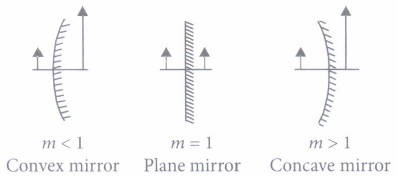
Reason: The minimum distance between a real object and its real image in a concave mirror is non zero.
Codes
(a) Both A and R are true, and R is correct explanation of the assertion.
(b) Both A and R are true, but R is not the correct explanation of the assertion.
(c) A is true, but R is false.
(d) A is false, but R is true
16.
Assertion: The dentists use convex mirrors to see large images of the teeth of patients.
Reason: The convex mirrors always produces the enlarged image of the object.
Codes
(a) If both assertion and reason are true and the reason is correct explanation of assertion.
(b) If both assertion and reason are true but reason is not a correct explanation of assertion. -.
(c) If assertion is true and reason is false.
(d) If both assertion and reason are false.
17.
Assertion: Alloy is made by mixing a metal with either other metal or non metal
Reason: It is prepared by first melting the primary metal and then dissolving the other elements in it in definite proportions.
Codes
(a) If both assertion and reason are true and the reason is correct explanation of assertion.
(b) If both assertion and reason are true but reason is not a correct explanation of assertion.
(c) If assertion is true and reason is false.
(d) If both assertion and reason are false.
18.
Assertion: Iron does not bum on heating
Reason: Iron filings bum vigorously when sprinkled in the flame of the burner.
Codes
(a) If both assertion and reason are true and the reason is correct explanation of assertion.
(b) If both assertion and reason are true but reason is not a correct explanation of assertion.
(c) If assertion is true and reason is false.
(d) If both assertion and reason are false.
19.
The lenses forms different types of images when object placed at different locations. When a ray is incident parallel to the principal axis, then after refraction, it passes through the focus or appears to come from the focus. When a ray goes through the optical centre of the lens, it passes without any deviation.
If the object is placed between focus and optical center of the convex lens, erect and magnified image is formed. As the object is brought closer to the convex lens from infinity to focus, the image moves away from the convex lens from focus to infinity. Also the size of image goes on increasing and the image is always real and inverted. A concave lens always gives a virtual, erect and diminished image irrespective to the position of the object.
(i) The location of image formed by a convex lens when the object is placed at infinity is
| (a) at focus | (b) at 2F |
| (c) at optical center | (d) between F and 2F |
(ii) When the object is placed at the focus of concave lens, the image formed is
| (a) real and smaller | (b) virtual and inverted |
| (c) virtual and smaller | (d) real and erect |
(iii) The size of image formed by a convex lens when the object is placed at the focus of convex lens is
| (a) small | (b) point in size |
| (c) highly magnified | (d) same as that of object |
(iv) When the object is placed at 2F in front of convex lens, the location of image is
| (a) at F | (b) at 2 F on the other side |
| (c) at infinity | (d) between F and optical center |
20.
When the rays of light travels from one transparent medium to another, the path of light is deviated. This phenomena is called refraction of light. The bending of light depends on the optical density of medium through which the light pass.
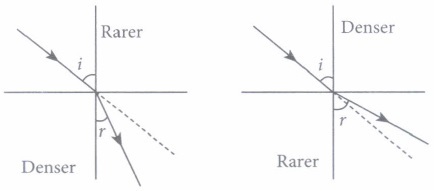
The speed of light varies from medium to medium. A medium in which the speed of light is more is optically rarer medium whereas in which the speed of light is less is optically denser medium. Whenever light goes from one medium to another, the frequency of light does not change however, speed and wavelength change. It concluded that change in speed of light is the basic cause of refraction.
(i) When light travels from air to glass, the ray of light bends
| (a) towards the normal | (b) away from normal |
| (c) anywhere | (d) none of these |
(ii) A ray of light passes from a medium A to another medium B. No bending of light occurs if the ray of light hits the boundary of medium B at an angle of
| (a) 0° | (b) 45° |
| (c) 90° | (d) 120° |
(iii) When light passes from one medium to another, the frequency of light
| (a) increases | (b) decreases |
| (c) remains same | (d) none of these |
(iv) When light passes from glass to water, the speed of light
| (a) increases | (b) decreases |
| (c) remains same | (d) first increases then decrease |
(v) The bottom of pool filled with water appears to be ______ due to refraction of light
| (a) shallower | (b) deeper |
| (c) at same depth | (d) empty |
21.
The spherical mirror forms different types of images when the object is placed at different locations.
When the image is formed on screen, the image is real and when the image does not form on screen, the image is virtual. When the two reflected rays meet actually, the image is real and when they appear to meet, the image is virtual.
A concave mirror always forms a real and inverted image for different positions of the object. But if the object is placed between the focus and pole, the image formed is virtual and erect.
A convex mirror always forms a virtual, erect and diminished image. A concave mirror is used as doctor's head mirror to focus light on body parts like eyes, ears, nose etc., to be examined because it can form erect and magnified image of the object. The convex mirror is used as a rear view mirrors in automobiles because it can form an small and erect image of an object.
(i) When an object is placed at the centre of curvature of a concave mirror, the image formed is
| (a) larger than the object | (b) smaller than the object |
| (c) same size as that of the object | (d) highly enlarged. |
(ii) No matter how far you stand from a mirror, your image appears erect. The mirror is likely to be
| (a) plane | (b) concave |
| (c) convex | (d) either plane or convex. |
(iii) A child is standing in front of a magic mirror. She finds the image of her head bigger, the middle portion of her body of the same size and that of the legs smaller. The following is the order of combinations for the magic mirror from the top.
| (a) Plane, convex and concave | (b) Convex, concave and plane |
| (c) Concave, plane and convex | (d) Convex, plane and concave |
(iv) To get an image larger than the object, one can use
(a) convex mirror but not a concave mirror
(b) a concave mirror but not a convex mirror
(c) either a convex mirror or a concave mirror
(d) a plane mirror.
(v) A convex mirror has wider field of view because
(a) the image formed is much smaller than the object and large number of images can be seen
(b) the image formed is much closer to the mirror
(c) both (a) and (b)
(d) none of these.
22.
On the basis of reactivity of different metals with oxygen, water and acids as well as displacement reactions, the metals have been arranged in the decreasing order of their reactivities. This arrangement is known as activity series or reactivity series of metals.
The basis of reactivity is the tendency of metals to lose electrons. If a metal can lose electrons easily to form positive ions, it will react readily with other substances. Therefore, it will be a reactive metal. On the other hand, if a meal loses electrons less rapidly to form a positive ion, it will react slowly with other substances. Therefore, such a metal will be less reactive.
(i) Which of the following metals is less reactive than hydrogen?
| (a) Copper | (b) Zinc | (c) Magnesium | (d) Lead |
(ii) Which of the following metals is more reactive than hydrogen?
| (a) Mercury | (b) Platinum | (c) Iron | (d) Gold |
(iii) Which of the following metals reacts vigorously with oxygen?
| (a) Zinc | (b) Magnesium | (c) Sodium | (d) Copper |
(iv) Which of the following represents the correct order of reactivity for the given metals?
| \({ (a) } \mathrm{Na}>\mathrm{Mg}>\mathrm{Al}>\mathrm{Cu}\) | \({ (b) } \mathrm{Mg}>\mathrm{Na}>\mathrm{Al}>\mathrm{Cu}\) | \({ (c) } \mathrm{Na}>\mathrm{Mg}>\mathrm{Cu}>\mathrm{Al}\) | \({(d) } \mathrm{Mg}>\mathrm{Al}>\mathrm{Na}>\mathrm{Cu}\) |
(v) Hydrogen gas is not evolved when a metal reacts with nitric acid. It is because HNO3 is a strong oxidising agent. It oxidises the H2 produced to water and itself gets reduced to any of the nitrogen oxides (N2O, NO, NO2 ). But ___________ and ___________ react with very dilute HNO3 to evolve H2 gas.
| (a) Pb, Cu | (b) Na, K | (c) Mg, Mn | (d) AI, Zn |
23.
The chemical reactivity of an element depends upon its electronic configuration. All elements having less than eight electrons in the outermost shell show chemical reactivity. During chemical reactions, atoms of all elements tend to achieve a completely filled valence shell. Metals are electropositive in nature. They have tendency to lose one or more electrons present in the valence shell of their atoms to form cations and achieve nearest noble gas configuration. The compounds formed by the transfer of electrons from one element to other are known as ionic or electrovalent compounds.
(i) The electronic configurations of three elements X, Y and Z are:
X : 2 Y: 2, 8, 7 Z : 2, 8, 2
Which of the following is correct regarding these elements?
| (a) X is a metal. | (b) Y is a metal. |
| (c) Z is a non-metal | (d)Yis a non-metal and Z is a metal |
(ii) Element X reacts with element Y to form a compound Z. During the formation of compound Z, atoms of X lose one electron each whereas atoms of Y gain one electron each. Which of the following properties is not shown by compound Z?
| (a) High melting point |
| (b) Low melting point |
| (c) Occurrence as solid |
| (d) Conduction of electricity in molten state |
(iii) Which of the following is correct representation of formation of magnesium chloride?
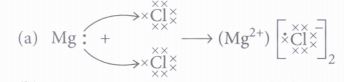 |
 |
 |
(d) None of these |
(iv) The electronic configuration of sodium ion is
| (a) 2,8,8 | (b) 2,8,2. | (c) 2,6 | (d) 2,8. |
(v)Which of the following represents an electropositive element?
| (a) 2,8,6 | (b) 2,8,8 | (c) 2,8,8,1 | (d) 2, 7 |
1.
Height of the object h = + 2.0 cm;
Focal length f = + 10 cm;
object-distance u = –15 cm;
Image-distance v = ?
Height of the image h′ = ?
Since \(\frac{1}{v}-\frac{1}{u}=\frac{1}{f}\)
or, \(\frac{1}{v}=\frac{1}{u}+\frac{1}{f}\)
\(\frac{1}{v}=\frac{1}{(-15)}+\frac{1}{10}=-\frac{1}{15}+\frac{1}{10} \)
\(\frac{1}{v}=\frac{-2+3}{30}=\frac{1}{30}\)
or, \(v=+30 \mathrm{~cm}\)
The positive sign of v shows that the image is formed at a distance of 30 cm on the other side of the optical centre. The image is real and inverted.
Magnification \(m=\frac{h^{\prime}}{h}=\frac{v}{u}\)
or, \(h^{\prime}=h(v / u)\)
Height of the image, \(h^{\prime}=(2.0)(+30 /-15)=-4.0 \mathrm{~cm}\)
Magnification \(m=v / u\)
or, \(m=\frac{+30 \mathrm{~cm}}{-15 \mathrm{~cm}}=-2\)
The negative signs of m and h' show that the image is inverted and real. It is formed below the principal axis. Thus, a real, inverted image, 4 cm tall, is formed at a distance of 30 cm on the other side of the lens. The image is two times enlarged.
2.
(a) Due to the formation of a layer of oxide i.e., Al2O3
(b) Na or Mg is more reactive metals as compared to carbon.
(c) In solid NaCI, the movement of ions is not possible due to its rigid structure but in aqueous solution or molten state, the ions can move freely.
(d) To protect from corrosion.
(e) They are highly reactive.
3.
(i) B is the most active metal as it displaces iron from its salt solution.
(ii) B will displace Cu from CuSO4 solution because B is more reactive than copper.
(iii) B > A > C > D.
4.
(c)
When object is placed between the focus and centre of curvature
5.
(b)
At twice the focal length
6.
(d)
Cu
7.
(d)
(i) and (iv)
8.
(d)
AgNO3 solution and copper metal
9.
Manganese or Magnesium.
10.
-S.png)
Angle of refraction = 40o
Deviation of rays
Angle of emergence = 55o
Direction of rays
11.
The mirror formula is \(\frac { 1 }{ v } +\frac { 1 }{ u } =\frac { 1 }{ f } \), where the symbols have standard meaning. When u is changed, v changes, but f remains constant. This is because focal length of mirror depends only on radius of curvature of the mirror.
12.
(a) No, because oxygen is added to aluminium therefore, it is getting oxidised.
(b) No, since manganese has lost oxygen therefore, it is getting reduced.
13.
Mercury is the metal which is found in liquid state and is used in instruments for measuring blood pressure. It occurs in nature a sulphide in the form of Cinnabar (HgS). Mercury is obtained from purified Cinnabar by roasting in the present air.
\(HgS\quad \underrightarrow { Air/Heat } \quad Hg+{ SO }_{ 2 }\)
14.
(a): The image formed in a plane mirror is at the same distance behind the mirror as the object is in the front of the mirror. Image and the object are at equal distances from a plane mirror.
15.
(d) A is false, but R is true
16.
(d) If both assertion and reason are false.
17.
(a) If both assertion and reason are true and the reason is correct explanation of assertion.
18.
(b) If both assertion and reason are true but reason is not a correct explanation of assertion.
19.
(i) (a): When an object is placed at infinity of convex lens, image will be formed at focus F.
(ii) (b): Virtual and inverted image is formed, when object is placed at focus of the concave lens.
(iii) (c) : When object is placed at focus of a convex lens, highly enlarged or magnified image is formed.
(iv) (b): When an object is placed at distance 2F in front of a convex lens, then the image formed is at a distance 2F on the other of the lens.
(v) (a): Image if formed between focus and optical centre when the object is placed anywhere between optical centre and infinity.
20.
(i) (a): When, a ray of light travels from air to glass, it bends towards the normal.
(ii) (c): No bending of light occurs when light is incident normally or perpendicularly on a boundary of two media since angle of incidence and angle of refraction both are zero.
(iii) (c): When light goes from one medium to other medium, its frequency does not change
(iv) (a): The speed to light increases when light passes from glass to water as water is optically rarer medium.
(v) (a): The bottom of a pool of water appears to be less deep than it actually is due to refraction.
21.
(i) (c):
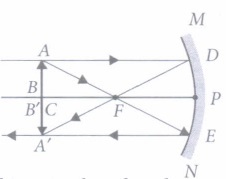
When the object is placed at the centre of curvature of concave mirror, the image formed is real, inverted and of the same size as that of the object.
(ii) (d): The image is erect in a plane mirror and also in a convex mirror, for all positions of the object.
(iii) (c) : As the image of head is bigger, the upper portion of magic mirror is concave. The middle portion of the image is of same size, so, middle portion of magic mirror is plane. Now, the image of legs looks smaller, therefore, the lower portion of magic mirror is convex.
(iv) (b)
(v) (c)
22.
(i) (a): Copper is placed below hydrogen in activity series therefore, it is less reactive than hydrogen.
(ii) (c): Iron is placed above hydrogen in activity series therefore, it is more reactive than hydrogen.
(iii) (c)
(iv) (a)
(v) (c)
23.
(i) (d)
(Ii) (b): '2' is an ionic compound
\({ (iii) }(\mathrm{a}): \mathrm{Mg} \longrightarrow \mathrm{Mg}^{2+}+2 e^{-}\) \(\mathrm{Cl}+e^{-} \longrightarrow \mathrm{Cl}^{-}\) \(\mathrm{Mg}^{2+}+2 \mathrm{Cl}^{-} \longrightarrow \mathrm{MgCl}_{2}\)
2,8,2 2,8 2,8,7 2,8,8
\((\text { iv })(\mathrm{d}): \mathrm{Na} \longrightarrow \mathrm{Na}^{+}+e^{-}\)
2,8,1 2,8
(v) (c): (a) and (d) represent electronegative elements and (b) represents a noble gas.

10th Standard CBSE Syllabus & Materials
10th Standard CBSE
CBSE 10th Social Science PS - Federalism - New Model Questions Papers Study Material - QB365 Set A
NEW10th Standard CBSE
CBSE 10th Social Science PS - Power Sharing - New Model Questions Papers Study Material - QB365 Set A
NEW10th Standard CBSE
CBSE 10th Social Science GEO - Manufacturing Industries - New Model Questions Papers Study Material - QB365 Set A
NEW10th Standard CBSE
CBSE 10th Social Science GEO - Minerals and Energy Resources - New Model Questions Papers Study Material - QB365 Set A



NCERT Books

Syllabus

Exam Pattern

Sample Question Papers

Previous year Question Papers

Important Notes

MCQ Practice test

NCERT Exemplers

Case study Questions

Image Based Questions

Passage based Questions

HOT Questions

Value Based Questions

Model Questions Papers
NCERT ( Book Back ) Questions

Assertion and Reason
Important Questions And Answers

CBSE 10th Standard CBSE Subjects
CBSE Standards



