
 100% FREE ACCESS
10th Standard CBSE Syllabus & Materials
10th Standard CBSE
CBSE 10th Social Science ECO - Globalisation and the Indian Economy - New Model Questions Papers Study Material - QB365 Set A
NEW10th Standard CBSE
CBSE 10th Social Science ECO - Money and Credit - New Model Questions Papers Study Material - QB365 Set A
NEW10th Standard CBSE
CBSE 10th Social Science ECO - Sectors of the Indian Economy - New Model Questions Papers Study Material - QB365 Set A
NEW10th Standard CBSE
CBSE 10th Social Science ECO - Development - New Model Questions Papers Study Material - QB365 Set A
NEW10th Standard CBSE
CBSE 10th Social Science PS - Outcomes of Democracy - New Model Questions Papers Study Material - QB365 Set A
NEW10th Standard CBSE
CBSE 10th Social Science PS - Gender, Religion and Caste - New Model Questions Papers Study Material - QB365 Set A

Published on: 26/10/2025
Download CBSE Class 10th Standard CBSE Science question papers, sample papers, important questions, and previous year solved papers in PDF format. Get free study materials, NCERT solutions, and exam preparation resources for Class 10th Standard CBSE Science
Questions + Answers key
Take MCQ Science Test
1.
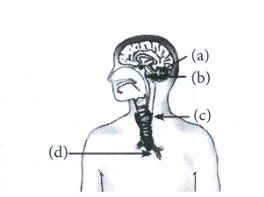
Label the endocrine glands in the given figure.
2.
What were the criteria used by Mendeleev in creating his Periodic Table?
3.
Name the functional groups present in the following compounds.
(a) CH3COCH2CH2CH3
(b) CH3CH2CH2COOH
(c) CH3CH2CH2CH2CHO
(d) CH3CH2OH
4.
What do the following transport?
(a)Xylem
(b)Phloem
(c)Pulmonary vein
(d)Pulmonary artery
5.
Write the balanced chemical equations for the following reactions and identify the type of reaction in each case.
(a) Nitrogen gas is treated with hydrogen gas in the presence of a catalyst at 773 K to form ammonia gas.
(b) Sodium hydroxide solution is treated with acetic acid to form sodium acetate and water.
(c) Ethanol is warmed with ethanoic acid to form ethyl acetate in the presence of concentrated H2SO4.
(d) Ethene is burnt in the presence of oxygen to form carbon dioxide, water and releases heat and light.
6.
What is a neutralisation reaction? Give two examples.
7.
Methyl orange is
Pink in acidic medium, yellow in basic medium
Yellow in acidic medium, pink in basic medium
Colourless in acidic medium, pink in basic medium
Pink in acidic medium, colourless in basic medium
8.
Opposition to the construction of large dams is due to
social reasons
economic reasons
environmental reasons
all the above
9.
In our country vast tracts of forests are cleared and a single species of plant is cultivated. This practice promotes
biodiversity in the area
monoculture in the area
growth of natural forest
preserves the natural ecosystem in the area
10.
The least distance of distinct vision for a young adult with normal vision is about
25 m
2.5 cm
25 cm
2.5 m
11.
A zygote which has an X - chromosome inherited from the father will develop into a
boy
girl
X - chromosome does not determine the sex of a child
either boy or girl
12.
Which of the first enzyme to mix with food in the digestive tract?
Pepsin
Cellulase
Amylase
Trypsin
13.
Choose the form in which mot plants absorb nitrogen
(i)Proteins
(ii)Nitrates and Nitrites
(iii)Urea
(iv)Atmospheric nitrogen
(i) and (ii)
(ii) and (iii)
(iii) and (iv)
(i) and (iv)
14.
The blood leaving the tissue becomes richer in
Carbon dioxide
Water
Haemoglobin
Oxygen
15.
Ocean thermal energy is due to
Energy stored by waves in the ocean
Temperature difference at different levels in the ocean
Pressure difference at different levels in the ocean.
Tides arising out in the ocean.
16.
During respiration exchange of gases take place in
Trachea and larynx
Alveoli of lungs
Alveoli and throat
Throat and larynx
17.
The resistivity does not charge if
the material is charged
the temperature is charged
the shape of the resistor is charge
both material and temperature are changed
18.
The ability of metals to be drawn into thin wire is known as
Ductility
malleability
Sonorousity
conductivity
19.
Junction between two neurons is called
Cell junction
Neuro muscular junction
Neural joint
Synapse
20.
The hormone which increases the fertility in males is called
Oestrogen
Testosterone
Insulin
Growth hormone
21.
Which of the following is not an involuntary action?
Vomiting
Salivation
Heart beat
Chewing
22.
Iodine is necessary for the synthesis of which hormone?
Adrenaline
Thyroxin
Auxin
Insulin
23.
Which is the correct sequence of the components of a reflex arc?
Receptors \(\rightarrow\) Muscles \(\rightarrow\) Sensory neuron \(\rightarrow\) Motor neuron \(\rightarrow\) Spinal cord
Receptors \(\rightarrow\) Motor neuron \(\rightarrow\) Spinal cord \(\rightarrow\) Sensory neuron \(\rightarrow\)Muscle
Receptors \(\rightarrow\) Spinal cord \(\rightarrow\) Sensory neuron \(\rightarrow\) Motor neuron \(\rightarrow\) Muscle
Receptors \(\rightarrow\) Sensory neuron \(\rightarrow\) Spinal cord \(\rightarrow\) Motor neuron \(\rightarrow\) Muscle
24.
The xylem in plants is responsible for
Transport of water
Transport of food
Transport of amino acids
Transport of oxygen
25.
Which of the following phenomena occur, when a small amount of acid is added to water?
(i) Ionisation (ii) Neutralisation (iii) Dilution (iv) Salt formation
(i) and (ii)
(i) and (iii)
(ii) and (iii)
(ii) and (iv)
26.
Which of the following are exothermic processes?
(i) Reaction of water with quicklime
(ii) Dilution of an acid
(iii) Evaporation of water
(iv) Sublimation of camphor(crystals)
(i) and (ii)
(ii) and (iii)
(i) and (iv)
(iii) and (iv)
27.
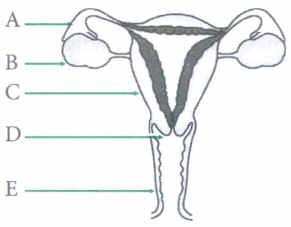
(a)Name the parts labelled A, B, C, D and E.
(b)Where do the following functions occur?
(i) Production of an egg
(ii) Fertilisation
(iii) Implantation of the zygote.
(c) What happens to the lining of uterus:
(i) before release of a fertilised egg?
(ii) if no fertilisation occurs?
28.
(a)Write the function of each of the following parts of human eye:
cornea; iris; crystalline lins; ciliary muscles
(b)Millions of people of the developing countries of the work are suffering from corneal blindness. These persons can be cured by replacing the defective cornea with the cornea of a donated eye. A charitable society of your city has organised a campaign in your neighbourhood in order to create awareness about this fact. If you are asked to participate in this mission how would you contribute in this noble cause?
(i)State the objective of organising such campaigns.
(ii)List two arguments which you would give to motivate the people to donate their eyes after death.
(iii)List two values which are developed in the persons who actively participate and contribute in such programmes.
29.
(a) What is 'environmental pollution'?
(b) Distinguish between biodegradable and non-biodegradable pollutants.
(c) Choose the biodegradable pollutants from the list given below:
Sewage, DDT, radioactive waste, agricultural waste.
30.
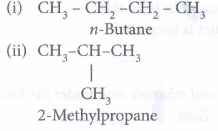
There are two isomers of butane, C4H10
Give reasons for the following:
(i) Element carbon forms compounds mainly by covalent bonding.
(ii) Diamond has a high melting point.
(iii) Graphite is a good conductor of electricity.
(iv) Acetylene burns with a sooty flame.
(v) Kerosene does not decolourise bromine water while cooking oils do.
31.
What are the methods used by plants to get rid of excretory products?
32.
Point out any 3 differences between calcination and roasting.
33.
Distinguish between an electric motor and generator?
34.
What is an homologous series? Explain with an example.
35.
(a) State one limitation of solar energy available from solar cells.
(b) What is the minimum wind velocity required to obtain useful energy with a windmill?
(c) Define the term 'nuclear fission'.
36.
Write three advantages of nuclear energy.
37.
List the properties of magnetic lines of force.
38.
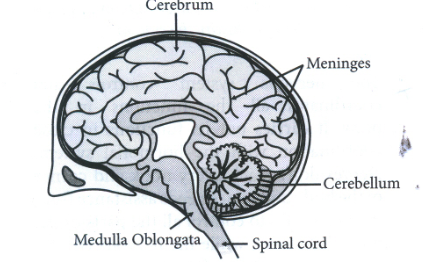
Draw a diagram of human brain and label on it the following of its parts:
(i) Cerebrum
(ii) Meninges
(iii) Medulla Oblongata
(iv) Cerebellum
39.
(a) What is meant by 'Electric Resistance' of a conductor?
(b) A wire of length 'L' and resistance 'R' is stretched so that its length is doubled and the area of cross-section is halved. How will its:
(i) resistance change
(ii) resistivity change
40.
Why is Government of India imposing a ban on the use of polythene bags? Suggest two alternatives to these bags and explain how this ban is likely to improve the environment.
1.
(a) Pineal gland
(b) Pituitary gland
(c) Thyroid gland
(d) Thymus
2.
The criteria for Mendeleev periodic table was the use of atomic masses. Mendeleev arranged the elements in increasing order of their atomic masses and according to their chemical properties.
3.
(a) -CO (keto group)
(b) -COOH (carboxyl group)
(c) -CHO (aldehydic group)
(d) -OH (hydroxyl group)
4.
(a)Xylem- Transports water and dissolved minerals in plants.
(b)Phloem-Transport prepared food in plants.
(c)Pulmonary vein-Transports oxygenated blood from lungs to left ventricles of heart.
(d)Pulmonary artery -Transports deoxygenated blood from body to right ventricles.
5.
(a)\(\underset{Nitrogen}{N_2}+\underset{Hydrogen}{3H_2} \xrightarrow{}Catalyst /773K\underset{Ammonia}{2NH_3}\)
It is a combination reaction
(b)\(\underset{Sodium Hydroxide}{NaOH}+\underset{Acetic\ acid}{CH_3COOH}\rightarrow\underset{Sodium\ acetate}{CH_3COONa}+ \underset{Water}{H_2O}\)
Since, number of various atoms present in both side is equal, thus it is balanced equation. It is a double displacement reaction.
(c)\(\underset{Ethanol}{C_2H_5OH}+\underset{Ethanoic\ acid}{CH_3COOH}\xrightarrow{Warmed/Conc.H_2SO_4}\underset{Ethyl\ Acetate}{CH_3COOC_2H_5}+\underset{Water}{H_2O}\)
Since, the number of various atoms present in both side is equal, thus it is a balanced equation. It is a combination reaction
(d)\(\underset{Ethene}{C_2H_4}+\underset{Oxygen}{3O_2}\rightarrow\underset{Carbon\ dioxide}{2CO_2}+\underset{Water}{2H_2O}+Heat+Light\)
It is redox reaction.
6.
The reaction between an acid and base to form salt and water is called neutralisation reaction.
Acid + Base \(\rightarrow\) Salt + Water
e.g. HNO3(aq) + KOH(aq) \(\rightarrow\) KNO3 (aq) + H2O(l)
HCl(aq) + NaOH(aq) \(\rightarrow\) NaCl(aq) + H2O(l)
7.
(a)
Pink in acidic medium, yellow in basic medium
8.
(d)
all the above
9.
(b)
monoculture in the area
10.
(c)
25 cm
11.
(b)
girl
12.
(c)
Amylase
13.
(b)
(ii) and (iii)
14.
(a)
Carbon dioxide
15.
(b)
Temperature difference at different levels in the ocean
16.
(b)
Alveoli of lungs
17.
(c)
the shape of the resistor is charge
18.
(a)
Ductility
19.
(d)
Synapse
20.
(b)
Testosterone
21.
(d)
Chewing
22.
(b)
Thyroxin
23.
(d)
Receptors \(\rightarrow\) Sensory neuron \(\rightarrow\) Spinal cord \(\rightarrow\) Motor neuron \(\rightarrow\) Muscle
24.
(a)
Transport of water
25.
(b)
(i) and (iii)
26.
(a)
(i) and (ii)
27.
(a) A\(\rightarrow \) Oviduct or Fallopian tube;
B\(\rightarrow \) Ovary;
C\(\rightarrow \) Uterus;
D\(\rightarrow \) Cervix;
E\(\rightarrow \) Vagina.
(b) (i) Ovaries;
(ii) Fallopian tube;
(iii) Lining of the uterus.
(c) (i) The lining of the uterus becomes
(ii) The lining of the uterus slowly breaks and comes out through the vagina as blood and mucous, if no fertilisation occurs.
28.
(a) Functions of the following parts of human eye:
(i) Comea: Objects enters the eye through cornea.
(ii) Iris: Iris controls the size of the pupil.
(iii) Crystalline lens: It focuses the image of the object on the retina.
(iv) Ciliary muscles: Ciliary muscles hold the eye lens and change the thickness of eye lens while focussing.
(b) (i) Objective of such campaigns. To make people aware of corneal blindness and make them realise their duties towards the society by taking pledge for eye donation.
(ii) (a) One pair of eyes can give eyesight to two corneal blind persons and make them see this beautiful world.
(b) Our eyes can live even after our death. People belonging to all age groups, even people with medical conditions like cataract, diabetes, hypertension can donate their eyes.
(iii) Values developed in persons who actively participate in such programmes:
(a) Concern for others and social welfare.
(b) Responsible behaviour and awareness.
29.
(a) Environmental pollution is an undesirable change in the physical, chemical or biological characteristics of the natural environment, brought about by man's activities. This pollution may affect the soil, rivers, seas or the atmosphere.
| Bio-degradable pollutants | Non-biodegradable pollutants |
| (i) These pollutants can broken down into non-poisonous substances in nature by the action of microorganisms. |
(i) These pollutants cannot be broken down into non-poisonous substances by microorganisms. |
| (ii) They get recycled thus, do not need any dumping sites. | (ii) They cannot be recycled thus, require dumping sites. |
| (iii) These are generally obtained from living things. | (iii) These are generally obtained from non-living things. |
| (iv) They cause minimum environmental pollution. | (iv) They cause environmental pollution. |
(c) Biodegradable pollutants are sewage and agricultural waste.
30.
(i) It is because carbon has four valence electrons, it cannot gain or loss four electrons because high energy is needed. It can only share four electrons.
(ii) It is due to strong covalent bonds and compact structure of diamond.
(iii) It is due to high to presence of free electrons in graphite because each carbon is linked to three more carbon atoms.
(iv) It is due to high percentage of carbon, it burns with sooty or smoky flame.
(v) Kerosene oil is mixture of saturated hydrocarbons therefore does not decolourise bromine water.
31.
Some of the methods employed by plants to get rid of excretory products are as follows
(i) Gaseous wastes (i.e. carbon dioxide and oxygen) are removed through stomata in leaves and lenticels in stems into the atmosphere.
(ii) Plants get rid of excess water by transpiration.
(iii) Some waste products are stored as resins and gums.
(iv) Plants also excrete some waste substances into the soil around them.
(v) Waste products may be stored in leaves, bark or any other plant part, which fall off.
32.
| Calcination | Roasting | ||
| 1. | Heating the carbonate ore in the absence of oxygen is called calcination. | 1. | Heating the sulphide ores in the presence of oxygen is called roasting. |
| 2 | CO2 gas is evolved. | 2. | SO2 gas is evolved. |
| 3. | \({ ZnCO }_{ 3 }\underrightarrow { Heat } ZnO+{ CO }_{ 2 }\) | 3. | \(2ZnS+{ 3O }_{ 2 }\rightarrow ZnO+{ SO }_{ 2 }\) |
33.
The major differences between an electric motor and generator are stated below:
Electric Motor:
1. It converts electrical energy into mechanical energy.
2. It needs electrical energy for its works.
3. They are used as water pumps, marble grinders etc.
Generator:
1. It converts mechanical energy into electrical energy
2. It needs mechanical energy for its working.
3. They are used as water pumps, marble grinders etc.
4. diesel generator, hydro-electric generator are the examples of it.
34.
A series of similarly constituted compounds in which the members present have the same functional group and similar chemical properties and any two successive members in a particular series differ in their molecular formula by ( - CH2) unit, is called a homologous series.
e.g. alkane series CnH2n+2
| CH4 C3H8 C5H12 |
Methane Propane Pentane |
C2H6 C4H10 |
Ethane Butane |
35.
(a) The solar cells are costly and hence the energy available from them expensive.
(b) 15 km/h is the minimum wind velocity required to obtain useful energy with a windmill.
(c) Nuclear fission is the process in which a radioactive atom splits up into smaller nuclei when struck with low energy neutrons.
36.
Nuclear energy has three advantages:
(a) It has very high efficiency, small amount of nuclear fuel can produce large amount of heat energy which can be controlled and used .
(b) It does not release any harmful gases like S02' CO2, N02 etc. in the air which may cause acid rain or green house effect.
(c) Once the reaction is initiated it can go on automatically for decades unless we want to stop it.
37.
Properties of magnetic field lines:
The magnetic field lines have the following properties:
(i) They originate from North pole of a magnet and end at its South pole, by convention.
(ii) These lines are closed and continuous curves.
(iii) They are crowded near the poles, where the magnetic field is strong and separated far from the poles, where the magnetic field is weak.
(iv) Field lines never intersect with each other. If they do, that would mean that there are two directions of the magnetic field at the point of intersection, which is impossible.
38.
39.
(a) Resistance is defined as the property of a conductor due to which it opposes the flow of current through it. The S.I. unit of resistance is Ohm \(\left( \Omega \right) \).
(b) (i) The resistance (R) of a conductor is related to its length (l) and area of cross section (A) as
\(R=\frac { p\times l }{ A } \) Where \(\rho \) is the resistivity of the conducting material.
Let R1= Resistance of the original wire
R2= Resistance of the wire when its length is doubled
I1= Length of original wire
l2= Length of original wire when doubled
A1= Area of the original wire
A2= Area when it is halved
Therefore,
\({ R }_{ 1 }=\frac { P\times { l }_{ 1 } }{ { A }_{ 1 } } \quad \quad ---\quad (1)\\ { R }_{ 2 }=\frac { P\times { l }_{ 2 } }{ { A }_{ 2 } } \quad \quad ---\quad (2)\)
Dividing equation (1) and (2) by equation (1), we obtain
\(\frac { { R }_{ 1 } }{ { R }_{ 2 } } =\frac { { l }_{ 1 } }{ { l }_{ 2 } } \times \frac { { A }_{ 1 } }{ { A }_{ 2 } } \quad ---\quad (3)\)
It is given that:
\({ l }_{ 1 }=2l_{ 1 }\quad and\quad { A }_{ 2 }=\frac { 1 }{ 2 } { A }_{ 1 }\\ \)
Putting these values in equation (3), we obtain
R2=4R1
Hence, the resistance of the wire will be 4 times of the original value.
(ii) The resistivity will not change on stretching the wire. Resistivity is the property of the conducting material. It does not depend on the dimension of the wire. As materials of both the wires are the same, the resistivity will not change.
40.
Plastic bags are non-biodegradable which can not be broken down into non-poisonous substances in nature.
Plastic bags are the main cause of sewer blockages as plastic bags are not decomposed by micro-organisms.
Plastic bags if eaten by stray animals can block their alimentary canal.
Two alternatives:
(1) We should take our own jute or cloth bags while going for purchasing articles from the market.
(2) Disposable paper cups should be used for serving tea in trains instead of plastic cups.
(3) Shopkeepers can use paper bags instead of plastic bags.

10th Standard CBSE Syllabus & Materials
10th Standard CBSE
CBSE 10th Social Science PS - Federalism - New Model Questions Papers Study Material - QB365 Set A
NEW10th Standard CBSE
CBSE 10th Social Science PS - Power Sharing - New Model Questions Papers Study Material - QB365 Set A
NEW10th Standard CBSE
CBSE 10th Social Science GEO - Manufacturing Industries - New Model Questions Papers Study Material - QB365 Set A
NEW10th Standard CBSE
CBSE 10th Social Science GEO - Minerals and Energy Resources - New Model Questions Papers Study Material - QB365 Set A



NCERT Books

Syllabus

Exam Pattern

Sample Question Papers

Previous year Question Papers

Important Notes

MCQ Practice test

NCERT Exemplers

Case study Questions

Image Based Questions

Passage based Questions

HOT Questions

Value Based Questions

Model Questions Papers
NCERT ( Book Back ) Questions

Assertion and Reason
Important Questions And Answers

CBSE 10th Standard CBSE Subjects
CBSE Standards



