
 100% FREE ACCESS
10th Standard CBSE Syllabus & Materials
10th Standard CBSE
CBSE 10th Social Science ECO - Globalisation and the Indian Economy - New Model Questions Papers Study Material - QB365 Set A
NEW10th Standard CBSE
CBSE 10th Social Science ECO - Money and Credit - New Model Questions Papers Study Material - QB365 Set A
NEW10th Standard CBSE
CBSE 10th Social Science ECO - Sectors of the Indian Economy - New Model Questions Papers Study Material - QB365 Set A
NEW10th Standard CBSE
CBSE 10th Social Science ECO - Development - New Model Questions Papers Study Material - QB365 Set A
NEW10th Standard CBSE
CBSE 10th Social Science PS - Outcomes of Democracy - New Model Questions Papers Study Material - QB365 Set A
NEW10th Standard CBSE
CBSE 10th Social Science PS - Gender, Religion and Caste - New Model Questions Papers Study Material - QB365 Set A

Published on: 05/12/2018
CBSE Class 10 is a crucial grade in your secondary school education. So learning with effective preparation is a must. Our study materials for CBSE Class 10 follow the latest CBSE syllabus and are prepared by subject experts who have much experience in the academic industry. In this question paper, the questions are cover from the 10th Science chapter Light Reflection and Refraction. Questions are prepared as per NCERT guidelines by the help of expert teachers.
By referring to our solutions, students get a clear understanding of each concept in detail. Students who have referred to our solutions have seen a significant increase in overall marks and ease in understanding the subjects. Our study materials are not only used by students but also by educational institutes in India.
In this post, we are providing you with the most important questions of Science exam from the chapter Light Reflection and Refraction. You should know answers to these questions in all likelihood to score good marks in Class 10 Science exam.
The latest sample papers have been designed as per the latest blueprints, syllabus and examination trends. Sample papers should be practiced in examination condition at home or school and also show it to your teachers for checking or compare with the answers provided.
Download CBSE Class 10th Standard CBSE Science question papers, sample papers, important questions, and previous year solved papers in PDF format. Get free study materials, NCERT solutions, and exam preparation resources for Class 10th Standard CBSE Science
Questions + Answers key
Take MCQ Science Test
1.
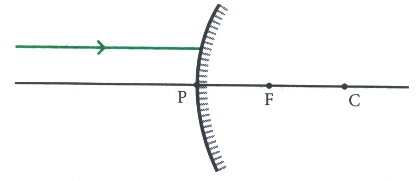
A ray of light is incident on a convex mirror as shown. Redraw the diagram and complete the path of this ray after reflection from the mirror. Mark angle of incidence and angle of reflection on it.
2.
Mention the types of mirrors used as
(i) rear view mirrors.
(ii) Shaving mirrors.
List two reasons to justify your answers in each case.
3.
"The magnification 'm' for a mirror is +1." What does this signify?
4.
How should a ray of light be incident on a rectangular glass slab so that it comes out from the opposite side of the slab without being displaced?
5.
The size of an object is 2 cm. The magnification produced by a mirror is +1. What is the size of the image?
6.
The speed of light in a transparent medium is 0.6 times that of its speed in vacuum. What is the refractive index of the medium?
7.
What is meant by power of a lens?
8.
A convex lens of focal length 20 cm can produce a magnified virtual as well as real image. Is this a correct statement? If yes, where shall the object is placed in each case for obtaining these images?
9.
The refractive index of diamond is 2.42.What is the meaning of this statement?
10.
Name a mirror that can give an erect and enlarged image of an object.
11.
Which of the following ray diagram is correct for the ray of light incident on a lens shown in Figure?
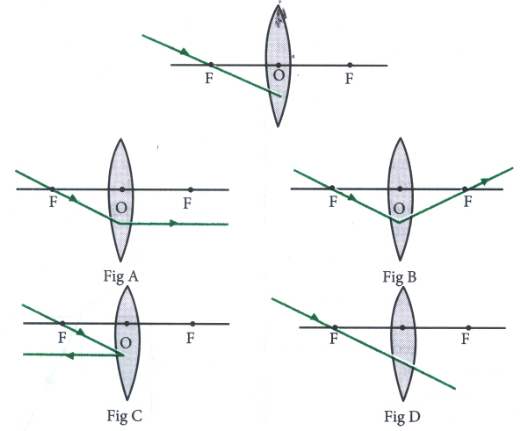
Fig. A
Fig. B
Fig. C
Fig. D
12.
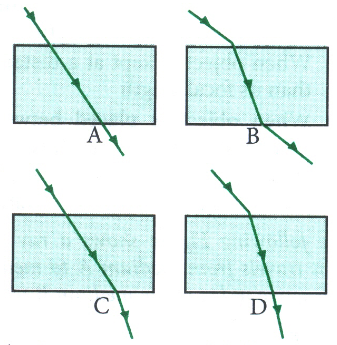
The path of a ray of light coming from air passing through a rectangular glass slab traced by four students are shown as A, B, C and D in Figure. Which one of them is correct?
A
B
C
D
13.
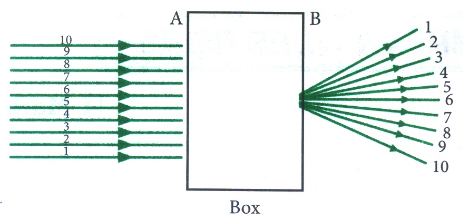
A beam of light is incident through the holes on side A and emerges out of the holes on the other face of the box as shown in the figure. Which of the following could be inside the box?
Concave lens
Rectangular glass slab
Prism
Convex lens
14.
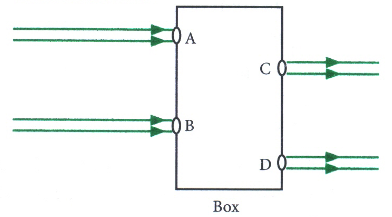
Beams of light are incident through the holes A and B and emerge out of box through the holes C and D respectively as shown in the Figure. Which of the following could be inside the box?
A rectangular glass slab
A convex lens
A convex lens
A prism
15.
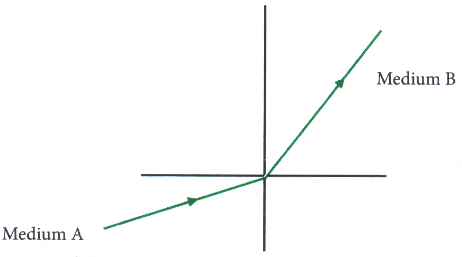
A light ray enters from medium A to medium B as shown in Figure. The refractive index of medium B relative to A will be
greater than unity
less than unity
equal to unity
zero
16.
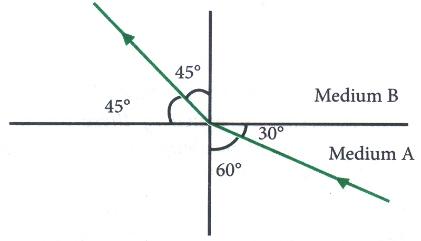
The following Figure shows a ray of light as it travels from medium A to medium B. Refractive index of the medium B relative to medium A is
\(\frac{\sqrt{3}}{\sqrt{2}}\)
\(\frac{\sqrt{2}}{\sqrt{3}}\)
\(\frac{{1}}{\sqrt{2}}\)
\({\sqrt{2}}\)
17.
In which of the following, the image of an object placed at infinity will be highly diminished and point sized?
Concave mirror only
Convex mirror only
Convex lens only
Concave mirror, convex mirror, concave lens and convex lens
18.
You are given water, mustard oil, glycerine and kerosene. In which of these media a ray light incident obliquely at same angle would bend the most?
Kerosene
Water
Mustard oil
Glycerine
19.
In torches search lights and headlights of vehicles the bulb is placed
between the pole and the focus of the reflector
very near to the focus of the reflector
between the focus and centre of curvature of the reflector
at the centre of curvature of the reflector.
20.
Magnification produced by a rear view mirror fitted in vehicles
is less than one
is more than one
is equal to one
can be more than or less than one depending upon the position of the object in front of it.
21.
Which of the following statements is true?
A convex lens has 4 dioptre power having a focal length 0.25 m
A convex lens has -4 dioptre power having a focal length 0.25 m
A concave lens has 4 dioptre power having a focal length 0.25 m
A concave lens has -4 dioptre power having a focal length 0.25 m.
22.
No matter how far you stand from a mirror, your image appears erect. The mirror is likely to be
plane
concave
convex
either plane or convex
23.
Where should an object be placed in front of a convex lens to get a real image of the size of the object?
At the principal focus of the lens
At twice the focal length
At infinity
Between the optical centre of the lens and its principal focus
24.
The image formed by a concave mirror is observed to be virtual, erect and larger than the object. Where should be the position of the object?
Between the principal focus and the centre of curvature
At the centre of curvature
Beyond the centre of curvature
Between the pole of the mirror and its principal focus.
25.
(a) One - half of a convex lens is covered with a black paper. Will such a lens produce an image of the complete object? Support your answer with a ray diagram.
(b) An object 5 cm high is held 25 cm away from a converging lens of focal length 10 cm.
(i) Draw the ray diagram and
(ii) Calculate the position and size of the image formed.
(iii) What is the nature of the image?
26.
(a) Define optical centre of a spherical lens.
(b) A divergent lens has a focal length of 20 cm At what distance should an object of height 4 cm from the optical centre of the lens be placed so that its image is formed 10 cm away from the lens. Find the size of the image also.
(c) Draw a ray diagram to show the formation of image in above situation.
27.
(i) One half of a convex lens of focal length 10 cm is converted with a black paper. Can such a lens produce an image of a complete object placed at a distance of 30 cm from the lens? Draw ray diagram to justify your answer.
(ii) A 4 cm tall object is placed perpendicular to the principal axis of a convex lens of focal length 20 cm. The distance of the object from the lens is 15 cm. Find nature, position and size of the image.
28.
The image of a candle flame formed by a lens is obtained on a screen placed on the other side of the lens. If the image is three times the size of the flame and the distance between lens and image is 80 cm, at what distance should the candle be placed from the lens? What is the nature of the image at a distance of 80 cm and the lens?
29.
Name the type of mirror used in following situations.
(a) Headlight of car
(b) Side/ rear view mirror of a vehicle
(c) Solar furnace
Support your answer with reason.
1.

2.
(i) Convex mirror is used as rear view in vehicles because
(a) It always produces an erect image of the objects.
(b) The image formed in a convex mirror is highly diminished thus it gives a wide field of view.
(ii) Concave mirrors are used as shaving mirrors because
(a) When the face is held within the focus of a concave mirror, then an enlarged image of the face is seen in the concave mirror. This helps in making a smooth shave.
3.
(a) Image is of same size as the object.
(b) Image is virtual and erect.
4.
Along the normal to the surface or at an incident angle of i = 0o .
5.
\(m=\frac { Image\quad size }{ Object\quad size } \\ +1=\frac { Image\quad size }{ 2 } =2cm\)
Image size = +2
6.
Since,\(n=\frac { c }{ v } \)
we get, \(n=\frac { c }{ 0.6c } =\frac { 1 }{ 0.6 } \approx 1.67\)
7.
It is a measure of the degree of convergence or divergence of light rays falling on it. It can also be defined as the reciprocal of its focal length in metres.
8.
Yes, a convex lens of focal length 20 cm can produce a magnified virtual as well as real image. The statement is correct. For magnified virtual image, the object must be held at a distance less than 20 cm from the lens. For magnified real image, the object must be held at a distance between 20 cm and 40 cm from the lens.
9.
Refractive index of any medium w.r.t. another indicates the extent to which light bends when it enters from first medium to the given medium. The given value of refractive index also states that speed of light in diamond is 1/2.42 times to the speed of light in vacuum.
10.
Concave mirror can give erect and enlarged image of an object.
11.
(a)
Fig. A
12.
(b)
B
13.
(d)
Convex lens
14.
(a)
A rectangular glass slab
15.
(a)
greater than unity
16.
(a)
\(\frac{\sqrt{3}}{\sqrt{2}}\)
17.
(d)
Concave mirror, convex mirror, concave lens and convex lens
18.
(d)
Glycerine
19.
(b)
very near to the focus of the reflector
20.
(a)
is less than one
21.
(a)
A convex lens has 4 dioptre power having a focal length 0.25 m
22.
(d)
either plane or convex
23.
(b)
At twice the focal length
24.
(d)
Between the pole of the mirror and its principal focus.
25.
(a) As we can see in the figure given, when the lower half of the convex lens is covered with a black paper, it still forms lens. However the intensity of the image is reduced when the convex lens is covered with black paper.
-S-1.png)
(b) (i) Converging lens (Convex lens):
Height of the object, h1= 5 cm
Object distance, u = -25 cm
Focal length, f= +10 cm
-S-2.png)
(ii) Image distance, v ?
Image size, h2 = ?
According to lens formula:
\(\frac { 1 }{ v } -\frac { 1 }{ u } =\frac { 1 }{ f } \)
\(\Rightarrow \frac { 1 }{ v } -\frac { 1 }{ -25 } =\frac { 1 }{ 10 } \)
\(\Rightarrow \frac { 1 }{ v } +\frac { 1 }{ 25 } =\frac { 1 }{ 10 } \)
\(\frac { 1 }{ v } =\frac { 1 }{ 10 } -\frac { 1 }{ 25 } \)
\(\Rightarrow \frac { 1 }{ v } =\frac { 5-2 }{ 50 } =\frac { 3 }{ 50 } \)
\(\Rightarrow v=\frac { 50 }{ 3 } =+16.6cm\)
\(\frac { { h }_{ 2 } }{ { h }_{ 1 } } =\frac { v }{ u } \)
\(\Rightarrow \frac { { h }_{ 2 } }{ 5 } =\frac { 50 }{ 3\times -25 } \)
-S.png)
(iii) Nature of the image
(a) The +ve of v shows that image is real.
(b) The -ve sign of h2 shows that image is inverted.
∴ Size of image = 3.3 cm
26.
(a) Optical centre of the lens. It is a point within the lens that lies on the principal axis through which away of light passes undeflected.
= f=-20cm h1 = 4 cm
v = -10 cm u=?
h2=?
\(\frac { 1 }{ f } =\frac { 1 }{ v } -\frac { 1 }{ u } \)
\(\Rightarrow \frac { 1 }{ -20 } -\frac { 1 }{ 10 } -\frac { 1 }{ u } \)
\(\Rightarrow \frac { 1 }{ u } =\frac { 1 }{ 10 } +\frac { 1 }{ 20 } \)
\(\Rightarrow \frac { 1 }{ u } -\frac { 1 }{ 10 } +\frac { 1 }{ 20 } \)
\(\Rightarrow \frac { 1 }{ u } =\frac { -2+1 }{ 20 } \)
\(\Rightarrow \frac { 1 }{ u } =\frac { -1 }{ 20 } \)
Now,
\(\frac { { h }_{ 2 } }{ { h }_{ 1 } } =\frac { v }{ u } \)
\(\Rightarrow \frac { { h }_{ 2 } }{ 4 } =\frac { -10 }{ -20 } \)
\(\Rightarrow { h }_{ 2 }=\frac { 10 }{ 20 } \times 4=2cm\)
h2=2cm
-S.png)
27.
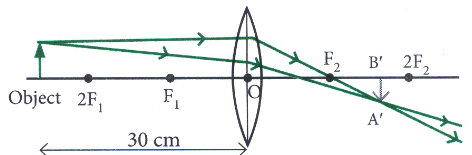
(i) Yes.If a convex lens of focal length 10cm is covered one half with a black paper, it can produce an image of the complete object between F2 and 2F2.The rays of light coming from the object get refracted by the upper half of the lens. The image formed will be real, inverted and diminished.
(ii)Object height, h1=4cm
Focal length, f=+20cm
Object distance, u=-15cm
Image distance, v=?
Image height, h2=?
By lens formula,
\({1\over f}={1\over v}-{1\over u}\)
\(\Rightarrow\ {1\over v}={1\over f}+{1\over u}={1\over +20}+{1\over -15}={1\over 20}-{1\over 15}\)
\(\Rightarrow\ {1\over V}={3-4\over 60}={-1\over 60}\)
v=-60cm
Negative sign of v shows that the image is virtual.
28.
Given m = -3, v = 80 cm, u = ?
Using the expression \(m=\frac { -v }{ u } \)
we have \(-3=\frac { 80 }{ u } \) or \(u=\frac { -80 }{ 3 } =-26.67cm\)
The image is real and the lens is a convex lens.
29.
(i) Concave mirror, to get powerful beam of light.
(ii) Convex mirror to get larger field of view and erect image.
(iii) Concave mirror, as it can converge light rays of the sun in a small area.

10th Standard CBSE Syllabus & Materials
10th Standard CBSE
CBSE 10th Social Science PS - Federalism - New Model Questions Papers Study Material - QB365 Set A
NEW10th Standard CBSE
CBSE 10th Social Science PS - Power Sharing - New Model Questions Papers Study Material - QB365 Set A
NEW10th Standard CBSE
CBSE 10th Social Science GEO - Manufacturing Industries - New Model Questions Papers Study Material - QB365 Set A
NEW10th Standard CBSE
CBSE 10th Social Science GEO - Minerals and Energy Resources - New Model Questions Papers Study Material - QB365 Set A



CBSE 10th Standard CBSE Subjects
CBSE Standards





