
 100% FREE ACCESS
10th Standard CBSE Syllabus & Materials
10th Standard CBSE
CBSE 10th Social Science ECO - Globalisation and the Indian Economy - New Model Questions Papers Study Material - QB365 Set A
NEW10th Standard CBSE
CBSE 10th Social Science ECO - Money and Credit - New Model Questions Papers Study Material - QB365 Set A
NEW10th Standard CBSE
CBSE 10th Social Science ECO - Sectors of the Indian Economy - New Model Questions Papers Study Material - QB365 Set A
NEW10th Standard CBSE
CBSE 10th Social Science ECO - Development - New Model Questions Papers Study Material - QB365 Set A
NEW10th Standard CBSE
CBSE 10th Social Science PS - Outcomes of Democracy - New Model Questions Papers Study Material - QB365 Set A
NEW10th Standard CBSE
CBSE 10th Social Science PS - Gender, Religion and Caste - New Model Questions Papers Study Material - QB365 Set A

Published on: 29/11/2018
In this question paper, the questions are covered from the entire syllabus. The questions are prepared from the creative as well as previous year question paper.
Parents can subscribe and get the pack to support their children for the exam.
Download CBSE Class 10th Standard CBSE Science question papers, sample papers, important questions, and previous year solved papers in PDF format. Get free study materials, NCERT solutions, and exam preparation resources for Class 10th Standard CBSE Science
Questions + Answers key
Take MCQ Science Test
1.
Name a functional group present in
(i) CH3CHO
(ii) C2H5COOH
2.
Name a non-metal which is lustrous and a metal which is non-lustrous.
3.
State one basic difference between a physical change and a chemical change.
4.
A wire of resistance 10 ohm is bent in the form of a closed circle. What is the effective resistance between the two points at the ends of any diameter of the circle?
5.
Find the power of a concave lens of focal length 2m.
6.
Give an example of a phenomenon where Tyndall effect can be observed.
7.
Suggest any four activities in daily life which are eco-friendly.
8.
Feather imprints were preserved along the dinosaur's bones but dinosaurs could not fly. What was the significance of feathers in reptiles and later on for other species?
9.
Name the carbon compound which on heating with excess of concentrated sulphuric acid at 443 K gives ethene.
10.
Which pancreatic enzyme is effective in digesting proteins?
11.
Name the ores of mercury.
12.
What happens when nitric acid is added to egg shell?
13.
In the reaction:
2KClO3 \(\overset { \Delta/MnO_2 }{ \rightarrow } \) 2KCl + 3O2, what does the '\(\Delta\)' and 'MnO2' signify? What type of reaction is this?
14.
A shiny brown coloured element 'X' on heating in air becomes black in colour. Name the element 'X' and the black coloured compound formed.
15.
(i) What is meant by the term hydrated salt?
(ii) Give two examples of hydrated salt which are white and state their chemical formula.
16.
Write one example of each of the following:
(i) Most malleable metal and most ductile metal.
(ii) The best conductor of heat and the poorest conductor of heat.
(iii) A metal with highest melting point and a metal with lowest melting point.
17.
(i)Two solutions X and Y are tested with universal indicator. Solution X turns orange whereas solution Y turns red. Which of the solutions is a stronger acid?
(ii) State the meaning of strong acids and weak acids. Give one example of each.
18.
A touch bulb is rated 2.5 V and 750 mA. Calculate (i) its power, (ii) its resistance and (iii) the energy consumed if this bulb is lighted for four hours.
19.
(i) An aqueous solution has a pH value of 7.0. Is this solution acidic, basic or neutral?
(ii) If H+ concentration of a solution is \(1\times 10^{-2}\ mol\ L^{-1},\) what is the pH value for it?
(iii) Which has a higher pH value, 1 M HCl or 1 M NaOH solution?
20.
(a) Draw a ray diagram to show the formation of image by concave lens when an object is placed in front of it.
(b) In the above diagram mark the object -distance (u) and the image-distance (v) with their proper signs (=ve or -ve as per the new Cartesian sign convention) and state how these distance are related to the focal length (f) of the concave lens in this case.
(c) Find the nature and power of a lens which forms a real and inverted image of magnification -1 at a distance of 40 cm from its optical centre.
21.
(i) One half of a convex lens of focal length 10 cm is converted with a black paper. Can such a lens produce an image of a complete object placed at a distance of 30 cm from the lens? Draw ray diagram to justify your answer.
(ii) A 4 cm tall object is placed perpendicular to the principal axis of a convex lens of focal length 20 cm. The distance of the object from the lens is 15 cm. Find nature, position and size of the image.
22.
(a) What is corrosion of metals? Name one metal which does not corrode and one which corrodes on being kept in atmosphere.
(b) How will you show that the rusting of iron needs oxygen and moisture at the same time?
23.
Name various plant hormones. Also give their physiological effects on plant growth and development.
24.
What is the difference between the manner in which movement takes place in a sensitive plant and the movement in our legs?
1.
i) Aldehyde, (ii) Carboxylic acid.
2.
Non-metal (lustrous) = Iodine (I)
Metal (non-lustrous) = Sodium (Na)
3.
In a physical change, no new substance is formed. In a chemical change, new substance is formed.
4.
As the wire is bent in the form of a closed circle, it will be have like two resistors of 5\(\Omega \) each, connected in parallel. Therefore, the equivalent resistance can be calculated as:
\(\frac { 1 }{ R_{ eq } } =\frac { 1 }{ { R }_{ 1 } } +\frac { 1 }{ { R }_{ 2 } } \)
\(\frac { 1 }{ R_{ eq } } =\frac { 1 }{ 5 } +\frac { 1 }{ 5 } \)=\(\frac { 1 }{ R_{ eq } } =\frac { 2 }{ 5 } \)
\(\frac { 1 }{ R_{ eq } } =\frac { 5 }{ 2 } =2.5\Omega \)
The effective resistance between the two points at the ends of an diameter of the circle is 2.5 \(\Omega \).
5.
\( \therefore Power=\frac{1}{Focal length}=-\frac{1}{2}=-0.50 D\)
Negative sign arises due to the divergent nature of concave lens.
6.
When sunlight passes through the canopy of a dense forest, the tiny water droplets in the mist scatter the sun light.
7.
(a) Walking and cycling for commute.
(b) Using jute/cloth shopping bag.
(c) using public transport.
(d) Switching off light/fans in unoccupied rooms.
8.
It is believed that features in dinosaurs might have provided insulation in cold weather but later on became useful for flights in birds.
9.
CH3CH2OH, ethanol
10.
Pancreatic trypsin
11.
Cinnabar, Hgs
12.
Egg shells contain calcium carbonate When nitric acid is added to it, carbon dioxide gas is evolved. The reaction can be given as
\(CaCO_3+2HNO_3\rightarrow Ca(NO_3)_2+H_2O+CO_2\)
13.
The above reaction is a decomposition reaction. The symbol \(\Delta\) represents the heat and the MnO2 represents that it acts as a catalyst for the decomposition reaction to take place. Since the decomposition takes place in presence of heat, the reaction is thermal decomposition.
14.
Element X is copper and the black coloured compound is copper (Il) oxide.
2Cu(s) + O2(g) \( \xrightarrow[]{Heat }\) 2CuO(s)
X(Brown) Copper (II) oxide (Black)
15.
(i) Salt that contains water of crystallisation.
(ii)Washing soda - Na2CO3.10H2O
Gypsum - CaSO4.2H2O
Plaster of pans - CaSO4.\(1\over 2\)H2O
16.
(i) Gold and silver are most malleable metal and most ductile metal,
(ii) Silver is the best conductor of heat and lead is the poorest conductor of heat.
(iii) Metal with highest melting point - Tungsten, iron. Metal with lowest melting point - Gallium, Cesium.
17.
(i) Solution Y is a stronger acid.
(ii) Strong acid: An acid which dissociates completely in water and produces a large amount of hydrogen ions. e.g., HCI
Weak acid: An acid which dissociates partially in water and produces a small amount of hydrogen ions. CH3COOH.
18.
It is given that: Voltage (V) = 2.50 V
Current (I) = 750 mA = 0.75 A
The bulb is lighted for 4 hours.
Thus,
(i) Power generated (P) = VI = 2.50\(\times\) 0.75 = 1.87 W
(ii) Resistance (R) = \(\frac { V }{ I } =\frac { 2.5 }{ 0.75 } =3.33\Omega \)
(iii) Energy consumed in 4 hours = Power\(\times\)Time = P\(\times\)t =1.87\(\times\)4 = 7.48 Wh
19.
(i) An aqueous solution with pH value 7.0 is neutral in nature.
(ii) The pH value is given by the formula:
\(pH=-log[H^+]\)
\(pH+-(-2)\ log\ 10\)
or, pH = 2
(iii) 1 M NaOH solution has a higher pH value. This because \(pH=-log[H^+]\ NaOH\) dissociates to give hydroxyl ion, not hydrogen ions. On the other hand, HCl is a strong acid and dissociates to give hydrogen ions.
20.
-S.png)
(b) CB=-uCF = -fCB=-v
The relation between u, v and f is given by the lens formula:
\(\frac { 1 }{ f } =\frac { 1 }{ v } -\frac { 1 }{ u } \)
As both u and v are negative the above equation will change to
\(\frac { 1 }{ f } =\frac { 1 }{ (-v) } -\frac { 1 }{ (-u) } \)
\(\frac { 1 }{ f } =\frac { -1 }{ v } +\frac { 1 }{ u } \)
\(\Rightarrow \frac { 1 }{ f } =\frac { 1 }{ u } -\frac { 1 }{ v } \)
We know that the focal length of a concave lens is negative, so the above equation will be changed to
\(\frac { 1 }{ -f } =\frac { 1 }{ u } -\frac { 1 }{ v } \)
\(\Rightarrow \frac { 1 }{ f } =\frac { 1 }{ v } -\frac { 1 }{ u } \)
(c) Magnification m=-1
v = + 40 cm (real and inverted)
Nature of the lens = ?
Power of the lens, P =?
\(\frac { v }{ u } =m\Rightarrow \frac { +40 }{ u } =-1\)
40=-u ⇒ u = -40 cm
According to the lens formula,
\(\frac { 1 }{ f } =\frac { 1 }{ v } -\frac { 1 }{ u } \)
\(\Rightarrow \frac { 1 }{ f } =\frac { 1 }{ 40 } -\frac { 1 }{ -40 } =\frac { 1 }{ 40 } +\frac { 1 }{ 40 } =\frac { 2 }{ 40 } =\frac { 1 }{ 20 } \)
f = +20 cm
fis +ve thus the lens is convex
\(P=\frac { 1 }{ f(metres) } =\frac { 1\times 100 }{ 20 } =+5D\)
Since power of lens is positive, lens will be converging in nature.
21.
(i) Yes.If a convex lens of focal length 10cm is covered one half with a black paper, it can produce an image of the complete object between F2 and 2F2.The rays of light coming from the object get refracted by the upper half of the lens. The image formed will be real, inverted and diminished.
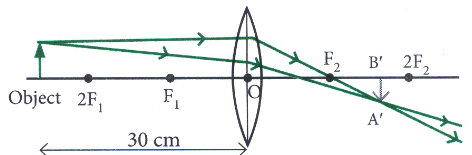
(ii)Object height, h1=4cm
Focal length, f=+20cm
Object distance, u=-15cm
Image distance, v=?
Image height, h2=?
By lens formula,
\({1\over f}={1\over v}-{1\over u}\)
\(\Rightarrow\ {1\over v}={1\over f}+{1\over u}={1\over +20}+{1\over -15}={1\over 20}-{1\over 15}\)
\(\Rightarrow\ {1\over V}={3-4\over 60}={-1\over 60}\)
v=-60cm
Negative sign of v shows that the image is virtual.
22.
(a) The eating up of metals by the action of air and moisture on their surface is called corrosion.
(i) Metal which does not corrode on being kept in the atmosphere is gold.
(ii) Metal which corrodes on being kept in the atmosphere is iron.
(b) Take three boiling tubes and label them as A, B, and C. Place clean iron nails, free from rust, in each tube. Add water to tube A in such a manner that some parts of the nails are exposed to air and seal it with the help of a rubber cork. Add boiled water to tube B in such a way that the nails are completely submerged. Then, pour some amount of kerosene oil in the tube and seal it with the help of a rubber cork. Add anhydrous calcium chloride to tube C and then seal it. Leave the tubes undisturbed for two weeks and observe the changes.
23.
Various plant hormones and their effects are as follows:
(i) Auxin : Promotes cell elongation and thus promotes growth of a plant part.
(ii) Gibberellins : Promotes growth.
(iii) Cytokinin : Promotes cell division and thus promotes growth.
(iv) Abscissic acid : Inhibits growth and is responsible for shedding or older parts.
24.
The differences between the movement in sensitive plant and our legs are as follows :
| Movement in Sensitive Plant | Movement in Legs |
| It occurs in response to an external stimulus like touch. | It is a voluntary action performed and controlled by our will. |
| Plant cells change their shape by changing the amount of water (turgor changes) in them. | Movement of legs (voluntary action) is controlled by cerebellum, a part of hindbrain. It is due to change in special proteins of muscles |
| No nerves are involved | Nerves carry the message for movement of legs. |

10th Standard CBSE Syllabus & Materials
10th Standard CBSE
CBSE 10th Social Science PS - Federalism - New Model Questions Papers Study Material - QB365 Set A
NEW10th Standard CBSE
CBSE 10th Social Science PS - Power Sharing - New Model Questions Papers Study Material - QB365 Set A
NEW10th Standard CBSE
CBSE 10th Social Science GEO - Manufacturing Industries - New Model Questions Papers Study Material - QB365 Set A
NEW10th Standard CBSE
CBSE 10th Social Science GEO - Minerals and Energy Resources - New Model Questions Papers Study Material - QB365 Set A



CBSE 10th Standard CBSE Subjects
CBSE Standards





