
 100% FREE ACCESS
10th Standard CBSE Syllabus & Materials
10th Standard CBSE
CBSE 10th Social Science ECO - Globalisation and the Indian Economy - New Model Questions Papers Study Material - QB365 Set A
NEW10th Standard CBSE
CBSE 10th Social Science ECO - Money and Credit - New Model Questions Papers Study Material - QB365 Set A
NEW10th Standard CBSE
CBSE 10th Social Science ECO - Sectors of the Indian Economy - New Model Questions Papers Study Material - QB365 Set A
NEW10th Standard CBSE
CBSE 10th Social Science ECO - Development - New Model Questions Papers Study Material - QB365 Set A
NEW10th Standard CBSE
CBSE 10th Social Science PS - Outcomes of Democracy - New Model Questions Papers Study Material - QB365 Set A
NEW10th Standard CBSE
CBSE 10th Social Science PS - Gender, Religion and Caste - New Model Questions Papers Study Material - QB365 Set A

Published on: 22/10/2025
Download CBSE Class 10th Standard CBSE Social Science question papers, sample papers, important questions, and previous year solved papers in PDF format. Get free study materials, NCERT solutions, and exam preparation resources for Class 10th Standard CBSE Social Science
Questions + Answers key
Take MCQ Social Science Test
1.
Mrs X, a rural farmer experiencing declining productivity, seeks financial aid to enhance her agricultural activities. Opting for a bank loan, she aims for affordable funds at lower interest rates without risking her property or falling into a debt trap. Her choice prioritises favorable repayment terms and interest-free periods during the loan tenure.
Which of the following statements best aligns with Mrs. X's reasons for choosing a bank loan to improve her agricultural activities?
(i) Accessibility to funds at lower interest rates compared to other sources.
(ii) Freedom from falling into a debt trap due to favorable repayment terms.
(iii) Avoidance of being coerced to sell her property to secure the loan.
(iv) No interest payment requirements during the repayment period.
Only (i)
(iii) and (iv)
(i) and (ii)
Only (ii)
2.
If there is a disruption by transporters and lorries refuse to transport vegetables, milk, etc. from rural areas to urban areas, food will become scarce in urban areas, whereas farmers will be unable to sell their products.
Which of the following sectors will be affected due to this situation stated above?
Primary and Secondary
Secondary and Tertiary
Tertiary, Primary and Secondary
Tertiary and Primary.
3.
Assume there are four families in a country.
The average per capita income of these families is Rs. 5,000. If the income of three families is Rs. 4,000, Rs. 7,000 and Rs. 3,000 respectively, what is the income of the fourth family?
Rs. 7,500
Rs. 3,000
Rs.2,000
Rs. 6,000
4.
Development of a country can generally be determined by
its per capita income
its average literacy level
health status of its people
All the above
5.
Which of the following acts would not apply to a company like TISCO?
Minimum wages act
National Rural Employment Guarantee act
Factories act
Payment of Gratuity act
6.
GDP is the total value of _______ produced during a particular year.
all goods and services
all final goods and services
all intermediate goods and services
all intermediate and final goods and services
7.
What do you mean by public facilities? Why are they important? Name two public facilities available in India.
8.
How can employment be increased in both rural and urban areas? Explain.
9.
Why is the tertiary sector becoming more important in India? Explain
10.
How can the workers of unorganised sector be protected?
11.
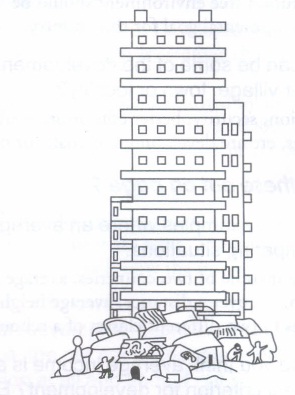
Look at the picture given below. What should be the developmental goals for such an area?
12.
Assertion (A) Kerala has low infant mortality rate.
Reason (R) Kerala has adequate provision of basic health and education facilities.
Codes
(a) Both A and R are true and R is the correct explanation of A
(b) Both A and R are true, but R is not the correct explanation of A
(c) A is true, but R is false
(d) A is false, but R is true
1.
(c)
(i) and (ii)
2.
(c)
Tertiary, Primary and Secondary
3.
(d)
Rs. 6,000
4.
(d)
All the above
5.
(b)
National Rural Employment Guarantee act
6.
(b)
all final goods and services
7.
Public facilities are the facilities provided by the government either free of cost or at very low price for the welfare of the people like schools, health centres, public transport, etc. The importance of these facilities is to make it available to everyone for use so that the standard of living improves.
The major public facilities are as follows
Basic Education Government provides school and other educational facilities like chair, books, etc. to be used by the public. But its use and performance is depended on collective response and community cooperation.
Basic Health Facilities Government provides hospitals, vaccine programmes to maintain basic quality of life.
Law and Order Facility/Security It is the duty of the government to ensure law and order and provide security in order to maintain peace in the country.
Provide for Public Distribution System Government opens PDS shops or ration shops through which it supplies basic food items like rice, wheat, pulses, etc. at very low price/subsidised rate to the lower income group or poor people.
8.
Unemployment is a major problem in India and it is prevalent in both rural and urban areas.
Underemployment is also visible as disguised unemployment in agricultural sector in rural areas and as unorganised service sector in urban areas.
These issues need to be addressed properly.
The steps that can be taken to increase employment are
(i) Education and health sector can create massive employment in urban as well as rural areas. Vocational training also creates massive employment so these sector should be encouraged.
(ii) Allied activities like horticulture, pisciculture should be promoted which will create employment in rural areas. Promotion of small scale industries will also create employment.
(iii) Cheap credit for setting up new businesses can create employment in both rural and urban areas.
(iv) Social safety programmes like MGNREGA, NRLM (National Rural Livelihood Mission), etc generate massive employment in rural and urban areas respectively so they should be encouraged.
9.
The Tertiary sector has emerged as the largest producing sector in the Indian economy in the last decade because
(i) Demand for tertiary sector activities like transport, storage and trade has increased substantially with the development of the Primary and Secondary sectors.
(ii) Increasing requirement of information, communication and technology has created lot of jobs.
(iii) With increase in the income levels of the people, demand for tourism, shopping, education and other services has increased.
(iv) Liberalisation of the financial environment has boosted faster growth in financial services.
(v) Basic services of education and healthcare require a large number of people to be engaged in tertiary sector activities.
10.
The workers in the unorganised sector need protection on the following issues
(i) Wages They are low and not regular. There is no provision for overtime, paid leave, etc. Minimum wages rules should be implemented strictly.
(ii) Safety Construction workers can get injured while working and they need to work under safe conditions. There should be a check on the working conditions along with the provision of insurance.
(iii) Health Long working hours and unhygienic working environment affect the health of the workers adversely. Health insurance along with a fixed number of working hours should be made mandatory.
11.
The developmental goals for the area such as shown in the picture varies in two aspects. One aspect should be that of people residing in flats and second aspect would be the perspective of slum dwellers or people residing in small hut.
For people residing in flats of multistory building, the developmental goals would be proper space and playground for their children, security, better schooling facilities, parking space, aesthetic locality, etc. While slum dwellers would be expecting proper houses, availability of basic necessary services like electricity, water and sanitation. Ideal way for development of locality would be a mix of developmental goals benefiting both communities without curtailing rights and interest of any community.
12.
(a) Both A and R are true and R is the correct explanation of A

10th Standard CBSE Syllabus & Materials
10th Standard CBSE
CBSE 10th Social Science PS - Federalism - New Model Questions Papers Study Material - QB365 Set A
NEW10th Standard CBSE
CBSE 10th Social Science PS - Power Sharing - New Model Questions Papers Study Material - QB365 Set A
NEW10th Standard CBSE
CBSE 10th Social Science GEO - Manufacturing Industries - New Model Questions Papers Study Material - QB365 Set A
NEW10th Standard CBSE
CBSE 10th Social Science GEO - Minerals and Energy Resources - New Model Questions Papers Study Material - QB365 Set A



NCERT Books

Syllabus

Exam Pattern

Sample Question Papers

Previous year Question Papers

Important Notes

MCQ Practice test

NCERT Exemplers

Case study Questions

Image Based Questions

Passage based Questions

HOT Questions

Value Based Questions

Model Questions Papers
NCERT ( Book Back ) Questions

Assertion and Reason
Important Questions And Answers

CBSE 10th Standard CBSE Subjects
CBSE Standards



