
 100% FREE ACCESS
10th Standard CBSE Syllabus & Materials
10th Standard CBSE
CBSE 10th Social Science ECO - Globalisation and the Indian Economy - New Model Questions Papers Study Material - QB365 Set A
NEW10th Standard CBSE
CBSE 10th Social Science ECO - Money and Credit - New Model Questions Papers Study Material - QB365 Set A
NEW10th Standard CBSE
CBSE 10th Social Science ECO - Sectors of the Indian Economy - New Model Questions Papers Study Material - QB365 Set A
NEW10th Standard CBSE
CBSE 10th Social Science ECO - Development - New Model Questions Papers Study Material - QB365 Set A
NEW10th Standard CBSE
CBSE 10th Social Science PS - Outcomes of Democracy - New Model Questions Papers Study Material - QB365 Set A
NEW10th Standard CBSE
CBSE 10th Social Science PS - Gender, Religion and Caste - New Model Questions Papers Study Material - QB365 Set A

Published on: 26/10/2025
Download CBSE Class 10th Standard CBSE Social Science question papers, sample papers, important questions, and previous year solved papers in PDF format. Get free study materials, NCERT solutions, and exam preparation resources for Class 10th Standard CBSE Social Science
Questions + Answers key
Take MCQ Social Science Test
1.
Why do you think that the share of formal sector credit is higher for the richer households compared to the poorer households?
2.
Explain any three drawbacks of barter system.
3.
Explain the meaning of 'terms of credit'.
4.
Why are banks willing to women organised in SHGs?
5.
Mention any four functions of money.
6.
Explain the loan activities of banks.
7.
How is credit helpful for the country's development?
8.
Manav needs a loan to set up a small business. On what basis will Manav decide whether to borrow from the bank or moneylender? Discuss.
9.
How does money solve the problem of double coincidence of wants? Explain with an example of your own.
10.
How does the use of money make it easier to exchange things?
11.
Consider the following information
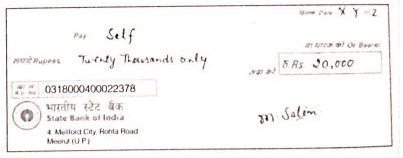
A shoe manufacturer, M. Salim has to make a payment to the leather supplier and writes a cheque for a specific amount. This means that the shoe manufacturer instructs his bank to pay this amount to the leather supplier. The leather supplier takes this cheque and deposits it in his own account in the bank. The money is trans- ferred from one bank account to another bank account in a couple of days. The transaction is complete without any payment of cash.
Now answer the following questions
Mr.Salim wants to withdraw Rs 20,000 in cash for making payments. How would he write a cheque to withdraw money?
12.
Discuss the functioning of Self-Help Groups (SHGs)
13.
Why is it necessary for the banks and cooperatives to increase their lending facilities in rural areas? Explain.
14.
"The credit activities of the informal sector should be discouraged". Support the statement with arguments.
15.
Why is cheap and affordable credit important for a country's development? Explain.
16.
Differentiate between formal sector credit and informal sector credit.
17.
What are the two main reasons for formal credit not being available to the rural poor? Why is there a need to expand rural credit?
18.
How do banks play an important role in the economy of India? Explain.
19.
Whose signatures are found on a 10-rupee note?
20.
What are SHGs?
21.
What kind of credit is crucial for a country's development?
22.
What are the main 'terms of credit'?
23.
What is collateral?
24.
What is a debt-trap?
25.
What is a cheque?
26.
Define money.
27.
What is meant by commercial bank?
28.
What are demand deposits?
29.
What was fiat money?
30.
What is "Barter System"?
1.
The share of the formal sector credit is higher for the richer households because the richer households are in a better position to provide collateral and other necessary documents which are required by the banks and cooperatives.
Richer households have means to exert pressure on banks and cooperatives to sanction loans. These households have greater capacity to repay the loans as compared to the poor households.
2.
The main drawbacks of barter system are:
(a) Double-coincidence of wants. It is a major drawbacks of the barter system as it essentially requires the two individuals under study to possess both the goods which they are willing to exchange, for the satisfaction of their respective wants. It indeed is a very cumbersome task which hinders the mutual exchange.
(b) Lack of a common unit of value. The absence of a common unit of measurement to evaluate the goods and services for exchange made proper accounting impossible.
(c) Lack of store of value. Barter system lacked any method, by which the purchasing power could be stored, to be used in future. It could be stored only in terms of commodities which in turn required huge storage space, thereby high storage cost and also faced the difficulty in the disposing of these commodities.
(d) Lack of standard for deferred payments. Barter system lacked any satisfactory unit to be used in contracts which involved payments to be made in future. Contractual payments or future payments were very difficult to ascertain under barter system of exchange.
3.
Interest rate, collateral, documentation requirement and the mode of repayment together comprise what is called the "terms of credit". These terms vary substantially from one credit arrangement to another. They may vary depending on the nature of the lender and the borrower. These are required to make the borrowers aware of the conditions to be followed for taking the loan.
4.
Banks are willing to lend to women organised in SHGs to help in the creation of self-employment opportunities for the members. Loans are given for releasing mortgaged land, for acquiring assets like sewing machines, handlooms, cattle for meeting working capital needs, etc.
5.
(a) Medium of Exchange (b) Measure of Value
(c) Standards of demand payments (d) Store of Value.
6.
Basically, banks borrow money to lend. Banks pay interest (suppose %) from whom it borrows. After keeping a portion of deposits as reserve, banks lend to people who demand money as loan and bank charge interest (suppose %) from them. The difference between what is charged from borrowers (%) and what is paid to depositors is their main sources of income. After meeting all expenses of banks out of this income, the resultant is profit/loss for the bank.
7.
Large numbers of transactions in our day to day activities involve credit in some form or the other. Credit helps people to meet the ongoing expenses of production, complete production on time and thereby increase their earnings. Hence, it plays a vital and positive role in a country's development.
8.
Manav will decide whether to borrow from a bank or the moneylender on the basis of the following loan terms
(i) The collateral and documentation required, which he should be able to make available.
(ii) The rate of interest to be charged from him.
(iii) The mode of repayment, its periodicity, in cash / kind, etc.
(iv) The penalty in case of default in repayment.
9.
In double coincidence of wants, goods are directly exchanged without the use of money, but by taking each other's goods. Using money as a medium of exchange, eliminates the double coincidence of wants by providing the crucial intermediate step of exchange i.e. money.
For example, it is not necessary for a shoemaker to look for a rice farmer who will buy shoes made by him and at the same time, sell rice to him. All he has to do is to find a buyer for his shoes, who will pay him money for them. With this money, he can purchase rice any other commodity available in the market.
10.
The use of money makes it easier to exchange things because
(i) it is accepted as a medium of exchange.
(ii) it serves as a unit of value.
(iii) it solves the problem of double coincidence of wants.
11.
12.
A Self-Help Group is an innovative way to organise rural and urban poor, particularly women. The following points sum up the functioning of Self-Help Groups.
(a) Typically, a SHG has 15-20 members belonging to one neigbourhood. They meet and pool their savings regularly. Savings per member may vary as per the capacity of the member.
(b) The group advances loans to its members at a nominal interest rate without any collateral.
(c) Most of the important decisions regarding savings and loan activities are taken by the group members themselves. The group decides whether loan is to be granted or not, purpose, amount, interest to be charged, repayment schedule etc.
(d) It is the group that is responsible for the repayment of the loan. In case of non-repayment by any member, all the members seriously follow up the repayment.
(e) The regular meetings of the group provides a platform to discuss and act on a variety of social issues such as health, nutrition, domestic violence, etc.
13.
Banks and cooperatives can help people in obtaining cheap and affordable loans. This will help people to grow crops, do business, set up small- scale industries or trade in goods and also help indirectly in the country's development. They should do so, so that relatively poor people do not have to depend on informal sources of credit (money lenders).
14.
The credit activities of the informal sector should be discouraged because:
(i) 85% of loans taken by the poor households in the urban areas are from informal sources. There is no organisation that supervises the credit activities of lenders in the informal sector.
(ii) Informal lenders charge very high interest on their loans. They try to charge more and more interest on their loans as there are no boundaries and restrictions.
(iii) Higher cost of borrowing means a larger part of the earnings of the borrowers is used to repay the loan.
(iv) In certain cases, the high interest rate for borrowing can mean that the amount to be repaid is greater than the income of borrower. This could lead to increasing debt and debt trap, therefore the credit activities of the informal sector should be discouraged.
15.
Cheap and affordable credit is crucial for a country's development because:
(a) More lending would lead to higher incomes and encourage people to invest in agriculture, engage in business and set up small industries.
(b) Cheap credit will enable more investment. This leads to acceleration of electronic activity.
(c) Cheap credit would also weaker sections of society to access formal sector of leading and get rid of from informal moneylenders.
(d) Affordable credit would also end the cycle of debt trap.
(e) Cheap and easy terms of credit would inspire better investment in technology and thus increase competition.
16.
| Formal Sector Credit | Informal Sector Credit |
| (a) This credit is provided by banks and cooperative societies to the borrowers | (a) This credit is provided by traders, moneylenders, employers, relatives, friends, etc. |
| (b) The Reserve Bank of India (RBI) supervises the functioning of formal sector loans. It periodically checks the interest rate and other details of the sources. | (b) There is no government or private organisation which supervises the informal sector loans. |
| (c) Proper terms of credit like collateral, documentation, rate of interest and mode of payment are followed. | (c) Terms of credit are flexible for the personal benefit of the lenders and pitiable condition of borrowers. |
| (d) They provide cheap and affordable credit with common terms of credit for all. | (d) They exploit the borrowers for their own benefits |
| (e) They charge less interest rates as compared to informal sectors. | (e) Their rate of interest is much higher than that of formal sector. |
17.
(a) The two main reasons for formal credit not being available to rural poor are':
(i) Absence of collateral and documentation is the main reason which prevents rural poor from getting bank loans.
(ii) The arrangements of informal sector loans are flexible in terms of timelines, procedural requirements, interest rates etc. They are adjustable according to the needs and convenience of the borrower.
(b) There is a need to expand rural credit from the side of formal sector because:
(i) Informal sectors exploit rural poor’s by putting them in debt-traps.
(ii) Cheap and affordable credit for rural poor’s is important for the country's overall development.
18.
(i) Banks help people to save their money and keep their money in safe custody. To ensure safety of their money, people deposit their money with banks. Banks accept deposits and pay interest on deposits.
(ii) Banks also grant loans to people for a variety of purposes. In times of need individuals, business houses and industries can borrow money form the banks.
(iii) Credit provided by banks is crucial for the country's growth and economic development. Credit is needed for all kinds of economic activities, to set up business, buy cars, houses etc.
(iv) Banks also help people in obtaining cheap and affordable loans. This can help people to grow crops, do business, set up small-scale industries or trade in goods and also help indirectly in the country's development. They should do so, so that relatively poor people do not have to depend on informal sources of credit (money-lenders).
19.
The signatures of the Governor of Reserve bank of India are found on a 10-rupee note.
20.
They are Self-Help Groups formed by the poor rural women.
21.
Cheap and affordable credit plays a crucial role in a country's development.
22.
Interest rate, collateral, documentation requirements and the mode of repayment together comprise 'terms of credit'.
23.
Collateral is an asset, such as land, vehicle, building, livestock and deposits with banks, that the borrower owns and uses this as a guarantee to a lender until the loan is repaid.
24.
A debt-trap is a situation when it becomes impossible to repay the loan and the borrower adds on a new debt to pay the existing debt.
25.
A cheque is an instrument instructing the bank to pay a specific amount from the person's account to the person in whose name the cheque has been issued.
26.
Money is anything which has common acceptability as a means of exchange, a measure and a store of value.
27.
It is a financial institution which performs the functions of accepting deposits from the general public and giving loans for investment with the aim of earning profit.
28.
The deposits in the bank account which can be withdrawn on demand are known as 'Demand Deposits'.
29.
It is that money which serves as money on basis of fiat or order of government.
30.
It is the system in which one type of goods or service is directly exchanged for another type of goods or service without the use of money.

10th Standard CBSE Syllabus & Materials
10th Standard CBSE
CBSE 10th Social Science PS - Federalism - New Model Questions Papers Study Material - QB365 Set A
NEW10th Standard CBSE
CBSE 10th Social Science PS - Power Sharing - New Model Questions Papers Study Material - QB365 Set A
NEW10th Standard CBSE
CBSE 10th Social Science GEO - Manufacturing Industries - New Model Questions Papers Study Material - QB365 Set A
NEW10th Standard CBSE
CBSE 10th Social Science GEO - Minerals and Energy Resources - New Model Questions Papers Study Material - QB365 Set A



NCERT Books

Syllabus

Exam Pattern

Sample Question Papers

Previous year Question Papers

Important Notes

MCQ Practice test

NCERT Exemplers

Case study Questions

Image Based Questions

Passage based Questions

HOT Questions

Value Based Questions

Model Questions Papers
NCERT ( Book Back ) Questions

Assertion and Reason
Important Questions And Answers

CBSE 10th Standard CBSE Subjects
CBSE Standards



