
 100% FREE ACCESS
10th Standard CBSE Syllabus & Materials
10th Standard CBSE
CBSE 10th Social Science ECO - Globalisation and the Indian Economy - New Model Questions Papers Study Material - QB365 Set A
NEW10th Standard CBSE
CBSE 10th Social Science ECO - Money and Credit - New Model Questions Papers Study Material - QB365 Set A
NEW10th Standard CBSE
CBSE 10th Social Science ECO - Sectors of the Indian Economy - New Model Questions Papers Study Material - QB365 Set A
NEW10th Standard CBSE
CBSE 10th Social Science ECO - Development - New Model Questions Papers Study Material - QB365 Set A
NEW10th Standard CBSE
CBSE 10th Social Science PS - Outcomes of Democracy - New Model Questions Papers Study Material - QB365 Set A
NEW10th Standard CBSE
CBSE 10th Social Science PS - Gender, Religion and Caste - New Model Questions Papers Study Material - QB365 Set A

Published on: 20/10/2025
Download CBSE Class 10th Standard CBSE Social Science question papers, sample papers, important questions, and previous year solved papers in PDF format. Get free study materials, NCERT solutions, and exam preparation resources for Class 10th Standard CBSE Social Science
Questions + Answers key
Take MCQ Social Science Test
1.
Which one of the following definitions is most suitable for the 'Literacy Rate'?
The literate population at the global level.
The proportion of literate population in the seven years and above.
The total number of children attending school in a region.
The average number of schools in a region.
2.
The literacy rate is highest in Kerala while the Infant Mortality Rate is highest in Bihar.
In relation to this information which statement is true?
Most of the people in Kerala and Bihar have good living conditions.
Both Bihar and Kerala lack basic necessities of life.
The standard of living in Kerala is better than Bihar.
The standard of living in Bihar is better than Kerala.
3.
Consider the statements given below and choose the correct answer.
Statement I The Gross Domestic Product (GDP) is the sum of the value of final goods and services produced in only the primary sector of an economy.
Statement II The tertiary sector has replaced the secondary sector as the largest producing sector in most countries.
Statement I is correct and statement II is incorrect.
Statement I is incorrect and statement II is correct.
Both statements I and II are incorrect.
Both statements I and II are correct.
4.
At the initial stages of development, which one of the following sectors was the most important of economic activity?
Primary
Secondary
Tertiary
Quaternary
5.
Which of the following statements accurately describes the role of 'Collateral' in the loan system?
I. It is a security against loans and is used as a guarantee to a lender until the loan is repaid.
II. Collateral is not required by lenders as it increases the risk involved in loaning money.
III. Collateral is a term used to describe the process of credit given by moneylenders.
IV. Collateral is solely an agreement between borrowers and lenders without any legal backing.
Only I
Only II
Both I and III
Only IV
6.
Identify the crop with the help of given information.
1. It is a crop which is used both as food and fodder.
2. It is a kharif crop which requires temperature between 21°C to 27 °C.
3. It grows well in old alluvial soil.
4. Use of modern inputs have contributed to the increasing production of this crop.
Maize
Millets
Wheat
Jowar
7.
Omar wanted to learn more about the Ottoman Empire.
France
Austria
Bulgaria
Switzerland
8.
Major step towards decentralisation in India was taken up in
1992
1993
1991
1990
9.
Consider the following statements and choose the appropriate option associated with Belgium
Belgium is a small country in North America
Belgium has borders with France, the Netherlands, Germany and Luxembourg
Out of total population of Belgium, 80%lives in the Flemish region and speaks French language.
The total population of Belgium is 10 crore.
10.
Which of the following is essential for sustainable existence of all forms of life?
Resource planning
Resource management
Resource extraction
Resource generation
11.
Find the incorrect option
Mahatma Gandhi return to India from South Africa in 1918.
In 1918, Gandhiji went to Ahmedabad to organise a Satyagarhi Movement.
Khilafat Movement was started in 1921.
Jallianwala Bagh massacre took place on 13th April 1919.
12.
Riya collected an object from which she was able to see through. What is the object?
Wood
Glass
Metal
Leather
13.
Which of the commercially valuable species have damaged the natural forests in south India?
Chir pine
Teak Monoculture
Himalayan Oak
None of them
14.
What do you mean by collateral?
It is the total sum of money with a person
It is the things kept in the locker
It is the guarantee given by the lender to the borrower
It is the security to a lender until the loan is repaid
15.
Why was the Round Table Conference held in England?
To discuss the provisions of future Indian Constitution.
To discuss the steps to be taken to check Indian National Movement
To give concessions to Indians
To make plans for improvement of agriculture in India.
16.
Name any two countries where women's participation in public life is very high.
Sri Lanka and Nepal
Pakistan and Bhutan
Sweden and Finland
South Africa and Maldives
17.
Which community was rich and powerful in Belgium?
German
French
Dutch
none of the mention above
18.
Which one of the following statements refers to the sustainable development?
Overall development of various resources
Development should take place without damaging the environment.
Economic development of people
Development that meets the desires of the members of all communities.
19.
What part of Total population of India is engaged in agriculture activities?
2/3
1/3
2/5
1/4
20.
Slav Nationalism gathered force in Habsburg and Ottoman Empire in
1914
1905
1870
1871
21.
What is Human Development. Explain its indicators.
22.
Give a comparative analysis between Belgium and India in the sphere of area
23.
Why was the Khilafat Movement supported by Gandhiji in 1919? What was his main aim?
24.
What are primary activities? Explain with examples.
25.
What are demand deposits? Describe any three salient features of demand deposits.
26.
Which countries were considered as Axis Power during the Second World War?
27.
Name the states created to recognise difference based on culture, ethnicity or geography.
28.
What is reflected in a sexual division of labour.
29.
Name the crop in growing which India is the second largest producer?
30.
How can the formal sector loans be made beneficial for poor farmers and workers? Explain.
31.
"Nuclear energy is expected to play an increasingly important role in India." Give arguments to support this statement.
32.
What led to the emergence of new middle class in Europe.
33.
How are often religious differences expressed in the field of politics?
34.
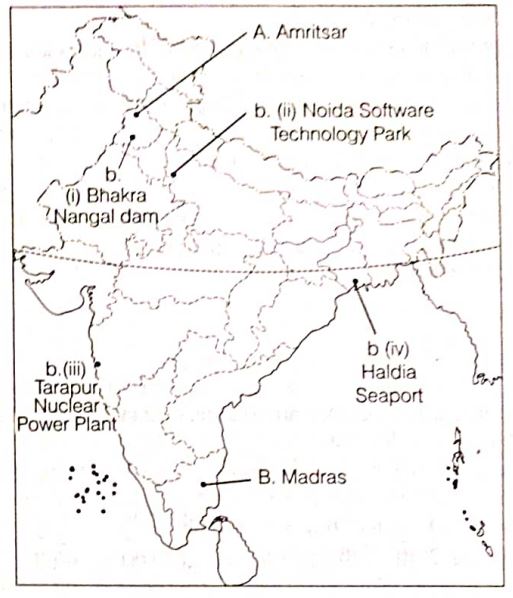
(a) Two places (A) and (B) have been marked on the given political outline map of India. Identify them with the help of the following information and write their correct names on the lines drawnnear them.
(i) The place where Jallianwala Bagh Massacre took place.
(ii) The place where the session of Indian National Congress was held in 1927.
(b) On the same political outline map of India, locate and label any three of the following with suitable symbols.
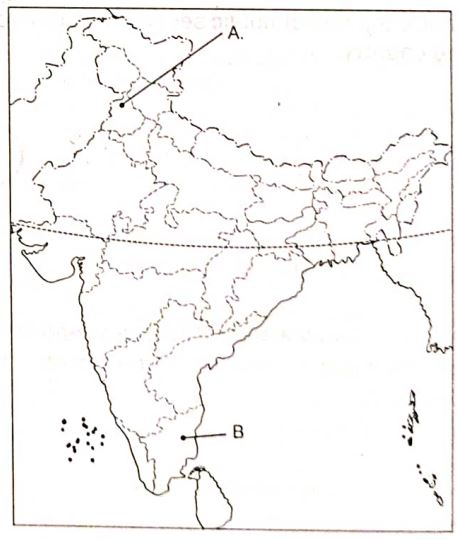
(i) Bhakra Nangal - Dam
(ii) Noida - Software Technology Park
(iii) Tarapur - Nuclear Power Plant
(iv) Haldia - Seaport
35.
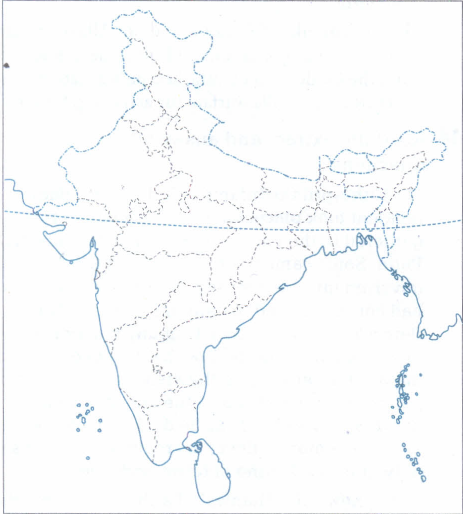
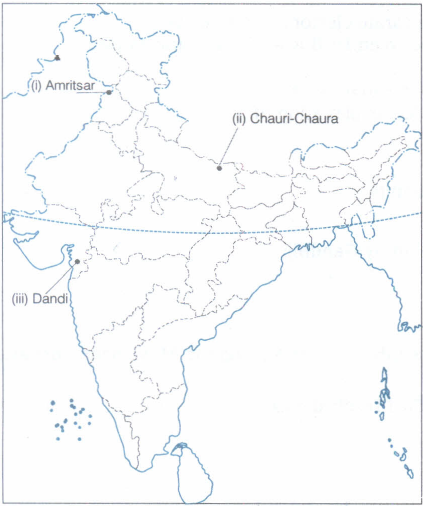
Mark and locate the following in given map of India.
(i) Jallianwala Bagh incident
(ii) Dandl March
36.
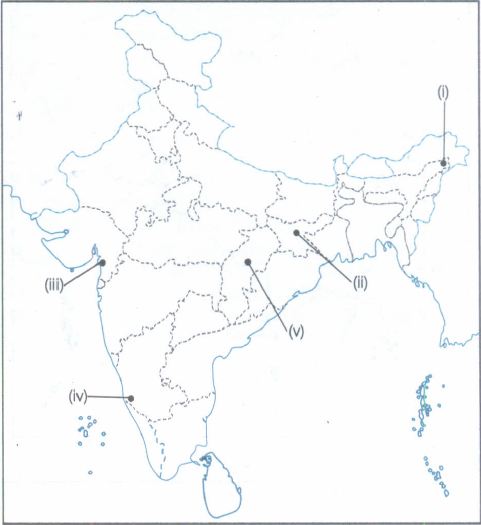
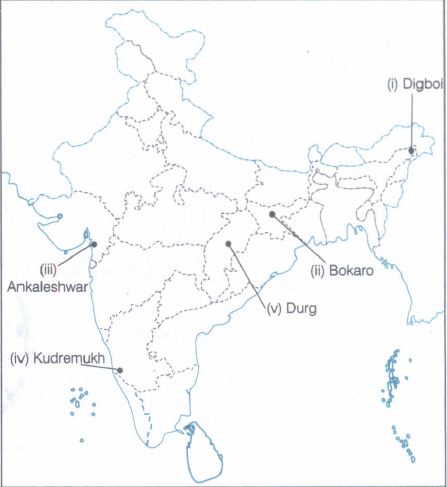
On a given political map of India identify any for features and name the following
(i) One oil field in Assam.
(ii) Coal mine in Jharkhand.
(iii) One oil field in Gujarat
(iv) One iron are mine in Karnataka.
(v) One iron are mine in Chhattisgarh
37.
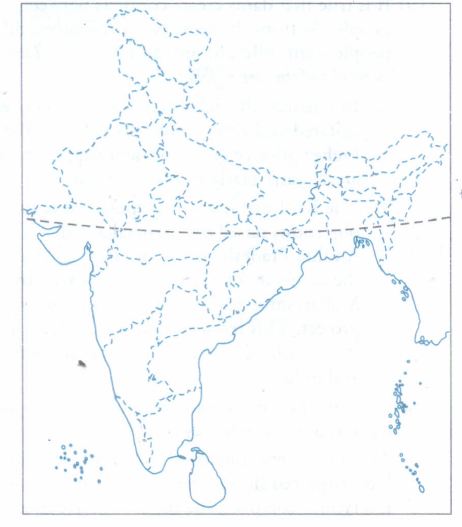
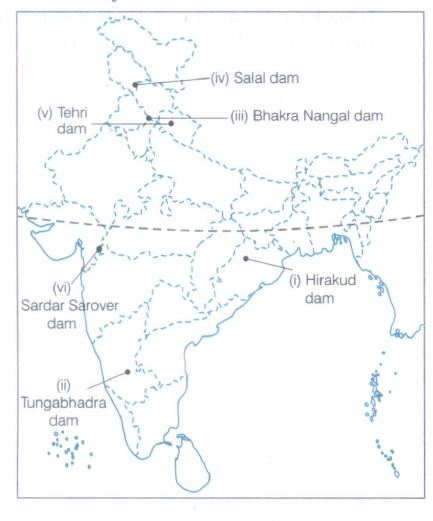
On the outline map of India given below, locate and label any four of the following dams
(i) Hirakud dam
(ii) Tungabhadra dam
(iii) Bhakra Nangal dam
(iv) Salal dam
(v) Tehri dam
(vi) Sardar Sarovar dam
38.
Concurrent List includes subjects of common interest to both the Union Government as well as the State Governments, such as education, forest, trade unions, marriage, adoption and succession. Both the Union as well as the State Governments can make laws on the subjects mentioned in this list. If their laws conflict with each other, the law made by the Union Government will prevail.
1. Who makes the laws on the subjects mentioned in the Concurrent List?
(a) Both the Union as well as the State Governments can make laws on the subjects mentioned in the Concurrent List. If their laws conflict with each other, then the law made by the Union Government will prevail.
(b) Only the State Governments can make laws on the subjects mentioned in the Concurrent List. The Union Government has no say over the subjects of this list.
(c) Only the Union Government can make laws on the subjects mentioned in the Concurrent List. The State Governments have no say over the subjects of this list.
(d) Both the Local as well as the State Governments can make laws on the subjects mentioned in the Concurrent List. If their laws conflict with each other, then the law made by the State Government will prevail.
2. Which of these is not a subject under the Concurrent List?
(a) Forest is not a subject under Concurrent List.
(b) Education is not a subject under Concurrent List.
(c) Adoption and succession is not a subject under Concurrent List.
(d) Agriculture is not a subject under Concurrent List.
3. Which of these is a subject under the Concurrent List?
(a) Foreign policy is a subject under Concurrent List.
(b) Marriage is a subject under Concurrent List.
(c) Banking is a subject under Concurrent List.
(d) Commerce is a subject under Concurrent List.
4. What happens when laws regarding Concurrent list are in conflict between the Union and the State government?
(a) If their laws conflict with each other, then the law made by the President will prevail.
(b) If their laws conflict with each other, then the law made by the State Government will prevail.
(c) If their laws conflict with each other, then the law made by the Union Government will prevail.
(d) If their laws conflict with each other, then the law made by the local governments will prevail.
39.
Many thought that given the disadvantages and rising resistance against the multipurpose projects, water harvesting system was a viable alternative, both socio-economically and environmentally. In ancient India, along with the sophisticated hydraulic structures, there existed an extraordinary tradition of water-harvesting system. People had in-depth knowledge of rainfall regimes and soil types and developed wide ranging techniques to harvest rainwater, groundwater, river water and flood water in keeping with the local ecological conditions and their water needs. In hill and mountainous regions people built diversion channels like the 'guls' or 'kuls' of the Western Himalayas for agriculture. 'Rooftop rainwater harvesting' was commonly practised to store drinking water, particularly in Rajasthan. In the flood plains of Bengal, people developed inundation channels to irrigate their fields. In arid and semi-arid regions, agricultural fields were converted into rainfed storage structures that allowed the water to stand and moisten the soil like the 'khadins' in Jaisalmer and 'Johads' in other parts of Rajasthan.
1. What were 'guls or kuls'?
(a) They were water diversion channels.
(b) They were road diversion channels.
(c) They were local people of Rajasthan.
(d) These were the only two wells availabe in Rajasthan.
2. Where is rooftop rainwater harvesting practices commonly?
(a) It is practised most commonly in Jaisalmer.
(b) It is practised most commonly in Bengal.
(c) It is practiced most commonly in Daiasthan
(d) It is practised most commonly in Western Himalayas.
3. India tracing the sophisticated hydraulic structures to which era?
(a) India traces the sophisticated hydraulic structures to the ancient era.
(b) India traces the sophisticated hydraulic structures to the modern era.
(c) India traces the sophisticated hydraulic structures to the Mesozoic era.
(d) India traces the sophisticated hydraulic structures to the Christian era
4. What is the most common use of rooftop rainwater harvesting?
(a) Roof top rainwater harvesting is practiced commonly to store water for growing vegetables.
(b) Roof top rainwater harvesting is practiced commonly to store drinking water.
(c) Roof top rainwater harvesting is practiced commonly to supply water in industries.
(d) Roof top rainwater harvesting is practiced commonly to store water for cattles only.
40.
Rinderpest, or the Cattle Plague
The loss of cattle destroyed African livelihoods. Planters, mine owners and colonial governments now successfully monopolised what scarce cattle resources remained, to strengthen their power and to force Africans into the labour market. Control over the scarce resource of cattle enabled European colonisers to conquer and subdue Africa.
1. Why was it easier for the planters, mine owners and colonial governments to establish their monopoly?
(a) It was easier for the planters, mine owners and colonial governments to establish their monopoly as the loss of cattle destroyed African livelihood.
(b) It was easier for the planters, mine owners and colonial governments to establish their monopoly as the loss of goat destroyed African livelihood.
(c) It was easier for the planters, mine owners and colonial governments to establish their monopoly as the loss of birds destroyed African livelihood.
(d) It was easier for the planters, mine owners and colonial governments to establish their monopoly as the loss of hens destroyed African livelihood.
2. Owners and colonial governments successfully monopolised the scarce cattle resources that remained.
| (a) Traders | (b) Planters |
| (c) Merchants | (d) Villagers |
3. Why did Planters, mine owners and colonial governments monopolised cattle resources?
(a) Planters, mine owners and colonial governments monopolised cattle resources to strengthen their power and to force Indians into the labour market.
(b) Planters, mine owners and colonial governments monopolised cattle resources to strengthen their power and to force Australians into the labour market.
(c) Planters, mine owners and colonial governments monopolised cattle resources to strengthen their power and to force Africans into the labour market.
(d) Planters, mine owners and colonial governments monopolised cattle resources to strengthen their power and to force American into the labour market.
4. Control over the scarce resource of cattle enabled European colonisers to conquer and subdue.
| (a) Australia | (b) India |
| (c) Africa | (d) America |
1.
(b)
The proportion of literate population in the seven years and above.
2.
(c)
The standard of living in Kerala is better than Bihar.
3.
(c)
Both statements I and II are incorrect.
4.
(a)
Primary
5.
(a)
Only I
6.
(a)
Maize
7.
(c)
Bulgaria
8.
(a)
1992
9.
(c)
Out of total population of Belgium, 80%lives in the Flemish region and speaks French language.
10.
(a)
Resource planning
11.
(a)
Mahatma Gandhi return to India from South Africa in 1918.
12.
(b)
Glass
13.
(d)
None of them
14.
(c)
It is the guarantee given by the lender to the borrower
15.
(a)
To discuss the provisions of future Indian Constitution.
16.
(c)
Sweden and Finland
17.
(d)
none of the mention above
18.
(b)
Development should take place without damaging the environment.
19.
(a)
2/3
20.
(b)
1905
21.
Human Development is the process of enlarging people's choices as well as raising the level of well being so that they can lead a purposeful and a creative life.
The four indicators of human development are
(i) Per Capita Income This is the total income of country divided by its total population.
(ii) Life Expectancy at Birth This is the number of years, a new born child is expected to live at the prevailing conditions.
(iii) Literacy Rate This is the total percentage of the population of an area at a particular time aged 7 years or above, who can read and write with understanding atleast one language.
(iv) Net Attendance Ratio It is the total number of children enrolled in or attending primary school, as a percentage of total number of children of primary school age.
22.
Belgium in area wise is a small country in Europe. It covers an area of 30,528 sq.km. It has borders with France, Netherlands, Germany and Luxembourg. Regarding population it has a population of over one crore, about half the population of Haryana.
On the other hand, India is a vast country (covers 3,284,590 sq. km) with 22 officially recognised languages. Hindi and English are used as official languages. To draw area wise division according to language spoken is very difficult in India.
23.
Though Rowlatt Satyagraha was a widespread movement, it was still limited to certain cities and town. Gandhiji wanted a more united and broad-based movement especially for bringing the Hindus and Muslims together. In 1919, Gandhiji supported the Khilafat Movement to protest against the humiliation caused to Turkish Khalifa by the British. The Khalifa was regarded as the spiritual head of the Muslims around the world. Gandhiji saw this as an opportunity to gain the support of the Muslim community.
Gandhiji's main aim was to unite Hindus and Muslim for a unified national movement.
24.
(a) Those activities wherein goods are produced by exploiting natural resources. It provides the basic raw materials for all goods subsequently produced.
(b) E.g. Agriculture, forestry, mining, fishing, animal husbandry etc.
(c) Share in India's GDP: 28%
25.
People with surplus money or extra amount deposit it in banks. The banks keep the money safe and give an interest on it. The deposits can be drawn at any time on demand by the depositors. That is why they are called 'deposits'.
(i) The demand deposits encashable by issuing cheques have the essential features of money
(ii) They make it possible to directly settle payments without the use of cash.
(iii) Since demand drafts/cheque are widely accepted as a means of payment along with currency, they constitute money in the modern economy.
26.
Nazi Germany, Japan, and Italy were considered as Axis Powers during the Second World War
27.
Nagaland, Uttarakhand and Jharkhand were created to recognise difference based on culture, ethnicity or geography.
28.
The main responsibility of women is housework and bringing up children. Women do all the work inside the home and men do all the work outside the home.
29.
Sugarcane is the crop in growing, which India is the second largest producer.
30.
The formal sector loans can be beneficial for poor farmers and workers in the following ways
The formal sector like banks and cooperatives should lend more to poor people and workers, particularly in rural areas.
The formal sector should provide cheap and affordable credit to the poor people so that repayment is easy.
Formal sector should work out other ways of arranging collateral from the poor people.
By providing linkage between Self Help Groups and banks, formal sector of credit can be increased.
There should be more number of cooperatives and banks in rural areas and people should be made aware of their presence.
31.
Nuclear energy is expected to play an increasingly important role in India due to the following reasons
(i) India has limited reserves of coal and petroleum. Nuclear energy minerals like Thorium is found in plenty in India. Hence, nuclear energy can compensate for deficiency of fossil fuels.
(ii) Nuclear power stations can be established easily and conveniently in those areas where other sources are not available.
(iii) Nuclear power releases tremendous amounts of energy. India can utilise this energy for peaceful purposes such as generation of electricity that can be used to run machines in industries.
(vi) Nuclear energy is a non-conventional source of energy. After the initial expenses, it becomes very economical.
32.
Industrialisation began in Europe during the 19th century and brought with it growth of towns and cities inhabited by strong commercial class which produced goods for domestic markets.
Along with it a class of people emerged called the new working class. It included professionals, businessmen and industrialists.
Though they were small in number, educated, liberal minded and believed in national unification. They strongly condemned aristocratic set up in the society. It was because of these ideals they gained popularity and emerged as a new social class. They stood for equality and freedom and stressed the formation of constitution given preference to representative from of government rather than established autocratic regimes.
33.
(i) Gandhiji used to say that religion can never be separated from politics. He believed that politics must be guided by ethics drawn from religion.
(ii) Human rights groups in our country have argued that most of the victims of communal riots in our country are people from religious minorities. They have demanded that the government take special steps to protect religious minorities.
(iii) Women's movement has argued that Family Laws of all religions discriminate against women. So they have demanded that government should change these laws to make them more equitable.
(iv) All these instances involve a relationship between religion and politics. But they do not seem very wrong or dangerous. Ideas, ideals and values drawn from different religions can and perhaps should play a role in politics.
(v) Those who hold political power should sometimes be able to regulate the practice of religion so as to prevent discrimination and oppression.
34.
35.
(i) Amritsar 1919-(Punjab), (ii) Dandi (Gujarat)
36.
37.
The locations of dam are marked below
38.
1. Both the Union as well as the State Governments can make laws on the subjects mentioned in the Concurrent List. If their laws conflict with each other, then the law made by the Union Government will prevail.
2. Agriculture is not a subject under Concurrent List.
3. Marriage is a subject under Concurrent List.
4. If their laws conflict with each other, then the law made by the Union Government will prevail.
39.
1. They were water diversion channels.
2. It is practiced most commonly in Daiasthan
3. India traces the sophisticated hydraulic structures to the ancient era.
4. Roof top rainwater harvesting is practiced commonly to store drinking water.
40.
1. It was easier for the planters, mine owners and colonial governments to establish their monopoly as the loss of cattle destroyed African livelihood.
2. Merchants
3. Planters, mine owners and colonial governments monopolised cattle resources to strengthen their power and to force American into the labour market.
4. America

10th Standard CBSE Syllabus & Materials
10th Standard CBSE
CBSE 10th Social Science PS - Federalism - New Model Questions Papers Study Material - QB365 Set A
NEW10th Standard CBSE
CBSE 10th Social Science PS - Power Sharing - New Model Questions Papers Study Material - QB365 Set A
NEW10th Standard CBSE
CBSE 10th Social Science GEO - Manufacturing Industries - New Model Questions Papers Study Material - QB365 Set A
NEW10th Standard CBSE
CBSE 10th Social Science GEO - Minerals and Energy Resources - New Model Questions Papers Study Material - QB365 Set A



NCERT Books

Syllabus

Exam Pattern

Sample Question Papers

Previous year Question Papers

Important Notes

MCQ Practice test

NCERT Exemplers

Case study Questions

Image Based Questions

Passage based Questions

HOT Questions

Value Based Questions

Model Questions Papers
NCERT ( Book Back ) Questions

Assertion and Reason
Important Questions And Answers

CBSE 10th Standard CBSE Subjects
CBSE Standards



