
 100% FREE ACCESS
10th Standard CBSE Syllabus & Materials
10th Standard CBSE
CBSE 10th Social Science ECO - Globalisation and the Indian Economy - New Model Questions Papers Study Material - QB365 Set A
NEW10th Standard CBSE
CBSE 10th Social Science ECO - Money and Credit - New Model Questions Papers Study Material - QB365 Set A
NEW10th Standard CBSE
CBSE 10th Social Science ECO - Sectors of the Indian Economy - New Model Questions Papers Study Material - QB365 Set A
NEW10th Standard CBSE
CBSE 10th Social Science ECO - Development - New Model Questions Papers Study Material - QB365 Set A
NEW10th Standard CBSE
CBSE 10th Social Science PS - Outcomes of Democracy - New Model Questions Papers Study Material - QB365 Set A
NEW10th Standard CBSE
CBSE 10th Social Science PS - Gender, Religion and Caste - New Model Questions Papers Study Material - QB365 Set A

Published on: 20/10/2025
Download CBSE Class 10th Standard CBSE Social Science question papers, sample papers, important questions, and previous year solved papers in PDF format. Get free study materials, NCERT solutions, and exam preparation resources for Class 10th Standard CBSE Social Science
Questions + Answers key
Take MCQ Social Science Test
1.
How much desired area is required for forest in our country?
16%
20%
23.2%
33%
2.
Soil is a:
Renewable Resource
Potential Resource
Non-Resource
None of them
3.
Tuticorin is located in the state of
Kerala
Tamil Nadu
Karnataka
Orissa
4.
Which one of the following public sector plants is located in Chhattisgarh?
Bokaro Steel Plant
Durgapur Steel Plant
Bhilai Steel Plant
Rourkela Steel Plant
5.
Which of the following industries generate the largest employment opportunities to the people?
Silk industry
Cotton industry
Textile industry
Jute industry
6.
Odisha is the leading producer of which ore of the following minerals?
Copper
Mica
Manganese ore
Iron ore
7.
Which year was known as the year of dear bread?
1830
1848
1789
1815
8.
It is a type of agriculture where farmers clear a patch of and produce rereads and other food crops to sustain that family that is:
Commercial farming
Extensive farming
Modern farming
Slash and burn farming
9.
Which one of the following is a leguminous crop?
Pulses
Jowar
Millets
Seamum
10.
Which act as a bulk carrier within India?
Airways
Roadways
Railways
Waterways
11.
Why did the peasant community actively participate in the Civil Disobedience Movement? Choose the most appropriate answer form the following:
Failure of talks in the 2nd Round table conference
The Government's refused to reduce the revenue demand
Khadi cloth was more expensive than mill made cloth
Racial discrimination
12.
What was Rowlatt Act?
It was an act which controlled the movement of plantation workers
It was an act through which the government get enormous power to repress political activities and allowed detention of political prisoners without trial for two years.
The act through which wages of workers were reduced.
None of the above.
13.
Who among the following was described as "the most dangerous enemy of social value" by Duke Metternich?
Giuseppe Mazzini
Johann Gottfried
Louis Philippe
Karol Kurpinski
14.
Koderma, in Jharkhand is the leading producer of which one of the following minerals?
bauxite
mica
iron ore
copper
15.
What led to the emergence of feelings of nationalism in Europe?
16.
How can solar energy solve the energy problem to some extent in India? Give your opinion.
17.
Mention the names of the main mica-producing areas of India
18.
Why is the cotton textile industry the largest industry in India today? Give any three reasons.
19.
(i) Name three states having black soil and the crop which is mainly grown in it.
(ii) What type of soil is found in the river deltas of the eastern coast? Give three main features of this type of soil.
(iii) what steps can be taken to control soil erosion in the hilly areas?
20.
Name two leading producers of the following crops.
(a) Mangoes
(b) Oranges
(c) Apple
(d) Bananas.
21.
Why are pulses grown as rotation crops? Give two reasons.
22.
Mention in brief, the various limitations from which the Indian agriculture suffers presently.
23.
Explain any four qualitative improvements made in Indian Railways.
24.
Define international trade. Why it is considered as economic barometer of a country?
25.
'Manufacturing industry is considered the backbone of economic development of India' Give three reasons.
26.
How are integrated steel plants from mini steel plants?
27.
"The plantation workers in Assam had their own understanding of Mahatma Gandhi and the notion of Swaraj." Support the statement with argumants.
28.
Who formed the aristocracy class?
29.
How did Lord Byron contribute to the Greek war of Independence?
30.
Why did the nationalists in India tour villages?
31.
In which state are the Bailadila mines located?
32.
Name the national highway between Delhi and Amritsar.
33.
Which is the second important metallurgical industry of India?
34.
What is the significance of 1848 for France and the rest of Europe? What did the liberals demand?
35.
Who presided over the Lahore Congress Session in December 1929? What were the immediate outcomes of this session?
36.
(i) Explain land use pattern in India and why has the land under forest not increased much since 1960-61?
(ii) How have technical and economic development led to more consumption of resources?
37.
Describe any four reforms brought in the India agriculture after independence through the efforts of the Indian Government.
38.
Mention four demerits of road transportation with reference of India.
39.
Explain any three problems faced by cotton textile industries in India.
40.
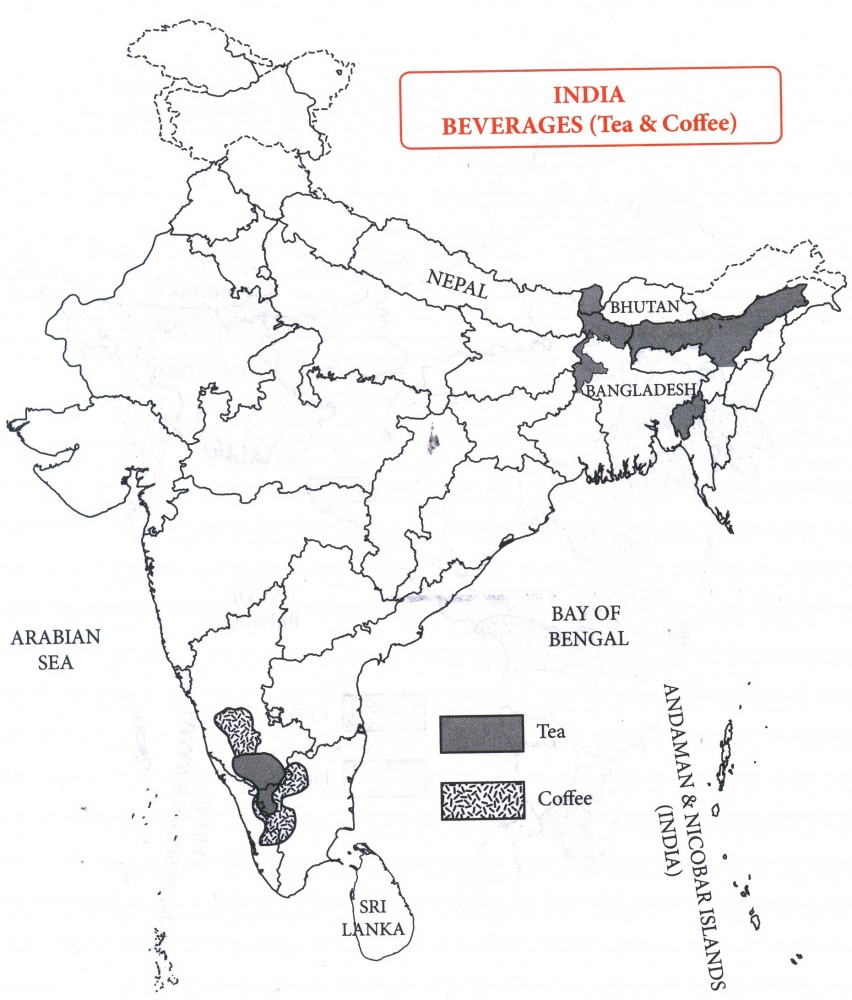
In the outline map of India, identify tea and coffee producing states.
(a) Karnataka
(b) Kerala
(c) Assam
(d) West Bengal
41.
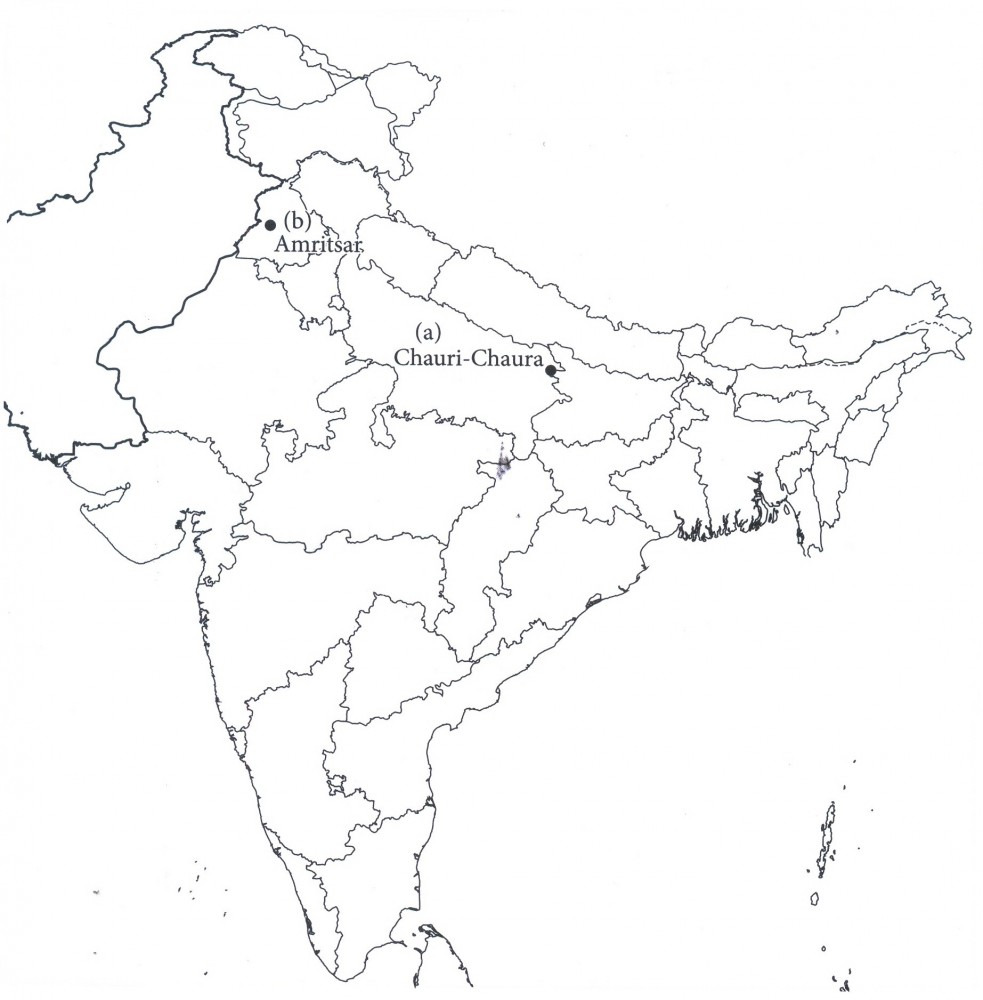
Locate and label the following items with appropriate symbols on the same map:
(a) Chauri-Chaura-The place of calling off the Non-Cooperation Movement (N.C.M.)
(b) Amritsar-The place where Jallianwalla Bagh incident took place.
1.
(a)
16%
2.
(a)
Renewable Resource
3.
(b)
Tamil Nadu
4.
(c)
Bhilai Steel Plant
5.
(c)
Textile industry
6.
(c)
Manganese ore
7.
(b)
1848
8.
(d)
Slash and burn farming
9.
(a)
Pulses
10.
(c)
Railways
11.
(b)
The Government's refused to reduce the revenue demand
12.
(b)
It was an act through which the government get enormous power to repress political activities and allowed detention of political prisoners without trial for two years.
13.
(a)
Giuseppe Mazzini
14.
(b)
mica
15.
During the nineteenth century, feelings of nationalism emerged and brought tremendous changes in Europe, politically and mentally. These changes became the reason were replaced with the nation-states. This idea of modern state, where a clearly defined territory, controlled by a centralised power, had been developing in Europe, over a long period of time. The concept of nation-state with both, rulers and citizens, joined hands and developed a sense of common identity and shared history.
16.
The western parts of India, especially the Thar Desert region, receives undisturbed sunshine for the most part of the year. This area has great potential for development of energy and can be utilised as the largest solar power house of India.
Solar energy is becoming fast popular in different parts of the country, especially in rural and remote areas. It can be used for cooking, heating of water, pumping, refrigeration, street lighting and room heating in cold areas. The largest solar plant of India is located at Madhapur near Bhuj in Gujarat. The solar energy is used to sterilize milk cans.
17.
The main mica producing areas of India are the
(a) Koderma-Gaya-Hazaribagh belt of Jharkhand is the leading mica-producing area of India.
(b) In Rajasthan, the major mica-producing area is around Ajmer.
(c) In Andhra Pradesh, the Nellore mica belt is an important mica-producing area.
18.
The cotton industry is the largest industry in India today because of the following reasons.
(a) The cotton textile industry contributes 14 per cent of the total industrial production.
(b) It provides employment to 35 million persons directly - the second largest after agriculture.
(c) Its share in GDP in terms of foreign exchange is considerable.
19.
(i) The three states having black soil are Madhya Pradesh, Chhattisgarh and Maharashtra. The crops, which mainly grown are cotton, tobacco and sugarcane.
(ii) Alluvial soil is found in the river deltas of the Eastern coast. Three main features of this type of soil are
(a) It is very fertile.
(b) It contains adequate proportion of potash, phosphoric acid and lime.
(c) It is more alkaline in the drier areas.
(iii) Following steps should be taken to control soil erosion in the hilly areas
(a) Afforestation This is done by planting trees.
(b) Terrace farming and contour ploughing This is done across the hill slopes.
(c) Restricted grazing of animals Animals should be moved over different pastures so as to avoid erosion of soil.
(d) Plugging of gullies By this method, gully erosion can be prevented
20.
(a) Mangoes - Maharashtra, Andhra Pradesh
(b) Oranges - Nagpur, Maghalaya
(c) Apples - Jammu Kashmir, Himachal Pradesh
(d) Bananas - Kerela, Mizoram.
21.
Pulses like Tur, Arhar and Urad are kharif crops and Moong and Masur, Peas and Gram are rabi crops. Plants of pulses help in restoring fertility of the soil and hence they are grown in rotation with other crops. Two important pulses are Gram and Tur. Gram is produced in Madhya Pradesh, Uttar Pradesh and Rajasthan and Tur is produced in Maharashtra, Uttar Pradesh, Karnataka, Andhra Pradesh and Madhya Pradesh.
22.
(a) Agricultural is not generating sufficient employment opportunities in the country.
(b) The growth rate in agriculture is decelerating which is an alarming situation.
(c) Today, Indian farmers are facing a big challenge from international competition and our government is going ahead with reduction in the public investment in agriculture sector particularly in irrigation, power, rural roads, market and mechanization.
23.
(i) Conversion of meter gauge to broad gauge.
(ii) Steam engines have been replaced by diesel and electric engines. This has increased the speed and haulage capacity.
(iii) The replacement of steam engine run by coal has improved the environment of stations and its surroundings.
(iv) Railways routes have been extended to areas were there was no railways lines earlier.
24.
International trade is defined as the exchange of goods and services between two or more countries. It is also considered as economic barometer because
(a) Advancement in international trade of a country leads to economic prosperity.
(b) Income earned from international trade constitutes a major part in the net national income.
(c) Large international trade leads to revival of domestic economy.
25.
1. Manufacturing industries not only help in modernizing agriculture but also reduce the heavy dependence of people on agricultural income by providing them jobs in secondary and tertiary sectors.
2. Industrial development is a precondition for eradication of unemployment and poverty from our country.
3. Establishing industries in tribal and backward areas help in bringing down regional disparities.
4. Export of manufactured goods expands trade and commerce and brings in much needed foreign exchange.
5. Industrial development brings prosperity to the country as it transforms raw materials into valuable products.
26.
(i) Mini steel plants are smaller and have electric furnaces, use steel scrap and sponge iron.
(ii) They have re-rollers that use steel ingot as well. They produce mild and alloy steel of given specifications.
(iii) An integral steel plant is large and handles everything related to smelting of iron. Raw materials are converted in to iron. Rolling and shaping is done here and steel bars are made.
(iv) Coal is used as a major source of fuel in integrated steel plants.
27.
Under the Inland Emigration Act of 1859, the plantation workers were not allowed to leave the tea gardens without permissions. Thousands of workers defied the authorities, left the plantations and headed home. They believed that Gandhi raj was coming and everyone would be given land in their own villages. However, they were caught by the police and brutally beaten up. When the tribals chanted Gandhiji's name and raised slogans demanding 'Swatantra Bharat', they were also emotionally relating to an all-India agitation.
28.
(i) They are the land owning class
(ii) They were small in numbers, but dominated Europe both socially and politically.
(iii) They spoke French which was considered the language of high society.
(iv) Their families were connected through marriage.
29.
Lord Byron, an English poet, organised funds for the Greek struggle against the Ottoman Empire and also participated in the war.
30.
Nationalists in India toured to gather folk songs and legends so as to produce a true picture of traditional Indian culture to discover one's identity and restore a sense of pride in one's past.
31.
The Bailadila mines are located in the state of Chhattisgarh
32.
Sher Shah Suri Marg is called National Highway No.1.
33.
Aluminium smelting.
34.
In 1848 Europe, the poor, unemployed workers and starving peasants led many revolts. In France, the educated middle class too started a revolution for the abolition of monarchy and establishment of a republic based on universal male suffrage. They took advantage of the growing popular unrest to put forward their demands for the creation of a nation-state based on parliamentary principles with an issue in which large number of women took active part. They formed political associations and published newspapers voicing their demands. Men and women from the liberal middle classes around Europe combined their demands for constitutionalism along with national unification.
35.
Jawaharlal Nehru presided over the Lahore Congress Session in December 1929. The following were the immediate outcomes of this session.
(a) The demand for Purna Swaraj or complete independence was formalised.
(b) It was declared that 26 January 1930 will be celebrated as the Independence Day.
(c) People were asked to take a pledge to struggle for complete independence.
(d) Gandhiji tried to find a way to relate this idea of freedom to issues of everyday life. This later came in the form of famous Civil Disobedience Movement.
36.
(i) Land resources in India are primarily divided into agricultural land, forest land, land meant for pasture and grazing, land for other non-agricultural use (such as housing, roads and industry) and waste land (rocky,arid and desert areas). According to recent data available, (2014-15) the percentage of Net Sown Area (NSA) in India is about 45.5% of the total reporting area 23.3% is covered by forests and 3.38% is used for grazing. The rest is waste land with traces of miscellaneous cultivation.
Land under forest has increased by only above 5 per cent since 1960-61 due to following reasons
Improper use of forest land has degraded the available land area and made conservation of forests difficult.
Human activities such as deforestation, mining and quarrying have contributed to the slow growth rate of forests.
(ii) The following technical and economic development have led to more consumption of resources
(a) Technological development has led to industrialisation which has increased the use of natural resources.
(b) Technological development has converted the subsistence agriculture to commercial agriculture and this has led to the over-utilisation of soil.
(c) Technological development has also improved the process of mining.
(d) The development of technology contributed to increase in production of quality goods and provision of better services to the people.
(e) Economic development has led to increasing urbanisation and modernisation which demand more resources.
37.
Technological Reforms:
(a) Modern machineries are used in agriculture for ploughing, sowing, harvesting and thrashing.
(b) Indian farmers have started to use chemical fertilizers on a large scale.
(c) High Yielding Varieties and early maturing quality seeds have been introduced to increase the agricultural production.
(d) Irrigation facilities have improved with the constructions of canals and the introduction of motor pumps, drip irrigation and use of sprinklers.
Institutional Reforms:
(a) The govt. abolished the Zamindari system to protect the interest of the farmers.
(b) The Govt abolished the Zamindari system to protect the interest of the farmers.
(c) The widespread use of radio and television acquainted farmers in new and improved techniques of cultivation.
(d) The crop insurance against drought, flood, fire, cyclone and diseases was another set up to protect the farmers in new and improved techniques of cultivation.
(e) Easy availability of capital or investment, through a well-knit network of rural banking like 'Grammen banks' was introduced.
38.
Road transportation is economical in transportation of smaller amount of goods and few passengers over short and medium distances. Though they are relatively cheap and easy to construct and maintain, road transportation in India is confronted with a number of problems.
(a) On account of its large population, India has large volumes of traffic and passengers which require a large number of vehicles. But the road network is not adequate to meet the requirement of handling heavy traffic.
(b) As most roads are kuccha or unmetalled, their usage is limited during the rainy season. The potholes on roads form muddy pools in the monsoon season and cause accidents.
(c) There are still more national highways to be built to connect the different parts of the country.
(d) The roads in the cities are highly congested and traffic jams are a constant problem. Most of the bridges and culverts are also old and narrow aggravating the problem.
(e) Roadside amenities like emergency medical facilities, telephone booths etc., are lacking. (f) Police patrolling on the highways in not adequate, so goods and passengers are not safe all the time.
39.
Three problems faced by cotton textile industries in India are
(i) Power supply is erratic. Regular power supply without breaks is essential for this industry.
(ii) Output of labour is low because the machinery is outdated. Particularly in the weaving and processing sectors, the machinery needs to be upgraded.
(iii) This industry faces stiff competition from the synthetic fibre industry in terms of cost and convenience of use.
40.
41.

10th Standard CBSE Syllabus & Materials
10th Standard CBSE
CBSE 10th Social Science PS - Federalism - New Model Questions Papers Study Material - QB365 Set A
NEW10th Standard CBSE
CBSE 10th Social Science PS - Power Sharing - New Model Questions Papers Study Material - QB365 Set A
NEW10th Standard CBSE
CBSE 10th Social Science GEO - Manufacturing Industries - New Model Questions Papers Study Material - QB365 Set A
NEW10th Standard CBSE
CBSE 10th Social Science GEO - Minerals and Energy Resources - New Model Questions Papers Study Material - QB365 Set A



NCERT Books

Syllabus

Exam Pattern

Sample Question Papers

Previous year Question Papers

Important Notes

MCQ Practice test

NCERT Exemplers

Case study Questions

Image Based Questions

Passage based Questions

HOT Questions

Value Based Questions

Model Questions Papers
NCERT ( Book Back ) Questions

Assertion and Reason
Important Questions And Answers

CBSE 10th Standard CBSE Subjects
CBSE Standards



