
 100% FREE ACCESS
10th Standard CBSE Syllabus & Materials
10th Standard CBSE
CBSE 10th Social Science ECO - Globalisation and the Indian Economy - New Model Questions Papers Study Material - QB365 Set A
NEW10th Standard CBSE
CBSE 10th Social Science ECO - Money and Credit - New Model Questions Papers Study Material - QB365 Set A
NEW10th Standard CBSE
CBSE 10th Social Science ECO - Sectors of the Indian Economy - New Model Questions Papers Study Material - QB365 Set A
NEW10th Standard CBSE
CBSE 10th Social Science ECO - Development - New Model Questions Papers Study Material - QB365 Set A
NEW10th Standard CBSE
CBSE 10th Social Science PS - Outcomes of Democracy - New Model Questions Papers Study Material - QB365 Set A
NEW10th Standard CBSE
CBSE 10th Social Science PS - Gender, Religion and Caste - New Model Questions Papers Study Material - QB365 Set A

Published on: 26/10/2025
Download CBSE Class 10th Standard CBSE Social Science question papers, sample papers, important questions, and previous year solved papers in PDF format. Get free study materials, NCERT solutions, and exam preparation resources for Class 10th Standard CBSE Social Science
Questions + Answers key
Take MCQ Social Science Test
1.
What is international tourism? Name two major items of export and two items of import in India.
2.
"Efficient means of transport are a prerequisite for fast development". Express your views in favour of this statement.
3.
Why do roadway have an edge over railways? Explain.
4.
What is the different between personal communication and mass communication?
5.
State the features of border roads.
6.
'Transport, communication and trade are complementary to each other'. Explain with four examples.
7.
Mention two merits and one demerits of airways.
8.
Mention the importance of water transport.
9.
As an industry, how has tourism a bright future in India? Explain.
10.
State any three merits of roadways.
11.
Who maintains the State Highways?
12.
Give full form of CPWD.
13.
Give two examples of personal communication.
14.
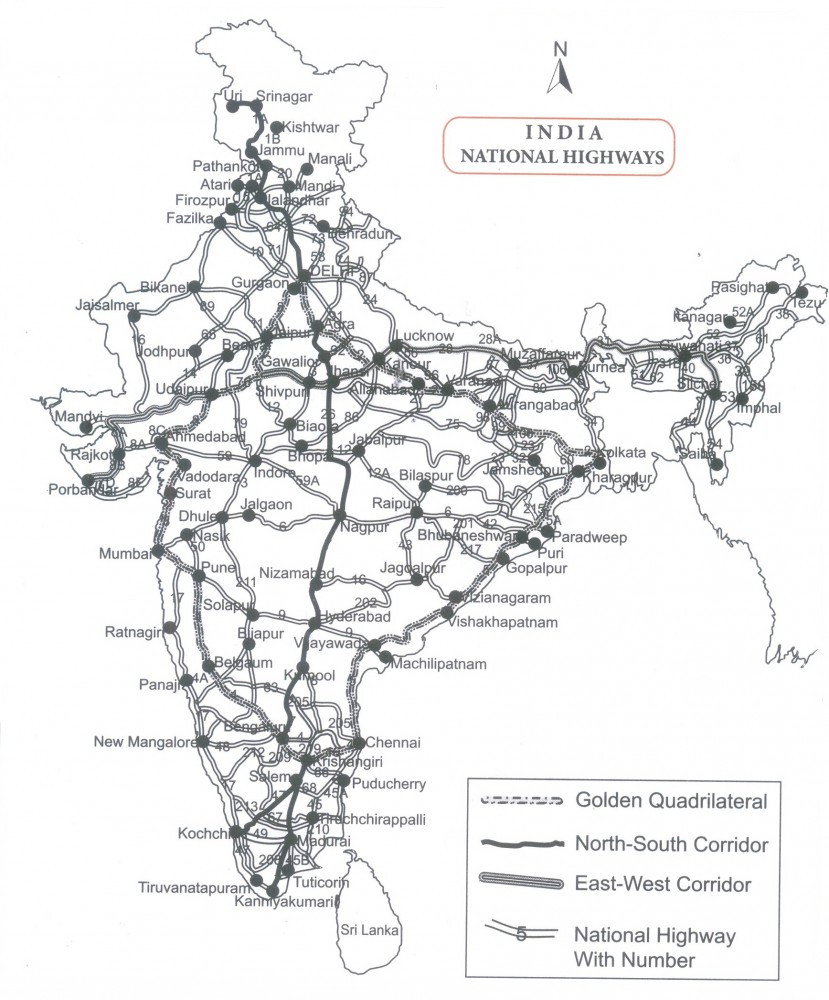
What is the Golden Quadrilateral Highway?
15.
What is the pre-requiste for the fast development of a country?
16.
Which people are responsible for making the products come to the consumers?
17.
Why are metalled roads better than unmetalled roads?
18.
Name the road connecting state capital with different district headquarters.
19.
Name the southern terminal of North-South Corridor.
20.
What are rural roads?
21.
What are the factors that cause heavy damage to the railways?
22.
How are pipelines useful? Explain any four merits of pipeline transport in India.
23.
Mention the six channels introduced recently to facilitate quick delivery of mails.
24.
"The distribution pattern of the railway network in India has been mainly influenced by physiographic and economic factors." Support the statement with suitable examples."
25.
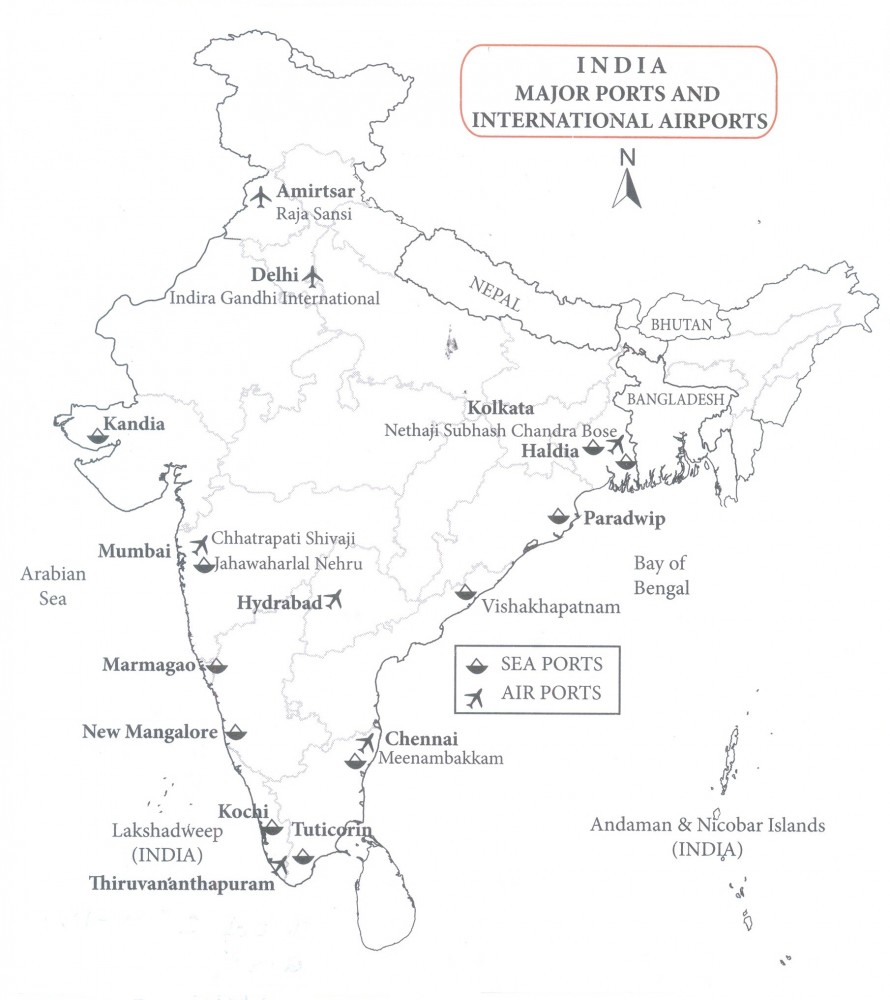
Locate and label the following on the political outline map of India:
(a) Kandla - sea port
(b) A major sea port in Gujarat
(c) Vishakhapatnam - sea port
(d) Kochi - sea port
(e) A major sea port in Kerala
(f) Chhatrapati Shivaji international airport
(g) Tuticorin.
26.
Locate and label the following on the political outline map of India:
(a) Two terminal cities of north-south corridor
(b) terminal station of east - west corridor.
1.
International tourism is the movement of people outside the country for various reasons like pleasure, medical treatment, business etc.
2.
Efficient means of transport are a prerequisite for the fast development as
Roads connect distant areas and increase connectivity.
Transport of perishable goods become easier.
Rail transport helps in the movement of heavy goods.
Ports help in the import as well as export of goods.
3.
Roadways have an edge over railways because it can be built and maintained at ease and at much lower cost. Roadways also provide door to door service.
4.
(a) Personal communication means a communication between two persons either through oral, letter or through telephone etc, while mass communication includes the use of radio, television, press, films etc, for wider public audience.
(b) The main sources of personal communication are telephone, mobiles, postal services, post cards etc. while radio, television, newspaper, internet etc are main sources of mass communication.
5.
(i) Boarder Roads Organisation a Government of India undertaking constructs and maintains roads in the bordering areas of the country.
(ii) This organisation was established in 1960 for the development of the roads of strategic importance in the northern and northeastern border areas.
(iii) These roads have improved accessibility in areas of difficult terrain and have helped in the economic development of these areas.
6.
(i) It linked with the country with the rest of the world.
(ii) Roadways, railways, newspaper, internet etc have been contributing to socio-economic progress in many ways.
(iii) Trades from local to international levels have boosted the economy.
(iv) It enriched life with many amenities that comforts life.
7.
Two merits of airways are:
(a) It is the fastest mode of transportation. Thousands of kilometers are covered within a few hours.
(b) It is the most comfortable mode of transportation.
A demerit of airways:
(a) It is the costliest mode of transportation and is out of the reach of common people.
8.
(i) Waterways are the cheapest means of transport.
(ii) They are most suitable for carrying heavy and bulky goods.
(iii) It is a fuel-efficient and environment friendly mode of transport.
9.
Tourism industry has a bright future in India because of its increasing contribution to foreign exchange (Rs. 21828 crore) number of foreign tourists (2.6 million) and direct employment of 15 million people in tourism industry.
10.
Three merits of roadways are
(a) They provide us door-to-door service.
(b) It is easier to construct roads at low cost as compared to railways.
(c) They provide a feeder service to link other means of transportation.
11.
The state Public Works Department (P.W.D)
12.
Central Public Works Department
13.
The two examples of personal communication are letters and phone.
14.
It is major road development project linking Delhi, Kolkata, Chennai and Mumbai.
15.
Efficient means of transport.
16.
The traders.
17.
Metalled roads are made of either cement or concrete or even bitumen of coal therefore durable over unmetalled road. Unmetalled roads go out of use in rainy season.
18.
State Highways.
19.
Kanyakumari.
20.
Roads which link rural areas and villages with towns are classified as rural roads.
21.
The factors that cause heavy damage to the railways are as follow:
Many passengers travel without tickets.
There are thefts and the railway property is often damaged.
Pulling of chains delays and disturbs the running of trains.
Carelessness on the part of officials in maintaining the tracks causes accidents.
The train drives are overworked and underpaid.
22.
Pipelines are used for the transportation of crude oil, petroleum products and natural gas. The merits of pipeline transportation in India are as follows.
(a) Pipelines help in the growth of refineries, petrochemicals, fertilizer factories and big thermal power plants by providing raw materials directly from the producing areas to the factories and plants.
(b) Pipelines can take petroleum and natural gas to places far off from the oil and gas fields. They help in the setting up of refineries in far off inland locations to cater to the demands of inland markets. The refineries of Barauni, Mathura and Panipat were possible due to the development of pipelines.
(c) The initial cost of laying the pipelines may be high but subsequent running costs are nominal.
(d) Pipelines transport petroleum and natural gas directly from the producing areas to demand areas. Hence, they rule out trans-shipment losses and delays.
23.
(a) The personal written communication is handled by the Indian postal network. Cards and envelopes are considered first-class mail and book packets, registered newspapers and periodicals are called second class mail. The first-class mail is air lifted while the second class mail is carried by surface transport. For quick delivery of mails in cities and large towns, six mail channels have been introduced. They are called Rajdhani Channel, Metro Channel, Green Channel, Business Channel, Bulk Mail Channel and Periodical Channel.
(b) India has one of the largest telecom networks in Asia. It has about 37,565 telephone exchanges spread all over the country. Apart from the towns and cities, more than two-thirds of the villages have already been covered with Subscriber Trunk Dialling (STD) telephone facility. There is uniform rate of STD facility all over India and provisions have been made to extend 24 hours SID facility to all villages. It has been possible by integrating development in Space Technology with Communication Technology. A number of private companies have entered the field of telecommunication and this has resulted in the availability of better facility to the customs.
24.
Examples of the distribution pattern of the railway network in the country being influenced by physiographic and economic factors are
Physiographic Factors
Following are some physiographic factors that affect the distribution of railways network in our country
(i) The Northern Plains with their vast level land, high population density and rich agricultural resources provided the most favourable condition for growth of railways, although crossing wide rivers posed some obstacles.
(ii) In the hilly terrain of the peninsular region, railway tracks were laid through low hills, gaps or tunnels.
(iii) The Himalayan mountain regions are unfavourable for the construction of railway lines due to high relief, undulating terrain and low traffic.
(iv) It is difficult to lay railway tracks in the sandy plains of Western Rajasthan, swamps of Gujarat and forested areas of states in Central India. e.g. Madhya Pradesh, Chhattisgarh, Odisha and Jharkhand.
Economic Factors
Given below are some economic factors that affect the distribution patten of railways network in our country
(i) State funding plays a vital role in the development of railways across the nations.
(ii) The state with flexible laws supports the growth of railways.
(iii) The places that are highly industrialised attract the development of railways.
25.
26.

10th Standard CBSE Syllabus & Materials
10th Standard CBSE
CBSE 10th Social Science PS - Federalism - New Model Questions Papers Study Material - QB365 Set A
NEW10th Standard CBSE
CBSE 10th Social Science PS - Power Sharing - New Model Questions Papers Study Material - QB365 Set A
NEW10th Standard CBSE
CBSE 10th Social Science GEO - Manufacturing Industries - New Model Questions Papers Study Material - QB365 Set A
NEW10th Standard CBSE
CBSE 10th Social Science GEO - Minerals and Energy Resources - New Model Questions Papers Study Material - QB365 Set A



NCERT Books

Syllabus

Exam Pattern

Sample Question Papers

Previous year Question Papers

Important Notes

MCQ Practice test

NCERT Exemplers

Case study Questions

Image Based Questions

Passage based Questions

HOT Questions

Value Based Questions

Model Questions Papers
NCERT ( Book Back ) Questions

Assertion and Reason
Important Questions And Answers

CBSE 10th Standard CBSE Subjects
CBSE Standards



