
 100% FREE ACCESS
10th Standard CBSE Syllabus & Materials
10th Standard CBSE
CBSE 10th Social Science ECO - Globalisation and the Indian Economy - New Model Questions Papers Study Material - QB365 Set A
NEW10th Standard CBSE
CBSE 10th Social Science ECO - Money and Credit - New Model Questions Papers Study Material - QB365 Set A
NEW10th Standard CBSE
CBSE 10th Social Science ECO - Sectors of the Indian Economy - New Model Questions Papers Study Material - QB365 Set A
NEW10th Standard CBSE
CBSE 10th Social Science ECO - Development - New Model Questions Papers Study Material - QB365 Set A
NEW10th Standard CBSE
CBSE 10th Social Science PS - Outcomes of Democracy - New Model Questions Papers Study Material - QB365 Set A
NEW10th Standard CBSE
CBSE 10th Social Science PS - Gender, Religion and Caste - New Model Questions Papers Study Material - QB365 Set A

Published on: 26/10/2025
Download CBSE Class 10th Standard CBSE Social Science question papers, sample papers, important questions, and previous year solved papers in PDF format. Get free study materials, NCERT solutions, and exam preparation resources for Class 10th Standard CBSE Social Science
Questions + Answers key
Take MCQ Social Science Test
1.
How did nationalism in Vietnam emerge through the efforts of different sections of the society to fight against the French? Explain.
2.
Describe the factors and developments leading to the US entry into Vietnamese struggle.
3.
By whom was the first image of Bharatmata painted?
Rabindranath Tagore
Abanindranath Tagore
Ravi Verma
Nandalal Bose
4.
Who was responsible for unification of Germany?
Bismarck
Cavour
Mazzini
Garibaldi
5.
Which act as a bulk carrier across nations?
Airways
Roadways
railways
waterways
6.
What is the rank of India in the production of nitrogenous fertilizers?
1st
2nd
3rd
4th
7.
In 1911, the monarchy in china was overthrown by
Ho Chi Minh
Sun Yat-sen
Bao Dai
Ngo Dinh Diem
8.
How did the female figures become an allegory of the nation?
9.
Examine the events that turned Vietnam into a war zone after 1954.
10.
Which are the three important networks of pipeline transportation in India?
11.
Describe the changing nature of the international trade in the last fifteen years.
12.
Explain the circumstances under which Gandhiji decided to call off the Civil Disobedience Movement in 1931.
13.
Classify industries on the basis of source of raw material.
14.
Why the sugar industries are located near to sugarcane producing areas?
15.
Mention any three major iron-ore belts of India. Write any three characteristics of the southernmost iron-belt.
16.
Differentiate between conventional and non-conventional source of energy with example
17.
What were the aims of 'Movement'?
18.
Why did nationalist tensions emerge in the Balkans?
19.
Discuss the lives of the aristocrats and the new middle class in 19th century France.
20.
What were the developments that led to the launching of the Civil Disobedience Movement?
21.
Discuss the role of NTPC in paving the way to control environmental degradation.
22.
State any two points of importance of mass communication.
23.
How do industries pollute environment? Explain with five examples.
24.
"The civil disobedience movement was different from the non-cooperation movement". Support the statement with examples.
25.
How is energy a basic requirement for the economic development of the country? Explain with examples
26.
Describe the distribution of coal in India.
27.
Define Plebiscite.
28.
In which states are the majority of sugar mills concentrated?
29.
What are considered first-class mail?
30.
Explain the term Nai-dhobi bandhs.
31.
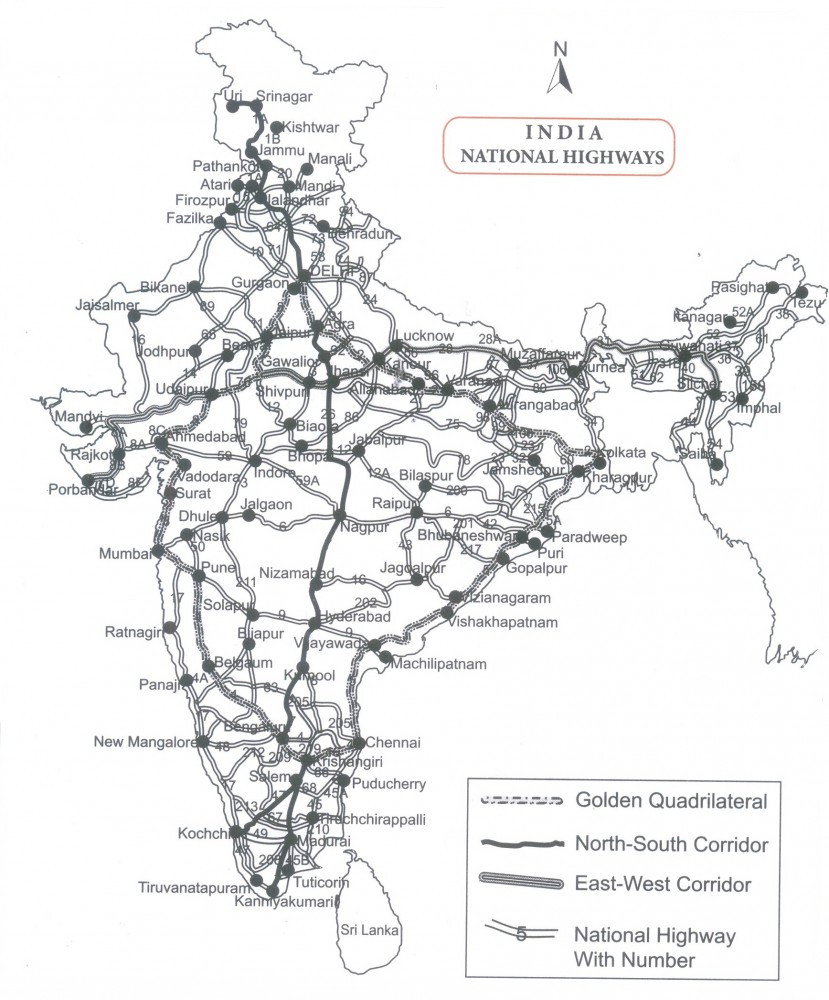
Locate and label the following on the political outline map of India:
(a) Two terminal cities of north-south corridor
(b) terminal station of east - west corridor.
32.
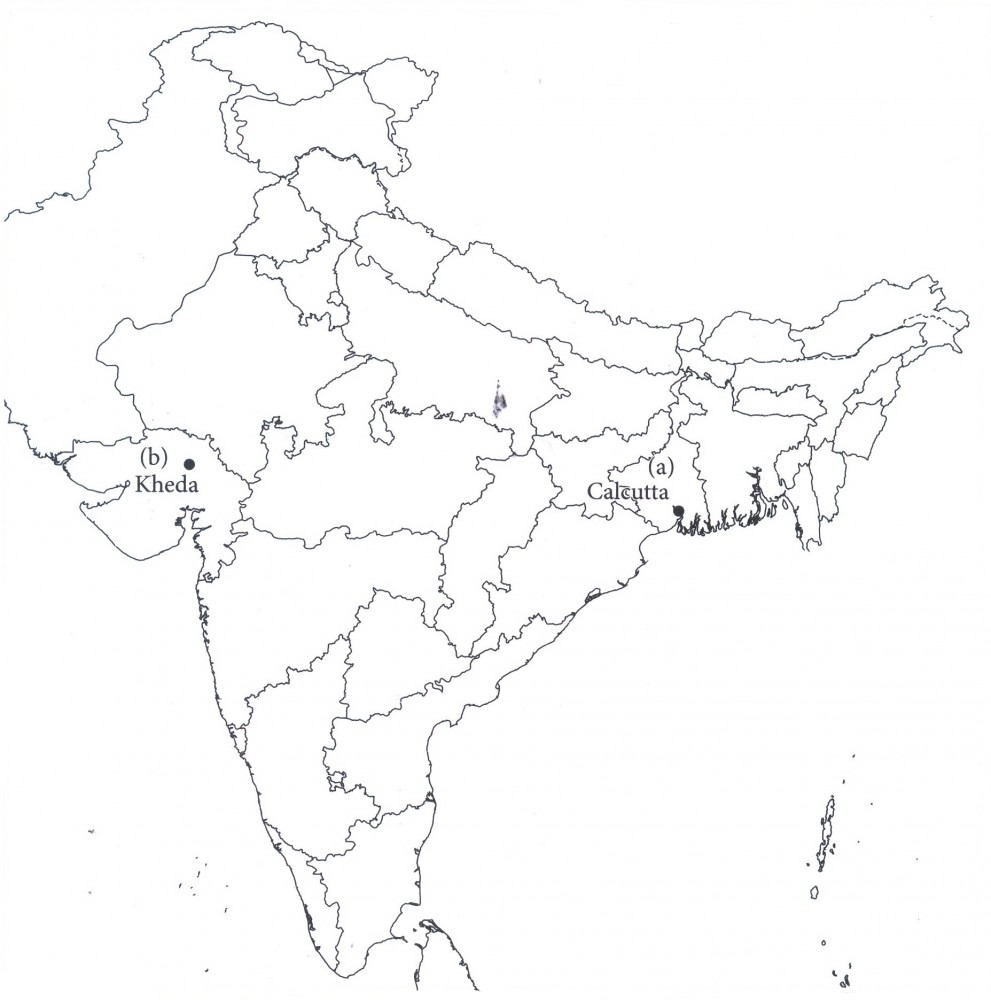
Two features - A and B are marked in the given political outline map of India. Identify these features with the help of the following information and write their correct names on the lines marked in the map:
(a) The place where Indian national Congress Session was held in September 1920.
(b) The place where the Peasant Satyagraha was help in Gujarat.
33.
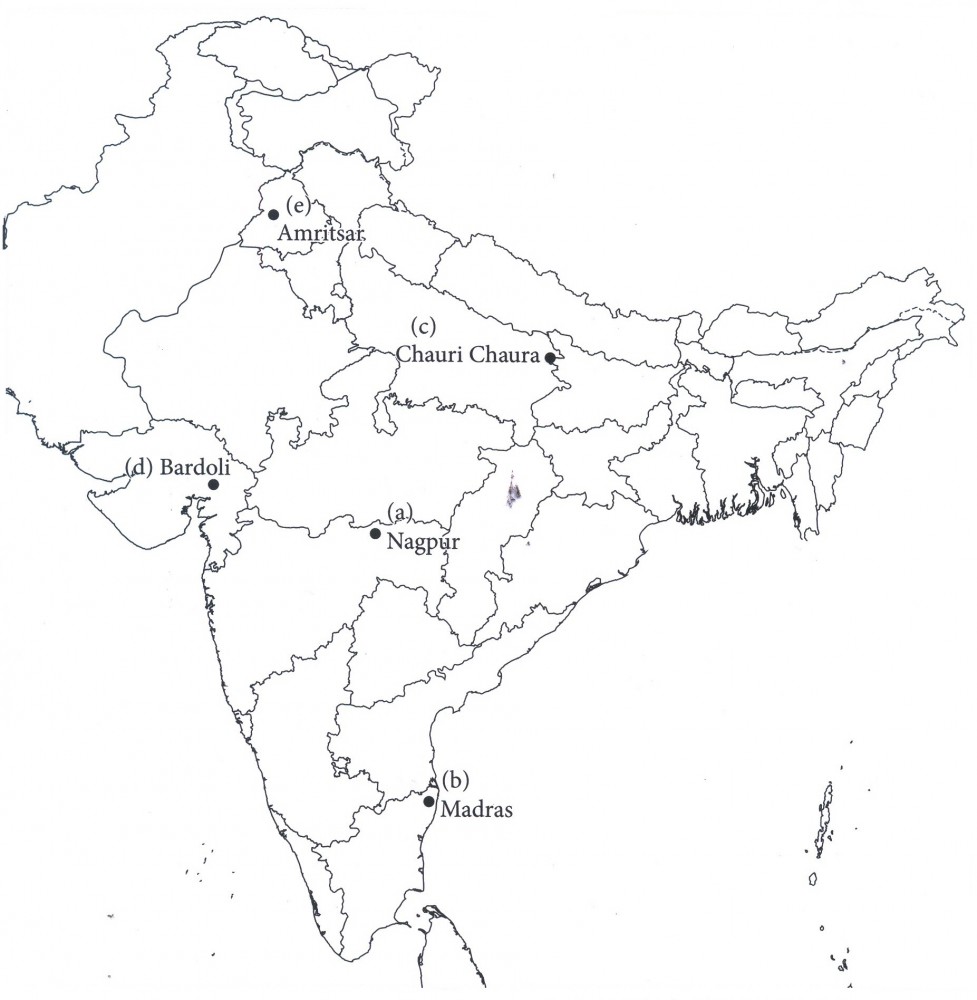
Five features with serial nos. (i) to (v) are marked in the given outline political map of India. Identify these features with the help of the following information and write their correct names on the lines marked in the map:
(a) A place where Indian National Congress Session was held in Dec. 1920.
(b) A place where Indian National Congress Session was held in 1927.
(c) A place where violence occurred due to which Mahatma Gandhi suddenly called off the Non-cooperation Movement.
(d) A place of peasants' Satyagraha in Gujarat.
(e) A place associated with Jallianwalla Bagh massacre.
34.
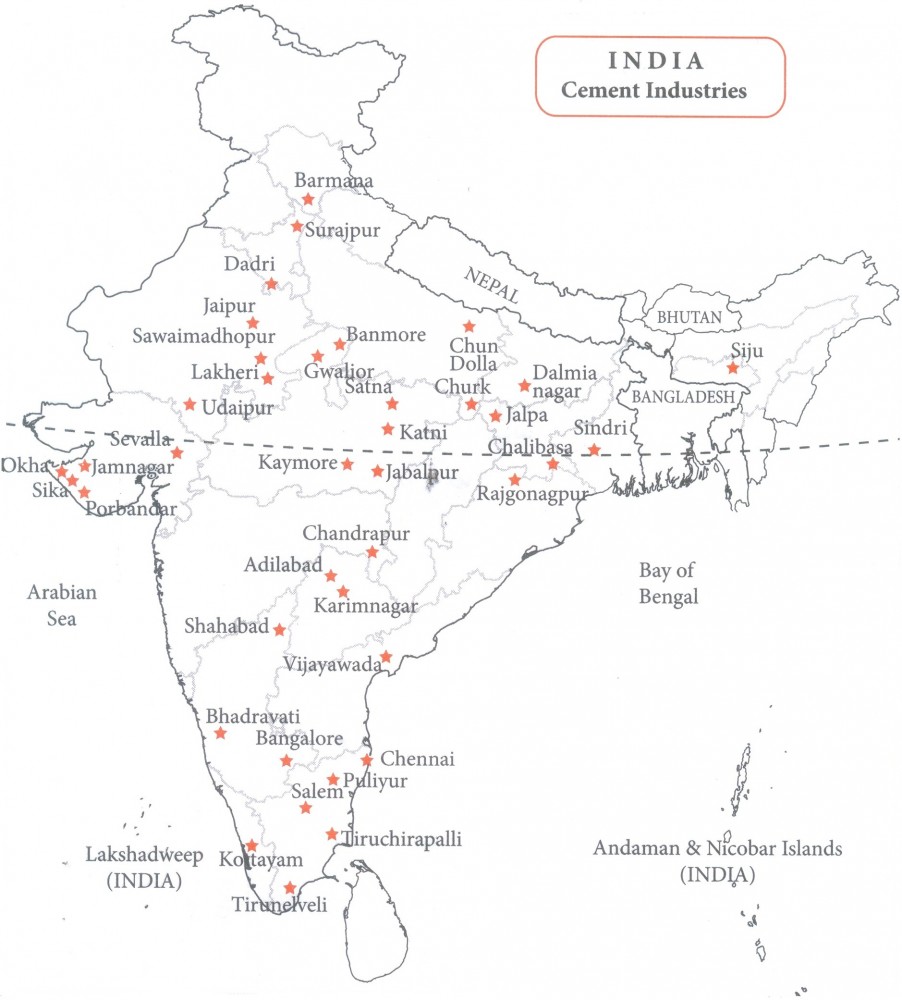
Study the given outline map of India showing the Cement Industries in India.
35.
Observe and study the following map showing nuclear and thermal power plants. Write the names of states where the following power plants are located
36.
Observe and study the following map showing distribution of minerals. Write the names of states where mica mines are located
1.
Nationalism in Vietnam emerged through the effort of different sections of the society to fight the French due to following reasons.
(a) Teachers were very active in resisting the French influence in Vietnam. They openly opposed the curriculum.
(b) Students too resisted the French efforts to prevent the Vietnamese from qualifying for white-collar jobs. They even formed political like Party of Young Annan and published nationalist like Annamese Student.
(c) In the early 20th century students initiated the 'Go East Movement'. They went to Japan for higher education with an objective to overthrow the puppet emperor and re-establish Nguyen Dynasty opposed to the French.
(d) The religious elite in Vietnam were hostile to western presence. They led a movement against French control and the spread of Christianity, popularly known as the Scholars Revolt in 1868.
(e) Phan Boi Chau resisted the French domination and became a major figure of anti-colonial resistance. He formed a Revolutionary Society.
2.
The Entry of the US into the War (1965-1972) : The US was apprehensive that establishment of a communist regime would spark a chain reaction which could lead to formation of similar regimes in the surrounding parts of the world. In order to stop the spread of communism, the US attacked Vietnam. The US occupation of Vietnam involved use of a high number of services personnel and also the use of latest warfare. In spite of advanced technology and good medical supplies, the US casualties were very high in Vietnam. Even the most powerful bombers of the time, the B52s were used in the battle. About 47,000 US soldiers died and 303,000 were wounded. About 23,000 suffered 100% disability. The struggle of the Vietnamese people against the US showed that the inspiration of saving the motherland can turn even the weak into a great battle force. The US probably underestimated this factor. Effect on US : Most of the people in the US were highly critical of the US involvement in Vietnam. Many contemporary thinkers were of the opinion that the US should not have involved itself in a war was impossible to win.
3.
(b)
Abanindranath Tagore
4.
(a)
Bismarck
5.
(d)
waterways
6.
(c)
3rd
7.
(a)
Ho Chi Minh
8.
The female figures became an allegory of the nation in the 18th and the 19th century in the following ways.
(a) The artists thought of giving a face to the nation and represented a country as a human form.
(b) Female figures were chosen though these did not stand for any particular woman in real life.
(c) It was just to give a symbolic idea to the physical form of a nation.
9.
Bao Dai's government in South Vietnam was overthrown by Ngo Dinh Diem through a coup. He set up an oppressive and dictatorial government. Anyone who opposed him was called a communist and jailed. He allowed Christianity and banned Buddhism which turned the people against him. This led to the formation of National liberation Front. With the help of Ho Chi Minh government in the north, NLF started a war against Bao Dai's government. The US began to fear the growing communist influence in the region and thus decided to intervence in the situation in Vietnam, turning it into a war zone.
10.
Three important networks of pipeline transportation in India are:
(a) From oilfields in Upper Assam to Kanpur in Uttar Pradesh, via Guwahati, Barauni and Allahabad. It has branches from Barauni to Haldia, via Rajbandh to Maurigram and Guwahati to Siliguri.
(b) From Salaya in Gujarat to Jalandhar in Punjab via Viramgam, Mathura, Delhi and Sonipat. It has branches to connect Koyali in Gujarat, Chakshu and other places.
(c) Gas pipeline from Hazira in Gujarat to Jagdishpur in Uttar Pradesh via Vijaipur in Madhya Pradesh. It has branches to Kota in Rajasthan, Shahajahanpur, Babrala and other places in Uttar Pradesh. The pipelines have played a significant role in the development of refineries like Barauni, Mathura, Panipat at far inland locations, away from producing areas to cater to the demand of the inland markets. The development of gas-based fertilizer plants in agricultural regions away from petroleum-producing areas has also been possible due to pipeline transport.
11.
International trade has undergone a sea change in the fifteen years. Exchange of commodities and goods have been superseded by the exchange of information and knowledge. India has emerged as a software giant at the international level and is earning large foreign exchange through the export of information technology.
12.
(i) When the colonial government began arresting the Congress leaders one by one, there were violent clashes in many places.
(ii) When Abdul Ghaffar Khan, a devout disciple of Gandhi was arrested in Peshawar, angry crowds demonstrated in the streets of Peshawar.
(iii) When Mahatma Gandhi himself was arrested, industrial workers in Sholapur attacked police posts, municipal buildings, law courts, railway station, all that symbolised British rule. The frightened government responded with a policy of brutal repression.
(iv) Peaceful Satyagrahis were attacked, women and children were beaten, and about one lakh of people were arrested. In such a situation Mahatma Gandhi once again decided to call off the movement in 1931.
13.
(i) Agro based industries.
(ii) Mineral based industries.
Differences between agro based and mineral based industries
| Agro-based Industries | Mineral-based Industries |
| (1) Agro-based industries use plant and animal based products as raw materials. | (1) Mineral-based industries are those that use mineral ores as their raw materials. |
| (2) These industries provide employment in rural areas. | (2) They provide employment to both rural and urban areas. |
| (3) Agro-based industries are mostly in private or co-operative sectors. | (3) These industries are mostly in public sector because of their large investment requirement. |
| (4) Examples of such industries are -jute, cotton textile, dairy products, leather industries etc. | (4) Examples of such industries are - iron and steel capital goods industries etc. |
14.
(a) Sugar industries are based on sugarcane as the raw material, which is very heavy. So industries are close to its producing areas.
(b) Moreover sugarcane is a perishable and weight losing products. It should be processed without delay to prevent losing of sugar content.
15.
(a)Major Iron Ore Belts in India
(i) Odisha (Orissa)-Jharkhand Belt
(ii) Durg-Baster-Chan drapur Belt
(iii) Bellary-Chitradurga-Chikmaglur-Tumkur Belt
(iv) Maharashtra-Goa Belt [any three]
(b) Southernmost Iron belt
Bellary-Chitradurga-Chikmaglur-Tumkur Belt: This belt lies in Karnataka. The Kudremukh mines located in the Western Ghats are 100 percent export unit. The ore from these mines is transported as slurry through a pipeline to a port near Mangalore.
16.
| S.No | Conventional Source of Energy | Non-conventional Source of Energy |
| 1. | Used since ages. | New technology |
| 2. | They are exhaustible except hydel power. | They inexhaustible. |
| 3. | They create pollution. | They are pollution-free and eco-friendly. |
| 4. | It is expensive. | It is a cheaper source |
| 5. | Limited availability except water | Abundant availability. |
| 6. | Non-dependable source of energy. | Future energy resources |
17.
(i) 'Go East Movement' became popular with first decade of the twentieth century.
(ii) It aimed at aquring modern education from Japan mainly to drive out the French from Vietnam, overthrow the puppet emperor and re-establish the Nguyen dynasty. The Nationalist looked for foreign arms and help.
(iii) Vietnamese students established a branch of the Restoration Society in Tokyo. But after 1908, the Japanese Ministry clamped down on them.
(iv) As a result including Phan Bor Chau, many were deported and sought exile in China and Thailand.
18.
Nationalist tension emerged in the Balkans because the Balkan states were aspiring for nationalism. The Balkans was a region comprising modern day Romania, Bulgaria, Albania, Greece, Macedonia, Croatia, Bosnia-Herzegovina, Slovenia, Serbia and Montenegro and their inhabitants were called Slavs. In 19th century, the major portion of the Balkans was under the Ottoman Empire.
The ideas of romantic nationalism developed in the Balkans. The rebellions nationalities in the Balkans thought that their struggle was the attempt to win back their long-lost independence.
19.
The landed aristocracy dominated all social and political spheres. They were united by a common lifestyle. Huge estates and large town-houses were owned by them. French was the language they preferred in the high society and diplomatic circles. Marriages connected the aristocratic families. Though they formed a small group, they dominated with power.
In the western and some parts of Central Europe, commercial classes began to emerge because of setting up of industries and beginning of trade. This class caused the emergence of new social groups like the middle class and the working class. The middle class included industrialists, businessmen and professionals. They were less in number. It was the liberal and educated middle-class that encouraged national unity and abolition of aristocratic privileges.
20.
Congress decided to launch a nationwide Civil Disobedience Movement because of the following reasons.
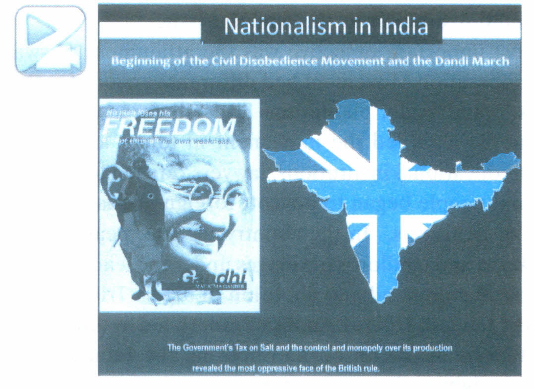
(a) Lord Irwin showed reluctance towards the eleven demands raised by Gandhiji. This led to the famous Salt March and beginning of the Civil Disobedience Movement.
(b) Worldwide economic depression slashed agricultural prices. This led to a decline in demand and exports. Peasants were the hardest hit by this crisis. On that, the government was not ready to lower the revenue demand. (c) The only-British commission called the Simon Commission was sent to India to look into the developments of the constitutional system. Indians got enraged as it had no Indian member in it. There were widespread agitations against the commission.
(d) Lord Irwin's proposal of granting dominion status and discussion at the Round Table Conference could not satisfy the nationalists.
(e) Finally at the Lahore session of Congress in 1929, it was decided to launch the Civil Disobedience Movement. This movement was sought to be related with the problems people faced in their daily life.
21.
NTPC is a major power providing corporation in India. It has ISO certification for EMS (Environmental Management System) 14001. The corporation has a proactive approach for preserving the natural environment and resources like water, oil, gas and fuels in places where it is setting up power plants. This is achieved through the following methods.
(a) Optimum utilization of equipment adopting latest techniques and upgrading existing equipment.
(b) Minimizing waste generation by maximizing ash utilization.
(c) Providing green belts for nurturing ecological balances and encouraging afforestation.
(d) Reducing environmental pollution through ash pond management, ash water recycling system and liquid waste management.
(e) Ecological monitoring reviews and online database management for all its power stations.
22.
(i) Mass communication provides entertainment.
(ii) They create awareness among people about various national programmes and policies.
(iii) They provide variety of programmes in national, regional and local languages for various categories of people, spread over different parts of the country.
(iv) They strengthen democracy in the country by providing news and information to the masses.
(v) They help in rural development which is suffering from illiteracy and superstitious social practices.
(vi) It helps in agriculture sector by helping farmers by providing them information about new agricultural practices.
23.
Manufacturing industries are responsible for environmental degradation and pollution. There are four types of pollution created by these industries.
(a) Air pollution: It is caused by the smoke or gases emitted by industries which contain poisonous gases like carbon monoxide and sulphur dioxide. Air-borne particulate materials consist of both solid and liquid particles. Dust, fume, mist, spray and smoke contain both types of particles. Air pollution affects human health, animals, plants materials and the atmosphere.
(b) Water pollution: The industrial effluents are discharged into rivers. They contain both organic and inorganic materials. Coal, dyes, soaps, pesticides, fertilizers, plastics and rubber are the common pollutants of water. The principal industries, which create water pollution are paper pulp, textiles, chemical petroleum, refining, tannery and electroplating. Fly ash, phospo-gypsum and iron and steel stags are the major solid wastes in India.
(c) Thermal pollution: The water occurs when hot water from factories and thermal power plants is drained into rivers and ponds before cooling.
(d) Land and soil pollution: Industrial wastes containing toxic metal, glass, and harmful chemicals pollute land and soil. Unscientific processing in many industries like ceramic industry and cement industry create a lot of dust containing chemicals settle down the land which causes pollution. Industrial effluents even cause acid rain, which degrade the land.
(e) Noise pollution: The unwanted noise arises from industry and transport vehicles create a lot of problems. The noise from mechanical saws and pneumatic drills is unbearable and it may cause impairment of hearing (deafness).
24.
The Civil Disobedience Movement was different from the Non-Cooperation Movement. The main differences between these two movements are
| Civil Disobedience Movement | Non-cooperation Movement |
| Civil Disobedience Movement was launched in 1930. | The Non-Cooperation Movement was launched in 1921 by Gandhiji. |
| The Civil Disobedience Movement was first supported by the Industrialists like GD Birla, Purshottamdas Thakur. | The Non-Cooperation Movement started with middle class participation. |
| The growing proximity of the Congress party and Hindu Mahasabha prevented the Muslims to participate in Civil Disobedience Movement. | Due to Khalifa issues Muslim community participated in Non-Cooperation on large scale |
| The Civil Disobedience Movement was withdrawn in 1931, when Gandhi signed 'Gandhi-Irwin' pact. | The Non-Cooperation Movement was withdrawn by Gandhiji due to violent incident at Chauri Chaura. |
| Large scale participation of women is one of the most significant features of the Civil Disobedience Movement. | In Non-Cooperation Movement, women did not participate in large scale. |
25.
(i) Energy is the basic requirement for economic development.
(ii) Every sector of national economy agriculture, industry, transport and commerce needs greater inputs of energy.
(iii) In the domestic sector also energy demands in the form of electricity are growing because of increasing use of electric gadgets and appliances.
(iv) The economic development plans implemented since independence necessarily required increasing amount of energy.
(v) Because of all these, per capita consumption of energy is continuously increasing.
26.
(a) In India, coal is the most abundantly available fossil fuel. Coal is found in a variety of forms depending on the degress of compression and the depth and time of burial. As per these basis, coal deposits are found mainly of two geological ages. These are
(i) Gondwana Coal Deposits These are about 200 million years old. The major coal deposit in India are Gondwana coal which are high quality metallurgical coal.
These coal deposits are located in Damodar Valley (West Bengal-Jharkhand). Jharia, Raniganj and Bokaro are important coal deposit fields. Besides, the Godavari, Mahanadi, Son and Wardha valleys also contain such coal deposits.
(ii) Tertiary Coal Deposits These are around 55 million years old. Tertiary coal deposits are found in the North-Eastern states of Meghalaya, Assam, Arunachal Pradesh and Nagaland. This coal is of lower quality than the Gondwana coal.
27.
Plebiscite is a system of direct vote by which the people of a region. themselves decide to accept or reject a proposal.
28.
The majority of sugar mills are concentrated in Uttar Pradesh and Bihar.
29.
Cards and envelopes.
30.
Nai dhobi bandhs were a type of social boycott targeted at oppressive landlords. The Panchayats organised the nai-dhobi bandhs to deprive landlords of the services of even barbers and washermen.
31.
32.
33.
34.
35.
Nuclear Power plant
(a) Naraura: Uttar Pradesh
(b) Kalpakkam: Tamil Nadu
(c) Kaiga: Karnataka
(d) Rawat Bhata: Rajasthan
Thermal power plant
(a) Namrup: Assam
(b) Tuticorin: Tamil Nadu
36.
(i) Nellore: Andra Pradesh
(ii) Gaya: Bihar
(iii) Ajmer, Bewar : Rajasthan
(iv) Hazaribagh, Kodarma: Jharkhand

10th Standard CBSE Syllabus & Materials
10th Standard CBSE
CBSE 10th Social Science PS - Federalism - New Model Questions Papers Study Material - QB365 Set A
NEW10th Standard CBSE
CBSE 10th Social Science PS - Power Sharing - New Model Questions Papers Study Material - QB365 Set A
NEW10th Standard CBSE
CBSE 10th Social Science GEO - Manufacturing Industries - New Model Questions Papers Study Material - QB365 Set A
NEW10th Standard CBSE
CBSE 10th Social Science GEO - Minerals and Energy Resources - New Model Questions Papers Study Material - QB365 Set A



NCERT Books

Syllabus

Exam Pattern

Sample Question Papers

Previous year Question Papers

Important Notes

MCQ Practice test

NCERT Exemplers

Case study Questions

Image Based Questions

Passage based Questions

HOT Questions

Value Based Questions

Model Questions Papers
NCERT ( Book Back ) Questions

Assertion and Reason
Important Questions And Answers

CBSE 10th Standard CBSE Subjects
CBSE Standards



