
 100% FREE ACCESS
10th Standard CBSE Syllabus & Materials
10th Standard CBSE
CBSE 10th Social Science ECO - Globalisation and the Indian Economy - New Model Questions Papers Study Material - QB365 Set A
NEW10th Standard CBSE
CBSE 10th Social Science ECO - Money and Credit - New Model Questions Papers Study Material - QB365 Set A
NEW10th Standard CBSE
CBSE 10th Social Science ECO - Sectors of the Indian Economy - New Model Questions Papers Study Material - QB365 Set A
NEW10th Standard CBSE
CBSE 10th Social Science ECO - Development - New Model Questions Papers Study Material - QB365 Set A
NEW10th Standard CBSE
CBSE 10th Social Science PS - Outcomes of Democracy - New Model Questions Papers Study Material - QB365 Set A
NEW10th Standard CBSE
CBSE 10th Social Science PS - Gender, Religion and Caste - New Model Questions Papers Study Material - QB365 Set A

Published on: 26/10/2025
Download CBSE Class 10th Standard CBSE Social Science question papers, sample papers, important questions, and previous year solved papers in PDF format. Get free study materials, NCERT solutions, and exam preparation resources for Class 10th Standard CBSE Social Science
Questions + Answers key
Take MCQ Social Science Test
1.
Explain any three features of the 'Nature-State' that emerged in Europe in the twentieth century.
2.
How has French artist, Frederic Sorrieu, visualised in his first print, of the series of four prints, his dream of a world made up of 'democratic and social republics"? Explain.
3.
Explain three phases by which treatment of industrial effluents can be done.
4.
What are the prime factors in the location of aluminium smelting industries? Where are the main aluminium smelting plants of the country located?
5.
Define international trade. Why it is considered as economic barometer of a country?
6.
Mention the importance of airways.
7.
What is the contribution of industry to national economy of India? Compare it with the East-Asian countries. What is the desired growth and present position of industry in GDP?
8.
How Mahatma Gandhi Successfully organised Satyagraha movements in various places just after arriving in India? Explain by giving three examples.
9.
Why is energy needed?
10.
What was the impact of the development in China on the Vietnamese nationalists?
11.
Explain the causes of the US involvement in the war in Vietnam. What effect did this involvement have on life within the US itself?
12.
Who was Paul Bernard?
13.
What was elle?
14.
Which mineral is indispensable for electric and electronic industries?
15.
Which port was the first to be developed soon after Independence?
16.
Oil India Limited (OIL) belongs to which type of industry?
17.
Name the auother of Anandamath.
18.
"Till mid-eighteenth century there were no nation-states in Europe." Support the statement with examples.
19.
Mention the features of the Gudem Hills rebellion? What methods were adopted by the tribals to gain swaraj?
20.
Name any two areas where large reserves of natural gas are found. Why is it called the fuel for the present century. Name any two popular uses of the natural gas today.
21.
Describe any four major problems faced by the road transportation in India.
22.
Explain any four reasons why a dense and efficient network of transport and communication is a pre-requisite for trade of today.
23.
Why did Mahatma Gandhi feel the need to launch a broad-based movement in 1920? Give reasons.
24.
What is the importance of manufacturing?
25.
Briefly trace the process of unification of Italy.
26.
Which one of the following is an agro-based industry
Sewing machine
Iron and steel
Jute
Toothpaste
27.
Which one of the following minerals is a fossil fuel?
Coal
Zircon
Uranium
Barium
28.
What did Mahatma Gandhi in his book, Hind Swaraj, declare?
British ruled India because the latter was militarily weak
British ruled India because Indians cooperated with them
British ruled India because they got international support
None of these
29.
Who wrote the History of the Loss of Vietnam?
Huynh Phu So
Phan Boi Chau
Phan Chu
None of these
30.
Which one of the following states is not connected with the H.V.J. Pipeline?
Madhya Pradesh
Maharashtra
Gujarat
Uttar Pradesh
31.
Which of the following was an allegory of the French nation?
Germania
Marianne
Liberty
None of these
32.
Locate and label the following on the political outline map of India:
(a) Kandla - sea port
(b) A major sea port in Gujarat
(c) Vishakhapatnam - sea port
(d) Kochi - sea port
(e) A major sea port in Kerala
(f) Chhatrapati Shivaji international airport
(g) Tuticorin.
33.
Locate and label the following items with appropriate symbols on the same map:
(a) Chauri-Chaura-The place of calling off the Non-Cooperation Movement (N.C.M.)
(b) Amritsar-The place where Jallianwalla Bagh incident took place.
34.
Locate and label the following on the given political outline map of India:
(a) A place where session of Indian National Congress was held in September 1920.
(b) A place where session of Indian National Congress was held in 1929.
(c) A place in Bihar where Satyagraha Movement of indigo planters took place.
(d) Baradoli, the place, from where No tax campaign was started.
(e) A place in Gujarat where Gandhiji violated the Salt law.
(f) a place in Punjab where Jalianwalla Bagh incident took place (or) Amritsar
(g) Chennai (Madras)
35.
Study the given outline map of India showing major Iron and Steel Plants in India.
36.
Study and Observe the following map of conventional source of energy. Write the names of coal mines and oil fields with respective states.
37.
What were the consequences of the partition of Vietnam into two countries?
38.
Mention the steps taken by the French to dismantle Chinese influence in Vietnam.
1.
(a) The concept and practices of a modern state with sovereign centralised power developed in Europe.
(b) Nation-state was supposed to be a state where majority of its citizens shared common identity and history.
(c) Nations began to be personified i.e. they were represented as a person with characteristics that identified their nations.
Mainly female figures were used to portray the nation.
2.
In the first print the artist shows the people of Europe and America-men and women of all ages and social classes-marking in a long trian offering homage to the Statue of Liberty as they pass by it. At that time after, French Revolution, 'Liberty' was imagined as a female figure who held the Torch of Enlightenment in one hand and the Charter of Rights of Man in the other. In the foreground the artist depicted the shattered remains of the symbols of absolutist institutions. In Sorrieu's idealist vision people of the world are grouped as distinct nations identified through their flags and national costumes. Leading the processions are the states of United States and Switzerland which were already nation-states at that time. France, with its revolutionary tricolour flag, had just reached the status.
3.
Following are the three phases by which the treatment of industrial effluents can be done.
(a) Primary treatment by mechanical means-this involves screening, grinding flocculation and sedimentation.
(b) Secondary treatment by biological process.
(c) Tertiary treatment by biological, chemical and physical processes. This involves recycling of waste water.
4.
Following are the prime factors for the location of aluminium smelting industries.
(a) Assured source of raw material, bauxite, at minimum cost, as it is a bulky material.
(b) Regular and quantitative supply of power.
Odisha produces about 45 per cent of the Indian's bauxite. Hence, aluminium smelting plants are located in Odisha. Also, the Hirakud Dam provides cheap hydroelectricity for the development of the aluminium industry in the state.
West bengal, Kerala, Uttar Pradesh, Chhattisgarh, Maharashtra, and Tamil Nadu are other states where aluminium smelting plants are located. INDAL, HINDALCO, MALCO, NALCO and Aluminium Corporation of India are names of the major smelting plants.
5.
International trade is defined as the exchange of goods and services between two or more countries. It is also considered as economic barometer because
(a) Advancement in international trade of a country leads to economic prosperity.
(b) Income earned from international trade constitutes a major part in the net national income.
(c) Large international trade leads to revival of domestic economy.
6.
(i) It is the fastest, most comfortable and prestigious mode of transport.
(ii) it can cover very difficult terrains like high mountains, dreary deserts, and dense forests.
(iii) It can also cover long oceanic stretches with great ease.
(iv) Airways have made access easier in the north-eastern part of the country which has big rivers, dissected relief, dense forests and frequent floods and international frontiers.
7.
In India, the share of manufacturing sector has stagnated at 17 present of GDP - out of total of 27 percent for the industry. This is much lower in comparison to some East Asian economics, where it is 25 to 35 percent. The desired growth rate over the next decade is 12 percent per annum.
8.
In Jan, 1915, Mahatma Gandhi returned to India from South Africa. In 1916, the first Gandhian mass-movement against the oppressive plantation system took place in Champaran (Bihar). In 1917, Gandhiji led the satyagraha movement in Kheda district of Gujarat, demanding relaxation of the revenue tax owing to the poverty experienced by the farmers because of the outbreak of plague and crop failure. in 1918, Gandhiji organised a Satyagraha movement against the cotton mill owners demanding an increase in the worker's wages and bonus in Ahmedabad.
9.
(i) Energy is the requirement for economic development
(ii) Every sector of national economy agriculture, industry, transport and commerce need greater inputs of energy.
(iii) In the domestic sector also, energy demands, in the form of electricity, are growing because of increasing use of electrical gadgets and appliances.
10.
(i) Development in China also inspired Vietnamese nationalists.
(ii) In 1911, the long-established monarchy in China was overthrown by a popular movement under Sun Yat-sen.
(iii) A Republic was set up. Inspired by these developments, the Vietnamese students organised the Association for the Restoration of Vietnam.
(iv) Now the nature of the anti-French independence movement changed. It aimed at establishing a democratic republic instead of a constitutional monarchy.
11.
The struggle for freedom by Vietnamese people was a long-drawn one. They faced the French, the Japanese and the USA. Many causes led the US to get involved in the VVietnam war. The US government was afraid that communism would find a stronghold in Vietnam. The US feared this would endanger the other capitalist countries. With these thoughts, the US was always ready to fight communist strongholds in any part of the world. The rise of communism in Vietnam was seen as a threat and US stepped in to intervene. France had been facing insulting revolts from Vietnam. France being a capitalist country, the US felt it had to step in to save French honour, as one of the capitalist brethren. Moreover, the French had been an ally of US in the Second World War.
12.
()
He was an influential writer and policy-marker.
13.
Elle was the measure of cloth. It was different for each of the 39 states of German confederation.
14.
Mica is indispensable for electric and electronic industries.
15.
Kandla port was the first port to be developed soon after Independence.
16.
Oil India Limited belongs to the Joint sector industries.
17.
Bankim Chandra Chattopadhyay.
18.
There were no nation-states in Europe till the mid-eighteenth century. Germany, Italy and Switzerland were ruled by different rulers with their well-defined territories. Eastern and central part of Europe too had autocratic monarchies. People from different ethnic groups occupied these areas and spoke different languages. Sudetenland and Bohemia were dominated by German-speaking people. It also included the provinces of Lombardy and Venetia which had Italian-speaking people. In Hungary, the half of the population spoke Magyar and the other half of the population spoke different dialects. In the part of Galicia, the aristocratic class spoke Polish.
There was absence of collective identity or common culture among these groups. Apart from this, a large group of peasant people like-Romans to the east in Transylvania, Bohemians and Slovaks to the north, Slovenes in Carniola and the Croats to the south lived within the boundary. The only tie binding these different groups together was a common allegiance to the emperor.
19.
The following were the features of the Gudem Hills rebellion.
(a) It was a guerrilla militant movement initiated by Alluri Sitaram Raju against the colonial misrule.
(b) This rebellion was against preventing the forest people entering the forests for grazing cattle, collecting fuel wood and fruits. It denied them their traditional rights over the forests and affected their livelihoods.
(c) The tribal people were also forced to do begar for road building which enraged the forest people.
The tribal people took the following steps to gain swaraj.
(a) Alluri Sitaram Raju inspired by Gandhiji and his Non-Cooperation Movement persuaded people to adopt khadi and give up drinking habits. But at the same time he asserted that India could only be liberated by the use of force.
(b) The Gudem rebels attacked police stations and attempted to kill British officials. They carried on their guerilla warfare and inflict losses on the British.
20.
The two areas where large reserves of natural gas are found are the Andaman and Nicobar Islands and the Mumbai High Region. Natural gas is called the fuel for the present century because it is pollution free and environment friendly. Besides being used as a source of power, natural gas is also used in vehicles as Compressed Natural Gas (CNG) and for purpose of cooking as Liquified Petroleum Gas (LPG).
21.
Road transportation is economical in transportation of smaller amount of goods and few passengers over short and medium distances. Though they are relatively cheap and easy to construct and maintain, road transportation in India is confronted with a number of problems.
(a) On account of its large population, India has large volumes of traffic and passengers which require a large number of vehicles. But the road network is not adequate to meet the requirement of handling heavy traffic.
(b) As most roads are kuccha or unmetalled, their usage is limited during the rainy season. The potholes on roads form muddy pools in the monsoon season and cause accidents.
(c) There are still more national highways to be built to connect the different parts of the country.
(d) The roads in the cities are highly congested and traffic jams are a constant problem. Most of the bridges and culverts are also old and narrow aggravating the problem.
(e) Roadside amenities like emergency medical facilities, telephone booths etc., are lacking. (f) Police patrolling on the highways in not adequate, so goods and passengers are not safe all the time.
22.
(a) They help in increasing cooperation and assistance between countries by easy movement of goods and material between countries.
(b) They help in trade and commerce within country.
(c) They have reduced distances thus bringing the world closer.
(d) They help in both production and distribution of goods and movement of large number of people and over long distance.
(e) They provide important links between producers and consumers of goods.
(f) They bring people very close to an another by promoting interdependence among people.
23.
Indians felt that their hardships would be brought to an end after the First World War. But that did not happen.
The Rowlatt Act of 1919:
The Rowlatt Act been hurriedly passed through the Imperial Legislative Council. It gave the government enormous powers to repress political activities, and allowed detention of political prisoners without trial for two years. Mahatma Gandhi launched a movement against these unjust laws. But when people were violent, he called off the movement. This had been a wide spread movement but limited to cities and towns. Mahatma Gandhi now planned to launch a more broad-based movement.
The Khilafat issue : The First World war ended with the defeat of Ottoman Turks. A harsh peace treaty was to be imposed on the Ottoman emperor - the spiritual head of the Islamic world (the Khalifa). At the Calcutta session of 1920, Gandhiji expressed the need for a Non-Cooperation movement in support of Khilafat issue as well as for Swaraj. In his famous book "Hind Swaraj" (1909) Mahatma Gandhi declared that the British rule was established in India with the cooperation of Indians. It had survived only because of this cooperation. If Indians refused to cooperate, British rule would collapse within a year, and swaraj would come. Hence he started the Non-cooperation movement in full swing.
24.
(i) Industries play an important role in the economy of a country. The economic strength of a country is judged by the development of manufacturing industries.
(ii) Industries provide employment opportunities and reduce poverty in India. Thus, solve unemployment problem. It helps reduce dependence of people on agriculture and provide them job in secondary and tertiary activities.
(iii) Industries bring foreign exchange. Export of manufactured goods expands trade and commerce and brings in much needed foreign exchange.
(iv) It provides tools and implements for agriculture.
(v) It brings down regional differences by establishing industries to tribal and backward areas.
25.
During the middle of the nineteenth century, Italy was divided into seven states, of which only one, Sardinia-Piedmont, was ruled by an Italian princely house. The north was ruled by Austrian Habsburgs, the centre by the Pope and the southern regions by the Bourbon kings of Spain. Italian language had varieties of dialects; therefore, it was not stable in its form. During the 1830s, Giuseppe Mazzini had sought to put together a coherent programme for a unitary Italian Republic. He had also formed a secret society called 'Young Italy' for the dissemination of his goals. The failure of revolutionary uprisings both in 1831 and 1848 fell on Sardinia-Piedmont under its ruler King Victor Emmanuel II to unify the Italian states through war. A unified Italy offered them the possibility of economic development and political dominance. Chief Minister Cavour who led the movement to unify the regions of Italy was neither a revolutionary nor a democrat. With a tactful diplomatic alliance with France by Cavour, Sardinia-Piedmont succeeded in defeating the Austrian forces in 1859. In 1859, a large number of armed volunteers under the leadership of Giuseppe Garibaldi joined the fray. In 1860, Sardinia- Piedmont's forces marched into south Italy and the Kingdom of the Two Sicilies and drove out the Spanish rulers. In 1861, Victor Emmanuel was declared as the king of united Italy and Rome was declared the capital of Italy.
26.
(c)
Jute
27.
(a)
Coal
28.
(b)
British ruled India because Indians cooperated with them
29.
(b)
Phan Boi Chau
30.
(b)
Maharashtra
31.
(b)
Marianne
32.
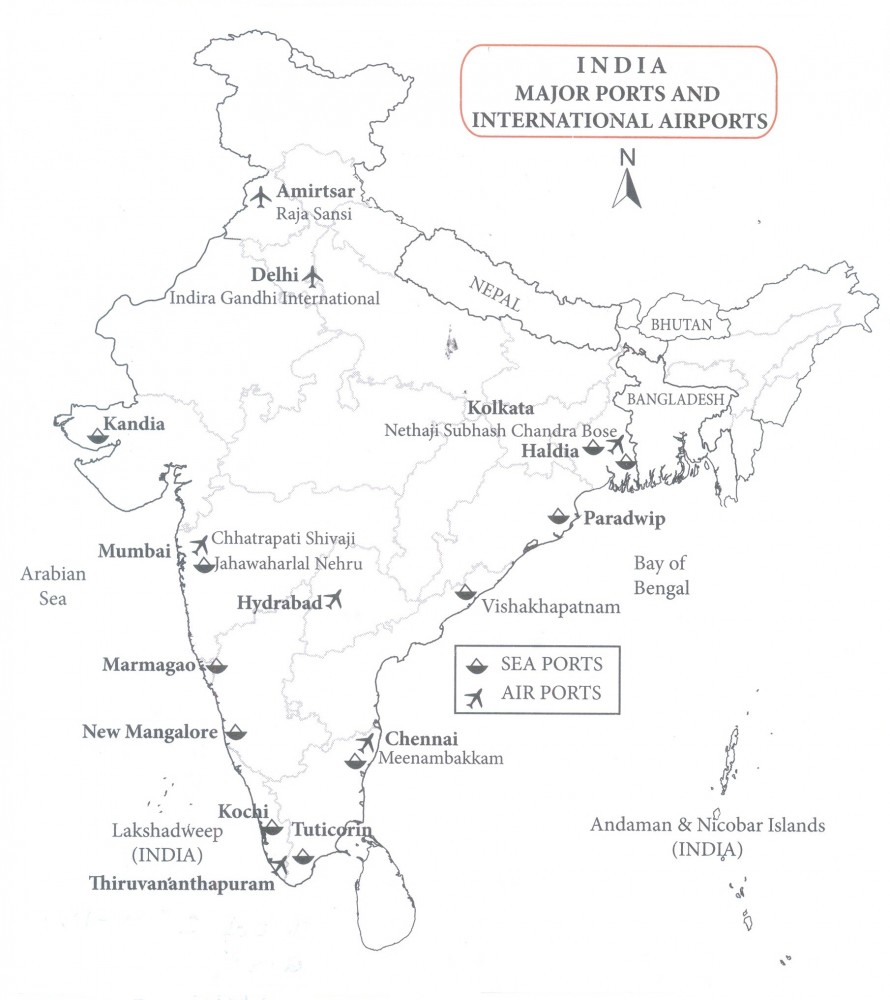
33.
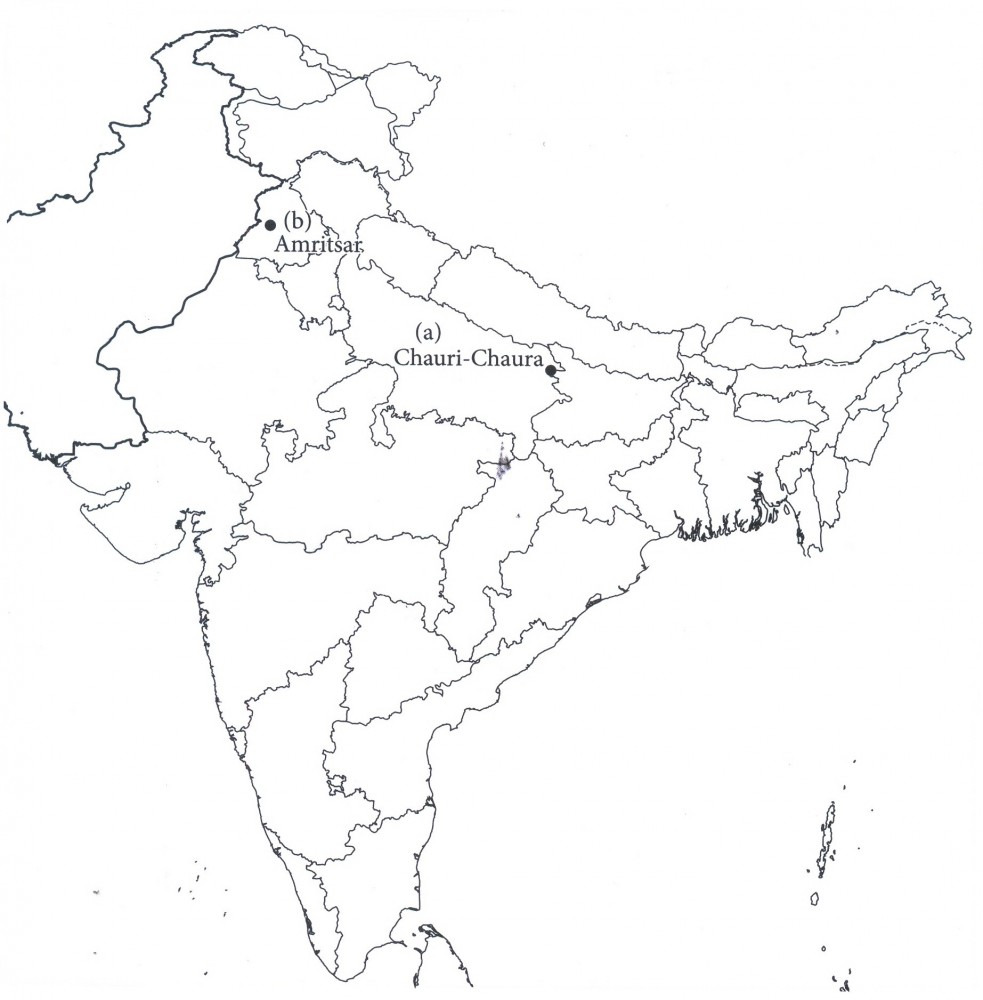
34.
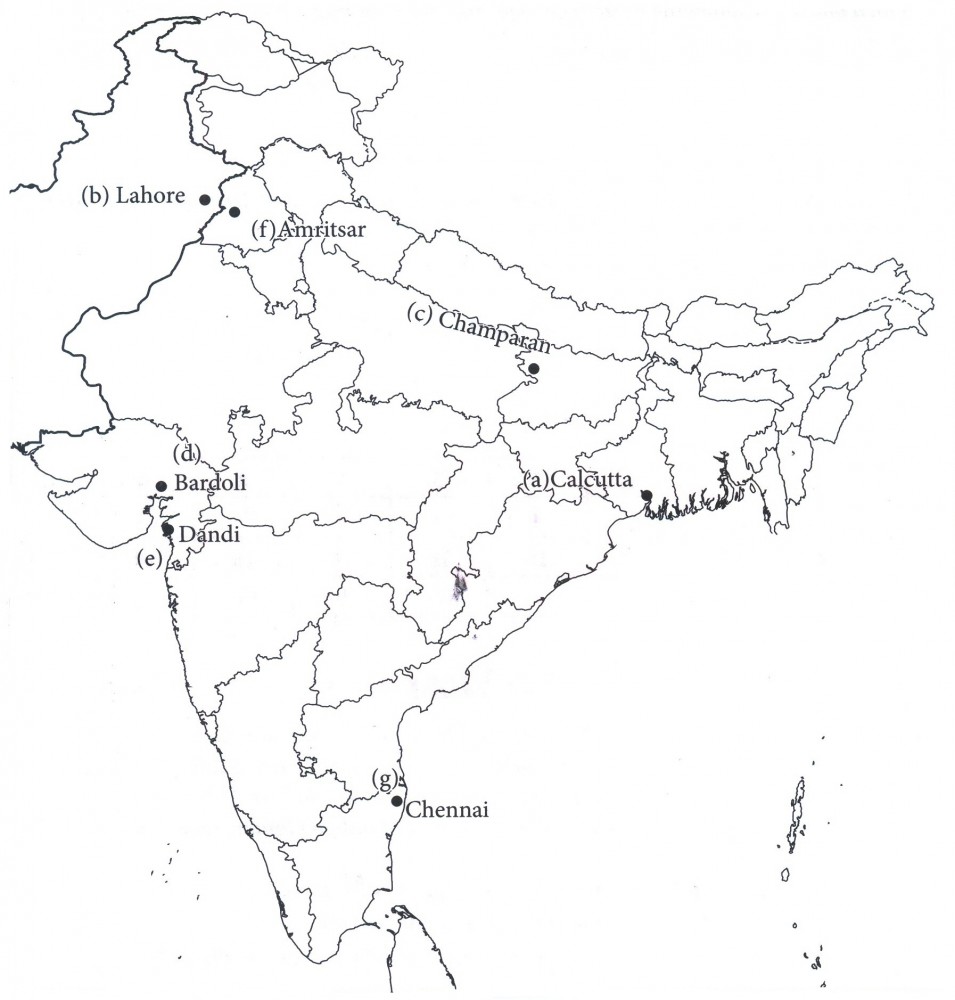
35.
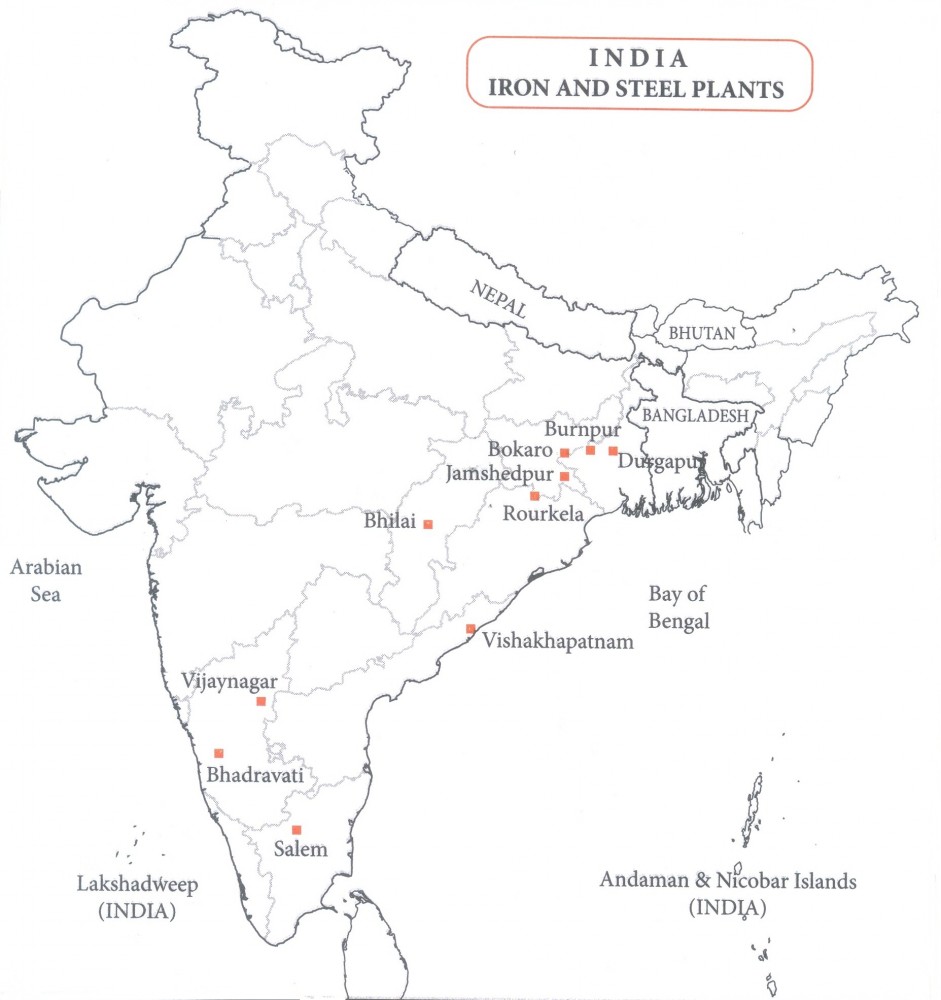
36.
Coal fields
(a) Bokaro, Jharia: Jharkhand
(b) Talcher: Odisha
(c) Neyveli: Tamil Nadu
Oil fields
(a) Ankaleshwar: Gujarat
(b) Digboi: Assam
(c) Mumbai high, Bassein: Maharashtra
37.
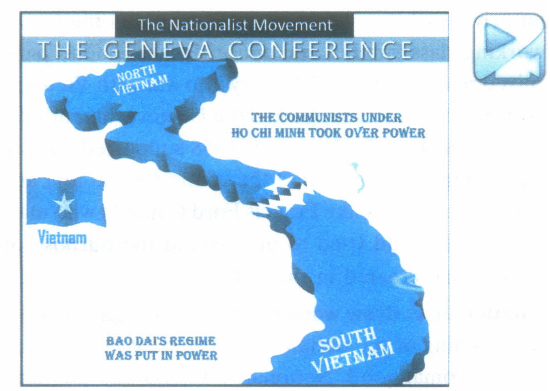
At the Geneva Convention held in 1954, even after the defeat of France, Vietnam was forced to accept its division. North Vietnam came under the Communist regime led by Ho Chi Minh and South Vietnam under Bao Dai. The following were the consequences of this partition.
(a) This division of Vietnam brought along with it a series of conflicting events that turned Vietnam into a battlefield, causing large number of deaths and widespread destruction.
(b) A repressive and authoritarian government was set up in south under Ngo Dinh Diem after sacking Bao Dai.
(c) He was not tolerant to any sort of opposition. There began a series of arrests and killings of the so-called communists or those who opposed him.
(d) Ordinance 10, a French law that permitted Christianity but outlawed Buddhism, was adopted by Ngo Dinh Diem.
(e) There began a broad opposition under the banner of the National Liberation Front (NLF) against the dictatorial rule of Ngo Dinh Diem.
(f) Fearing the spread of communist ideology, USA intervened and turned Vietnam into a battlefield.
38.
The following steps were taken by the French to dismantle the Chinese influence in Vietnam.
(a) French schools were established to spread western outlook.
(b) Medium of instruction was replaced either by French or by Vietnamese.
(c) Chinese language used by the elites in Vietnam was discouraged.
(d) The Vietnamese were forced to learn French culture.
(e) Tonkin Free School was set up to provide western-style education to spread French culture.
(f) In religion, the French introduction Christianity in Vietnam which challenged Confucianism, the Chinese religion followed by many Vietnamese.

10th Standard CBSE Syllabus & Materials
10th Standard CBSE
CBSE 10th Social Science PS - Federalism - New Model Questions Papers Study Material - QB365 Set A
NEW10th Standard CBSE
CBSE 10th Social Science PS - Power Sharing - New Model Questions Papers Study Material - QB365 Set A
NEW10th Standard CBSE
CBSE 10th Social Science GEO - Manufacturing Industries - New Model Questions Papers Study Material - QB365 Set A
NEW10th Standard CBSE
CBSE 10th Social Science GEO - Minerals and Energy Resources - New Model Questions Papers Study Material - QB365 Set A



NCERT Books

Syllabus

Exam Pattern

Sample Question Papers

Previous year Question Papers

Important Notes

MCQ Practice test

NCERT Exemplers

Case study Questions

Image Based Questions

Passage based Questions

HOT Questions

Value Based Questions

Model Questions Papers
NCERT ( Book Back ) Questions

Assertion and Reason
Important Questions And Answers

CBSE 10th Standard CBSE Subjects
CBSE Standards



