
 100% FREE ACCESS
10th Standard CBSE Syllabus & Materials
10th Standard CBSE
CBSE 10th Social Science ECO - Globalisation and the Indian Economy - New Model Questions Papers Study Material - QB365 Set A
NEW10th Standard CBSE
CBSE 10th Social Science ECO - Money and Credit - New Model Questions Papers Study Material - QB365 Set A
NEW10th Standard CBSE
CBSE 10th Social Science ECO - Sectors of the Indian Economy - New Model Questions Papers Study Material - QB365 Set A
NEW10th Standard CBSE
CBSE 10th Social Science ECO - Development - New Model Questions Papers Study Material - QB365 Set A
NEW10th Standard CBSE
CBSE 10th Social Science PS - Outcomes of Democracy - New Model Questions Papers Study Material - QB365 Set A
NEW10th Standard CBSE
CBSE 10th Social Science PS - Gender, Religion and Caste - New Model Questions Papers Study Material - QB365 Set A

Published on: 20/10/2025
Download CBSE Class 10th Standard CBSE Social Science question papers, sample papers, important questions, and previous year solved papers in PDF format. Get free study materials, NCERT solutions, and exam preparation resources for Class 10th Standard CBSE Social Science
Questions + Answers key
Take MCQ Social Science Test
1.
| LIST I | LIST II |
| A. Indian National Congress | 1. 1925 |
| B. Communist Party of India | 2. 1980 |
| C. Bharatiya Janata Party | 3. 1885 |
| A | B | C |
| 1 | 3 | 2 |
| A | B | C |
| 2 | 3 | 1 |
| A | B | C |
| 3 | 1 | 2 |
| A | B | C |
| 3 | 2 | 1 |
2.
What is the average child sex ratio in India?
923
926
935
933
3.
Name any two political leaders who fought against caste inequalities.
Dr. Manmohan Singh and Smt. Pratibha Devi Singh Patil.
Mr. Nitesh Kumar and Mr. Narendra Modi.
Dr.S. Radhakrishnan and Shri Morarji Desai
Mahatma Gandhi and B.R. Ambedkar.
4.
Which one of the following was the view of Mahatma Gandhi about religion?
He was in favour of Hinduism.
He was an ardent supporter of Muslim Religion
By religion, Gandhi meant for moral values that inform all religions.
He said that India should adopt Christianity.
5.
Which one of the following social reformers fought against caste inequalities?
Periyar Ramaswami Naiker
Swami Dayanand Saraswati
Raja Ram Mohan Roy
Ishwar Chandra Vidyasagar
6.
Which among the following statements about Indian's Constitution is wrong?
It prohibits discrimination on grounds of religion
It gives official status to one religion
It provides to all individuals freedom to profess any religion.
It ensures equality of citizens within religious communities.
7.
Bahujan Samaj Party does not represent which section of the society?
Dalits
Adivasis
OBCs
Trade Unions
8.
Which country has a two-party system?
India
Sri Lanka
United Kingdom
Nepal
9.
In which South Asia country is dictatorship preferred over democracy?
Bangladesh
Pakistan
Nepal
Sri Lanka
10.
Which South Asian Country remains least doubtful about the suitability of democracy for its country?
Sri Lanka
India
Pakistan
Bangladesh
11.
What is regarded as a 'define plus point' of democratic regimes?
rule of majority
ability to handle social differences, divisions, and conflicts
participative decision making
None of these
12.
Democracies have successfully eliminated
conflicts among people
economic inequalities
idea of political inequality
difference of opinion about how marginalized sections are to be treated
13.
Largest producer of Jute and Jute made goods
Bangladesh
India
Sri Lanka
Brazil
14.
In 1857 where the first cotton mill of India was founded
Mysore
Madras
Surat
Bombay
15.
Magnetite is the finest iron or with a new higher content iron upto
60%
70%
80%
90%
16.
Biogas plants using cattle dung are called
hydel plants
gobar gas plants
thermal power station
gas station
17.
What is 'Rat hole' mining?
Mining in places where there are lots of rats
Mining done by family members in the form of a long narrow tunnel
Mining that kills rats
None of these
18.
Which out of the following minerals occur in the sands of valley floors and the base of hills?
Gold
Copper
Sulphur
Marble
19.
Which one of the following industries uses limestone as a raw material?
Aluminium
Cement
Sugar
Jute
20.
Koderma, in Jharkhand is the leading producer of which one of the following minerals?
bauxite
mica
iron ore
copper
21.
Why is the cotton textile industry the largest industry in India today? Give any three reasons.
22.
Explain the various forms that communalism can take in politics.
23.
How does democracy help reduce inequality and poverty?
24.
What is the necessity of a political party for a democracy?
25.
What are the characteristics of a political party?
26.
Distinguish between the following in not more than 30 words.
(a)Ferrous and non-ferrous minerals
(b)Conventional and non-conventional sources of energy.
27.
Define the term secularism. Explain any four features of secularism in India.
28.
"Women still lag behind men in India despite some improvements since independence' Analyse the statement.".
29.
Differentiate between national and regional parties.
30.
Describe any four functions of political parties in India.
31.
How does democracy lead to peaceful and harmonious life among citizens? Explain.
32.
"The economic strength of a country is measured by the development of manufacturing industries". Support the statement with arguments.
33.
Explain any five measures to control industrial pollution in India.
34.
Name any three major iron ore belts found in India. Write main features of each.
35.
How is energy a basic requirement for the economic development of the country? Explain with examples
36.
Why is conservation of mineral resources essential? Explain any three methods to conserve them
37.
What do you mean by one-party system?
38.
Explain the term 'Feminist Movement'.
39.
Why is a democratic government better than other alternatives?
40.
What is urbanisation?
41.
What is the role played by the Panchayat Raj in women's political representation?
42.
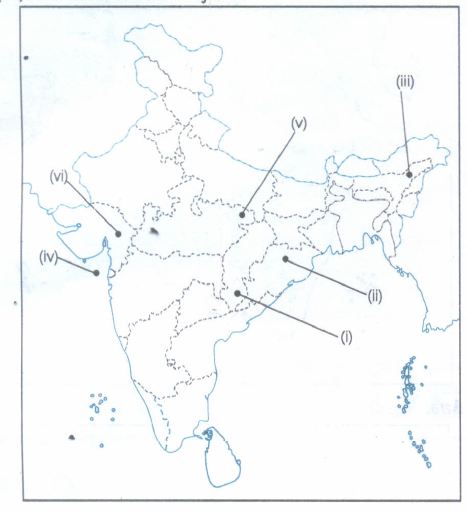
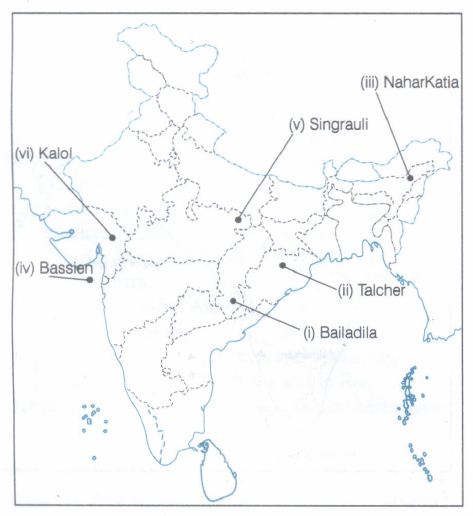
On the given political map of India, identify and label any four of the following features with appropriate symbols.
(i) Iron are mine in Chhattisgarh
(ii) Coal mine in Odisha
(iii) An oil field in Assam
(iv) An offshore oil field near Mumbai High
(v) A power thermal plant in Madhya Pradesh
(vi) An oil field in Gujarat
43.
The Equal Remuneration Act, 1976 provides that equal wages should be paid to equal work. However in almost all areas of work, from sports and cinema, to factories and fields, women are paid less than men, even when both do exactly the same work.
1. In which fields are women paid less than men?
(a) In almost all areas of work, from sports and cinema, to factories and fields, women are paid less than men, even when both do exactly the same work.
(b) In the case of theft women are paid less than men, even when both do exactly the same work.
(c) In the case of murders women are paid less than men, even when both do exactly the same work.
(d) In the field of teaching women are paid less than men, even when both do exactly the same work.
2. What is The Equal Remuneration Act, 1976?
(a) The Equal Remuneration Act, 1976 provides that equal wages should be paid to equal work.
(b) The Equal Remuneration Act, 1976 provides that equal wages should be paid to unequal work.
(c) The Equal Remuneration Act, 1976 provides that equal wages should be paid only to all farmers.
(d) The Equal Remuneration Act, 1976 provides that equal wages should be paid only to all shopkeepers.
3. What is that Act called which provides equal wages should be paid to equal work?
(a) The Equal Rating Act, 1976.
(b) The Equal Remuneration Act, 1976.
(c) The Equal Remuneration Act, 1876.
(d) The Equal Act, 1976.
4. In almost all areas of work, from sports and cinema, to factories and fields, are paid less than men.
| (a) Women | (b) Animals |
| (c) Kings | (d) Farmers |
44.
In some countries, power usually changes between two main parties. Several other parties may exist, contest elections and win a few seats in the National legislatures. But only the main parties have a serious chance of winning majority of seats to form government. Such a party system is called two party system. The United States of America and the United Kingdom are examples of two-party system. If several parties compete for power, and more than two parties have a reasonable chance of coming to power either on their own strength or in alliance with others, we call it a multi party system. Thus, in India, we have a multi party system. In this system, the government is formed by various parties coming together in a coalition. When several parties in a multi-party system join hands for the purpose of contesting elections and winning power, it is called an alliance or a front. For example, in India
there were three such major alliances in 2004 parliamentary elections the National Democratic Alliance, the United Progressive Alliance and the Left Front. The multi party system often appears very messy and leads to political instability. At the same time, this system allows a variety of interests and opinions to enjoy political representation.
1. Countries having Bi- party system:
| (a) USA | (b) India |
| (c) China | (d) All of these |
2. The multi-party system:
| (a) appears very messy | (b) leads to political instability |
| (c) not free to form political party | (d) Only 'A' and 'B |
3. The government is formed coming together in a/an____________.
| (a) alliance | (b) front |
| (c) coalition | (d) opposition |
4. Which party leads the ruling NDA government at the center
| (a) Indian national congress | (b) Bhartiya janta party |
| (c) Janshakti Party | (d) Communist Party of India |
45.
Manganese is mainly used in the manufacturing of steel and ferro-manganese alloy. Nearly 10 kg of manganese is required to manufacture one tonne of steel. It is also used in manufacturing bleaching powder, insecticides and paints.
1. What are the uses of manganese?
(a) Manganese is mainly used in the manufacturing of copper and ferro-manganese alloy.
(b) Manganese is mainly used in the manufacturing of steel and ferro-phosphorus alloy.
(c) Manganese is mainly used in the manufacturing of steel and ferro-manganese alloy.
(d) Manganese is mainly used in the manufacturing of zinc and ferro-magnesium alloy.
2. How much manganese is required to manufacture one tonne of steel?
(a) Nearly 100 kg of manganese is required to manufacture one tonne of steel.
(b) Nearly 10 kg of manganese is required to manufacture one tonne of steel.
(c) Nearly 1 kg of manganese is required to manufacture one tonne of steel.
(d) Nearly 1000 kg of manganese is required to manufacture one tonne of steel.
3. Manganese is mainly used in manufacturing of which alloy?
(a) Manganese is mainly used in manufacturing of ferro-phosphorus alloy.
(b) Manganese is mainly used in manufacturing of ferro-magnesium alloy.
(c) Manganese is mainly used in manufacturing of ferro-phosphate alloy.
(d) Manganese is mainly used in manufacturing of ferro-manganese alloy.
4. Which mineral is used to manufacture bleaching powder?
(a) Manganese is used to manufacture bleaching powder.
(b) Potassium is used to manufacture bleaching powder.
(c) Sulphur is used to manufacture bleaching powder.
(d) Sodium is used to manufacture bleaching powder.
1.
(c)
| A | B | C |
| 3 | 1 | 2 |
2.
(d)
933
3.
(d)
Mahatma Gandhi and B.R. Ambedkar.
4.
(c)
By religion, Gandhi meant for moral values that inform all religions.
5.
(a)
Periyar Ramaswami Naiker
6.
(b)
It gives official status to one religion
7.
(d)
Trade Unions
8.
(c)
United Kingdom
9.
(b)
Pakistan
10.
(d)
Bangladesh
11.
(b)
ability to handle social differences, divisions, and conflicts
12.
(c)
idea of political inequality
13.
(b)
India
14.
(d)
Bombay
15.
(b)
70%
16.
(b)
gobar gas plants
17.
(b)
Mining done by family members in the form of a long narrow tunnel
18.
(a)
Gold
19.
(b)
Cement
20.
(b)
mica
21.
The cotton industry is the largest industry in India today because of the following reasons.
(a) The cotton textile industry contributes 14 per cent of the total industrial production.
(b) It provides employment to 35 million persons directly - the second largest after agriculture.
(c) Its share in GDP in terms of foreign exchange is considerable.
22.
Different forms of the communal politics:
(a) The most common expression of communalism is in everyday beliefs. These routinely involve religious prejudices, stereotypes of religious communities and belief in the superiority of one's religion over other religious. This is so common that we often fail to notice it, even when we believe in it.
(b) A communal mind often leads to political dominance of one's own religious community. For those belonging to majority community, it takes the form of majoritarian dominance. For those belonging to the minority community, it can take the form of a desire to form a separate political unit.
(c) Political mobilization on religious lines is another frequent form of communalism. This involves the use of sacred symbols, religious leaders and emotional appeal, in order to bring the followers of one religion together in the political arena. In electoral politics, this often involves special appeal of votes in the name of religion.
(d) Sometimes communalism takes its most ugly form of communal violence, riots and massacre. India and Pakistan suffered some of the worst communal riots at the time of the Partition. The post-independence period has also seen large-scale communal violence.
23.
(i) Economic inequality and poverty are the twin problems of India. Different political parties are committed to remove these since it is included in their election manifesto.
These are responsive to the needs of the people. The elected Government from time to time started a number of poverty alleviation programmes to reduce poverty in India.
(ii) More over many employment scheme like Rural Works Programme, National Rural Employment Programme etc. are started by democratic Government in India.
24.
Political parties can be easily seen as one of the most visible institutions in democracies all over the world. The need of political parties lies in the facts -
(1) It brings different representatives together so that a responsible government can be formed.
(2) They act as a mechanism to restrict the government from framing any unjust policies or laws.
(3) For most ordinary citizens, democracy means political parties. It happens because political parties fulfill the needs and aspirations of the people. So, political parties are in fact, a necessary condition in modern democracies.
25.
The characteristics of a political party are
(i) They reflect fundamental political division in a society.
(ii) Parties are a part of society and thus involve partisanship.
(iii) They seek to implement policies and programmes of their agenda by winning popular support through election.
(iv) They are formed to promote the collective good through policies and programmes.
26.
(i) The differences between ferrous and non-ferrous mineral are
| Ferrous Minerals | Non-ferrous Minerals |
| The minerals which contain iron ore are known as ferrous minerals. | The minerals which do not contain iron ore are known as non-ferrous minerals. |
| These are helpful in the development of metallurgical industries. | These play an important role in engineering and electrical industries. |
| Iron ore, chromite, cobalt, etc are the examples of ferrous minerals. | Copper, zinc, lead and aluminium are the examples of non-ferrous minerals. |
(ii) The differences between conventional and non-conventional sources of energy are
| Conventional Sources of Energy | Non-conventional Sources of Energy |
| They have been used since a long time. | These are of recent origin and have not been commonly used. |
| They are non-renewable and exhaustible sources of energy. | These are renewable sources of energy. |
| Wood, fuel, coal, petroleum, etc are some examples. | Wind, tidal energy, solar energy, etc are some of the examples. |
| These sources pollute the environment. | These sources are pollution free sources. |
27.
Secularism refers to the separation of religion from the state. It means that the state should not discriminate among its citizens on the basis of religion. It should neither encourage nor discourage the followers of any religion.
In India main features of secularism are
(i) There is no official religion for the Indian states, i.e. unlike Sri Lanka (Buddhism), Pakistan (Islam) and England (Christianity).
(ii) All individuals and communities have the freedom to profess, practice and propagate any religion or not to follow any religion.
(iii) It prohibits discrimination on grounds of religion.
(iv) It allows the state to intervene in the matters of religion in order to ensure equality within religious communities, viz. it bans untouchability.
28.
In India women still lag behind men despite some improvements since independence. This can be analysed in the following ways
(i) As India is still dominated by Patriarchal society, gender discrimination is prevalent at present. Parents prefer to spend money for boy's education, thus dropout among girl child is high in schools.
(ii) Girls perform as well as boys in school, but the literacy rate among women in only 54 percent compared with 76 percent among men.
(iii) The proportion of women among the highly paid and valued jobs is still very little. Much of her work is not paid and therefore not valued.
(iv) In almost all areas of work, women are paid less than the men, even when both works exactly the same.
(v) Women still face harassment, exploitation and violence in out society.
29.
The following are the differences between the national parties and regional parties.
| National Parties | Regional Parties |
|---|---|
| (a) National parties have influence all over the country. | (a) The influence of regional parties is limited to a particular region or state. |
| (b) National parties deal with national problems. | (b) Regional parties are concerned with the problems and demands of a particular region only. |
| (c) The activities of the national parties give priority to the national problems over the regional problems. |
(c) The activities of regional parties are restricted to the region or the state in which they function. |
| (d) In order to become a national party, a party has to secure at least six per cent of total votes in Lok Sabha or Assembly elections in four states and win at least four seats in the Lok Sabha. |
(d) In order to become a regional party, a party has to secure at least six per cent of total votes in the legislative election and win at least two seats. |
| (e) BJP, Congress and BSP are the examples of national parties. | (e) Janta Dal, Assam United Democratic Front and Manipur People's Party are the examples of regional parties. |
30.
Main functions of a political party are:
(1) To contest elections
In democracies, elections are fought mainly among the candidates put up by different political parties. Parties select their candidates in different ways. In India top party leaders choose candidates for contesting elections.
(2) Forming policies and programmes
Parties put forward different policies and programmes and the voters choose from them.
(3) Making laws
When parties come into power, they make laws for the country. Formally laws are debated and passed in the Legislature. Members of the ruling party follow the directions of the party leaders, irrespective of their personal opinions.
(4) Parties form and run government
Parties recruit leaders, train them and then make them ministers to run government in the way they want.
(5) Role of opposition Parties that lose in elections, play the role of opposition to the parties in power by criticizing the government for its failure or wrong policies.
(6) Shaping public opinion
They raise and highlight issues. Parties have lot of members and activities spread all over the country. Many of the pressure groups are extension of political parties among different sections of the society. Parties, sometimes also launch movements for the resolutions of problems faced by people.
(7) Access to government machinery and welfare schemes
For any ordinary citizen it is easy to approach a local party leader than a government officer. That is why they feel close to the parties even when they do not fully trust them. Parties have to respective to people's needs and demands.
31.
(i) Democracies accommodate various social divisions. for example, Belgium has peacefully solved her ethnic problems and solved the differences.
(ii) All democracies usually develop a procedure to competition, i.e. conduct elections, power-sharing, etc. This reduces the possibility of tensions, due to social divisions, turning violent or explosive.
(iii) Democracy teaches people to respect the differences and resolves conflicts among different groups peacefully. In non-democratic countries, rulers either turn a blind eye to or suppress internal differences. For example, Sri Lanka. The plus point in democratic regime is the ability to handle social differences, divisions and conflicts.
(iv) A democracy is not just a rule by majority opinion. The majority always needs to work with the minority so that the government represents the general view.
(v) A democratic government ensures that the rule by the majority does not become autocratic in terms of religion, race or linguistic group etc. It tries that in case of every election, different persons and groups can form a majority. It tries to see that every citizens has a chance to be in majority at some point of time and is not barred on the basis of birth. All these things ensured by a democratic regime lead to a peaceful and harmonious life.
32.
(i) Manufacturing industries help in modernizing agriculture.
(ii) They also reduce the heavy dependence of people on agricultural income by providing them jobs.
(iii) Industrial development reduces unemployment and poverty.
(iv) It also brings down regional disparities. v.Export of manufactured goods expands trade and commerce, and brings foreign exchange.
(v) Prosperity of our country depends on transforming raw materials into furnished goods of higher value and diversifying our industries.
(vi) Industrial sector contributes 27% of GDP and manufacturing contributes 17% of GDP.
33.
Five measures or steps to control or minimise industrial pollution in India are as follows
(i) Particulate matter in the air can be reduced by fitting smoke stacks to factories with electrostatic precipitators, fabric filters, scrubbers and inertial separators.
(ii) Smoke can be reduced by using oil or gas instead of coal in factories.
(iii) Updated machinery and equipment should be used that makes less noise and generators should be fitted with silencers.
(iv) Pollution check certificates should be made compulsory.
(v) Machineries used in the industries can be redesigned to increase energy efficiency and reduce noise. Noise absorbing material may also be used.
34.
(a) Odisha- Jharkhand Belt:
Badampahar mines in the Mayurbhanj and Kendujhar districts of Orissa have high grade hematite ore. Additionally, hematite iron ore is mined in Gua and Noamundi in Singhbhum district of Jharkhand.
(b) Durg- Bastar-ChandrapurBelt:
This belt lies in Chhattisgarh and Maharashtra. The Bailadila range of hills in the Bastar district of Chhattisgarh has very high grade hematite ore. This hilly range as 14 deposits of super high grade hematite ore. Iron from these mines is exported to Japan and South Korea via Vishakapatnam port.
(c) Bellary-Chitradurga-Chikmaglur- Tumkur Belt:
This belt lies in Karnataka. The Kudremukh mines located in the Western Ghats are a 100 percent export unit. The ore from these mines is transported as slurry through a pipeline to a port near Mangalore.
(d) Maharashtra-Goa Belt:
This belt includes the state of Goa and Ratnagiri district of Maharashtra. The ores in these mines are not of very high quality. They' are exported through Marmagao port.
35.
(i) Energy is the basic requirement for economic development.
(ii) Every sector of national economy agriculture, industry, transport and commerce needs greater inputs of energy.
(iii) In the domestic sector also energy demands in the form of electricity are growing because of increasing use of electric gadgets and appliances.
(iv) The economic development plans implemented since independence necessarily required increasing amount of energy.
(v) Because of all these, per capita consumption of energy is continuously increasing.
36.
(a) Conservation of minerals resources is essential because:
(i) The formation of minerals takes a long geological period of millions of years.
(ii) They are finite, i.e. limited in nature.
(iii) Many of them are non-renewable and exhaustible.
(iv) The rate of replenishment of minerals is infinitely small in comparison to rate of consumption.
(v) They have to be preserved for our future generations because they are very important for industrial development of the nation.
(b) Methods of conserving mineral resources.
(i) We should use minerals in a planned and sustainable manner.
(ii) Improved technologies need to be evolved to allow use of low grade ores at low cost.
(iii) Recycling of metals.
(iv) Using scrap metals and other substitutes.
(v) Wastages in mining, processing and distribution should be minimized.
(vi) Controlled export of minerals.
37.
A system under which only one political party is allowed to function in the country is called one party system
38.
A Feminist Movement is a movement aimed at equality in personal and family life for men and women.
39.
Democracy is preferred as the better form of government because it ensure people's rule based on popular consensus and enhances the dignity of the individual.
40.
Urbanisation means shift of population from rural areas to urban areas.
41.
One third of seats in local government bodies - in panchayats and municipalities - are now reserved for women. Now there are more than 10 lakh elected women representatives in rural and urban local bodies.
42.
43.
1. In almost all areas of work, from sports and cinema, to factories and fields, women are paid less than men, even when both do exactly the same work.
2. The Equal Remuneration Act, 1976 provides that equal wages should be paid to equal work.
3. The Equal Rating Act, 1976.
4. Kings
44.
1. alliance
2. Only 'A' and 'B
3. coalition
4. Communist Party of India
45.
1. Manganese is mainly used in the manufacturing of steel and ferro-manganese alloy.
2. Nearly 10 kg of manganese is required to manufacture one tonne of steel.
3. Manganese is mainly used in manufacturing of ferro-manganese alloy.
4. Manganese is used to manufacture bleaching powder.

10th Standard CBSE Syllabus & Materials
10th Standard CBSE
CBSE 10th Social Science PS - Federalism - New Model Questions Papers Study Material - QB365 Set A
NEW10th Standard CBSE
CBSE 10th Social Science PS - Power Sharing - New Model Questions Papers Study Material - QB365 Set A
NEW10th Standard CBSE
CBSE 10th Social Science GEO - Manufacturing Industries - New Model Questions Papers Study Material - QB365 Set A
NEW10th Standard CBSE
CBSE 10th Social Science GEO - Minerals and Energy Resources - New Model Questions Papers Study Material - QB365 Set A



NCERT Books

Syllabus

Exam Pattern

Sample Question Papers

Previous year Question Papers

Important Notes

MCQ Practice test

NCERT Exemplers

Case study Questions

Image Based Questions

Passage based Questions

HOT Questions

Value Based Questions

Model Questions Papers
NCERT ( Book Back ) Questions

Assertion and Reason
Important Questions And Answers

CBSE 10th Standard CBSE Subjects
CBSE Standards



