
 100% FREE ACCESS
10th Standard CBSE Syllabus & Materials
10th Standard CBSE
CBSE 10th Social Science ECO - Globalisation and the Indian Economy - New Model Questions Papers Study Material - QB365 Set A
NEW10th Standard CBSE
CBSE 10th Social Science ECO - Money and Credit - New Model Questions Papers Study Material - QB365 Set A
NEW10th Standard CBSE
CBSE 10th Social Science ECO - Sectors of the Indian Economy - New Model Questions Papers Study Material - QB365 Set A
NEW10th Standard CBSE
CBSE 10th Social Science ECO - Development - New Model Questions Papers Study Material - QB365 Set A
NEW10th Standard CBSE
CBSE 10th Social Science PS - Outcomes of Democracy - New Model Questions Papers Study Material - QB365 Set A
NEW10th Standard CBSE
CBSE 10th Social Science PS - Gender, Religion and Caste - New Model Questions Papers Study Material - QB365 Set A

Published on: 20/10/2025
Download CBSE Class 10th Standard CBSE Social Science question papers, sample papers, important questions, and previous year solved papers in PDF format. Get free study materials, NCERT solutions, and exam preparation resources for Class 10th Standard CBSE Social Science
Questions + Answers key
Take MCQ Social Science Test
1.
'Tiger is one of the key wildlife species in the faunal web. In 1973,the authorities realised that the tiger population had dwindled to 1,827 from an estimated 55,000 at the turn of the century'.
(i) What are the major threats to tiger population?
(ii) Mention the names of some of the tiger reserves in India.
2.
Describe any three features of Joint Forest Management.
3.
How have human activities affected the depletion of flora and fauna? Explain.
4.
Read the sources given below and answer the questions
Source A Are Colonial Forest Polices to be Blamed
Some of our environmental activists say that the promotion of a few fovoured species, in many parts of India, has been carried through the ironically termed 'enrichment plantation', in which a single 'commercially valuable species was extensively planted and other species eliminated.
(i) For what sense the Colonial Forest Policy is being blamed for?
Source B Sacred Groves a Wealth of Diverse and Rare Species
Indian society comprises several cultures, each with its own set of traditional methods of conserving nature and its creations. Sacred qualities are often ascribed to springs, mountain peaks, plants and animals which are closely protected you.
(ii) What does the extract tell us about environment conservation in Indian society?
Section C Gautama Buddha (487 Bc)
The tree is a peculiar organism of unlimited kindness and benevolence and makes no demand for its sustenance and extends generously the products of its life activity. It affords protection to all beings, offering shade even to the axe men who destroy it.
(iii) To what extent do you agree that conservation of trees is necessary. Give one reason.
5.
Generally there are news of threat perception to wildlife, some are gharials, migratory birds, etc. What do you feel would be the result if any of such single species is extinct in future?
6.
How would you differentiate reserved forest and protected forest?
7.
What is the importance of the Himalayan Yew? Why is it under threat? Explain.
8.
Read the source given below and answer the questions that follows
Source A Soil Erosion and Soil Conservation Large fields can be divided into strips. Strips of grass are left to grow between the crops. This breaks up the force of wind. This method is known as strip cropping. Planting lines of trees to create shelter also works in a similar way. Rows of such trees are called shelter belts. These shelter belts have contributed significantly to the stabilisation of sand dunes and in stabilising the desert in western India.
(i) Evaluate the effectiveness of shelterbelts in stabilisation of sand dunes
Source B Land use pattern in India The pattern of net sown area varies greatly from one state to another. It is over 80 percent of the total area in Punjab and Haryana and less than 10 percent in Arunachal Pradesh, Mizoram, Manipur, and Andaman and Nicobar Islands.
(ii) Give one reason for so much variation in net sown area in India.
Source C Resource planning in India The history of colonisation reveals that rich resources in colonies were the main attractions for the foreign invaders. It was primarily the higher level of technological development of the colonising countries that helped them to exploit resources of other regions and establish their supremacy over the colonies. Therefore, resources can contribute to development only when they are accompanied by appropriate technological development and institutional changes. India has experienced all this in different phases of colonisation.
(iii) What led the imperial powers to exploit the rich resources of the colonies?
9.
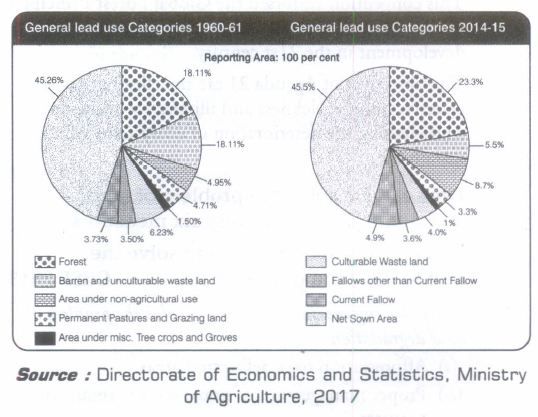
Compare the diagrams given and find out land use category which had the highest increase during the period 1960-61 to 2014-15 and the category which had the highest decrease during the period. Give one major reason for each.
10.
What do you mean by net sown area? Describe it with reference to India?
11.
What are the objectives of Agenda 21?
12.
In environment destruction women are affected more than men - Explain.
13.
How far were the colonial forest policies responsible for the depletion of forest resources in India?
14.
What are vulnerable species? Give four examples.
15.
Distinguish between endangered and extinct species.
16.
What are the effects of the destruction of bio-diversity in India?
17.
What is biodiversity? Why is biodiversity important for human lives?
18.
Explain the three steps involved in the resource planning in India
19.
What is resource planning? Write any three utility of resources.
20.
What type of soil is found in river deltas of the eastern coast? Give three main features of this type of soil.
21.
Write characteristics each of Khadar and Bangar?
22.
When and why was the Rio-de-Janeiro Earth summit held?
23.
What steps can be taken to control soil erosion in hilly areas?
24.
Examine the three major problems that have been created due to the indiscriminate use of resources by human beings.
25.
Write brief note on first earth summit.
26.
(i) Name three states having black soil and the crop which is mainly grown in it.
(ii) What type of soil is found in the river deltas of the eastern coast? Give three main features of this type of soil.
(iii) what steps can be taken to control soil erosion in the hilly areas?
27.
Suggest any two ways to solve the problem of land degradation.
28.
On 9th March, Mohammad Arif,a 35-years-old man from Mandkha, Uttar Pradesh, was booked under the Wildlife Protection Act,1972, for "illegally' keeping and nursing an injured Sarus crane (Grus Antigone) he found in his village.
What are the protections provided under the Wildlife Protection Act, 1972?
29.
Aaron gave his friends three clues about a type of soil.
1. It is found in Maharashtra, the largest producer of cotton in India.
2. During summers, the soil exhibits self-aeration capacity.
3. It is rich in nutrients.
What soils being referred to by Aaron?
30.
'Madhya Pradesh has nearly 18 lakh hectares of ravines with steep but shallow gullies. This area is mainly along the banks of the river Chambal and its tributaries.'
Source : India TV
Define the phenomenon responsible for the formation of ravines and gullies.
31.
Mr. Palani is from Tamilnadu, wishes to cultivate either tea or wheat.
Which one of the crops out of the two can he cultivate in his state? Substantiate your answer with any two reasons.
32.
Suggest any two ways for the conservation of resources.
1.
(i) The major threats to tiger population are numerous, such as poaching for trade, shrinking habitat, depletion of prey base species, growing human population, etc. The trade of tiger skins and the use of their bones in traditional medicines, especially in the Asian countries left the tiger population on the verge of extinction
(ii) Some of the tiger reserves of India are Corbett National Park in Uttarakhand, Sunderbans National Park in West Bengal, Bandhavgarh National Park in Madhya Pradesh, Sariska Wildlife Sanctuary in Rajasthan, Manas Tiger Reserve in Assam and Periyar Tiger Reserve in Kerala.
2.
Joint Forest Management (JFM) programmes have been launched by various State Governments. The first state to start this programme was Odisha in 1988.
The important features of JFM are
(i) In India, Joint Forest Management (JFM) programme has been proved to be a good example for involving local communities in the management and restoration of degraded forests.
(ii) The major purpose of the JFM is to protect the forests from encroachments, grazing, theft and fire and also to improve the forests in accordance with an approved Joint Forest Management Plan.
(iii) JFM depends on the formation of local (village) institutions that undertake protection activities mostly on degraded forest land managed by the forest department.
3.
The human activities that have been major causes for the depletion of flora and fauna, are
(i) Agricultural expansion.
(ii) Shifting cultivation (Jhum), a type of slash and burn agriculture.
(iii) Large-scale development projects.
(iv) Mining activities.
4.
(i) Colonial Forest Policy is being blamed for promoting 'enrichment plantation' which in the course of time eliminates native precious species.
(ii) The extract tells us that environment conservation was a traditional practice in India society. It is mixed in our cultural norms and beliefs.
(iii) It is essential to conserve the trees as human beings receive many products from trees and their conservation is a way to return that kindness.
5.
Every species is the part of a particular eco-system. Human beings due to their diversified adaptability and abundance in nature have become part of almost all eco-systems on the Earth. When any species is lost or extinct, it affects the eco-system in the following ways
1. Food chain and food web are two important aspects of any eco-system. When any species is lost, the link fails and energy and material could not transfer/ flow properly in the trophic levels.
2. All species including human being are affected resulting in catastrophic events in long-term.
6.
The differences between reserved forests and protected forests are
(i) In reserved forests, right to all activities like hunting, grazing, etc are banned unless specific orders are issued by the government. But in protected areas, right to do activities like hunting and grazing ere are sometimes given to communities living on the fringes of the forests and depend on forests for their livelihood.
(ii) Reserve forests enjoy a higher degree of protection and may be upgraded to the status of wildlife sanctuary and national parks. The protected forests do not face such possibility.
(iii) More than half of the total forest land has been declared as reserved forests. On the other hand, only one-third of the total forest area is under protected forests.
(iv) Madhya Pradesh, Jammu and Kashmir, Andhra Pradesh, Uttarakhand, Kerala, Tamil Nadu, West Bengal and Maharashtra have large percentages of reserved forests of their total forest area. On the other hand, Bihar, Odisha, Haryana, Punjab, Himachal Pradesh and Rajasthan have their large area under protected forests.
7.
Importance of Himalayan Yew
1. The Himalayan Yew (Taxus wallachiana) is a medicinal plant found in various parts of Himachal Pradesh and Arunachal Pradesh. A chemical compound called 'taxol' is extracted from the bark, needles, twigs and roots of this tree.
2. It has been successfully used to treat some cancers.
3. The drug is now the biggest selling anti-cancer drug in the world.
Threat to Himalayan Yew
1. The Himalayan Yew is under great threat due to over-exploitation.
2. In the last one decade, thousands of yew trees have dried up in various parts of Himachal Pradesh and Arunachal Pradesh
8.
(i) In shelter belts, rows of trees are planted at the edge of farm lands. This breaks up the force of wind thereby reducing the spreading of sand dunes.
(ii) There is so much variation in net sown area in India due to the presence of different types of landforms i.e. mountains, plateaus and plains.
(iii) Their high level of technological development led to the exploitation of rich resources of the colonies.
9.
The highest increase was in forest cover i.e. from 18.11% in 1960-61 to 23.3% in 2014-15. This increase is due to government efforts made in. the field of conservation of environment by demarking the forest areas. Still, it is below the outline of 33% set in National Forest Policy, 1952.
The highest decrease was in Barren and Uncultivable wasteland i.e. from 18.11 % to 5.5%. It is due to rise in area under non-agricultural uses. Massive urbanisation, development of roads, railways, and other uses have brought wasteland into area under non-agricultural uses.
10.
Gross Cropped Area (GCA) is the total area sown once as well as more than once in a particular year. When the crop is sown on a piece of land for twice, the area is counted twice in GCA. On the other hand, Net Sown Area is the area sown with crops but is counted only once.
11.
The objectives of agenda 21 are as follows:
1) It aims for achieving Global Sustainable Development.
2) It is an agenda to fight environmental damage, poverty, disease etc.
3) In agenda 21, needs of shared responsibilities were discussed. example: polio drops.
4) One of its major objectives is that every local govt. should draw its own agenda 21.
12.
(i) The forest dependent Communities directly depend on various components of the forest and wildlife for food, drink, medicine, culture, spirituality etc.
(ii) Within the poor, women are affected more than men.
(iii) In many societies, women have the major responsibility of collection of fuel, fodder, water and other basic subsistence needs.
(iv) As these resources are depleted, the drudgery of women increases and sometimes they have to walk for more than 10 km to collect these resources.
(v) This causes serious health problems for women and negligence of home and children.
(vi) Due to increased hours of work, there are many serious social implications.
(vii) The indirect impact of degradation such as severe drought or deforestation induced floods, etc. also hits the poor hardest.
(viii) Poverty in these cases is a direct outcome of environmental destruction.
13.
(i) In the name of enrichment plantation, the promotion of a few favoured species, in many parts of India, has been carried.
(ii) In enrichment plantation, a single commercially valuable species was extensively planted and other species eliminated.
(iii) For example, teak manufacturer has damaged the natural forests in South India.
(iv) Chir Pine plantations in the Himalayas have replaced the Himalayan oak and Rhododendron forests.
(v) During the colonial period, the greatest damage was inflicted on Indian forests due to the expansion of the railways, agriculture, commercial and scientific forestry and mining activities.
14.
Vulnerable Species: The population of species which has decreased to the level into endangered category in the near future are known as vulnerable species. E.g. Asiatic elephant, blue sheep, Gangetic dolphin etc.
15.
| Endangered species | Extinct species |
| These are species which are facing danger of extinction |
These are species which are not found after searches of known or likely areas where they may occur |
| The survival of such species is difficult if the negative factors that have led to a decline in their population continue to operate |
They are already missing and their survival is suspicious |
| Example of these species are black buck, wild ass, Indian rhino, crocodile, lion-tailed macaque and so on. |
Examples of these species are Asiatic cheetah, pink-headed duck and so on |
16.
Direct effects:
i. Many tribal communities or forest dependent communities are impoverished due to the destruction of forests and wildlife.
ii. Many species of plants and animals became endangered or extinct.
Indirect effects:
i. It destroyed the ecological balance.
ii. It leads to severe droughts in some parts and floods in other areas.
iii. It affected the health of women and negligence of home and children because of their increased hours of work to collect their requirements.
17.
Biodiversity:
Biodiversity refers to rich flora and wildlife. In this diversity, species with diverse forms and functions live together.
Importance of Biodiversity for Human:
Biodiversity is important for human lives because the human being, along with the biodiversity, form a complete ecological system in which we are a part and are dependent on this system for our own existence.
18.
a) Resource planning in India is done through Five Year Plan after independence.
b) Resource planning is a complex process which involves:
(i) Identification and inventory of resources across the region of the country. This involves surveying, mapping and qualitative and quantitative estimation and measurement of the resources.
(ii) Evolving a planning structure endowed with appropriate technology, skill and institutional set up for implementing resource development plans.
(iii) Matching the resource development plans with overall national development plans.
19.
Resource Planning is a technique of skill of proper utilization of resources.
1. They are beneficial to human being
2. Different types of things are made by them
3. Resources are limited. Do not waste the great gifts of the nature.
20.
Alluvial Soil
(1) Most important soil
(2) Such a soil is the result of deposits of river.
(3) Very fertile soil
21.
Khadar (New Alluvium)
(1) New Alluvium a new soil (2) Very fertile soil less Kankar nodules
Bangar (Old Alluvium)
(1) Old alluvium or Old soil (2) Not to fertile, often contains Kankar nodules
22.
1992.Rio-de-Janeiro(Brazil)
To achieve sustainable development in order to combat environment damage, poverty and disease, it laid emphasis on global cooperation mutual needs and shared responsibilities.
23.
1.Terracing on hilly area
2.Building Dams on hilly areas
3.Afforestion
24.
(a) Depletion of resources for satisfying the greed of few individuals.
(b) Accumulation of resources in few hands, which, in turn, divided the society into two segments as haves and have notes or rich and poor.
(c) Indiscriminate exploitation of resources has led to global ecological crises such as global warming, ozone layer depletion, environmental pollution and land degradation.
25.
It held at Rio de Janerio in Brazil.
It is the first ever International Earth Summit.
It is United Nations Conference on Environment and Development [UNCED].
The Summit was aimed at the urgent problems of environmental protection and socioeconomic development at the global level.
The assembled leaders signed the Declaration on Global Climatic Change and Biological Diversity. The Rio Convention recognised 21 for achieving Sustainable Development in the 21st century.
26.
(i) The three states having black soil are Madhya Pradesh, Chhattisgarh and Maharashtra. The crops, which mainly grown are cotton, tobacco and sugarcane.
(ii) Alluvial soil is found in the river deltas of the Eastern coast. Three main features of this type of soil are
(a) It is very fertile.
(b) It contains adequate proportion of potash, phosphoric acid and lime.
(c) It is more alkaline in the drier areas.
(iii) Following steps should be taken to control soil erosion in the hilly areas
(a) Afforestation This is done by planting trees.
(b) Terrace farming and contour ploughing This is done across the hill slopes.
(c) Restricted grazing of animals Animals should be moved over different pastures so as to avoid erosion of soil.
(d) Plugging of gullies By this method, gully erosion can be prevented
27.
Two ways to solve the problems of land degradation are as follows
(i) Afforestation and proper management of grazing lands.
(ii) Discharge and disposal of industrial wastes after treatment.
28.
The Indian Wildlife (Protection) Act was implemented in 1972. This act consisted of various provisions for protecting habitats. Under this act, an all India list of protected species was also published. The main objective of this programme was protecting the remaining population of certain endangered species by banning hunting and restricting trade in wildlife.
29.
From the above descriptions, it is known that black soil is being referred to by Aaron as this type of soil is mainly found in Maharashtra.
30.
The denudation of the soil cover and it's subsequent washing down is described as soil erosion. It is responsible for the formation of gullies and ravines.
31.
Mr. Palani can cultivate tea in his state Tamil Nadu. Tea is more suitable in his state than wheat due to the following reasons
(i) Laterite soils found in Tamil Nadu which is very useful for growing tea, after adopting appropriate soil conservation techniques.
(ii) Laterite soil lacks nutrient due to leaching which is required by wheat crops.
32.
Two ways for the conservation of resources are
(i) Judicious use of limited energy rersources
(ii) Use of public transport

10th Standard CBSE Syllabus & Materials
10th Standard CBSE
CBSE 10th Social Science PS - Federalism - New Model Questions Papers Study Material - QB365 Set A
NEW10th Standard CBSE
CBSE 10th Social Science PS - Power Sharing - New Model Questions Papers Study Material - QB365 Set A
NEW10th Standard CBSE
CBSE 10th Social Science GEO - Manufacturing Industries - New Model Questions Papers Study Material - QB365 Set A
NEW10th Standard CBSE
CBSE 10th Social Science GEO - Minerals and Energy Resources - New Model Questions Papers Study Material - QB365 Set A



NCERT Books

Syllabus

Exam Pattern

Sample Question Papers

Previous year Question Papers

Important Notes

MCQ Practice test

NCERT Exemplers

Case study Questions

Image Based Questions

Passage based Questions

HOT Questions

Value Based Questions

Model Questions Papers
NCERT ( Book Back ) Questions

Assertion and Reason
Important Questions And Answers

CBSE 10th Standard CBSE Subjects
CBSE Standards



