
 100% FREE ACCESS
10th Standard CBSE Syllabus & Materials
10th Standard CBSE
CBSE 10th Social Science ECO - Globalisation and the Indian Economy - New Model Questions Papers Study Material - QB365 Set A
NEW10th Standard CBSE
CBSE 10th Social Science ECO - Money and Credit - New Model Questions Papers Study Material - QB365 Set A
NEW10th Standard CBSE
CBSE 10th Social Science ECO - Sectors of the Indian Economy - New Model Questions Papers Study Material - QB365 Set A
NEW10th Standard CBSE
CBSE 10th Social Science ECO - Development - New Model Questions Papers Study Material - QB365 Set A
NEW10th Standard CBSE
CBSE 10th Social Science PS - Outcomes of Democracy - New Model Questions Papers Study Material - QB365 Set A
NEW10th Standard CBSE
CBSE 10th Social Science PS - Gender, Religion and Caste - New Model Questions Papers Study Material - QB365 Set A

Published on: 20/10/2025
Download CBSE Class 10th Standard CBSE Social Science question papers, sample papers, important questions, and previous year solved papers in PDF format. Get free study materials, NCERT solutions, and exam preparation resources for Class 10th Standard CBSE Social Science
Questions + Answers key
Take MCQ Social Science Test
1.
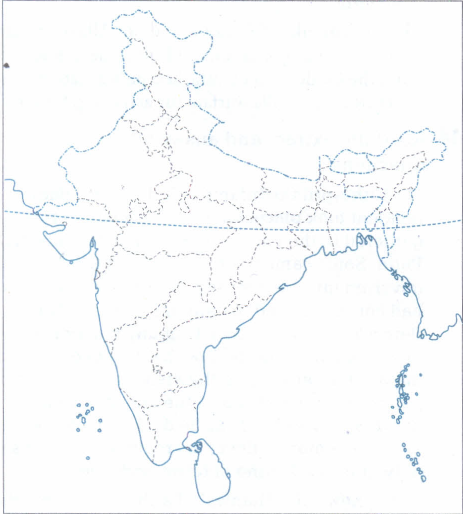
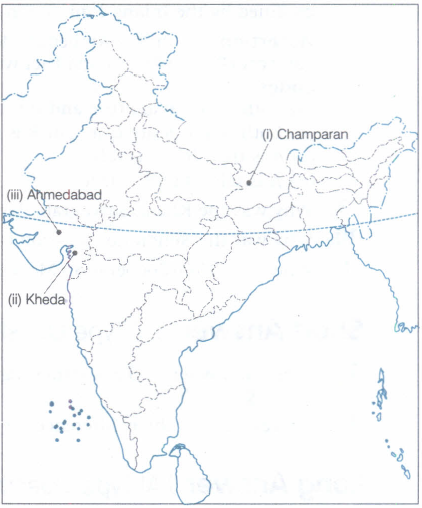
Mark and locate the following in given map of India.
(i) Movement of Indigo planters
(ii) Peasant Satyagarha
(iii) Cotton mill workers Satyagraha
2.
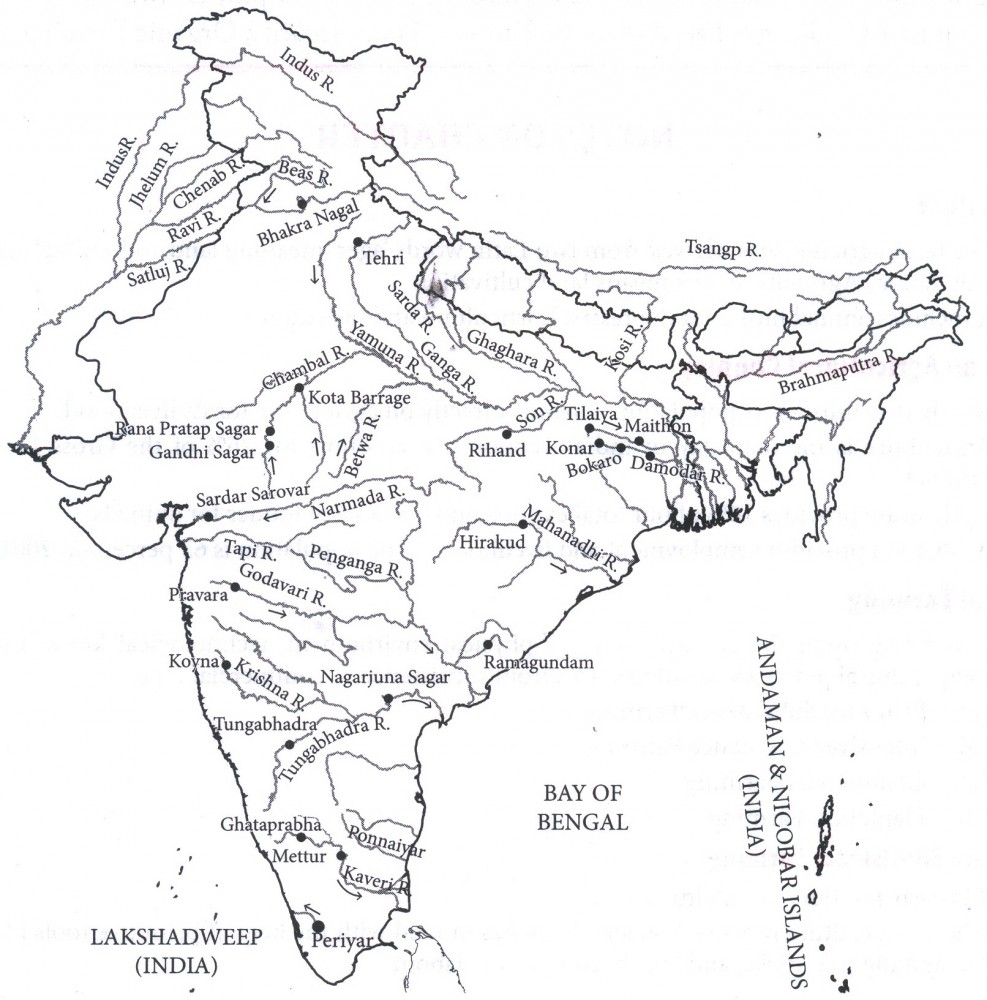
In the outline map of the India, show the following multi-purpose projects or dams.
(a) Bhakra
(b) Damodar Valley
(c) Nagarjuna Sagar
(d) Hirakud
(e) Chambal
3.
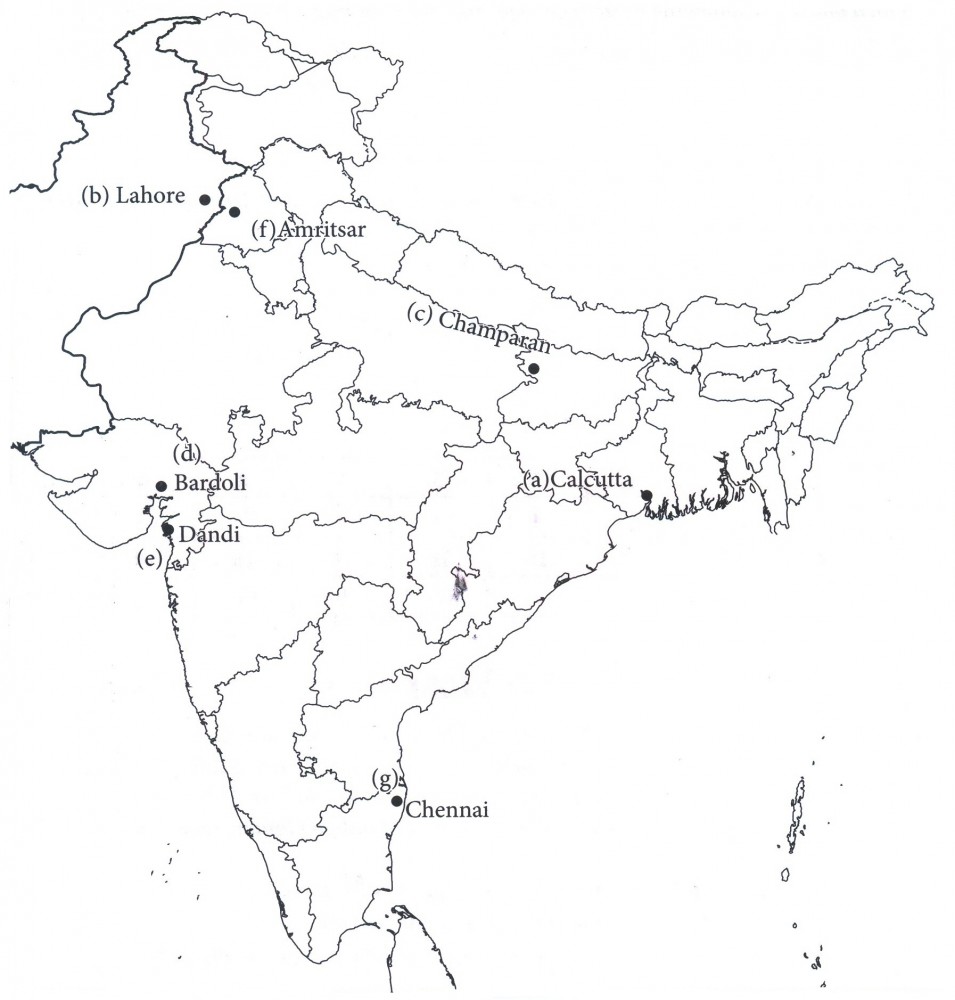
Locate and label the following on the given political outline map of India:
(a) A place where session of Indian National Congress was held in September 1920.
(b) A place where session of Indian National Congress was held in 1929.
(c) A place in Bihar where Satyagraha Movement of indigo planters took place.
(d) Baradoli, the place, from where No tax campaign was started.
(e) A place in Gujarat where Gandhiji violated the Salt law.
(f) a place in Punjab where Jalianwalla Bagh incident took place (or) Amritsar
(g) Chennai (Madras)
4.
Observe and study the following map showing distribution of minerals. Write the names of states where mica mines are located
5.
Read the given data and find out children of which state has attained maximum elementary school education.
| State | Per Capita Income For 2018-2018 (in Rs) | Infant Mortality Rate per 1,000 live births (2018) | Literacy Rate % | Net Attendance Ratio (per 100 persons) secondary state (age 14 and 15 years) 2017-18 |
| 2017-18 | ||||
| Haryana | 2,36,147 | 30 | 82 | 61 |
| Kerala | 2,04,105 | 7 | 94 | 83 |
| Bihar | 40,982 | 32 | 62 | 43 |
Sources : Economic Survey 2020-21, P.A 157, National Sample Survey Organisation (Report No. 585), National Statistical Office, Government of India.
Haryana
Bihar
Haryana and Kerala
Kerala
6.
Sarah, an environmental researcher from a coastal region, has been studying the impact of urbanisation on the local ecosystem. She noticed a significant rise in construction activities along the coastline, leading to the destruction of mangrove forests and the natural habitat of several species of fish and birds.
Which of the following consequences is most likely to occur as a result of the described development in the coastal region?
Decline in marine biodiversity and disruption of the local ecosystem.
Increased employment opportunities for the local community.
Enhanced recreational activities and tourism influx in the area.
Improved infrastructure leading to better living conditions for residents.
7.
Consider the statements given below and choose the correct answer.
Statement I The Gross Domestic Product (GDP) is the sum of the value of final goods and services produced in only the primary sector of an economy.
Statement II The tertiary sector has replaced the secondary sector as the largest producing sector in most countries.
Statement I is correct and statement II is incorrect.
Statement I is incorrect and statement II is correct.
Both statements I and II are incorrect.
Both statements I and II are correct.
8.
At the initial stages of development, which one of the following sectors was the most important of economic activity?
Primary
Secondary
Tertiary
Quaternary
9.
The states such as Assam, Nagaland, Arunachal Pradesh and Mizoram enjoy special powers under certain provisions of the Constitution of India. What is the context under which they do get these provisions?
Trade and commerce purposes
Defense purposes
Protection of land rights of indigenous people
Special provisions for agricultural purposes
10.
On which of the following modern aspects did the new Germany place a strong emphasis?
I. Currency
II. Banking
III. Legal system
IV. Demography Codes
Both I and II are correct
Both II and III are correct
Both III and IV are correct
Both I, II and III are correct
11.
Read the facts regarding the Revolution of the Liberals in Europe during 1848
I. Abdication of the monarch
II. Universal male suffrage had been proclaimed
III. Political rights to women were given
IV. Freedom of the press had been asked for Codes
Both I and II are correct
I, II and III are correct
Both II and IV are correct
I, II and IV are correct
12.
| List I | List II |
| A Sri Lanka got independence | 1 1956 |
| B Act declared Sinhala as the official language |
2 2009 |
| C Civil war ended in Sri Lanka | 3.1948 |
| A | B | C |
| 2 | 1 | 3 |
| A | B | C |
| 3 | 1 | 2 |
| A | B | C |
| 2 | 3 | 1 |
| A | B | C |
| 1 | 2 | 3 |
13.
Which type of agriculture practice is famous in North-Eastern states like Assam, Meghalaya, Mizoram and Nagaland?
Jhumming cultivation
Slash and burn farming
Commercial farming
Subsistence farming
14.
Arrange the following in the correct sequence.
i. Brundtland Commission Report
ii. National Forest Policy of India
iii. Resource Conservation at the Club of Rome
iv. Rio De Janeiro Earth Summit
III, I, II and IV
I, IV, II and III
IV, II, I and III
II, III, I and IV
15.
When did the joint forest management come into existence
1958
1968
1978
1988
16.
The percentage of forest cover in India is
14.69%
15.39%
19.39%
19.67%
17.
In rural areas, farmers take credit for?
Family
Health
Crop production
Education
18.
Modern forms of money include
paper notes
gold coins
silver coins
copper coins
19.
Satyagraha was
pure soul force
weapon of the week
physical force
force of arms
20.
Which among the following was the prime factor in the emergence of modern nationalism in India?
New symbols
New ideas
Icons
Anti-colonial movement
21.
Which one of the following was the view of Mahatma Gandhi about religion?
He was in favour of Hinduism.
He was an ardent supporter of Muslim Religion
By religion, Gandhi meant for moral values that inform all religions.
He said that India should adopt Christianity.
22.
Prudential reasons of power sharing stress on.
A. the stability of political order
B. to reduce the possibility of conflict between social groups
C. a fair share to minority
D. the intrinsic worth of power sharing.
Consider the statement:
All are appropriate
Only A, C and D are appropriate
Only B and D are appropriate
A, B and C are appropriate.
23.
Which one of the following statements refers to the sustainable development?
Overall development of various resources
Development should take place without damaging the environment.
Economic development of people
Development that meets the desires of the members of all communities.
24.
It is a type of agriculture where farmers clear a patch of and produce rereads and other food crops to sustain that family that is:
Commercial farming
Extensive farming
Modern farming
Slash and burn farming
25.
Developmental goals are differing goals also. Explain with an example.
26.
Which sector, organised or unorganised, is preferable for employment? Explain.
27.
Explain any three effects of the Non-Cooperation Movement on the Indian economy.
28.
Describe any three advantages of the Self-Help groups (SHGs) for the poor.
29.
What were the demands of Sri Lankan Tamils? How they struggled for their demands?
30.
"Role of women is gradually enhancing in the politics of the country." Examine the statement.
31.
Mention two factors that are important for the growth of plantations.
32.
How did the British manufacturers attempt to take over the Indian market with the help of Advertisements? Give three examples.
33.
Explain the term holding together federations.
34.
Define the term secularism. Explain any four features of secularism in India.
35.
"Till mid-eighteenth century there were no nation-states in Europe." Support the statement with examples.
36.
Differentiate between formal sector credit and informal sector credit.
37.
Why is conservation of minerals essential? Explain any four measures to conserve minerals.
38.
Read the source given below and answer the questions that follow.
Maharashtra is a state located in Western India, with a population of over 110-million people. The state is home to several large cities, including Mumbai, and has a significant agricultural sector. However, the state is facing a severe water crisis, with its water resources coming under increasing pressure due to climate change, industrialisation and urbanisation.
The main challenges faced by water resource management in Maharashtra are Overexploitation of groundwater Maharashtra is one of the most groundwater-stressed states in India, with the demand for water exceeding the supply. Overexploitation of groundwater for agriculture and urban use has led to a decline in water levels, which has severe implications for the sustainability of water
resources.
Pollution of surface water Industrialisation and urbanisation have led to the pollution of surface. water bodies such as rivers and lakes. The pollution has led to water quality degradation, which poses risks to human health and the environment.
Inefficient irrigation practices The agricultural sector is the largest user of water in Maharashtra, accounting for around 80% of total water use. However, traditional irrigation practices such as flood irrigation are inefficient and lead to the wastage of water.
(i) Mention any two reasons for the water crisis faced by the state Maharashtra.
(ii) Despite being the second highest rainfall- receiving state of the country, Maharashtra still faces water crisis. Substantiate this statement in 40 words.
(iii) Propose any one solution to mitigate the water crisis faced by Maharashtra state.
39.
Unlike Sri Lanka, the leaders of our country adopted a very cautious attitude in spreading the use of Hindi. According to the Constitution, the use of English for official purposes was to stop in 1965. However, many non Hindi speaking states demanded that the use of English continue. In Tamil Nadu, this movement took a violent form. The Central Government responded by agreeing to continue the use of English along with Hindi for official purposes. Many critics think that this solution favoured the English speaking elite. Promotions of Hindi continues to be the official policy of the Government of India. Promotion does not mean the Central Government can impose Hindi on States where people speak a different language. The flexibility shown by Indian political leaders helped our country avoid the kind of situation that Sri Lanka finds itself in.
1. When was the use of English stopped for official purpose in India?
(a) The use of English was stopped for official purpose in 1947 in India.
(b) The use of English was stopped for official purpose in 1991 in India.
(c) The use of English was stopped for official purpose in 1965 in India.
(d) The use of English was stopped for official purpose in 1960 in India.
2. Which other language was continued along with English for official purpose?
(a) Urdu was continued along with English for official purpose.
(b) Punjabi was continued along with English for official purpose.
(c) Tamil was continued along with English for official purpose.
(d) Hindi was continued along with English for official purpose.
3. Which state demanded the use of English to continue?
(a) Tamil Nadu demanded the use of English to continue.
(b) Mizoram demanded the use of English to continue.
(c) Punjab demanded the use of English to continue.
(d) Delhi demanded the use of English to continue.
4. Which other country also witnessed a similar mass movement on imposition of an official language?
(a) Pakistan witnessed a mass movement against the imposition of an official language.
(b) Singapore witnessed a mass movement against the imposition of an official language.
(c) Sri Lanka witnessed a mass movement against the imposition of an official language.
(d) Egypt witnessed a mass movement against the imposition of an official language.
40.
Post-war Settlements and the Bretton Woods Institutions:
The Bretton Woods conference established the International Monetary Fund (IMF) to deal with external surpluses and deficits of its member nations. The International Bank for Reconstruction and Development (popularly known as the World Bank) was set up to finance postwar reconstruction. The IMF and the World Bank are referred to as the Bretton Woods institutions or sometimes the Bretton Woods twins. The post-war international economic system is also often described as the Bretton Woods system.
1. Why was Bretton Woods established?
(a) The Bretton Woods conference established the International Monetary Fund (IMF) to deal with external surpluses and deficits of its member nations.
(b) The Bretton Woods conference established the International Municipal Fund (IMF) to deal with external surpluses and deficits of its member nations.
(c) The Bretton Woods conference established the International Maritime Fund (IMF) to deal with external surpluses and deficits of its member nations.
(d) The Bretton Woods conference established the International Mandatory Fund (IMF) to deal with external surpluses and deficits of its member nations.
2. What was set up to finance post war reconstruction?
(a) The International Forum for Reconstruction and Development was set up to finance postwar reconstruction
(b) The International Bank for construction and Development was set up to finance postwar reconstruction
(c) The International Bank for Reconstruction and Development was set up to finance postwar reconstruction.
(d) The International Bank for Reconstruction and fund raising was set up to finance postwar reconstruction.
3. What was International Bank for Reconstruction and Development popularly known as?
| (a) National Bank | (b) International Bank |
| (c) State Bank | (d) World Bank |
4. What were known as the Bretton Woods Twins?
| (a) IMF and State Bank | (b) World Bank and UN |
| (c) World Bank and Twin Towers | (d) IMF and World Bank |
1.
(i) Champaran (ii) Kheda (iii) Ahmedabad
2.
3.
4.
(i) Nellore: Andra Pradesh
(ii) Gaya: Bihar
(iii) Ajmer, Bewar : Rajasthan
(iv) Hazaribagh, Kodarma: Jharkhand
5.
(d)
Kerala
6.
(a)
Decline in marine biodiversity and disruption of the local ecosystem.
7.
(c)
Both statements I and II are incorrect.
8.
(a)
Primary
9.
(c)
Protection of land rights of indigenous people
10.
(d)
Both I, II and III are correct
11.
(d)
I, II and IV are correct
12.
(b)
| A | B | C |
| 3 | 1 | 2 |
13.
(a)
Jhumming cultivation
14.
(d)
II, III, I and IV
15.
(d)
1988
16.
(c)
19.39%
17.
(c)
Crop production
18.
(a)
paper notes
19.
(a)
pure soul force
20.
(d)
Anti-colonial movement
21.
(c)
By religion, Gandhi meant for moral values that inform all religions.
22.
(d)
A, B and C are appropriate.
23.
(b)
Development should take place without damaging the environment.
24.
(d)
Slash and burn farming
25.
Development goals are differing goals because different people have different situations in life due to which their goals are different.
For example, development goals of a girl from a rich urban family will be surely different from a farmer in Rajasthan. It is because their situations, lifestyle and status are very different from each other.
The goal of a person is something, which is entirely dependent on his or her present life situation. Over a period of time, if the situation changes, automatically goals of a person will also change. Hence, developmental goals are differing goals also.
26.
The preference between organised and unorganised sectors for employment varies based on factors like job security, benefits and regulations. Organised sectors typically offer more stability, regulated work conditions, benefits like health insurance and legal protections.
In contrast, the unorganised sector lacks formal structures, stability, and often involves lower wages and minimal job security.
Depending on individual priorities, the organised sector may be preferable due to its stability and benefits, while the unorganised sector might offer flexibility but lacks formal protections and stability.
27.
The effects of Non-Cooperation Movement on the economic front were
(a) Foreign goods were boycotted, liquor shops picketed and foreign cloth were burnt hugely.
(b) The import of foreign cloth halved between 1921 and 1922. Its value dropped from Rs.102 crore to Rs. 57 crore.
(c) In many areas, traders and merchants refused to trade in foreign goods and sometimes even they refused to finance foreign trade.
(d) As the boycott movement spread, people used only Indian clothes and began to discard foreign clothes. As a result, production of Indian textile mills and handloom went up largely
28.
The three advantages of the SHGs for the poor are as follows.
(a) These groups help the rural poor, in particular women, to get organised to handle the money collected and sanction loans.
(b) These groups help the women to become financially self- reliant.
(c) These groups create self-employment opportunities for the members and thus save the poor from the clutches of the moneylenders.
29.
A feeling of alienation was seen among the Sri Lankan Tamils.
(a) The Sri Lankan Tamils launched parties and struggles for the recognition of Tamil as an official language.
(b) For regional autonomy.
(c) Equality of opportunity in securing education and jobs.
This was denied by the Sinhala dominated government.
By 1980s, several political organisations were formed demanding an independent Tamil Eelam (state) in northern and eastern parts of Sri Lanka.
These differences in the two different communities pushed Sri Lanka into the state of civil war.
30.
The role of women is gradually enhancing in the politics of the country. This can be seen from the reservation for women in Panchayati Raj institutions. It was implemented under the 73rd Amendment. It ensures a minimum of one-third seats for women in local bodies. The purpose is to encourage women's active participation and empowerment in governance.
31.
The two factors are well developed system of transport and communication that connects the plantation to the factories and well developed markets.
32.
Use of Indian icons, national heroes.
33.
When a large country decides to divide its power between the constituent states and the national government, it is known as holding together federations.
34.
Secularism refers to the separation of religion from the state. It means that the state should not discriminate among its citizens on the basis of religion. It should neither encourage nor discourage the followers of any religion.
In India main features of secularism are
(i) There is no official religion for the Indian states, i.e. unlike Sri Lanka (Buddhism), Pakistan (Islam) and England (Christianity).
(ii) All individuals and communities have the freedom to profess, practice and propagate any religion or not to follow any religion.
(iii) It prohibits discrimination on grounds of religion.
(iv) It allows the state to intervene in the matters of religion in order to ensure equality within religious communities, viz. it bans untouchability.
35.
There were no nation-states in Europe till the mid-eighteenth century. Germany, Italy and Switzerland were ruled by different rulers with their well-defined territories. Eastern and central part of Europe too had autocratic monarchies. People from different ethnic groups occupied these areas and spoke different languages. Sudetenland and Bohemia were dominated by German-speaking people. It also included the provinces of Lombardy and Venetia which had Italian-speaking people. In Hungary, the half of the population spoke Magyar and the other half of the population spoke different dialects. In the part of Galicia, the aristocratic class spoke Polish.
There was absence of collective identity or common culture among these groups. Apart from this, a large group of peasant people like-Romans to the east in Transylvania, Bohemians and Slovaks to the north, Slovenes in Carniola and the Croats to the south lived within the boundary. The only tie binding these different groups together was a common allegiance to the emperor.
36.
| Formal Sector Credit | Informal Sector Credit |
| (a) This credit is provided by banks and cooperative societies to the borrowers | (a) This credit is provided by traders, moneylenders, employers, relatives, friends, etc. |
| (b) The Reserve Bank of India (RBI) supervises the functioning of formal sector loans. It periodically checks the interest rate and other details of the sources. | (b) There is no government or private organisation which supervises the informal sector loans. |
| (c) Proper terms of credit like collateral, documentation, rate of interest and mode of payment are followed. | (c) Terms of credit are flexible for the personal benefit of the lenders and pitiable condition of borrowers. |
| (d) They provide cheap and affordable credit with common terms of credit for all. | (d) They exploit the borrowers for their own benefits |
| (e) They charge less interest rates as compared to informal sectors. | (e) Their rate of interest is much higher than that of formal sector. |
37.
Minerals are required in all spheres of our life in agriculture, industries and for domestic purposes. We are rapidly consuming the mineral resources that required millions of years to be formed and concentrated. The geological processes of mineral formation are so slow that the rates of replenishment are infinitely small in comparison to the present rates of consumption. They are finite resources that are non-renewable, yet are getting exhausted due to rapid exploitation. Continued extraction bring down their quality as well as increases costs of extraction. To save these valuable resources from exhaustion and to preserve them for future generations as well, we should conserve our mineral resources. Methods of conserving minerals are as follows.
(a) Causing minimum wastage of minerals during the process of mining and processing of minerals.
(b) Improved technologies to utilize low-grade ores at low cost.
(c) Using minerals in a planned manner by adopting the policy of recycle and reuse. Recycling of metals, using scrap metals and other substitutes to reduce exploitation of the present deposits.
(d) Looking for some other eco-friendly options for its replacement like CNG.
38.
(i) Two reasons for facing a water crisis in Maharashtra are overexploitation of groundwater and pollution of surface water bodies due to industrialisation and urbanisation.
(ii) Despite receiving the second-highest rainfall in the country, traditional irrigation practices like flood irrigation leading to water shortages in Maharashtra. This is because flood irrigation involves excessive water use, and the water gets lost due to runoff, leading to less water available for other uses.
(iii) To mitigate the water crisis in Maharashtra, one solution could be to promote the adoption of more efficient irrigation practices, such as drip irrigation and sprinkler systems, that use less water and are more targeted in their delivery.
39.
1. The use of English was stopped for official purpose in 1965 in India.
2. Hindi was continued along with English for official purpose.
3. Tamil Nadu demanded the use of English to continue.
4. Sri Lanka witnessed a mass movement against the imposition of an official language.
40.
1. The Bretton Woods conference established the International Monetary Fund (IMF) to deal with external surpluses and deficits of its member nations.
2. The International Bank for Reconstruction and Development was set up to finance postwar reconstruction.
3. World Bank
4. IMF and World Bank

10th Standard CBSE Syllabus & Materials
10th Standard CBSE
CBSE 10th Social Science PS - Federalism - New Model Questions Papers Study Material - QB365 Set A
NEW10th Standard CBSE
CBSE 10th Social Science PS - Power Sharing - New Model Questions Papers Study Material - QB365 Set A
NEW10th Standard CBSE
CBSE 10th Social Science GEO - Manufacturing Industries - New Model Questions Papers Study Material - QB365 Set A
NEW10th Standard CBSE
CBSE 10th Social Science GEO - Minerals and Energy Resources - New Model Questions Papers Study Material - QB365 Set A



NCERT Books

Syllabus

Exam Pattern

Sample Question Papers

Previous year Question Papers

Important Notes

MCQ Practice test

NCERT Exemplers

Case study Questions

Image Based Questions

Passage based Questions

HOT Questions

Value Based Questions

Model Questions Papers
NCERT ( Book Back ) Questions

Assertion and Reason
Important Questions And Answers

CBSE 10th Standard CBSE Subjects
CBSE Standards



