
 100% FREE ACCESS
10th Standard CBSE Syllabus & Materials
10th Standard CBSE
CBSE 10th Social Science ECO - Globalisation and the Indian Economy - New Model Questions Papers Study Material - QB365 Set A
NEW10th Standard CBSE
CBSE 10th Social Science ECO - Money and Credit - New Model Questions Papers Study Material - QB365 Set A
NEW10th Standard CBSE
CBSE 10th Social Science ECO - Sectors of the Indian Economy - New Model Questions Papers Study Material - QB365 Set A
NEW10th Standard CBSE
CBSE 10th Social Science ECO - Development - New Model Questions Papers Study Material - QB365 Set A
NEW10th Standard CBSE
CBSE 10th Social Science PS - Outcomes of Democracy - New Model Questions Papers Study Material - QB365 Set A
NEW10th Standard CBSE
CBSE 10th Social Science PS - Gender, Religion and Caste - New Model Questions Papers Study Material - QB365 Set A

Published on: 20/10/2025
Download CBSE Class 10th Standard CBSE Social Science question papers, sample papers, important questions, and previous year solved papers in PDF format. Get free study materials, NCERT solutions, and exam preparation resources for Class 10th Standard CBSE Social Science
Questions + Answers key
Take MCQ Social Science Test
1.
Describe the role played by Mahatma Gandhi National Rural Employment Guarantee Act (MGNREGA) in improving the employment situation in India.
2.
What were the major proposals of the Vienna Congress?
or
Describe in brief any four features of the Vienna Treaty of 1815.
or
What was the impact of Treaty of Vienna (1815) on European people? Write any three points
3.
Distinguish between the organised and unorganised sectors.
4.
Who was Giuseppe Mazzini? Explain his role in the unification of Italy?
5.
"Culture Played an important role in creating the idea of the nation in Europe". Support the statement with examples.
6.
"Napoleon had, no doubt, destroyed democracy in France, but in the administrative field he has incorporated revolutionary principles in order to make the whole system more rational and efficient". Support the statement.
7.
Consider the statements given below and choose the correct answer.
Statement I The Gross Domestic Product (GDP) is the sum of the value of final goods and services produced in only the primary sector of an economy.
Statement II The tertiary sector has replaced the secondary sector as the largest producing sector in most countries.
Statement I is correct and statement II is incorrect.
Statement I is incorrect and statement II is correct.
Both statements I and II are incorrect.
Both statements I and II are correct.
8.
What measures and practices were introduced by the French revolutionaries to foster a sense of collective. Identity among the French people during the French Revolution?
I. Promotion of regional dialects
II. Adoption of the tricolour as the new French flag.
III. Abolition of the Estates General
IV. Promotion of a uniform system of weights and measures Codes
Statements II and III are correct
Statements I and IV are correct.
Statements II and IV are correct.
Statements I and III are correct.
9.
| List I(Year) | List II(Events) |
| A. 1804 | 1. Greek struggle for independence began |
| B. 1815 | 2.Napoleon Wars began |
| C. 1797 | 3.Treaty of Vienna |
| D. 1821 | 4.Civil Code |
| A | B | C | D |
| 1 | 2 | 3 | 4 |
| A | B | C | D |
| 4 | 3 | 2 | 1 |
| A | B | C | D |
| 1 | 3 | 2 | 4 |
| A | B | C | D |
| 4 | 2 | 1 | 3 |
10.
Find the incorrect option
Treaty of Vienna was signed in 1845.
Sardinia-Piedmont was ruled by an Italian Princely House
Victor Emmanuel II was proclaimed the king of United Italy
During the 19th century nationalism emerged as force in Europe
11.
Which of the following acts would not apply to a company like TISCO?
Minimum wages act
National Rural Employment Guarantee act
Factories act
Payment of Gratuity act
12.
Sahara airlines and BSES are example of
Private sector
Public sector
Tertiary sector
All the above
13.
In Galicia, the aristocracy spoke
French
Magyar
German
Polish
14.
Who amongst the following Italian leaders was neither a revolutionary nor a democrat?
Mazzini
Victor Emmanuel II
Cauour
Garibaldi
15.
Who among the following was described as "the most dangerous enemy of social value" by Duke Metternich?
Giuseppe Mazzini
Johann Gottfried
Louis Philippe
Karol Kurpinski
16.
Which customs union was formed by Prussia to abolish tariff barriers?
Zollverein
La Patrie
Elle
European Economic Union
17.
Which of the following is not true with reference to Napoleon?
He promoted democracy in France
He introduced Napoleonic Code
The Napoleonic Code was exported to all regions under French control
He made the administrative system more rational and efficient.
18.
What is under employment?
19.
What is Gross Domestic Product?
20.
How did the Greek War of Independence mobilise nationalist feeling among the educated elite across Europe?
21.
How does tertiary sector becoming more important than other sectors in India?
22.
How can the workers of unorganised sector be protected?
23.
Which of the following aspects best signifies this image of Germania?
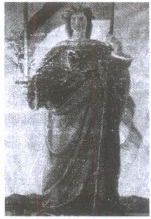
(a) Heroism and Justice
(b) Folk and Cultural Tradition
(c) Austerity and Asceticism
(d) Revenge and Vengeance
24.
Assertion (A) : On Prussian initiative 'Zolleverin' Custom Union was formed.
Reason (R) : It was to create unified economic territory allowing the unhindered movement of goods, people and capital
Codes :
(a) Both A and R are true and R is the correct explanation of A
(b) Both A and R are true, but R is not the correct explanation of A
(c) A is true, but R is false
(d) A is false, but R is true
1.
Mahatma Gandhi National Rural Employment Guarantee Act (MGNREGA) provides guaranteed 100 days of employment per year to those who are able to, and are in need of work in the rural areas. It has now been extended to villages in over 625 districts.
Thus, it provides employment to rural people in the activities specified under the scheme and has helped in reducing the number of unemployed population in India.
2.
The four major proposals! features of the Vienna Congress were
(i) The Bourbon dynasty, which had been deposed during the French Revolution, was restored to power and France lost the territories it had annexed.
(ii) A series of states were set up on the boundaries. of France to prevent the French expansion in future. Thus, the kingdom of the Netherlands, which included Belgium, was set up in the North, and Genoa was added to Piedmont in the South.
(iii) Prussia was given important new territories on its Western frontiers, while Austria was given control of Northern Italy.
(iv) The German confederation of 39 states that had been set up by Napoleon was left untouched.
3.
| Organised sector | Unorganised sector |
| This sector carries all its activities through a system and as per the law of the land. |
System are not in place and most of the labour laws are violated. |
| Wages are as per government norms. | Wages are below what is prescribed by the government. |
| Employee get all the social security as per the law. |
No social security net is in place. |
| Job is secure. | Job security is absent. |
4.
He was an Italian revolutionary, born in Genoa in 1807. He became the member of the secret society of the Carbonari. He was sent to exile for attempting a revolution in Liguria in 1831. He founded two underground societies Young Italy in Marseilles and Young Europe in Berne. The members of these societies were from Poland, France, Italy and the German states. He contributed to the unification of Italy. He inspired the youth of Italy with national ideas. Metternich described him as 'the most dangerous enemy of our social order'. His harsh opposition to kingdoms and his vision of democratic republic frightened the traditionalist.
5.
The growth of nationalism did not come only through wars but also through the different forms of culture such as art, poetry, dance, music tic contributed to the growth of nationalism. The following three examples will show the contribution of culture to the growth of nationalism in Europe: -
Example 1 - Romanticism - It is a cultural movement which developed nationalist sentiment through creative works like painting, poetry, literature, folk songs, dances etc. It focused on emotions, intuition and mystical feelings. They aimed to create a sense of collective heritage as the basis of a nation.
Example 2 - Emphasis on Vernacular Language - It carried the modern nationalist message to people who were illiterate. Though Poland is no longer existed as an independent nation, national feelings were kept alive through music and language. Karol Kurpinski celebrated the national struggle through music, folk dances into nationalist symbols.
Example 3 - Johann Gottfried Herder - According to him, German culture was inculcated to the common people through folk songs, folk poetry and folk dances. So collecting and recording these forms of folk culture was essential to the nation - building.
6.
Napoleon introduced the following changes to make the administrative system more efficient in the territories ruled by him:-
(a) The Civil Code introduced by him in 1804 abolished all privileges based on birth, established equality before law and secured the right to property.
(b) He divided the administrative divisions.
(c) He abolished the feudal system and free peasants from serfdom and dues.
(d) He removed guild restrictions in the towns.
(e) He improved transport and communication systems.
(f) Peasants, artisans, workers and new businessmen were given freedom.
(g) he introduced uniform laws, standardised weight and measures.
(h) He introduced a common national currency.
(i) His code was applicable to regions under French control to create a feeling of oneness among all people of the French empire.
7.
(c)
Both statements I and II are incorrect.
8.
(c)
Statements II and IV are correct.
9.
(b)
| A | B | C | D |
| 4 | 3 | 2 | 1 |
10.
(a)
Treaty of Vienna was signed in 1845.
11.
(b)
National Rural Employment Guarantee act
12.
(d)
All the above
13.
(d)
Polish
14.
(c)
Cauour
15.
(a)
Giuseppe Mazzini
16.
(a)
Zollverein
17.
(a)
He promoted democracy in France
18.
This is a situation where people are apparently working but all of them are made to work less than their potential.
19.
The value of final goods and services produced in each sector during a particular year provides the total production of the sector for that year. And the sum of production in the three sectors gives which is called the Gross Domestic Product (GDP).
20.
Greece was the part of Ottoman Empire since the fifteenth century.
(a) The Greeks were influenced by the growth of revolutionary nationalism in Europe and they started a struggle for their independence in 1821.
(b) Nationalists in Greece got support from the Greeks residing in different countries.
(c) Even the West European countries sympathised with the Greek and their ancient culture.
(d) Poets and artists too admired Greece as the basis of European civilisation and mobilised public opinion in its support. English poet Lord Byron even organised fund and participated in the war.
(e) Finally, in 1832, Greece was recognised as an independent nation by the Treaty of Constantinople.
21.
(a) In any country several services such as hospitals, educational institutions, post and telegraph services, police stations, courts, village administrative offices, municipal corporations , defence, transport, banks, insurance companies, etc. are required. These can be considered as basic services. In a developing country the government has to take responsibility for the provision of these services.
(b) The development of agriculture and industry leads to the development of services such as transport, trade, storage and the like, as we have already seen. Greater the development of the primary and secondary sectors, more would be the demand for such services.
(c) As income levels rise, certain sections of people start demanding many more services like eating out, tourism, shopping, private hospitals, private schools, professional training etc. These changes can be seen in cities, especially in big cities.
(d) Over the past decade or so, certain new services such as those based on information and communication technology have become important and essential. The production of these services has been rising rapidly.
22.
The workers in the unorganised sector need protection on the following issues
(i) Wages They are low and not regular. There is no provision for overtime, paid leave, etc. Minimum wages rules should be implemented strictly.
(ii) Safety Construction workers can get injured while working and they need to work under safe conditions. There should be a check on the working conditions along with the provision of insurance.
(iii) Health Long working hours and unhygienic working environment affect the health of the workers adversely. Health insurance along with a fixed number of working hours should be made mandatory.
23.
(a) Heroism and Justice
24.
(a) Both A and R are true and R is the correct explanation of A

10th Standard CBSE Syllabus & Materials
10th Standard CBSE
CBSE 10th Social Science PS - Federalism - New Model Questions Papers Study Material - QB365 Set A
NEW10th Standard CBSE
CBSE 10th Social Science PS - Power Sharing - New Model Questions Papers Study Material - QB365 Set A
NEW10th Standard CBSE
CBSE 10th Social Science GEO - Manufacturing Industries - New Model Questions Papers Study Material - QB365 Set A
NEW10th Standard CBSE
CBSE 10th Social Science GEO - Minerals and Energy Resources - New Model Questions Papers Study Material - QB365 Set A



NCERT Books

Syllabus

Exam Pattern

Sample Question Papers

Previous year Question Papers

Important Notes

MCQ Practice test

NCERT Exemplers

Case study Questions

Image Based Questions

Passage based Questions

HOT Questions

Value Based Questions

Model Questions Papers
NCERT ( Book Back ) Questions

Assertion and Reason
Important Questions And Answers

CBSE 10th Standard CBSE Subjects
CBSE Standards



