
 100% FREE ACCESS
10th Standard CBSE Syllabus & Materials
10th Standard CBSE
CBSE 10th Social Science ECO - Globalisation and the Indian Economy - New Model Questions Papers Study Material - QB365 Set A
NEW10th Standard CBSE
CBSE 10th Social Science ECO - Money and Credit - New Model Questions Papers Study Material - QB365 Set A
NEW10th Standard CBSE
CBSE 10th Social Science ECO - Sectors of the Indian Economy - New Model Questions Papers Study Material - QB365 Set A
NEW10th Standard CBSE
CBSE 10th Social Science ECO - Development - New Model Questions Papers Study Material - QB365 Set A
NEW10th Standard CBSE
CBSE 10th Social Science PS - Outcomes of Democracy - New Model Questions Papers Study Material - QB365 Set A
NEW10th Standard CBSE
CBSE 10th Social Science PS - Gender, Religion and Caste - New Model Questions Papers Study Material - QB365 Set A

Published on: 22/10/2025
Download CBSE Class 10th Standard CBSE Social Science question papers, sample papers, important questions, and previous year solved papers in PDF format. Get free study materials, NCERT solutions, and exam preparation resources for Class 10th Standard CBSE Social Science
Questions + Answers key
Take MCQ Social Science Test
1.
Although average are useful for comparing countries, they also hide disparities? Explain the meaning of this statement. Support the statement with suitable arguements.
2.
The following table shows the proportion of adults (15-49 years) whose BMI is below normal (BMI < 18.5 kg/m2 ) in India. It is based on a survey of various states for the year 2015-16. Look at the table and answer the following questions.
| State | Male (%) | Female (%) |
| Kerala | 8.5 | 10 |
| Karnataka | 17 | 21 |
| Madhya Pradesh | 28 | 28 |
| All States | 20 | 23 |
(i) Compare the nutritional level of people in Kerala and Madhya Pradesh.
(ii) Can you guess why around one fifth of people in the country are undernourished even though it is argued that there is enough food in the country? Describe in your own words.
3.
How have the Centre-State relations been restructured to strengthen federalism?
4.
Point out one feature in the practice of federalism in India that is similar to and one feature that is different from that of Belgium.
5.
How does the United Nations Development Program's (UNDP's) developmental criterion differ from the World Bank? Explain.
6.
Write any one aspiration that a prosperous farmer from Punjab may possess for his development.
7.
Mention the important change that took place in 1993 in Belgium.
8.
Which type of government to Tamils of Sri Lanka want?
9.
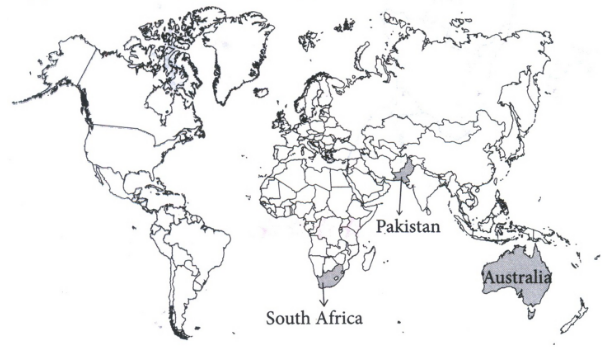
Identify and shade three federal countries [other than India] on a blank outline political map of the world
10.
Which one of the following definitions is most suitable for the 'Literacy Rate'?
The literate population at the global level.
The proportion of literate population in the seven years and above.
The total number of children attending school in a region.
The average number of schools in a region.
11.
Who has special power in administering the Union Territories in India?
Central Government
Chief Minister
President
Governor
12.
In Unitary form of government
all the power is divided between the centre/union and the state provincial government
all the power is with the citizens.
State Government has all the powers.
power is concentrated with the Central Government
13.
Identify the Prime Minister of India and the name of Alliance headed by him.
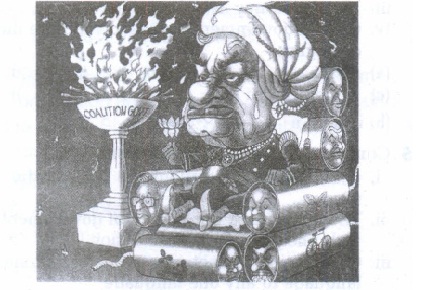
(a) Atal Bihari Vajpayee, NDA
(b) PV Narasimha Rao, UPA
(c) HD Deve Gowda, NDA
(d) Atal Bihari Vajpayee, UPA
14.
Assertion (A) Kerala has low infant mortality rate.
Reason (R) Kerala has adequate provision of basic health and education facilities.
Codes
(a) Both A and R are true and R is the correct explanation of A
(b) Both A and R are true, but R is not the correct explanation of A
(c) A is true, but R is false
(d) A is false, but R is true
15.
Assertion (A) Municipalities are set up in towns.
Reason (B) In a municipal corporation, chairperson is known as the Mayor.
Codes
(a) Both A and R are true and R is the correct explanation of of A
(b) Both A and R are true, but R is not the correct explanation of A
(c) A is true, but R is false
(d) A is false, but R is true
16.
Let us get back to the contrast between Belgium and Sri Lanka that we saw in the last chapter. You would recall that one of the key changes made in the Constitution of Belgium was to reduce the power of the Central Government and to give these powers to the regional governments. Regional governments existed in Belgium even earlier. They had their roles and powers. But all these powers were given to these governments and could be withdrawn by the Central Government. The change that took place in 1993 was that the regional governments were given constitutional powers that were no longer dependent on the central government. Thus, Belgium shifted from a unitary to a federal form of government. Sri Lanka continues to be, for all practical purposes, a unitary system where the national government has all the powers. Tamil leaders want Sri Lanka to become a federal system.
Federalism is a system of government in which the power is divided between a central authority and various constituent units of the country. Usually, a federation has two levels of government. One is the government for the entire country that is usually responsible for a few subjects of common national interest. The others are governments at the level of provinces or states that look after much of the day-to-day administering of their state. Both these levels of governments enjoy their power independent of the other. In this sense, federations are contrasted with unitary governments. Under the unitary system, either there is only one level of government or the sub-units are subordinate to the central government. The central government can pass on orders to the provincial or the local government. But in a federal system, the central government cannot order the state government to do something. State government has powers of its own for which it is not answerable to the central government. Both these governments are separately answerable to the people.
1. What change took place in 1993 in Belgium?
(a) The change that took place in Belgium in 1993 was that the regional governments were not given constitutional powers that were no longer dependent on the Central Government. Belgium shifted from a unitary to a federal form of government.
(b) The change that took place in Belgium in 1993 was that the regional governments were given constitutional powers that were no longer dependent on the Central Government. Belgium shifted from a federal to a unitary form of government.
(c) The change that took place in Belgium in 1993 was that the Central government was given constitutional powers that were no longer dependent on the regional governments. Belgium shifted from a federal to a unitary form of government.
(d) The change that took place in Belgium in 1993 was that the regional governments were given constitutional powers that were no longer dependent on the Central Government. Belgium shifted from a unitary to a federal form of government.
2. What is Federalism? How many levels of government are there in federation?
(a) Federalism is a system of government in which the power is divided between a central authority and various constituent units of the country. Usually, a federation has five levels of government.
(b) Federalism is a system of government in which the power is divided between a central authority and various constituent units of the country. Usually, a federation has two levels of government.
(c) Federalism is a system of government in which the power is divided between a central authority and various constituent units of the country. Usually, a federation has only one level of government.
(d) Federalism is a system of government in which the power is divided between a central authority and various constituent units of the country. Usually, a federation has nine levels of government.
3. Federations are contrasted with unitary government. Explain.
(a) Under the unitary system, either there is only one level of government or the sub-units are subordinate to the central government. But in a federal system, state government has powers of its own for which it is not answerable to the central government.
(b) Under the unitary system, either there is two levels of government or the sub-units are subordinate to the central government. But in a federal system, state government has powers of its own for which it is not answerable to the central government.
(c) Under the unitary system, either there is only one level of government or the sub-units are subordinate to the central government. But in a federal system, state government has powers of its own for and is answerable to the central government.
(d) Under the unitary system, either there is only one level of government or the sub-units are subordinate to the central government. But in a federal system, central government has powers of its own for which it is not answerable to the state governments or the judiciary.
4. What is the contrast drawn here between Belgium and Sri Lanka?
(a) Belgium shifted from a federal to a unitary form of government. Sri Lanka continues to be a unitary system where the national government has all the powers.
(b) Belgium shifted from a unitary to a federal form of government. Sri Lanka continues to be a federal system where the national government has all the powers.
(c) Belgium shifted from a unitary to a federal form of government. Sri Lanka continues to be a unitary system where the national government has all the powers.
(d) Belgium shifted from a unitary to a federal form of government. Sri Lanka continues to be a federal system where the national government has equal powers as the state.
17.
Discuss the significance of the Human Development Index (HDI) in measuring a nation's progress and elucidate how it surpasses the limitations of assessing development solely based on economic indicators like per capita income.
18.
How are the legislative powers distributed between the Union Government and the State Government by the Constitution? Explain with example.
1.
Average or Per Capita Income is useful for comparing countries, but they also hide disparities. They do not give the true picture of a country due to the following reasons
They do not tell us how equally or evenly income is distributed.
They do not give information regarding the human development index such as Literacy Rate, Infant Morality Rate, etc.
They do not give us any information regarding the non-materialistic goods and services such as equality, freedom, respect, dignity.
2.
(i) Kerala has less percentage of people who are undernourished as compared to Madhya Pradesh. This means people are able to fulfill their food requirement.
(ii) There is enough food in the country but even then one fifth of the people in the country are undernourished because of the following reasons
(a) There is a lack of educational and health facilities in many parts of the country. So, many people remain backward and poor, and they are unable to get nutritious food.
(b) In most of the states, the Public Distribution System (PDS) does not function properly and the poor people cannot get food items at cheap rates so they remain undernourished.
3.
Restructuring the centre state relation is a way in which federalism has been strengthen in practice. The way by which constitutional arrangements share power and work in reality depends to a large extent on how the ruling parties and their leaders follow this arrangement. For a long time, in India, the same party ruled both at the centre and in most of the states.
Here states did not exercise their autonomous power. When the ruling party at the centre and the states are different, the centre tried to dominate the state. After 1990, the era of coalition government began in India. This resulted in a new culture of power sharing between the states and the centre. The Supreme Court authorised the autonomy of the State Government and made it difficult for the Central Government to dismiss State government in an arbitrary manner. Thus, federal power sharing became more effective than it was before.
4.
One similar feature of federalism between India and Belgium is that both are holding together federations, where the Central Government tends to be more powerful vis-a-vis the states or regions. One different feature of federalism between India and Belgium is that in Belgium, there are three kinds of government
(i) Government at the Centre
(ii) Government at the State level
(iii) The Community Government
The Community Government has powers regarding cultural, educational and language related issues. But in India, the third kind of government is not a Community Government. It is the local self-government (Municipalities or Panchayats).
5.
The United Nations Development Programme's (UNDP's) development criterion differ from the World Bank because the World Bank classifies countries based on per capita income, focusing on economic indicators. Whereas, the UNDP employs a broader approach, considering income, education and health indices in its Human Development Index. It provides a comprehensive perspective on a country's well-being.
6.
A prosperous farmer from Punjab may want to hire more work force in his farm to produce more and earn more profit.
7.
The change that took place in 1993 in Belgium was that the regional governments were given constitutional powers. They were no longer dependent on the central government.
8.
The Tamils of Sri Lanka want Federal type of government
9.
Three federal countries other than India are:
(1) South Africa (2) Australia (3) Pakistan
10.
(b)
The proportion of literate population in the seven years and above.
11.
(a)
Central Government
12.
(d)
power is concentrated with the Central Government
13.
(a) Aral Bihari Vajpayee, NDA
14.
(a) Both A and R are true and R is the correct explanation of A
15.
(b) Both A and R are true, but R is not the correct explanation of A
16.
1. The change that took place in Belgium in 1993 was that the regional governments were given constitutional powers that were no longer dependent on the Central Government. Belgium shifted from a unitary to a federal form of government.
2. Federalism is a system of government in which the power is divided between a central authority and various constituent units of the country. Usually, a federation has two levels of government.
3. Under the unitary system, either there is only one level of government or the sub-units are subordinate to the central government. But in a federal system, state government has powers of its own for which it is not answerable to the central government.
4. Belgium shifted from a unitary to a federal form of government. Sri Lanka continues to be a unitary system where the national government has all the powers.
17.
The Human Development Index (HDI) is a crucial tool because it offers a broader view of a country's progress beyond just economic wealth. Unlike solely relying on income or money, HDI takes into account various important factors that contribute to people's well-being. It considers things like how long people live, how educated they are, and their standard of living.
For example, a country might have a high income, but if its citizens lack access to healthcare or education, the HDI will reflect these shortcomings. HDl serves as a more comprehensive measure, providing insights into the overall quality of life within a nation.
By incorporating multiple dimensions such as health, education, and income, the HDl enables a more nuanced assessment of a country's development. It showcases whether a nation is genuinely enhancing the lives of its citizens, offering a more realistic depiction beyond monetary wealth.
Therefore, HDI acts as a valuable indicator, highlighting areas for improvement and emphasising the importance of holistic development for a nation's population.
18.
The division of power between the Central and State Governments is done in a three fold distribution of legislative powers between the Union Government and the State Government. There are three lists i.e. Union list, State list and Concurrent list.
(i) Union List It includes subjects of national importance, e.g. defence of the country, foreign affairs, banking, communication and currency. The Central Government alone can make decisions on these matters. The aim of including these matters in Union List is to ensure uniformity in the policy of these areas throughout the country.
(ii) State List It includes subjects of state and local importance such as police, trade, commerce, agriculture and irrigation. The State Government alone can make laws and decisions on these areas.
(iii) Concurrent List It includes those subjects which are of common interest to both the Central as well as State Governments. It includes matters like education, forests, marriage and trade unions. Both the State and Central Government can make decision on these matters.

10th Standard CBSE Syllabus & Materials
10th Standard CBSE
CBSE 10th Social Science PS - Federalism - New Model Questions Papers Study Material - QB365 Set A
NEW10th Standard CBSE
CBSE 10th Social Science PS - Power Sharing - New Model Questions Papers Study Material - QB365 Set A
NEW10th Standard CBSE
CBSE 10th Social Science GEO - Manufacturing Industries - New Model Questions Papers Study Material - QB365 Set A
NEW10th Standard CBSE
CBSE 10th Social Science GEO - Minerals and Energy Resources - New Model Questions Papers Study Material - QB365 Set A



NCERT Books

Syllabus

Exam Pattern

Sample Question Papers

Previous year Question Papers

Important Notes

MCQ Practice test

NCERT Exemplers

Case study Questions

Image Based Questions

Passage based Questions

HOT Questions

Value Based Questions

Model Questions Papers
NCERT ( Book Back ) Questions

Assertion and Reason
Important Questions And Answers

CBSE 10th Standard CBSE Subjects
CBSE Standards



