
 100% FREE ACCESS
10th Standard CBSE Syllabus & Materials
10th Standard CBSE
CBSE 10th Social Science ECO - Globalisation and the Indian Economy - New Model Questions Papers Study Material - QB365 Set A
NEW10th Standard CBSE
CBSE 10th Social Science ECO - Money and Credit - New Model Questions Papers Study Material - QB365 Set A
NEW10th Standard CBSE
CBSE 10th Social Science ECO - Sectors of the Indian Economy - New Model Questions Papers Study Material - QB365 Set A
NEW10th Standard CBSE
CBSE 10th Social Science ECO - Development - New Model Questions Papers Study Material - QB365 Set A
NEW10th Standard CBSE
CBSE 10th Social Science PS - Outcomes of Democracy - New Model Questions Papers Study Material - QB365 Set A
NEW10th Standard CBSE
CBSE 10th Social Science PS - Gender, Religion and Caste - New Model Questions Papers Study Material - QB365 Set A

Published on: 22/10/2025
Download CBSE Class 10th Standard CBSE Social Science question papers, sample papers, important questions, and previous year solved papers in PDF format. Get free study materials, NCERT solutions, and exam preparation resources for Class 10th Standard CBSE Social Science
Questions + Answers key
Take MCQ Social Science Test
1.
Why is tertiary sector growing so rapidly in India? Explain it with four reasons.
2.
Explain the impacts of scrapping of the Corn Law.
3.
Three-fourths of the earth's surface is covered with water, but still there is a scarcity of water across the globe. Explain giving three reasons.
4.
'Print not only stimulate the publication of conflicting opinions amongst communities, but it also connected communities and people in different parts of India.' Explain.
5.
Examine with the help of three examples, how dignity and freedom of citizens are best guaranteed in a democracy.
6.
Briefly trace the process of unification of Italy.
7.
Why is the Himalayan Yew under great threat?
8.
What is the role of Public Distribution System?
9.
"We are still a long way from realising the ideal of self-government" Elucidate the statement
10.
During the first world war years industrial production in India boomed. Give reason.
11.
Differentiate between the novels written by Charlotte Bronte and the novels written by Jane Austen?
12.
Why did some people in eighteenth century Europe think that print culture would bring enlightenment and end despotism?
13.
Give your description of the challenges for the democracy in each situation given below:
| Case and Context | Your description of the challenges for democracy in that situation |
| US Civil Rights: Blacks have won equal rights, but they are still poor, less educated and marginalised. | |
| Northern Ireland: The civil war has ended but Catholics and Protestants yet to develop trust. | |
| Nepal: Constituent Assembly about to be elected; unrest in Tarai areas; Maoists have not surrendered arms. | |
| Bolivia: Morales, a supporter of water struggle, becomes Prime Minister; MNCs threaten to leave the country. |
14.
What is manufacturing?
15.
Make a distinction between hydroelectricity and thermal electricity starting three points all are of distinction. What values are associated with using hydroelectricity?
16.
Name any two sectional interest groups.
17.
What has brought about the availability of greater choice of goods in the market for the consumers?
18.
How many members does a typically SHG comprise of?
19.
Mention any two ways of exploitation of consumers in the market.
20.
Why is democracy preferred as the better form of government than dictatorship?
21.
What are MNCs?
22.
Who discovered spinning jenny?
23.
"The policy of racialism was visible in the colonial cities.' Explain by giving examples.
24.
Why is there a significant change in the age old economic activity called agriculture in India?
25.
State with highest road density.
26.
Explain four ways to reform democracy in India.
27.
What re the differences between a pressure group and political party?
28.
What does Indo-China comprise of?
29.
A group of people who come together to contest elections and hold power in the government is called a ____________.
30.
On the physical outline map of India given below, identify any four soil types of India.
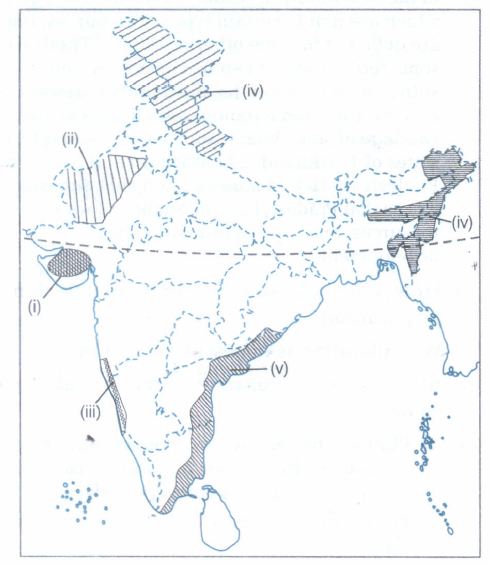
31.
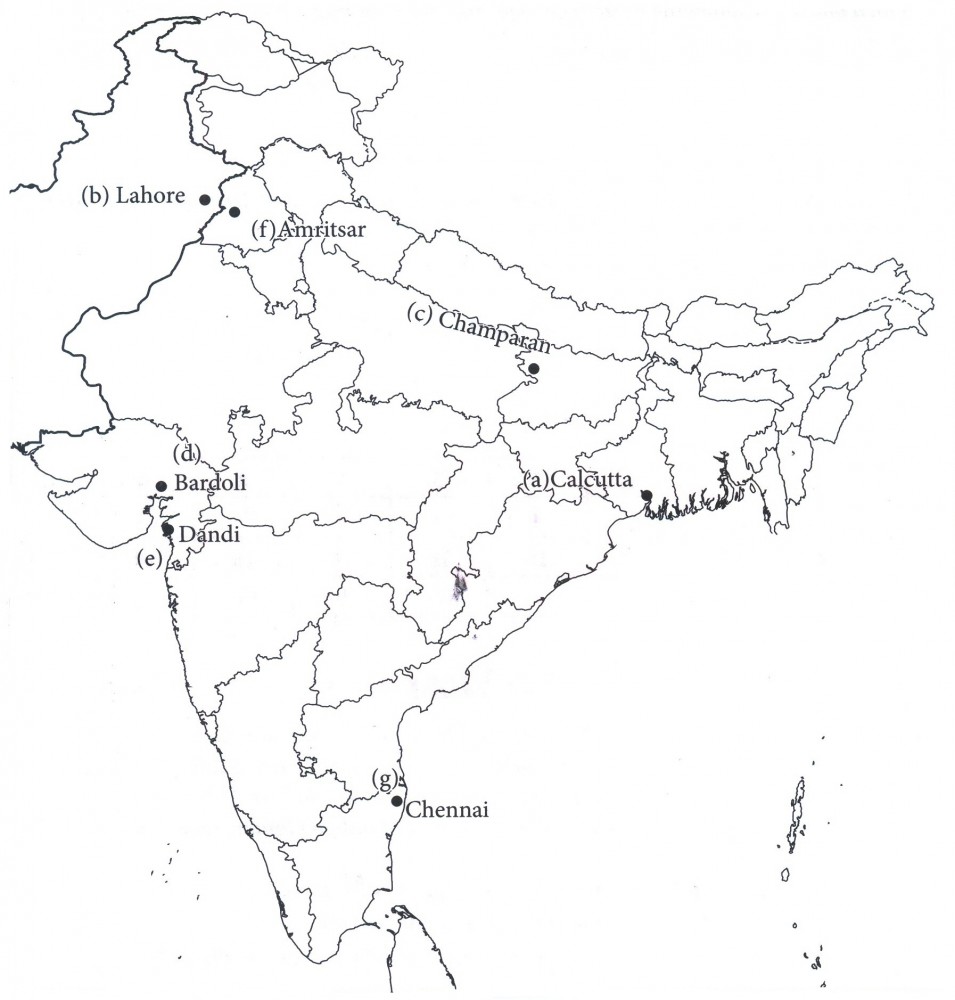
Locate and label the following on the given political outline map of India:
(a) A place where session of Indian National Congress was held in September 1920.
(b) A place where session of Indian National Congress was held in 1929.
(c) A place in Bihar where Satyagraha Movement of indigo planters took place.
(d) Baradoli, the place, from where No tax campaign was started.
(e) A place in Gujarat where Gandhiji violated the Salt law.
(f) a place in Punjab where Jalianwalla Bagh incident took place (or) Amritsar
(g) Chennai (Madras)
1.
(a) In any country several services such as hospitals, educational institutions, post and telegraph services, police stations, courts, village administrative offices , municipal corporations , defence, transport, banks, insurance companies, etc. are required. These can be considered as basic services. In a developing country the government has to take responsibility for the provision of these services.
(b) The development of agriculture and industry leads to the development of services such as transport, trade, storage and the like, as we have already seen. Greater the development of the primary and secondary sectors, more would be the demand for such services.
(c) As income levels rise, certain sections of people start demanding many more services like eating out, tourism, shopping, private hospitals, private schools, professional training etc. These changes can be seen in cities, especially in big cities.
(d) Over the past decade or so, certain new services such as those based on information and communication technology have become important and essential. The production of these services has been rising rapidly.
2.
Under the pressure from industrialists and urban dwellers, the British Government abolished the Corn Laws. The effects of it were
(i) Food could be imported into Britain more cheaply than it would be produced within the country.
(ii) British agriculture was unable to compete with imports. Vast Areas of land were left uncultivated and people started migrated to cities or other countries.
(iii) As food prices fell, consumption in Britain rose. Faster industrial growth in Britain also led to higher incomes and therefore more food import.
(iv) Around the world in Eastern Europe, Russia, America and Australia land were cleared and food production expanded to meet the British demand.
3.
(a) It is predicted that large parts of India will join countries or regions having absolute water scarcity by 2025.
(b) Through, it is the fact that water is abundant and renewable, it is difficult to imagine that we may suffer from water scarcity.
(c) It is associated with regions having low rainfall or those that are drought prone.
(d) The availability of water resources varies over space and time, mainly due to the variations in seasonal and annual precipitation, but water scarcity in most due to the variations in seasonal and annual precipitation, but water scarcity in most cases is caused but over-exploitation, excessive use and unequal access to water among different social groups.
4.
(i) Debate on religious, social and economic issues : From the early nineteenth century, there were serious debates on religious, social and economic issues. Different people had different opinions regarding the colonial society. Reformers offered a variety of new interpretations of the beliefs of different religions. There were many who criticised the existing practices and campaigned for reforms while others countered.
(ii) Impact on debates : These debates were carried out openly in public and in print. Printed tracts and newspapers not only spread the new ideas, but they also shaped the nature of the debates.
(iii) New ideas and clashes : A wider range of people could now participate in these public discussions and express their views. New ideas emerged through these clashes of opinions.
(iv) Pan-Indian identities : Newspapers conveyed news from one place to another, creating pan-Indian identities. Newspapers reported on colonial misrule and encouraged nationalist activities.
(v) Print and depressed classes : From the 19th century, issue of caste discrimination began to be written. Jyotiba Phule, Dr B.R. Ambedkar, E.V. Ramaswamy wrote extensively on the depressed classes and provided the depressed classes a common platform.
5.
(i) In a democratic country people have the freedom to choose their representatives on the basis of universal adult franchise.
(ii) Most societies across the world were historically male dominated. Equal treatment of women became the necessary requirement of a democratic society. Thus, their status in democratic countries improved.
(iii) In a non-democratic setup, there is no legal basis for freedom and dignity of individuals. Democracy in India has strengthened the claims of the disadvantaged and discriminated castes for equal status and equal opportunity.
(iv) Democracy transforms people from the status of subjects under a king or a dictator to the status of citizens with rights and duties. Many Fundamental rights are granted to citizensin a democratic country. One such right is the right to freedom, which is a cluster of many rights like freedom to travel anywhere, freedom to assemble anywhere, freedom to choose any profession, to choose any religion etc.
6.
During the middle of the nineteenth century, Italy was divided into seven states, of which only one, Sardinia-Piedmont, was ruled by an Italian princely house. The north was ruled by Austrian Habsburgs, the centre by the Pope and the southern regions by the Bourbon kings of Spain. Italian language had varieties of dialects; therefore, it was not stable in its form. During the 1830s, Giuseppe Mazzini had sought to put together a coherent programme for a unitary Italian Republic. He had also formed a secret society called 'Young Italy' for the dissemination of his goals. The failure of revolutionary uprisings both in 1831 and 1848 fell on Sardinia-Piedmont under its ruler King Victor Emmanuel II to unify the Italian states through war. A unified Italy offered them the possibility of economic development and political dominance. Chief Minister Cavour who led the movement to unify the regions of Italy was neither a revolutionary nor a democrat. With a tactful diplomatic alliance with France by Cavour, Sardinia-Piedmont succeeded in defeating the Austrian forces in 1859. In 1859, a large number of armed volunteers under the leadership of Giuseppe Garibaldi joined the fray. In 1860, Sardinia- Piedmont's forces marched into south Italy and the Kingdom of the Two Sicilies and drove out the Spanish rulers. In 1861, Victor Emmanuel was declared as the king of united Italy and Rome was declared the capital of Italy.
7.
(i) Himalayan Yew is a medicinal plant found in various parts of Himachal Pradesh and Arunachal Pradesh.
(ii) A chemical compound called 'taxol' is extracted from the bark, needles, twigs and roots of this tree.
(iii) This has been successfully used to treat some cancers.
(iv) The drug is now the biggest selling anti-cancer drug in the world.
(v) The spices is under great threat due to over-exploitation.
(vi) In the last one decade, thousands of yew trees have dried up in various parts of Himachal Pradesh and Arunachal Pradesh.
8.
(i) Public Distribution System ensures availability of essential commodities like wheat, rice, sugar, edible oils and kerosene etc. to the consumers through a network of outlets or fair price shops. The need of public distribution system was felt to check the forces of supply and demand.
(ii) Apart from ensuring food security to the poor as a part of certain administrative measures, public distribution system is also expected to strengthen measures to prevent hoarding, black-marketing and over charging by traders.
9.
(i) The new system of local government is the largest experiment in democracy conducted anywhere in the world.
(ii) There are now about 36lakh elected representatives in the panchayats and municipalities etc., all over the country.
(iii) This number is bigger than the population of many countries in the world
(iv) Constitutional status for local government has helped to deepen democracy in our country.
(v) It has also increased women's representation and voice in our democracy.
(vi) At the same time, there are many difficulties. While elections are held regularly and enthusiastically, gram sabhas are not held regularly.
(vii) Most state governments have not transferred significant powers to the local governments.
(viii) Nor have they given adequate resources.
(ix) We are thus still a long way from realising the ideal of self-government.
10.
(i) Manchester imports into India declined as British mills were busy with war production
(ii) Indian industries were also called upon to supply war needs jute bags, cloth for army uniform, tents and leather boots.
11.
(i) The novels of Jane Austen give us a glimpse of women in genteel rural society in their domestic role. Bronte talks about the women who broke established norms of the society.
(ii) Austen's characters are preoccupied with marriage and money while Bronte's characters are daring and assertive.
(iii) Austen's characters are opting for wealth and facilities. They wish to live a luxurious life while Bronte's character protests the hypocrisy of elders and wants to live a more dignified life at equal footage.
12.
Due to following reasons, some people in the 18th, century thought that print culture would bring enlightenment and end despotism.
(i) Spreading of New ldeas After the coming of print culture, the ideas of scientists and philosophers now became more accessible to the common people. Ancient and medieval scientific texts were compiled and published.
(ii) Books as Medium of Progress By the 18th century, books became a medium of spreading progress and enlightenment which could change society and the world. It was also believed that the books could liberate society from despotism and tyranny.
(iii) Writings of Scholars The writings of thinkers such as Jean Jacques Rousseau, Thomas Paine and Voltaire were also widely printed and could gain popularity. Thus, their ideas about science, rationality and reasoning found their way into popular literature.
(iv) Scientific Discoveries Maps and more accurate scientific diagrams were widely printed when scientists like Isaac Newton began to publish their discoveries. They could influence a much wider circle of scientifically-minded readers.
(v) ldeas of Enlightened Thinkers Print popularised the ideas of the enlightened thinkers like Martin Luther who attacked the authority of the church and the despotic power of the state.
(vi) A New Culture of Dialogue and Debate The printing press was believed to be the most powerful engine of progress and public opinion. Many historians have argued that print culture created the conditions for the end of despotism in France through the French Revolution.
13.
| Case and Context | Your description of the challenges for democracy in that situation |
| US, Civil Rights: Blacks have won equal rights, but they are still poor, less educated and marginalised. | To establish economic equality and provide equal opportunities of education and health facilities to all including blacks. |
| Northern Ireland: The civil war has ended but Catholics and Protestants yet to develop trust. | To provide equal political, religious and economic freedom to both the communities. |
| Nepal: Constituent Assembly about to be elected; unrest in Tarai areas; Maoists have not surrendered arms. | To establish and strengthen democracy and to prevent violence that can threaten the forces of democracy. |
| Bolivia: Morales, a supporter of water struggle, becomes Prime Minister; MNCs threaten to leave the country. | To establish democratic principles, which are beneficial to each and every section of society. |
14.
Manufacturing is production of goods in large quantities after processing raw materials into ready-to-use, more valuable products.
15.
| Hydroelectricity | Thermal electricity |
| (i) Hydroelectricity is generated by fast flowing water which drives turbines to generate electricity. | (i) Thermal electricity is generated by using coal, petroleum and natural gas. |
| (ii) It is a renewable resource and is cheap. | (ii) The thermal power stations use non-renewable fossil fuels. |
| (iii) India has a number of multipurpose projects like the Bhakra Nangal, Damodar Valley Corporation etc. producing hydroelectric power. | (iii) There are over 310 thermal power plants in India. |
Values:
(i) It is eco-friendly as it saves our reserves of fossil fuels but requires submergence of large forest cover or land for damming the river.
(ii) It is an absolutely clean source of energy.
(iii) Hydroelectric power plants do not create any waste byproducts in their conversion.
16.
()
Trade unions and Professional bodies like teachers, lawyers etc.
17.
The entry of MNCs in the market has led to the availability of greater choice of goods for the consumers.
18.
A typical SHG usually comprises 15-20 members.
19.
The two ways by which a consumer can be exploited in the market are:
(a) A shopkeeper weighing less than what he should.
(b) Charging a price higher than what is mentioned.
20.
Democracy is preferred as the better form of government because it ensure people's rule based on popular consensus and enhances the dignity of the individual.
21.
MNCs means Multinational Corporation are large companies that operate in more than one country.
22.
James Hargreaves.
23.
(i) The Bombay fort area was divided between a 'native town' where mes of the Indians lived and a 'white section'. where the Europeans lived.
(ii) A European suburb and an industrial zone developed to the North of the fort area with a similar suburb and cantonment in the South.
24.
Over these years, cultivation methods have changed significantly depending upon the characteristics of physical environment, technological know-how and socio-cultural activities.
25.
Kerala.
26.
(i) Carefully devised changes in law can help to discourage wrong political practices and encourage good ones. At the same time, legal-constitutional changes by themselves cannot overcome challenges to democracy. They are to be carried out mainly by political activities, parties movements and politically conscious citizens.
(ii) Legal changes can sometimes be counter-productive. Generally, laws that seek to ban something are not very successful. Rather laws that give political actors incentives to do good things have more chances of working. For, example, the `Right to Information Act' empowers people to act as watchdogs of democracy.
(iii) The main focus of political reforms should be on ways to strengthen democratic practice. The most important concern should be to increase and improve the quality of political participation by ordinary citizens.
(iv) Any proposal for political reforms should think not only about what is a good solution but also about who will implement it and how measures that rely or democratic movements, citizens' organisations and the media are likely to succeed.
27.
(i)A political party is a group of people who come together to contest elections and hold power in the government where as a pressure group is an organization formed when people with common occupation, interest, aspirations or opinions come together in order to achieve a common objective
(ii)Pressure groups do not aim to directly control or share political power as political parties do.
(iii)Political parties have to face the people in elections, but pressure groups are not accountable to the people.
(iv)Pressure groups and movements may not get their funds and support from the people as political parties get.
(v)A pressure group is a temporary set up where as political parties are permanent set up.
28.
()
Indo-China comprises modern-day Vietnam, Laos and Cambodia.
29.
()
Political party
30.
(I) Black soil (ii) Arid soil
(iii) Laterite soil (iv) Forest and Mountainous soil
(v) Alluvial soil (vi) Red and Yellow soil
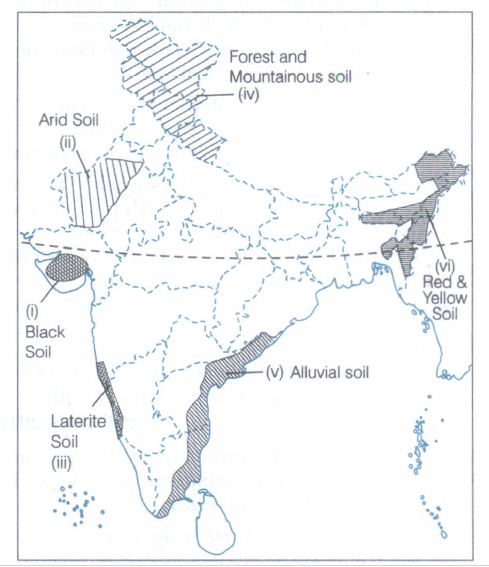
31.

10th Standard CBSE Syllabus & Materials
10th Standard CBSE
CBSE 10th Social Science PS - Federalism - New Model Questions Papers Study Material - QB365 Set A
NEW10th Standard CBSE
CBSE 10th Social Science PS - Power Sharing - New Model Questions Papers Study Material - QB365 Set A
NEW10th Standard CBSE
CBSE 10th Social Science GEO - Manufacturing Industries - New Model Questions Papers Study Material - QB365 Set A
NEW10th Standard CBSE
CBSE 10th Social Science GEO - Minerals and Energy Resources - New Model Questions Papers Study Material - QB365 Set A



NCERT Books

Syllabus

Exam Pattern

Sample Question Papers

Previous year Question Papers

Important Notes

MCQ Practice test

NCERT Exemplers

Case study Questions

Image Based Questions

Passage based Questions

HOT Questions

Value Based Questions

Model Questions Papers
NCERT ( Book Back ) Questions

Assertion and Reason
Important Questions And Answers

CBSE 10th Standard CBSE Subjects
CBSE Standards



