
 100% FREE ACCESS
10th Standard CBSE Syllabus & Materials
10th Standard CBSE
CBSE 10th Social Science ECO - Globalisation and the Indian Economy - New Model Questions Papers Study Material - QB365 Set A
NEW10th Standard CBSE
CBSE 10th Social Science ECO - Money and Credit - New Model Questions Papers Study Material - QB365 Set A
NEW10th Standard CBSE
CBSE 10th Social Science ECO - Sectors of the Indian Economy - New Model Questions Papers Study Material - QB365 Set A
NEW10th Standard CBSE
CBSE 10th Social Science ECO - Development - New Model Questions Papers Study Material - QB365 Set A
NEW10th Standard CBSE
CBSE 10th Social Science PS - Outcomes of Democracy - New Model Questions Papers Study Material - QB365 Set A
NEW10th Standard CBSE
CBSE 10th Social Science PS - Gender, Religion and Caste - New Model Questions Papers Study Material - QB365 Set A

Published on: 20/10/2025
Download CBSE Class 10th Standard CBSE Social Science question papers, sample papers, important questions, and previous year solved papers in PDF format. Get free study materials, NCERT solutions, and exam preparation resources for Class 10th Standard CBSE Social Science
Questions + Answers key
Take MCQ Social Science Test
1.
Explain any three elements of Belgian model of accommodation.
2.
'Federalism works only in big countries'. Discuss the statement.
3.
Here are three reactions to the language policy followed in India.
Give an argument and an example to support any of these positions.
Sangeeta: The policy of accommodation has strengthened national unity.
Arman: Language-based States have divided us by making everyone conscious of their language.
Harish:This policy has only helped to consolidate the dominance of English over all other languages.
4.
State different forms of the communal politics with one example of each.
5.
State one prudential reason and one moral reason for power sharing with an example from the Indian context.
6.
Describe the horizontal and vertical power sharing in modern democracies.
7.
Suggest some reforms to strengthen parties so that they perform their functions well?
8.
Democracy is not free from corruption. Is is true?
9.
What is called decentralisation?
10.
What is Federalism?
11.
Why was there tension between the Dutch-speaking and French-speaking communities during the 1950s and 1960s?
12.
What is communal politics?
13.
What did Gandhiji mean saying that religion can never be separated from politics?
14.
What are the common features of all type of democracies?
15.
How do we assess democracy's outcomes? Explain.
16.
"Communalism is harmful for the nation''. Explain.
17.
What steps have been taken by NTPC towards environmental protection?
18.
How far is it correct to say that it is not politics that gets caste ridden, but it is the caste that gets politicised? Explain.
19.
Political parties are a necessary condition for a democracy. Analyse the statement with examples.
20.
What is decentralisation? What is the importance or need for decentralisation?
21.
Differentiate between horizontal and vertical division of powers
22.
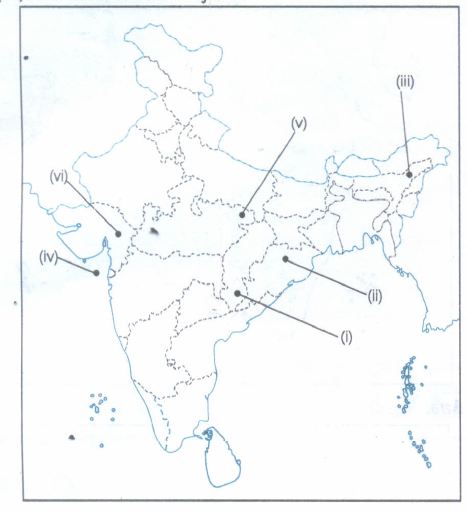
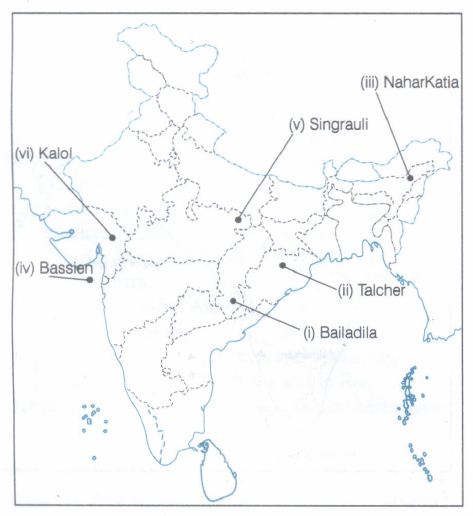
On the given political map of India, identify and label any four of the following features with appropriate symbols.
(i) Iron are mine in Chhattisgarh
(ii) Coal mine in Odisha
(iii) An oil field in Assam
(iv) An offshore oil field near Mumbai High
(v) A power thermal plant in Madhya Pradesh
(vi) An oil field in Gujarat
1.
To accommodate diverse regional and cultural diversities, Belgian Government adopted the following measures
(i) Constitution prescribes that the number of Dutch and French-speaking ministers shall be equal in the Central Government.
(ii) Many power of the Central Government have been given to State Governments of the two regions of the country.
(iii) Brussels, the capital of Belgium, has a separate government in which both the communities have equal representations.
2.
Federalism works in big countries where the area of the country is large and it makes it difficult to be effectively managed through one level of government. In such case, different levels of the government are formed to have broad based participation of the people. However, it is wrong to say that federalism works only in big countries. Even in a smaller country by size, which has complex diversity in respect to racial religious, cultural or language differences, federalism is practised. The rationale behind federalism is sharing power so that there is equal representation of all the social groups. So, federalism works in countries, big or small, where there is need to divide power in various levels of the government for efficient working of the entire system.
3.
The position held by Sangeeta is the correct one. In reality, the policy of accommodation has strengthened national unity.
An example is the case of the English language. According to the Constitution, the use of English for official purposes was to stop in 1965. But many non-Hindi speaking states demanded that the use of English should continue.
The Central Government agreed to continue the use of English along with Hindi for official purposes.
4.
Communalism can take several forms in politics like
(i) The most common expression of communalism is of communal superiority in our everyday beliefs. For example, Militant religious groups.
(ii) Sometimes, communalism takes its worst form in riots. India and Pakistan suffered some of the worst communal riots at the time of partition.
(iii) A communal mind often leads to a quest for political dominance of one's own religious community.
(iv) Political mobilisation based on religion is another form of communalism. This involves the use of sacred symbols, religious leaders, emotional appeal to bring the followers of one religion together in political areas. In India. politicians are trying to influence voters exploiting their religious sentiments from the two largest religious communities in the country.
5.
The prudential reason for power sharing helps to reduce the possibility of conflict between social groups. An example is the reservation of constituencies for SC, ST, minorities in India. In this way, the power sharing tries to reduce the possibility of conflicts.
Power sharing for moral reason is based on moral considerations. An example of power sharing for a moral reason is decentralisation of powers in India through formation of local, state and central governments operating at different levels. Here power is morally shared between different governments.
6.
Different forms of power sharing in modern democracies:
(a) Horizontal division of power:
It is the sharing of power among the different organs of government. The division of government into the executive, the legislature and the judiciary is an example of horizontal division of power. In such a power sharing arrangement, different organs of government, placed at the same level, exercise different powers. This separation of powers ensures that no organ exercises unlimited power. Each organ checks the others, thereby putting in place a system of checks and balances. The division of power between the Council of Ministers headed by the Indian Prime Minister, the Parliament of India and the Indian Supreme Court is an example of this kind of power sharing.
(b) Vertical division of power:
It is the sharing of power among governments at different levels - a general government for the entire country and governments at the provincial or regional level. For example, in India, the Constitution defines the way power is to be shared between the Central or Union government and the various State governments. There are certain matters on which only the Central government can take decisions, while there are others on which only an individual state government has an exclusive right for decision making.
(c) Division of power among social groups:
Power can also be shared among different groups which differ socially. The system of 'community government' in Belgium is an example of this type of power division. This government is elected by people belonging to one language community (Dutch, French and German speaking) and has the power to take decisions regarding cultural, educational and language related issues. The system of reserved constituencies in India is another example.
(d) Division of power between political parties, pressure groups and movements:
Political parties are the organisations which aim to control power by contesting elections. In a democracy, citizens have the freedom to choose among the various contenders for power (the different political parties or the different alliances comprising political parties). Such a freedom of choice entails competition among the different parties, which in turn ensures that power does not remain in one hand, and is shared among different political parties representing different ideologies and social groups. Pressure groups and movements also share governmental power, either through participation in governmental committees or by influencing the decision making process.
7.
Some suggestions to reform political parties are
(i) Anti-Defection Law which prevents elected MLAs and MPs from changing parties. At the same time, this law has made any dissent even more difficult.
(ii) It is mandatory for every candidate to give details of his property and criminal cases pending against him.
(iii) Political parties should maintain a register of its members and have periodic elections for its office bearers.
(iv) Political parties should have one-third seats reserved for women.
(v) The government should give parties money to support their election expenses.
(vi) People should put pressure on political parties through petitions, publicity and agitations.
8.
There is no denying the fact the democracy is not free from corruption but, it is only in a democracy that people can openly expose this evil and ask for its elimination.
9.
When power is taken away from central and state governments and given to local government, it is called decentralisation.
10.
Federalism is a system of government in which the powers is divided between a central authority and various constituent units of the country.
11.
The Dutch-speaking community got the benefit of economic development and education much later compared to the French-speaking community. This was the cause for tension between the two communities during the 1950s and 1960s.
12.
When beliefs of one religion are presented as superior to those of other religious when the demands of one religious group are formed in opposition to another and when state power is used to establish domination of one religious group over the rest it is called communal politics.
13.
What Gandhiji meant by religion was not any particular religion like Hinduism or Islam but moral values that inform all religious. He believed that politics must be guided by ethics drawn from religion.
14.
They have formal constitutions, they hold elections, they have parties, and they guarantee Rights of citizens.
15.
Assessing democracy's outcomes involves evaluating whether it fulfills the expectations associated with democratic governance. This assessment can be done through following criteria
Promotion of Equality Evaluate the extent to which democracy promotes equality among citizens, both in terms of political rights and socio-economic opportunities. This involves examining indicators such as income distribution, social mobility and access to education and healthcare.
Enhancement of Individual Dignity Assess whether democracy upholds the dignity of individuals by safeguarding their fundamental rights and freedoms. This includes evaluating the protection of civil liberties, freedom of expression and the rule of law.
Quality of Decision-making Evaluate the effectiveness and transparency of decision-making processes within democratic institutions. This involves assessing the extent to which decisions are made through open debate, public participation and adherence to democratic norms and principles.
Conflict Resolution Examine democracy's ability to peacefully resolve conflicts and manage societal tensions through democratic means, such as dialogue, negotiation and compromise.
Capacity for Course Correction Assess whether democracy provides mechanisms for accountability and responsiveness to address mistakes and address societal challenges.
16.
Communalism means the followers of a particular religion must belong to one community and their fundamental interests are the same.
People of different religions cannot belong to the same community and their interests are bound to be different and involve a conflict.
Communalism leads to the belief that people belonging to different religions cannot live as equal citizens within one nation.
Communalism makes hindrances in the functioning of our democracy in the following ways
(i) Communalism involves religious prejudices, stereotypes of religious communities and beliefs in the superiority of one's religion over other religions. These are not desirable in democracy.
(ii) Communalism leads to the majoritarian dominance of majority community and desire to form separate political unit by minority community which is dangerous for democracy.
(iii) Communalism involves the use of sacred symbols, religious leaders, emotional appeal to the voters of one religion in preference to others which leads to political mobilisarion on religions lines. This cannot be afforded by democracy.
(iv) Sometimes communalism leads to communal violence, riots and massacre which disturbs the very foundation of democracy.
17.
(1) Optimum utilisation of equipment by adopting latest techniques and upgrading existing equipment.
(2) Minimising waste generation by maximising ash utilisation.
(3) Providing green belts for nurturing ecological balance.
(4) Reducing environmental pollution through ash pond management, ash water recycling system and liquid waste management.
(5) Ecological monitoring, reviews and online data base management for all its power stations.
18.
It is correct to say that it is not politics that gets caste ridden, but it is the caste that gets politicised. Caste can take various forms in politics
(i) Each caste group tries to become bigger by incorporating within it neighbouring castes or -sub-castes which were earlier excluded from it.
(ii) Various caste groups are required to enter a coalition with other castes or communities and thus enter a dialogue and negotiation.
(iii) New kinds of caste groups have come up in the political arena like 'backward' and 'forward' caste groups.
(iv) Caste plays different kinds of roles in politics. In some cases, politics gives many disadvantaged communities the opportunity to demand their share of power.
(v) Politics has helped people from OBC and Dalit castes to gain better access to decision-making.
(vi) But sometimes exclusive attention to caste can produce negative results like tensions, conflicts and violence in our society.
19.
In a democratic set-up, political parties are required because without political parties:
(a) every candidate in the elections will be independent. No promises could be made and the utility of the government formed will remain uncertain.
(b) no one will be responsible for running the country. Elected representatives will only be accountable to their constituency.
(c) there will be no agency to gather and present different views on various issues to the government.
(d) no one will be responsible for bringing various representatives together so as to form a responsible government.
(e) there will be no mechanism to support the government, make policies and justify or oppose them.
20.
Decentralisation
When power is taken away from Central and State governments and given to local governments it is called decentralisation
Need for Decentralisation
(i) India is a vast country with a huge population and hence, it is not possible to rule the country by a single Government or state governments.
(ii) Even the states in India are internally very diverse and hence, there is a need for power sharing within the state too.
(iii) Large number of problems and issues are best solved at the local level.
(iv) People have better knowledge of problems in their localities and hence, have better ideas on where to spend money and how to manage things more efficiently.
(v) Besides, at the local level it is possible for the people to directly participate in decision making that helps to inculcate a habit of democratic participation.
(vi) Forming local government is the best way to realise one important principle of democracy, namely local self-government.
21.
Differentiate between horizontal and vertical division of powers
| Horizontal Division of Power | Vertical Division of Power |
| In this division of power sharing arrangement, power is shared among different organs of government such as legislature, executive and judiciary |
In this division of power sharing arrangement, power is shared among governments at different levels like union, state and locall evels |
| In this division, different organs of government exercise different powers. It is a concept of separation of power |
In this division, constitution clearly lays down the power of the different levels of government |
| It specifies the concept of checks and balances in order to check the unlimited powers of the different organs |
In this division, there is no concept of checks and balances because powers are clearly divided among higher and lower level |
22.

10th Standard CBSE Syllabus & Materials
10th Standard CBSE
CBSE 10th Social Science PS - Federalism - New Model Questions Papers Study Material - QB365 Set A
NEW10th Standard CBSE
CBSE 10th Social Science PS - Power Sharing - New Model Questions Papers Study Material - QB365 Set A
NEW10th Standard CBSE
CBSE 10th Social Science GEO - Manufacturing Industries - New Model Questions Papers Study Material - QB365 Set A
NEW10th Standard CBSE
CBSE 10th Social Science GEO - Minerals and Energy Resources - New Model Questions Papers Study Material - QB365 Set A



NCERT Books

Syllabus

Exam Pattern

Sample Question Papers

Previous year Question Papers

Important Notes

MCQ Practice test

NCERT Exemplers

Case study Questions

Image Based Questions

Passage based Questions

HOT Questions

Value Based Questions

Model Questions Papers
NCERT ( Book Back ) Questions

Assertion and Reason
Important Questions And Answers

CBSE 10th Standard CBSE Subjects
CBSE Standards



