
 100% FREE ACCESS
10th Standard CBSE Syllabus & Materials
10th Standard CBSE
CBSE 10th Social Science ECO - Globalisation and the Indian Economy - New Model Questions Papers Study Material - QB365 Set A
NEW10th Standard CBSE
CBSE 10th Social Science ECO - Money and Credit - New Model Questions Papers Study Material - QB365 Set A
NEW10th Standard CBSE
CBSE 10th Social Science ECO - Sectors of the Indian Economy - New Model Questions Papers Study Material - QB365 Set A
NEW10th Standard CBSE
CBSE 10th Social Science ECO - Development - New Model Questions Papers Study Material - QB365 Set A
NEW10th Standard CBSE
CBSE 10th Social Science PS - Outcomes of Democracy - New Model Questions Papers Study Material - QB365 Set A
NEW10th Standard CBSE
CBSE 10th Social Science PS - Gender, Religion and Caste - New Model Questions Papers Study Material - QB365 Set A

Published on: 20/10/2025
Download CBSE Class 10th Standard CBSE Social Science question papers, sample papers, important questions, and previous year solved papers in PDF format. Get free study materials, NCERT solutions, and exam preparation resources for Class 10th Standard CBSE Social Science
Questions + Answers key
Take MCQ Social Science Test
1.
Explain the judicial structure of consumer disputes in India.
2.
How are some countries in the world facing foundational challenge of democracy? Explain with examples.
3.
What are the main objectives of JFM?
4.
State the problems faced by cotton weavers of India.
5.
State any three points of importance of penny chapbooks.
6.
Summarise the concern in both nineteenth-century Europe and India about women reading novels. What does this suggest about how women were viewed?
7.
In the present day energy crisis which steps will you take saving energy?
8.
should democracy be judged by its outcome?
9.
What was the role of technology in transforming in the 19th century world? Explain with an example.
10.
Give for reasons for the rising importance of tertiary sector in India.
11.
Explain any three methods of traditional rainwater harvesting techniques in India.
12.
Give three ways in which early printed books closely resembled manuscripts.
13.
Describe the process of unification of Germany.
14.
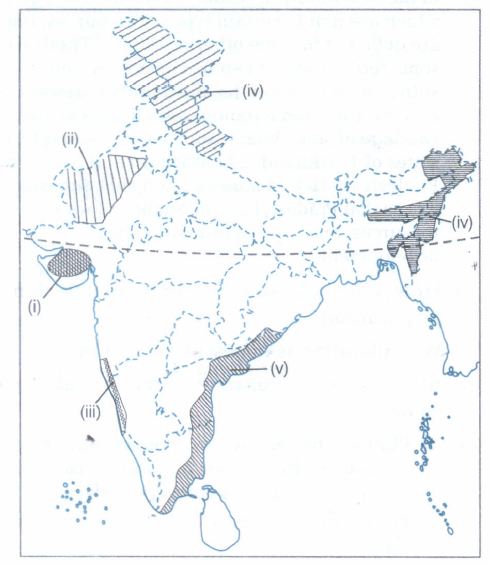
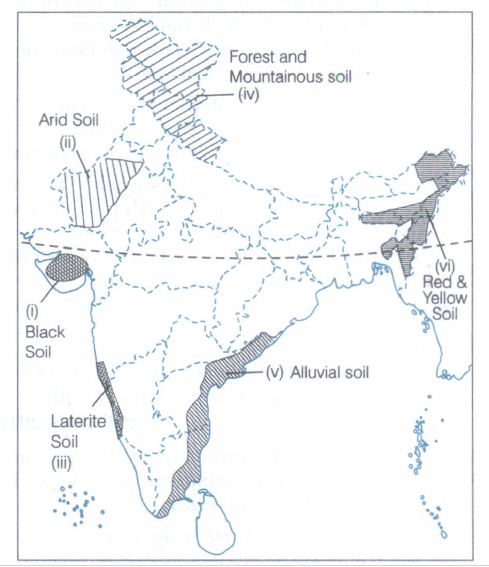
On the physical outline map of India given below, identify any four soil types of India.
15.
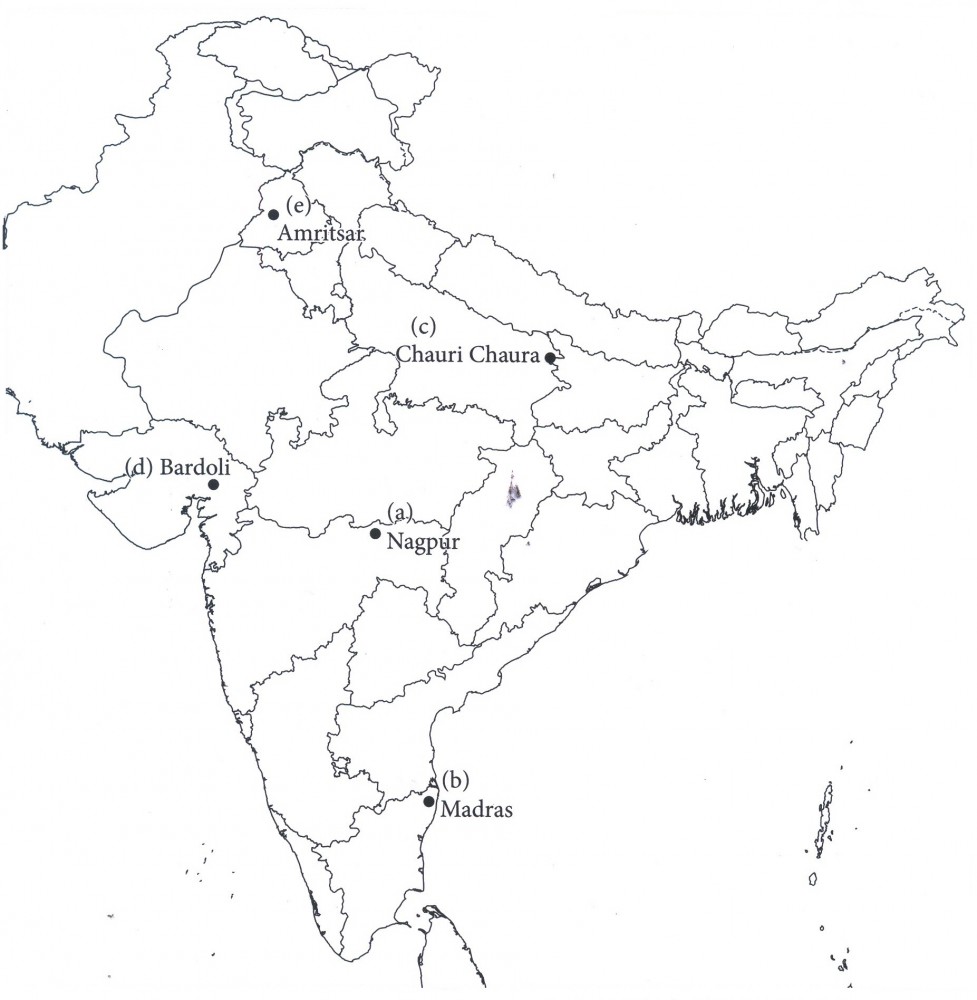
Five features with serial nos. (i) to (v) are marked in the given outline political map of India. Identify these features with the help of the following information and write their correct names on the lines marked in the map:
(a) A place where Indian National Congress Session was held in Dec. 1920.
(b) A place where Indian National Congress Session was held in 1927.
(c) A place where violence occurred due to which Mahatma Gandhi suddenly called off the Non-cooperation Movement.
(d) A place of peasants' Satyagraha in Gujarat.
(e) A place associated with Jallianwalla Bagh massacre.
16.
What was the aim behind establishing Chamber of Commerce?
17.
Mention any two modes of exchange of ideas and goods in ancient world.?
18.
What prompts people to move from one country to another?
19.
The modern currency is accepted as a medium of exchange. Why?
20.
Why did the consumer movement begin as a social force in India?
21.
Which constitutional bodies suggest reforms in political parties?
22.
Which port was the first to be developed soon after Independence?
23.
Which factor is considered as the most prominent one in the industrial location in a region?
24.
"The policy of racialism was visible in the colonial cities.' Explain by giving examples.
25.
Mention the growing and harvesting period of rabi crops.
26.
Which form of the forms of government has support in genial?
27.
What are generic movements?
28.
What is a challenge? Explain the three major challenges before the countries of the world regarding democracy?
29.
Describe the main features of popular mass struggle for restoring democracy in Nepal.
30.
Why did writers like Paul Bernard believe in developing the economy of the colonies?
1.
A three-tier quasi-judicial machinery at the district, state and national level, was set up under COPRA, for redressal of consumer disputes in India.
(a) At the district level, consumer courts deal with cases involving claims up to Rs 20 lakh.
(b) At the state level, consumer courts deal with cases involving claims between Rs 20 lakh and Rs 1 crore.
(c) At the national level, consumer courts deal with cases involving claims exceeding Rs 1 crore. If the case is dismissed at the district level, then the consumer can appeal at the state and then at the national level, if required

2.
The foundational challenge of democracy consists of making the transition to democracy and then instituting a democratic government.
This challenge involves three main areas of change.
(a) It brings down the existing non-democratic regime.
(b) It keeps the military away from controlling governement.
(c) It establishes a sovereign and functional state.
The example of struggle for democracy in Nepal justifies the foundational challenge People demanded abolition of monarchy and establishment of democratic institutions.
3.
(a) The members of the local communities were involved the management and restoration of degraded forests.
(b) The members of these communities are entitled to intermediary benefits like non-timber forest produces and share in the timber harvested by 'successful protection'.
4.
(i) Collapse of local and foreign market: Due to industrialisation in Britain, their export market collapsed. as British traders started exporting machine-made-clothes to India, so their local market shrank.
(ii) Shortage of raw material: As raw cotton was being exported to England, there was a shortage of raw materials.
When the American Civil War broke out and the cotton supplies from the United states were cut off. Britain turned to India. As raw cotton exports Iron and increased, the price of raw cotton shot up Weavers in India were starved of supplies and forced to buy raw cotton at higher prices.
(iii) Clashes with Gomasthas: Gomasthas were appointed by the government to supervise weaves to collect supplies and examine the quality of cloth. The Gomasthas acted arrogantly and punished weavers for delays in supply. So the weavers dashed with them.
(iv) System of advances: The Britishers started the system of advances to regularise the supply of cotton and cloth. The weavers eagerly took the advance, in a hope to cam more but they faded to do so.they even started losing small plots of land which they had earlier cultivated
5.
(i) Pocket-sized books that were sold by travelling peddlers called chapmen.
(ii) These became popular from the time of the sixteenth-century print revolution.
(iii) It includes many kinds of printed material such as pamphlets, political and religious tracts, nursery rhymes, poetry, folk tales, children's literature and almanacs. Where there were illustrations, they would be popular prints.
6.
The concern in both nineteenth-century Europe and India about women reading novels bore more or less similar fears. Women were seen as easily corruptible and an imaginary world that the novel provided was seen as a dangerous opening for the imaginations of its readers. In certain Indian communities, it was felt that women who read novels would leave their domestic environments and aspire to be part of the outside world the male domain. This suggests that women were viewed as delicate and incapable of their financial needs while they maintained his household and remained subservient to him.
7.
i) Using more of public transport system instead of individual vehicles.
ii) Switching off electrical devices when not in use.
iii) Using power saving devices.
iv) Using non-conventional sources of energy such as solar energy, wind energy, etc.
v) Getting the power equipment regularly checked to detect damages and leakages.
8.
Democracy should be judged by its outcome because it opens the path of expectations which is one of the criteria for judging any democratic country. Following points Justify the above statement
(i) The examination procedure of democracy is eternal, as it passes one test, it produces another test.
(ii) It automatically gives rise to expectations as well as complaints by the people when they want to know about the functioning of democracy.
(iii) The fact that people also complaint about democracy indicates the awareness and the ability of people to expect and to look critically at power holders and the high and the mighty.
(iv) It transforms people from the status of a subject into that of a citizen.
(v) Most individuals today believe that their vote makes a difference to the way the government is run and to their own self-interest.
9.
(i)Transformation of the world economy: Technology played a major role in all these developments. Railways, steam shipping, telegraph , ect., were important inventions without which it was not possible to imagine the transformation of nineteenth-century world.
(ii) Linking the markets: New investments and improvements in transport faster railways lighter wagons and larger ships helped move food more cheaply and quickly from far away farms to final markets.
(iii) Impact on the meat trade: Till the 1870s, moat from America was shipped to Europe in the form of live animals which were then slaughtered in Europe. But live animals took up a lot of ship space. Many also died in voltage fell ill lost weight or became unfit to eat. So the prices of meat were very high and it was beyond the reacts of the European poor. Due to high price the demand and production meat from one region to another.
(iv) Social peace and imperialism: The refigerated ships reduced shipping cost and lowered meat prices in Europe. The poor Europe could now consume a more varied diet. Better living conditions promoted social peace within the country and support for imperialism abroad.
(v) Colonialism: Technology played very important role in linking the world markets which promoted the sprit of colonialism.
10.
(a) In any country several services such as hospitals, educational institutions, post and telegraph services, police stations, courts, village administrative offices , municipal corporations , defence, transport, banks, insurance companies, etc. are required. These can be considered as basic services. In a developing country the government has to take responsibility for the provision of these services.
(b) The development of agriculture and industry leads to the development of services such as transport, trade, storage and the like, as we have already seen. Greater the development of the primary and secondary sectors, more would be the demand for such services.
(c) As income levels rise, certain sections of people start demanding many more services like eating out, tourism, shopping, private hospitals, private schools, professional training etc. These changes can be seen in cities, especially in big cities.
(d) Over the past decade or so, certain new services such as those based on information and communication technology have become important and essential. The production of these services has been rising rapidly.
11.
(a) Roof-Top Rainwater Harvesting
(i) Here, the rainwater is collected in underground tanks connected to the rooftop through pipes.
(ii) Rain falling on rooftops travels down the pipes to the tanks and is stored for future usage.
(iii) It is also used for recharging hand pumps and tube wells.
(iv) 'Rooftop rain water harvesting' was commonly practised to store drinking water, particularly in Rajasthan.
(b) Bamboo Drip Irrigation System
(i) It was practised in Meghalaya.
(ii) It is a 200-year old system.
(iii) Here, the water from the streams is tapped using bamboo pipes and used for irrigating the roots of plants.
(iv) The long bamboo pipes are connected with each other to form a chain from the stream to the crops.
(v) The water flows through the pipes and drops directly at the site of the plant.
(c) Diversion Channels
(i) In hill and mountainous regions, people built diversion channels like the guls' or luls' of the Western Himalayas for agriculture. Diversion Channels.
(ii) In the flood plains of Bengal, people developed inundation channels to irrigate their fields.
(d) Rain fed Storage
(i) In arid and semi-arid regions, agricultural fields were converted into rain fed storage structures that allowed the water to stand and moisten the soil like the 'khadins' in Jaisalmer and `Johads' in other parts of Rajasthan.
12.
(i) Early printed books were technically printed but those were not very different from manuscripts.
(ii) There were many kinds of same features available in similar books which made printed books closely resembling with manuscripts.
(iii) Both printed books and manuscripts looked similar because metal letters imitated the ornamental handwritten style.
(iv) Like handwritten manuscripts, borders of printed books were also illuminated by hand with foliage and other patterns and illustrations were painted.
(v) In the books printed for rich people, space for decoration was kept blank on the printed pages.
(vi) Each buyer could choose the design and decide on the painting school that would do the illustrations.
13.
The German people did not exist as a united nation. Men and women of middle classes combined their demands for constitution with national unification. In 1848, the popular effort was failure to succeed in forming constitution (Frankfurt Parliament) in Germany due to the combined forces of the monarchy and the military, supported by the large landowners (Junkers) of Prussia. Prussia took on the leadership of the movement for national unification with its chief minister as Otto Von Bismarck. He reached his goal with the help of Prussian army and bureaucracy. The process of unification was ended with three wars over 7 years with Austria, Denmark and France. In Jan 1871, an assembly consisting of the princes of German states, representatives of the army, important Prussian ministers including Otto von Bismarck gathered in the Hall of Mirrors in the Palace of Versailles to proclaim the new German head as Kaiser William I of Prussia. The new state placed a strong prominence on modernizing the currency, banking, legal and judicial systems in Germany. Prussian measures and practices became a model for the rest of Germany.
14.
(I) Black soil (ii) Arid soil
(iii) Laterite soil (iv) Forest and Mountainous soil
(v) Alluvial soil (vi) Red and Yellow soil
15.
16.
To Protect the interest of Indian business class.
17.
Travelers , missionaries , explorers
18.
People usually move from one country to another in search of better income, jobs and education.
19.
It is accepted as a medium of exchange because it is authorised by the Government of India.
20.
In India, the consumer movement as a social force originated with the necessity of protecting and promoting the interests of consumers against unethical and unfair trade practices.
21.
The Constitution of India and the Election Commission of India suggest reforms in political parties.
22.
Kandla port was the first port to be developed soon after Independence.
23.
Availability of raw materials is considered the most prominent factor in the industrial location in a region.
24.
(i) The Bombay fort area was divided between a 'native town' where mes of the Indians lived and a 'white section'. where the Europeans lived.
(ii) A European suburb and an industrial zone developed to the North of the fort area with a similar suburb and cantonment in the South.
25.
Growing period: October to December
Harvesting period: April to June
26.
Democracy.
27.
()
Generic movements are long-term movements that involve more than one issue.
28.
A challenge refers to a difficulty which carries within it an opportunity for further progress and can be overcome
The following are the major challenges to democracy in India.
(a) Foundational challenge: This challenge involves:
(i) making transition to democracy and then instituting democratic government.
(ii) bringing down the existing non-democratic regime.
(iii) keeping military away from controlling government.
(iv) establishing a sovereign and functional state.
(b) Challenge of expansion of democracy: This challenge signifies:
(i) extension of democratic power to local governments.
(ii) expansion of federal principles to all the federal units.
(iii) political empowerment to women and minorities.
(c) Challenge of deepening of democracy: This challenge ensures:
(i) strengthening of democratic institutions and democratic principles.
(ii) to check the influence of the wealthy and powerful people in democratic decisions.
(iii) empowering the general section of people through democratic institutions.
29.
(i) It was a movement started by all the major political parties in the parliament by r forming a Seven Party Alliance. It was aimed at regaining popular control over the government from the king and restoring democracy.
(ii) It started with a four-day strike in Kathmandu, the country's capital. This protest soon turned into an indefinite strike in which Maoist insurgents and various other organizations joined hands.
(iii) On 21 April, they served an ultimatum to the king. They stuck to their demand for restoration of parliament, power to an all-party government and a new constituent assembly.
(iv) On 24 April 2006, the last day of the ultimatum, the king was forced to concede all the three demands.
(v) The SPA chose Girija Prasad Koirala as the new Prime Minister of the interim government. The restored parliament met and passed laws taking away most of the powers of the king.
(vi) The SPA and the Maoists came to an understanding about pow the new Constituent
Assembly was going to be elected. This struggle came to be known as Nepal's second movement for democracy
30.
()
To increase the profit opportunities, purchase of more goods, more business for French.

10th Standard CBSE Syllabus & Materials
10th Standard CBSE
CBSE 10th Social Science PS - Federalism - New Model Questions Papers Study Material - QB365 Set A
NEW10th Standard CBSE
CBSE 10th Social Science PS - Power Sharing - New Model Questions Papers Study Material - QB365 Set A
NEW10th Standard CBSE
CBSE 10th Social Science GEO - Manufacturing Industries - New Model Questions Papers Study Material - QB365 Set A
NEW10th Standard CBSE
CBSE 10th Social Science GEO - Minerals and Energy Resources - New Model Questions Papers Study Material - QB365 Set A



NCERT Books

Syllabus

Exam Pattern

Sample Question Papers

Previous year Question Papers

Important Notes

MCQ Practice test

NCERT Exemplers

Case study Questions

Image Based Questions

Passage based Questions

HOT Questions

Value Based Questions

Model Questions Papers
NCERT ( Book Back ) Questions

Assertion and Reason
Important Questions And Answers

CBSE 10th Standard CBSE Subjects
CBSE Standards



