
 100% FREE ACCESS
10th Standard CBSE Syllabus & Materials
10th Standard CBSE
CBSE 10th Social Science ECO - Globalisation and the Indian Economy - New Model Questions Papers Study Material - QB365 Set A
NEW10th Standard CBSE
CBSE 10th Social Science ECO - Money and Credit - New Model Questions Papers Study Material - QB365 Set A
NEW10th Standard CBSE
CBSE 10th Social Science ECO - Sectors of the Indian Economy - New Model Questions Papers Study Material - QB365 Set A
NEW10th Standard CBSE
CBSE 10th Social Science ECO - Development - New Model Questions Papers Study Material - QB365 Set A
NEW10th Standard CBSE
CBSE 10th Social Science PS - Outcomes of Democracy - New Model Questions Papers Study Material - QB365 Set A
NEW10th Standard CBSE
CBSE 10th Social Science PS - Gender, Religion and Caste - New Model Questions Papers Study Material - QB365 Set A

Published on: 20/10/2025
Download CBSE Class 10th Standard CBSE Social Science question papers, sample papers, important questions, and previous year solved papers in PDF format. Get free study materials, NCERT solutions, and exam preparation resources for Class 10th Standard CBSE Social Science
Questions + Answers key
Take MCQ Social Science Test
1.
European and western novelists presented the new woman –Explain the statement.
2.
Write a note on Project Tiger.
3.
What legal measures were taken by the government to empower the consumers in India?
4.
The Constitution was amended to make the third-tier democracy more powerful and effective- Explain.
5.
Why there were clashes between weavers and gomasthas?
6.
Briefly explain how the challenge of deepening of democracy can be met?
7.
What were the effects of the spread of the spread of print culture for poor people in nineteenth century India?
8.
Distinguish between commercial and non-commercial energy.
9.
What was the aim behind establishing Chamber of Commerce?
10.
What was the most powerful weapon of the Spanish conquerors?
11.
What prompts people to move from one country to another?
12.
Define money.
13.
Which logo would you like to see while purchasing a tin of edible oil?
14.
Name any two types of paddy grown in Assam, West Bengal and Odisha.
15.
Who was Henry Mayhew?
16.
What is transparency?
17.
Why did India follow a multiparty system?
18.
Who implements the superhighways in India?
19.
Name the major electronics goods producing centres in India.
20.
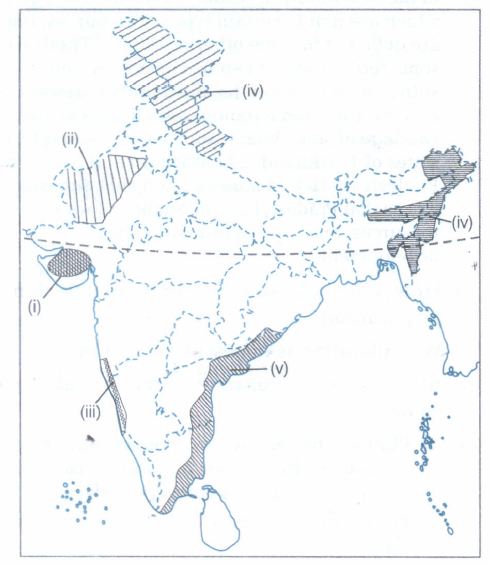
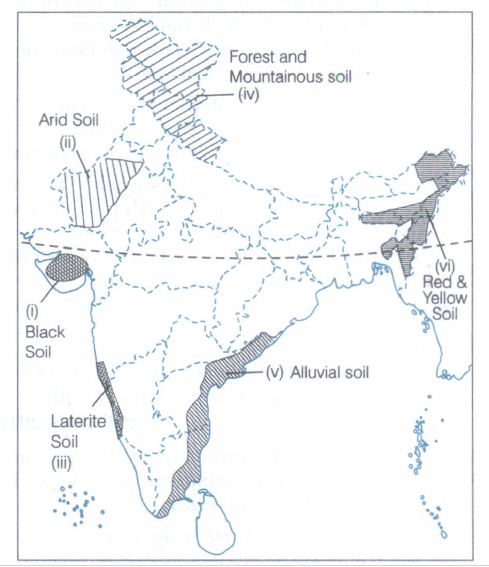
On the physical outline map of India given below, identify any four soil types of India.
21.
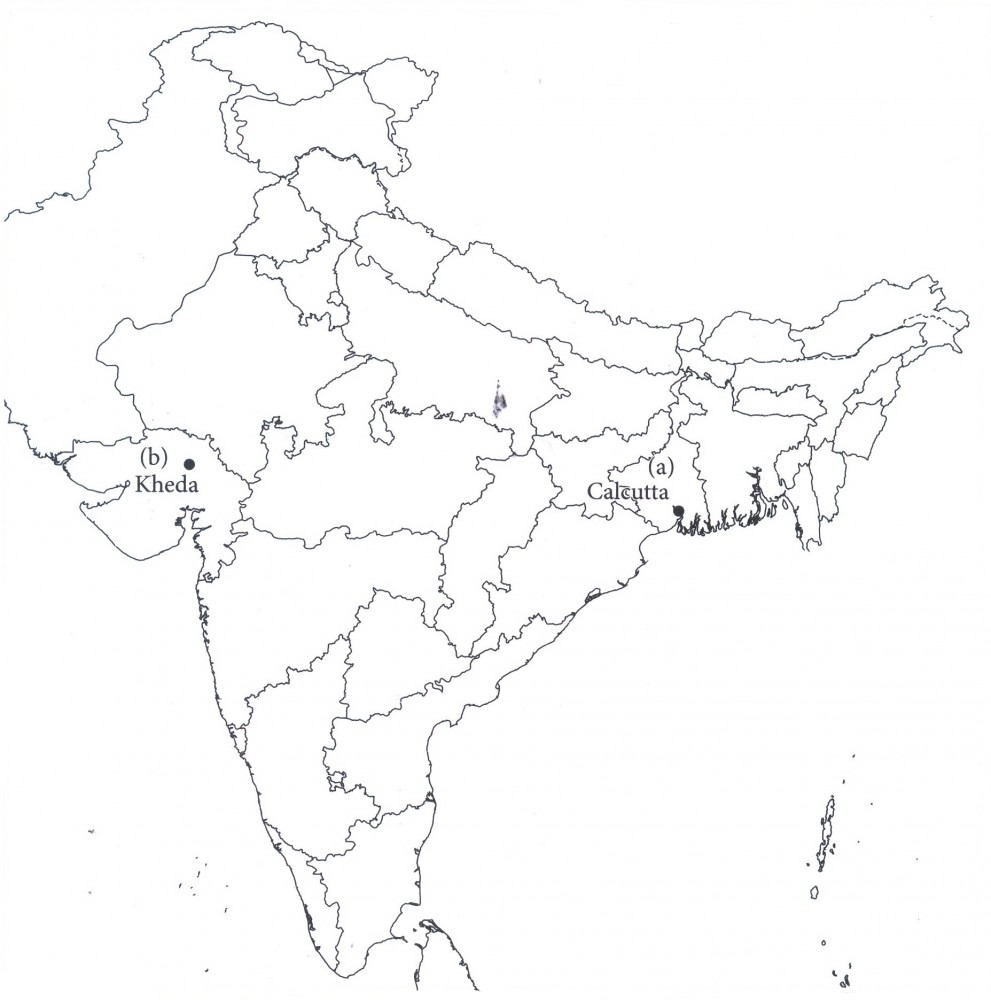
Two features - A and B are marked in the given political outline map of India. Identify these features with the help of the following information and write their correct names on the lines marked in the map:
(a) The place where Indian national Congress Session was held in September 1920.
(b) The place where the Peasant Satyagraha was help in Gujarat.
22.
How does tertiary sector help in the development of primary and secondary sectors? Explain with examples.
23.
Why 19thcentury indenture has been described as a 'New system of slavery'?
24.
Explain any three methods of traditional rainwater harvesting techniques in India.
25.
How did print culture develop in Europe? Explain.
26.
Examine with the help of three examples, how dignity and freedom of citizens are best guaranteed in a democracy.
27.
Describe the main features of popular mass struggle for restoring democracy in Nepal.
28.
Explain which four guidelines should be kept in mind while devising ways and means for political reforms in India?
29.
In which areas of Vietnam did the French built a canal to increase the cultivation for export?
30.
What is NAPAM?
1.
Women were allowed to speak with authority, wrote about family and experience, earned public recognition.
2.
(i) It was initiated in 1973.
(ii) Tiger population has dwindled to about 1800 from 55000 in the early 20th century.
(iii) The main reasons for decline in the number of tigers include,
(a) Poaching for trade in tiger skin
(b) Shrinking habitat
(c) Depletion of prey species
(d) Growing human population
3.
The legal measures taken by the government to empower the consumers in India were
(i) The MRTP Act enacted in 1984, to check unfair trade practices by manufacturers and service providers.
(ii) The Consumer Protection Act (COPRA) enacted in 1986, to protect consumers from exploitation in the marketplace.
(iii) Consumer Courts have been set up to provide justice to consumers who have been treated unfairly in the marketplace.
4.
(i) A major step towards decentralisation was taken in 1992.
(ii) The Constitution was amended to make the third-tier of democracy more powerful and effective.
(iii) Now it is constitutionally mandatory to hold regular elections to local government bodies.
(iv) Seats are reserved in the elected bodies and the executive heads of these institutions for the Scheduled Castes, Scheduled Tribes and Other Backward classes.
(v) At least one-third of all positions are reserved for women
(vi) The State Election Commission has been created in each State to conduct panchayat and municipal elections.
(vii) The State governments are required to share some powers and revenue with local government bodies.
5.
The new gomasthas were outsides, with no long term social link with the village. So they acted arrogantly, marched into villages with the police and punished weavers for delay in supply. So, there were reports of dashed between weavers and gomasthas.
6.
It means strengthening the existing institutions of democracy and practices of democracy. As different people, different countries have different people, different countries have different expectations from democracy means that a democracy has to encourage people's participation and control on democratic institutions. It has to curb and cut down the role of money power, the influence of the rich on making governmental decisions.
7.
The poor people benefitted from the spread of print culture in India on account of the availability of low-price books and public libraries. Enlightening essays were written against caste discrimination and its inherent injustices. These were read by people across the country. On the encouragement and support of social reformers, over-worked factory workers set up libraries for self-education, and some of them even published their own works, for example, Kashibaba and his "ChhoteAur Bade Sawal".n
8.
| S.No | Commercial Energy | Non-commercial Energy |
| 1. | The source of energy used by the people for commercial purposes. | The source of energy used by the people for home consumption |
| 2. | It can be used as an indicator of economic development of the country. | It can be used as an indicator of living standard of the country. |
| 3. | It includes coal, petroleum, natural gas, hydro-electricity etc. | It includes firewood, charcoal, cow-dung etc. |
9.
To Protect the interest of Indian business class.
10.
Small Pox Germs
11.
People usually move from one country to another in search of better income, jobs and education.
12.
Money is anything which has common acceptability as a means of exchange, a measure and a store of value.
13.
Agmark
14.
Aus, Aman and Boro.
15.
He was a writer and a philosopher who wrote several volumes on the London labour and compiled long lists of those who made a living from crime.
16.
In a democratic government, a citizen has the right and the means to examine the decisions taken by the govt. It is known as transparency.
17.
India has evolved a multi-party system, because the social and geographical diversity in such a large country is not easily absorbed by two or even three parties.
18.
National Highway Authority of India (NHAI).
19.
Hyderabad, Delhi, Mumbai, Chennai, Kolkata, Kanpur, Pune, Lucknow and Coimbatore.
20.
(I) Black soil (ii) Arid soil
(iii) Laterite soil (iv) Forest and Mountainous soil
(v) Alluvial soil (vi) Red and Yellow soil
21.
22.
(a) In any country several services such as hospitals, educational institutions, post and telegraph services, police stations, courts, village administrative offices , municipal corporations , defence, transport, banks, insurance companies, etc. are required. These can be considered as basic services. In a developing country the government has to take responsibility for the provision of these services.
(b) The development of agriculture and industry leads to the development of services such as transport, trade, storage and the like, as we have already seen. Greater the development of the primary and secondary sectors, more would be the demand for such services.
(c) As income levels rise, certain sections of people start demanding many more services like eating out, tourism, shopping, private hospitals, private schools, professional training etc. These changes can be seen in cities, especially in big cities.
(d) Over the past decade or so, certain new services such as those based on information and communication technology have become important and essential. The production of these services has been rising rapidly.
23.
(i) In the 19th century, hundreds of thousands of Indians and Chinese laborers went to work on plantations in mines and in mines and in road and railways construction projects around the world.
(ii) In India, indentures laborers were hired under contracts which promises return travel to India after they had worked for five years on plantations.
(iii) Gradually in India cottage industries declined, land rents rose, land were cleared for mines and plantations. All this affected the lines of the poor. They failed to pay their rents become indebted, and were forced to migrate in search of work.
(iv) The main destinations of Indian indentured migrants were the Caribbean islands, Trinidad, Guyana, Surinam, Mauritius, Fiji and Ceylon and Malaya.
(v) Recruitment was done by agent engaged by employers and paid small commission.
24.
(a) Roof-Top Rainwater Harvesting
(i) Here, the rainwater is collected in underground tanks connected to the rooftop through pipes.
(ii) Rain falling on rooftops travels down the pipes to the tanks and is stored for future usage.
(iii) It is also used for recharging hand pumps and tube wells.
(iv) 'Rooftop rain water harvesting' was commonly practised to store drinking water, particularly in Rajasthan.
(b) Bamboo Drip Irrigation System
(i) It was practised in Meghalaya.
(ii) It is a 200-year old system.
(iii) Here, the water from the streams is tapped using bamboo pipes and used for irrigating the roots of plants.
(iv) The long bamboo pipes are connected with each other to form a chain from the stream to the crops.
(v) The water flows through the pipes and drops directly at the site of the plant.
(c) Diversion Channels
(i) In hill and mountainous regions, people built diversion channels like the guls' or luls' of the Western Himalayas for agriculture. Diversion Channels.
(ii) In the flood plains of Bengal, people developed inundation channels to irrigate their fields.
(d) Rain fed Storage
(i) In arid and semi-arid regions, agricultural fields were converted into rain fed storage structures that allowed the water to stand and moisten the soil like the 'khadins' in Jaisalmer and `Johads' in other parts of Rajasthan.
25.
(i) Paper from China : Paper reached Europe from China through the Silk route in the 11th century. With this, the production of manuscripts written by scribes became a regular feature.
(ii) Role of travellers and explorers : Marco Polo, a great explorer reached Italy after several years of exploration in China in the year 1295. Marco Polo brought back with him the technology of woodblock printing. Now Italians started publishing books with woodblocks. The technology became popular in other parts of Europe, as well.
(iii) Woodblock printing : By the early fifteenth century, woodblocks started being widely used in Europe to print textiles, playing cards and religious pictures with simple, brief texts.
(iv) Johann Gutenberg and the printing press : A major revolution in the print technology was brought by Johann Gutenberg. He developed the first known printing press in the 1430's. The first book he printed was the Bible.
(v) Spread of printing presses : In the next hundred years i.e. between 1450 and 1550, printing presses were set up in most countries of Europe.
26.
(i) In a democratic country people have the freedom to choose their representatives on the basis of universal adult franchise.
(ii) Most societies across the world were historically male dominated. Equal treatment of women became the necessary requirement of a democratic society. Thus, their status in democratic countries improved.
(iii) In a non-democratic setup, there is no legal basis for freedom and dignity of individuals. Democracy in India has strengthened the claims of the disadvantaged and discriminated castes for equal status and equal opportunity.
(iv) Democracy transforms people from the status of subjects under a king or a dictator to the status of citizens with rights and duties. Many Fundamental rights are granted to citizensin a democratic country. One such right is the right to freedom, which is a cluster of many rights like freedom to travel anywhere, freedom to assemble anywhere, freedom to choose any profession, to choose any religion etc.
27.
(i) It was a movement started by all the major political parties in the parliament by r forming a Seven Party Alliance. It was aimed at regaining popular control over the government from the king and restoring democracy.
(ii) It started with a four-day strike in Kathmandu, the country's capital. This protest soon turned into an indefinite strike in which Maoist insurgents and various other organizations joined hands.
(iii) On 21 April, they served an ultimatum to the king. They stuck to their demand for restoration of parliament, power to an all-party government and a new constituent assembly.
(iv) On 24 April 2006, the last day of the ultimatum, the king was forced to concede all the three demands.
(v) The SPA chose Girija Prasad Koirala as the new Prime Minister of the interim government. The restored parliament met and passed laws taking away most of the powers of the king.
(vi) The SPA and the Maoists came to an understanding about pow the new Constituent
Assembly was going to be elected. This struggle came to be known as Nepal's second movement for democracy
28.
(i) Carefully devised changes in law can help to discourage wrong political practices and encourage good ones. At the same time, legal-constitutional changes by themselves cannot overcome challenges to democracy. They are to be carried out mainly by political activities, parties movements and politically conscious citizens.
(ii) Legal changes can sometimes be counter-productive. Generally, laws that seek to ban something are not very successful. Rather laws that give political actors incentives to do good things have more chances of working. For, example, the `Right to Information Act' empowers people to act as watchdogs of democracy.
(iii) The main focus of political reforms should be on ways to strengthen democratic practice. The most important concern should be to increase and improve the quality of political participation by ordinary citizens.
(iv) Any proposal for political reforms should think not only about what is a good solution but also about who will implement it and how measures that rely or democratic movements, citizens' organisations and the media are likely to succeed.
29.
()
The French build a canal to increase the cultivation for export in the region of Mekong delta.
30.
()
National alliance for People's Movements (NAPM) is an organisation of organisations which coordinates the activities of a large number of people's movements in our country.

10th Standard CBSE Syllabus & Materials
10th Standard CBSE
CBSE 10th Social Science PS - Federalism - New Model Questions Papers Study Material - QB365 Set A
NEW10th Standard CBSE
CBSE 10th Social Science PS - Power Sharing - New Model Questions Papers Study Material - QB365 Set A
NEW10th Standard CBSE
CBSE 10th Social Science GEO - Manufacturing Industries - New Model Questions Papers Study Material - QB365 Set A
NEW10th Standard CBSE
CBSE 10th Social Science GEO - Minerals and Energy Resources - New Model Questions Papers Study Material - QB365 Set A



NCERT Books

Syllabus

Exam Pattern

Sample Question Papers

Previous year Question Papers

Important Notes

MCQ Practice test

NCERT Exemplers

Case study Questions

Image Based Questions

Passage based Questions

HOT Questions

Value Based Questions

Model Questions Papers
NCERT ( Book Back ) Questions

Assertion and Reason
Important Questions And Answers

CBSE 10th Standard CBSE Subjects
CBSE Standards



