
 100% FREE ACCESS
10th Standard CBSE Syllabus & Materials
10th Standard CBSE
CBSE 10th Social Science ECO - Globalisation and the Indian Economy - New Model Questions Papers Study Material - QB365 Set A
NEW10th Standard CBSE
CBSE 10th Social Science ECO - Money and Credit - New Model Questions Papers Study Material - QB365 Set A
NEW10th Standard CBSE
CBSE 10th Social Science ECO - Sectors of the Indian Economy - New Model Questions Papers Study Material - QB365 Set A
NEW10th Standard CBSE
CBSE 10th Social Science ECO - Development - New Model Questions Papers Study Material - QB365 Set A
NEW10th Standard CBSE
CBSE 10th Social Science PS - Outcomes of Democracy - New Model Questions Papers Study Material - QB365 Set A
NEW10th Standard CBSE
CBSE 10th Social Science PS - Gender, Religion and Caste - New Model Questions Papers Study Material - QB365 Set A

Published on: 22/10/2025
Download CBSE Class 10th Standard CBSE Social Science question papers, sample papers, important questions, and previous year solved papers in PDF format. Get free study materials, NCERT solutions, and exam preparation resources for Class 10th Standard CBSE Social Science
Questions + Answers key
Take MCQ Social Science Test
1.
Why was the Khilafat Movement supported by Gandhiji in 1919? What was his main aim?
2.
Mention any three impacts of mining on the health of the miners.
3.
(i) Explain what is referred to as the G-77 countries.
(ii) In what ways can G-77 be seen as a reaction to be activities of the Bretton Woods twins?
4.
What is the meaning of a manufacturing industry? Why is it considered the backbone of economic development? Give two reasons.
5.
What are the advantages of local government?
6.
"Women are discriminated or disadvantaged in India." Justify the statement with any three suitable examples.
7.
Describe the horizontal and vertical power sharing in modern democracies.
8.
Explain the blood-less revolution by Vinoba Bhave.
9.
10.
Rinderpest is a
Cattle disease in Africa
Cattle disease in China
Cattle disease in India
Cattle disease in Russia
11.
The Descendants of indentures workers is a Noble Prize winning writer is
Bob Moreley
V.S.Naipaul
Amartya Sen
Ram Naresh Sarwan
12.
Which disease spread like wildfire in Africa in the 1890's?
Cattle plague
Small pox
Pneumonia
None of these
13.
Consider the statement on Ethnic Composition and mark the answer.
A. The Ethnic Composition of Belgium is very complex because of diverse language speaking.
B. French speaking community was in minority and more powerful.
C. Dutch speaking community was in majority and less powerful.
D. There was conflicts between the French and Dutch communities.
Which of the statements given above are correct?
Both B and C are true
Only A is true
Both A and D are true
All are false.
14.
Match the List I with List Il and select the correct answer using the codes given below the lists.
| List I | List II |
|---|---|
| 1. Union of India | A. Prime Minister |
| 2. State | B. Sarpanch |
| 3. Municipal corporation | C. Governor |
| 4. Gram Panchayat | D. Mayor |
| 1 | 2 | 3 | 4 |
| D | A | B | C |
| 1 | 2 | 3 | 4 |
| B | C | D | A |
| 1 | 2 | 3 | 4 |
| A | C | D | B |
| 1 | 2 | 3 | 4 |
| C | D | A | B |
15.
Which among the following statements about Indian's Constitution is wrong?
It prohibits discrimination on grounds of religion
It gives official status to one religion
It provides to all individuals freedom to profess any religion.
It ensures equality of citizens within religious communities.
16.
removal of barriers set by the government is known as
Globalization
Liberalization
Industrialization
privatization
17.
A type of agriculture where a single crop is grown on large area is
Shifting Agriculture
Plantation agriculture
Horticulture
Extensive Agriculture
18.
Jhumming refers to
Primitive subsistence farming in Brazil
'Slash and burn' agriculture in North-eastern states of India.
Primitive farming in Malaysia
Commercial farming in Punjab.
19.
Six Lane Highways are called .........
National Highway
International Highway
State Highway
Golden quadrilateral super highways.
20.
Gandhiji in his work 'Hind Swaraj' said that.
The British must Quit India
Indians must not cooperate with the British
The Government must concede the right to make salt.
Indians must be involved in the government of India.
21.
Name the region where iron and steel industries are concentrated the maximum.
Deccan Plateau
Malwa Plateau
Chotanagpur Plateau
None of the above
22.
What was Rowlatt Act?
It was an act which controlled the movement of plantation workers
It was an act through which the government get enormous power to repress political activities and allowed detention of political prisoners without trial for two years.
The act through which wages of workers were reduced.
None of the above.
23.
In 1857 where the first cotton mill of India was founded
Mysore
Madras
Surat
Bombay
24.
Which mode of transportation reduces trans-shipment losses and delays?
Railways
Roadways
Pipeline
Waterways.
25.
What is 'Rat hole' mining?
Mining in places where there are lots of rats
Mining done by family members in the form of a long narrow tunnel
Mining that kills rats
None of these
26.
Which one of the following industries uses bauxite as a raw material?
Aluminium Smelting
Cement
Jute
Steel
27.
Which customs union was formed by Prussia to abolish tariff barriers?
Zollverein
La Patrie
Elle
European Economic Union
28.
Which one of the following minerals is contained in the Monazite sand?
oil
uranium
thorium
coal
29.
Minerals are deposited and accumulated in the stratas of which of the following rocks?
sedimentary rocks
metamorphic rocks
igneous rocks
none of the above
30.
What was the impact of the Great Depression on USA? Explain.
31.
What are the features of communal politics?
32.
What are the key features of federalism?
33.
Describe the impact of globalisation on Indian economy with examples.
34.
Why is road transport more useful than rail transport in India? Explain giving four reasons.
35.
Explain new economic and political situations created in India during the First World War.
36.
Describe the process of unification of Italy.
37.
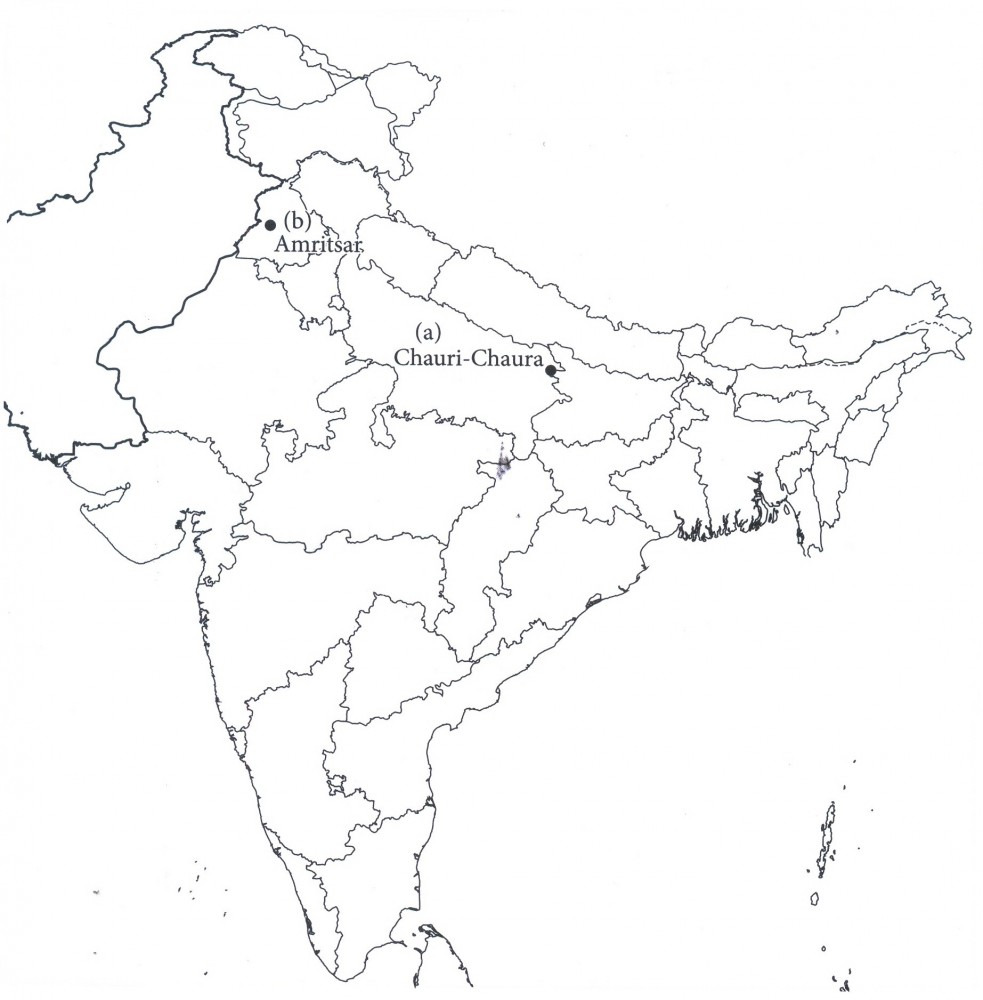
Locate and label the following items with appropriate symbols on the same map:
(a) Chauri-Chaura-The place of calling off the Non-Cooperation Movement (N.C.M.)
(b) Amritsar-The place where Jallianwalla Bagh incident took place.
1.
Though Rowlatt Satyagraha was a widespread movement, it was still limited to certain cities and town. Gandhiji wanted a more united and broad-based movement especially for bringing the Hindus and Muslims together. In 1919, Gandhiji supported the Khilafat Movement to protest against the humiliation caused to Turkish Khalifa by the British. The Khalifa was regarded as the spiritual head of the Muslims around the world. Gandhiji saw this as an opportunity to gain the support of the Muslim community.
Gandhiji's main aim was to unite Hindus and Muslim for a unified national movement.
2.
The three impacts of mining on the health of the miners are:
(i) Problems in lungs due to the dust and fumes inhaled by the workers
(ii) Roofs collapse
(iii) Flooding and fires are a constant threat to miners.
3.
The G-77 is a coalition of developing nations designed to promote its members collective, economic interest and create an enhanced joint negotiating capacity for the United Nations.
Later on, more developing countries joined the group and now it consists of about 135 countries. They have demanded a New International Economic Order (NIEO) in which they have a real control over their natural resources.
By NIEO, they got more development assistance and fairer prices for raw materials, and better access to the markets in developed countries for their manufactured goods.
G-77 was seen as a reaction to the activities of the Bretton Woods twins because
(i) The Bretton Woods twins, IMF and World Bank were mainly setup to favour the developed nations.
As a result most developing countries did not benefit from the fast growth that the Western economics experienced in the 1950s and 1960s. So, they organised themselves as a group-the group of 77 of G-77 to demanda new economic order.
(ii) The developing nations organised themselves into G-77 so as to gain real control over their natural resources.
(iii) They also wanted a better opportunity for their manufactured goods in the markets of developed nations.
4.
Production of good in the factories in large quantities after processing from raw materials to more valuable products, is called manufacturing industry. Manufacturing industry is considered as the backbone of economic development because of the following reasons.
(a) It helps in modernizing agriculture which is the backbone of our economy.
(b) Export of manufactured goods expands trade and commerce and brings the much needed foreign exchange.
5.
(i) Large number of problems and issues are best solved at best solved at the local level. People have better knowledge of problems in their localities. They also have better ideas on where to spend money and how to manage things more efficient.
(ii)Besides, at the local level it is possible for the people to directly participate in decision making. This to inculcate a habit of democratic participation. Forming Local government is the best way to realize one important principle of democracy, namely local self-government.
6.
In India, women are discriminated and disadvantaged in the following ways:
(i) Low literacy: The literacy rate among women is only 54% compared with 76% among men. Similarly, a smaller proportion of girl students go for higher studies. When we look at school results, girls and boys perform equally, if not better in some places. But they drop out because parents prefer to spend their resources for their boy's education rather than spending equally on their sons and daughters.
(ii) Low Position: The proportion of women among the highly paid and valued jobs is still very small. On an average, an Indian woman works one hour more than an average man every day. Yet much of her work is not paid and therefore often not valued.
(iii) Low Pay: The Equal Wages Act provides that equal wages should be paid to equal work. However in almost all areas of work, from sports and cinema, to factories and fields, women are paid less than men, even when both do exactly the same work.
(iv) Preference of a male child: In many parts of India, parents prefer to have sons and find ways to have the girl child aborted before she is born. Such sex-selective abortion led to a decline in child sex ratio (number of girl children per thousand boys) in the country to merely 927.
(v) Exploitation: There are reports of various kinds of harassment, exploitation, and violence against women. Urban areas have become particularly unsafe for women. They are not safe even within their own home from beating, harassment and other forms of domestic violence.
7.
Different forms of power sharing in modern democracies:
(a) Horizontal division of power:
It is the sharing of power among the different organs of government. The division of government into the executive, the legislature and the judiciary is an example of horizontal division of power. In such a power sharing arrangement, different organs of government, placed at the same level, exercise different powers. This separation of powers ensures that no organ exercises unlimited power. Each organ checks the others, thereby putting in place a system of checks and balances. The division of power between the Council of Ministers headed by the Indian Prime Minister, the Parliament of India and the Indian Supreme Court is an example of this kind of power sharing.
(b) Vertical division of power:
It is the sharing of power among governments at different levels - a general government for the entire country and governments at the provincial or regional level. For example, in India, the Constitution defines the way power is to be shared between the Central or Union government and the various State governments. There are certain matters on which only the Central government can take decisions, while there are others on which only an individual state government has an exclusive right for decision making.
(c) Division of power among social groups:
Power can also be shared among different groups which differ socially. The system of 'community government' in Belgium is an example of this type of power division. This government is elected by people belonging to one language community (Dutch, French and German speaking) and has the power to take decisions regarding cultural, educational and language related issues. The system of reserved constituencies in India is another example.
(d) Division of power between political parties, pressure groups and movements:
Political parties are the organisations which aim to control power by contesting elections. In a democracy, citizens have the freedom to choose among the various contenders for power (the different political parties or the different alliances comprising political parties). Such a freedom of choice entails competition among the different parties, which in turn ensures that power does not remain in one hand, and is shared among different political parties representing different ideologies and social groups. Pressure groups and movements also share governmental power, either through participation in governmental committees or by influencing the decision making process.
8.
(i) When Vinoba Bhave was delivering a lecture at Pochampalli in Andhra Pradesh, some poor landless villagers demanded some land for their economic well-being.
(ii) Suddenly, Shri Ram Chandra Reddy offered 80 acres of land to be distributed among 80 landless villagers.
(iii) This act was known as 'Bhoodan'.
(iv) Following this some Zamindars, owners of many villages, offered to distribute some villages among the landless.
(v) This act was known as Gramdan.
(vi) This Bhoodan-Gramdan movement initiated by Vinoba Bhave is also known as the Blood-less Revolution.
9.
10.
(a)
Cattle disease in Africa
11.
(b)
V.S.Naipaul
12.
(c)
Pneumonia
13.
(b)
Only A is true
14.
(c)
| 1 | 2 | 3 | 4 |
| A | C | D | B |
15.
(b)
It gives official status to one religion
16.
(b)
Liberalization
17.
(b)
Plantation agriculture
18.
(b)
'Slash and burn' agriculture in North-eastern states of India.
19.
(d)
Golden quadrilateral super highways.
20.
(b)
Indians must not cooperate with the British
21.
(c)
Chotanagpur Plateau
22.
(b)
It was an act through which the government get enormous power to repress political activities and allowed detention of political prisoners without trial for two years.
23.
(d)
Bombay
24.
(c)
Pipeline
25.
(b)
Mining done by family members in the form of a long narrow tunnel
26.
(a)
Aluminium Smelting
27.
(a)
Zollverein
28.
(c)
thorium
29.
(a)
sedimentary rocks
30.
(i) With the fall in prices and the prospect of a depression, the banks also called domestic lending and called back loans.
(ii) Farms were unable to sell their harvests.
(iii) Faced with falling income, many households in the US could not repay what they had borrowed and were forced to give up their homes. cars and other consumer durables.
(iv) Industrial production registered a fail of about 35 per cent.
(v) The number of the unemployed started rising, and in 1933 it touched 17 million. As unemployment soared, people trudged long distances looking for any work they could find. Ultimately, the US banking system itself collapsed.
31.
(a) It is based on the idea that religion is the principal basis of social community.
(b) The followers of a particular religion must belong to one community with the same fundamental interests.
(c) Any difference that they may have is irrelevant or trivial for community life.
(d) It also follows of different religion have some commonalities these are superficial and immaterial.
(f) Their interests are bound to be different and involve a conflict.
(g) In its extreme form communalism leads to the belief that people belonging to different religions cannot live as equal citizens within one nation.
(h) Either, one of them has to dominate the rest or they have to form different nations.
32.
(i)There are two or more levels (or tiers) of government
(ii)Different tiers of government govern the same citizens, but each tier has its own jurisdiction in specific matters of legislation, taxation and administration
(iii)The jurisdictions of the respective levels or tiers of government are specified in the constitution. So the existence and authority of each tier of government is constitutionally guaranteed.
(iv)The fundamental provisions of the constitution cannot be unilaterally changed by one level of government. Such changes require the consent of both the levels of government.
(v)Courts have the power to interpret the constitution and the powers of different levels of government. The highest court acts as an umpire if disputes arise between different levels of government in the exercise of their respective powers.
(vi)Sources of revenue for each levels of government are clearly specified to ensure its financial autonomy.
33.
(i) Greater competition among producers (both local and foreign), has been advantageous to consumers, particularly the well-off section. There is greater choice before the consumers who now enjoy improved quality and lower prices of several products.
(ii) Globalisation has led to a higher standard of living especially in urban areas.
(iii) MNCs have increased their investments in India in industries such as electronics, automobiles, cellphones, soft drinks, fast food, banking services etc. leading to more job opportunities in these industries and services.
(iv) Globalisation has enabled some large Indian companies to emerge as MNCs themselves like Tata Motors, Infosys, Ranbaxy, Asian Paints, etc.
(v) Globalisation has also created new opportunities for companies providing services particularly those involving IT (Information Technology). For example, call centres.
(vi) Local companies supply raw materials to foreign industries and have prospered. However, for a large number of producers and workers the impact has not been uniform and globalisation has posed major challenges.
34.
(i) Construction cost of roads is much lower than that of railway lines.
(ii) Roads can traverse comparatively more dissected and undulating topography.
(iii) Roads can negotiate higher gradients of slopes and as such can traverse mountains such as the Himalayas.
(iv) Road transport is economical in transportation of few persons and relatively smaller amount of goods over short distances.
(v) It also provides door-to-door service, thus the cost of loading and unloading is much lower.
(vi) Road transport is also used as a feeder to other modes of transport such as they provide a link between railway stations, air and sea ports.
35.
(a) Colonisation : It affected people's freedom, and nationalist sentiments surged during the process of struggle against imperial domination. The sense, of oppression and exploitation became a common bond for people from different walks of life, and this resulted in the growth of nationalist ideals. Thus, growth of nationalism in the colonies is linked to anti-colonial movements.
(b) During the First World War : The British army conducted forced recruitment from rural areas in India. TcMlnance the defence expenditure, high custom duties and income taxes were imposed. Also, during 1918-19 and 1920-21, crops failed in many parts of India, thereby resulting in acute food shortages. All this caused extensive anger and opposition against the British colonial rule, and the national movement of India headed towards a stronger, more definitive direction.
(c) The Rowlatt Act : It was passed hurriedly through the Imperial Legislative Council despite opposition from Indian members. It gave the government autocratic powers to repress political activities besides allowing it to detain political prisoners without a trial, for two years. The Indian were outraged by this act as it was clearly undemocratic and oppressive, and hurt national sentiments and dignity
(d) Non-Cooperation Movement : Gandhiji decided to withdraw the Non-Cooperation Movement due to various incidents of violence perpetrated by the masses, especially the Chauri Chaura incident in 1922 where the people dashed with the police, setting a police-station on fire. Gandhiji felt that the people were not yet ready for a mass struggle, and that satyagrahis needed to be properly trained for non-violent demonstrations.
36.
During the middle of the nineteenth century, Italy was divided into seven states, of which only one, Sardinia-Piedmont, was ruled by an Italian princely house. The north was ruled by Austrian Habsburgs, the centre by the Pope and the southern regions by the Bourbon kings of Spain. Italian language had varieties of dialects; therefore, it was not stable in its form. During the 1830s, Giuseppe Mazzini had sought to put together a coherent programme for a unitary Italian Republic. He had also formed a secret society called 'Young Italy' for the dissemination of his goals. The failure of revolutionary uprisings both in 1831 and 1848 fell on Sardinia-Piedmont under its ruler King Victor Emmanuel II to unify the Italian states through war. A unified Italy offered them the possibility of economic development and political dominance. Chief Minister Cavour who led the movement to unify the regions of Italy was neither a revolutionary nor a democrat. With a tactful diplomatic alliance with France by Cavour, Sardinia-Piedmont succeeded in defeating the Austrian forces in 1859. In 1859, a large number of armed volunteers under the leadership of Giuseppe Garibaldi joined the fray. In 1860, Sardinia- Piedmont's forces marched into south Italy and the Kingdom of the Two Sicilies and drove out the Spanish rulers. In 1861, Victor Emmanuel was declared as the king of united Italy and Rome was declared the capital of Italy.
37.

10th Standard CBSE Syllabus & Materials
10th Standard CBSE
CBSE 10th Social Science PS - Federalism - New Model Questions Papers Study Material - QB365 Set A
NEW10th Standard CBSE
CBSE 10th Social Science PS - Power Sharing - New Model Questions Papers Study Material - QB365 Set A
NEW10th Standard CBSE
CBSE 10th Social Science GEO - Manufacturing Industries - New Model Questions Papers Study Material - QB365 Set A
NEW10th Standard CBSE
CBSE 10th Social Science GEO - Minerals and Energy Resources - New Model Questions Papers Study Material - QB365 Set A



NCERT Books

Syllabus

Exam Pattern

Sample Question Papers

Previous year Question Papers

Important Notes

MCQ Practice test

NCERT Exemplers

Case study Questions

Image Based Questions

Passage based Questions

HOT Questions

Value Based Questions

Model Questions Papers
NCERT ( Book Back ) Questions

Assertion and Reason
Important Questions And Answers

CBSE 10th Standard CBSE Subjects
CBSE Standards



