
 100% FREE ACCESS
10th Standard CBSE Syllabus & Materials
10th Standard CBSE
CBSE 10th Social Science ECO - Globalisation and the Indian Economy - New Model Questions Papers Study Material - QB365 Set A
NEW10th Standard CBSE
CBSE 10th Social Science ECO - Money and Credit - New Model Questions Papers Study Material - QB365 Set A
NEW10th Standard CBSE
CBSE 10th Social Science ECO - Sectors of the Indian Economy - New Model Questions Papers Study Material - QB365 Set A
NEW10th Standard CBSE
CBSE 10th Social Science ECO - Development - New Model Questions Papers Study Material - QB365 Set A
NEW10th Standard CBSE
CBSE 10th Social Science PS - Outcomes of Democracy - New Model Questions Papers Study Material - QB365 Set A
NEW10th Standard CBSE
CBSE 10th Social Science PS - Gender, Religion and Caste - New Model Questions Papers Study Material - QB365 Set A

Published on: 22/10/2025
Download CBSE Class 10th Standard CBSE Social Science question papers, sample papers, important questions, and previous year solved papers in PDF format. Get free study materials, NCERT solutions, and exam preparation resources for Class 10th Standard CBSE Social Science
Questions + Answers key
Take MCQ Social Science Test
1.
How does caste affect politics in India?
2.
State different forms of the communal politics with one example of each.
3.
What are the conditions under which democracies accommodate social diversities?
4.
Name some prominent leaders of our country who worked for the elimination of caste system in India.
Jotiba Phule
Dr BR Ambedkar
Mahatma Gandhi
All of them
5.
What is the average child sex ratio in India?
923
926
935
933
6.
Match List I with List II and select the correct answer using the codes given below the Lists:
| List I | List II |
| 1. A person who believes in equal rights and opportunities for women and men | A. Communalist. |
| 2. A person who says that religion is the principal basis of community | B. Feminist |
| 3. A person who thinks that caste is the principal basis of community | C. Secularist |
| 4. A person who does not discriminate others on the basis of religious beliefs | D. Castiest |
| 1 | 2 | 3 | 4 |
| B | C | A | D |
| 1 | 2 | 3 | 4 |
| B | A | D | C |
| 1 | 2 | 3 | 4 |
| D | C | A | B |
| 1 | 2 | 3 | 4 |
| C | A | B | D |
7.
In India seats are reserved for women in
Lok Sabha
State Legislative Assemblies
Cabinets
Panchayati Raj bodies
8.
In which South Asia country is dictatorship preferred over democracy?
Bangladesh
Pakistan
Nepal
Sri Lanka
9.
Studies on political and social inequalities in democracy show that
democracy and development go together
inequalities exist in democracies
inequalities do not exist under dictatorship
dictatorship is better than democracy
10.
What is a Secular state?
11.
What is a patriarchal society?
12.
Which is the most important outcome of democracy?
13.
Locate and label the following on the political outline map of India:
(a) Kandla - sea port
(b) A major sea port in Gujarat
(c) Vishakhapatnam - sea port
(d) Kochi - sea port
(e) A major sea port in Kerala
(f) Chhatrapati Shivaji international airport
(g) Tuticorin.
14.
Write a note on women's political representation in our country.
15.
How does democracy lead to peaceful and harmonious life among citizens? Explain.
16.
Communal politics is based on the idea that_________is the principal basis of social community.
17.
Assertion (A)Democracy transforms people from the status of a subject into that of a citizen.
Reason (R) Most individuals believe that their vote makes a difference to the way the government is run and to their own self-interest.
Codes
(a) Both A and R are true and R is the correct explanation of A
(b) Both A and R are true, but R is not the correct explanation of A
(c) A is true, but R is false
(d) A is false, but R is true
18.
Assertion (A) There is no official religion for the Indian state for maintaining its democratic status.
Reason (R) Communalism is one of the major challenges to democracy in our country.
Codes
(a) Both A and R are true and R is the correct explanation of A
(b) Both A and R are true, but R is not the correct explanation of A
(c) A is true. but R is false
(d) A is false, but R is true
19.
Given below is a cartoon created by Neelabh Banerjee, the renowned Indian cartoonist, illustrator and comics artist.
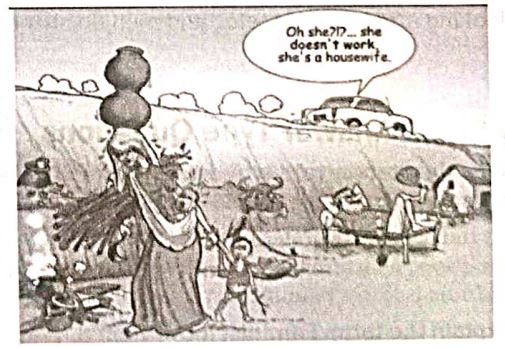
What is the cartoon trying to depict?
(a) The sexual division of labour in India.
(b) Natural and unchangeable gender divisions.
(c) Income generating activities done by women in rural India.
(d) The ability of men to contribute equally to domestic work as women.
1.
Caste can take various forms in politics.
(i) When parties choose candidates in elections, they keep in mind the caste composition of the electorate and nominate candidates from different caste to muster necessary support to win elections.
(ii) When governments are formed, political parties usually make sure that representatives of different castes and tribes find a place in it.
(iii) Political parties and candidates in elections make appeals to caste sentiment to muster support. Some political parties are known to favour some castes and are seen as their representatives.
(iv) There are many associations and even political parties formed in the name of castes. They openly contest in the election to protect the interests of a particular caste.
(v) Universal adult franchise and the principle of one-person-one-vote compelled political leaders to gear up to the task of mobilizing and securing political support. It also brought new consciousness among the people of castes that were hitherto treated as inferior and low. The focus on caste in politics can sometimes give an impression that elections are all about caste and nothing else.
2.
Communalism can take several forms in politics like
(i) The most common expression of communalism is of communal superiority in our everyday beliefs. For example, Militant religious groups.
(ii) Sometimes, communalism takes its worst form in riots. India and Pakistan suffered some of the worst communal riots at the time of partition.
(iii) A communal mind often leads to a quest for political dominance of one's own religious community.
(iv) Political mobilisation based on religion is another form of communalism. This involves the use of sacred symbols, religious leaders, emotional appeal to bring the followers of one religion together in political areas. In India. politicians are trying to influence voters exploiting their religious sentiments from the two largest religious communities in the country.
3.
Almost every country in the world has social diversities in respect to caste, race, religion, language, etc. Democracy is considered to be the most suitable form of government to accommodate these diversities.
It aims at giving equal rights and opportunities to all the citizens irrespective of caste, religion, colour, sex, race, etc.
Democracy is not simply ruled by majority opinion. The majority always needs to work for minority. Democracy does not believe in any kind of discrimination among citizens. Thus, it accommodates all social diversities.
4.
5.
(d)
933
6.
(b)
| 1 | 2 | 3 | 4 |
| B | A | D | C |
7.
(d)
Panchayati Raj bodies
8.
(b)
Pakistan
9.
(b)
inequalities exist in democracies
10.
In a Secular state there is no official religion. Freedom is given to all individuals to profess, practice and propagate any religion and no grounds of religion.
11.
It is a male dominated society where women face disadvantage, discrimination and oppression in various ways.
12.
Accountable government and responsive government
13.
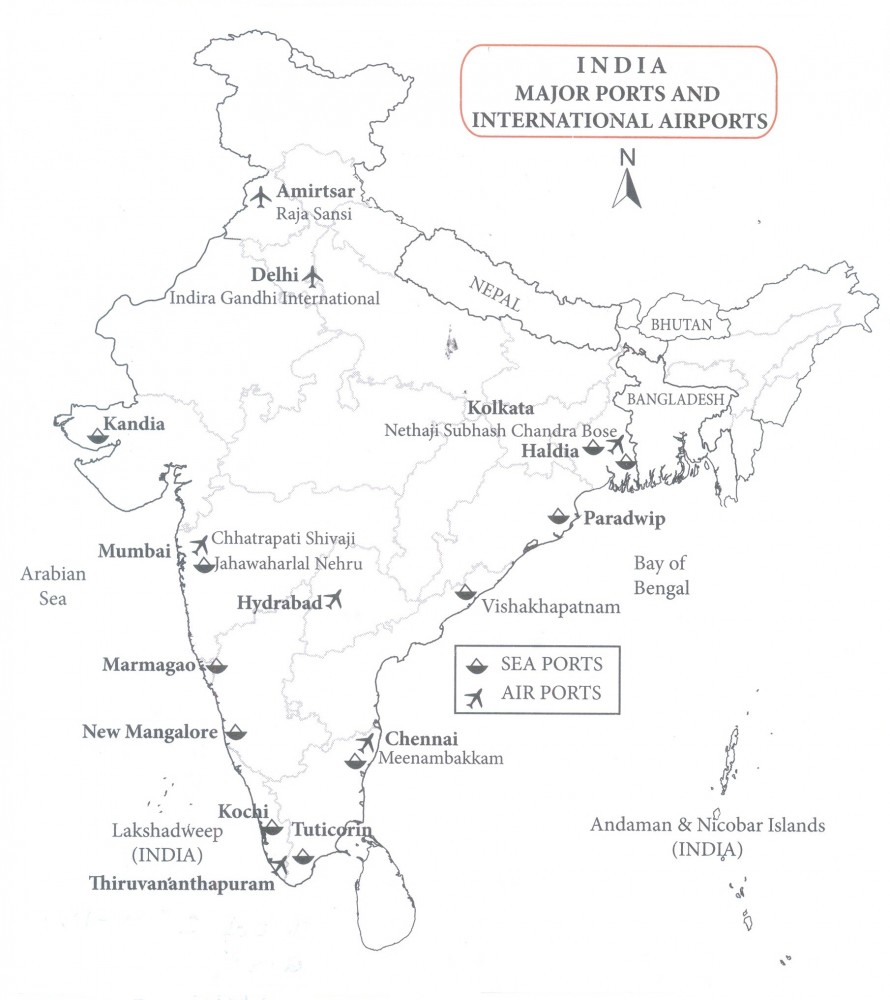
14.
(i) There are many feminists and women's movements worked to ensure more women as elected representatives.
(ii) In India, the proportion of women in the legislature has been very low. For example, the percentage of elected women members in Lok Sabha has crossed 10 percent of its total strength for the first time in 2009. Their share in the state assemblies is less than 5 percent. In this respect India is among the bottom group of nations in the world
(iii) On way to solve this problem is to make it legally binding to have a fair proportion of women in the elected bodies. This is what the Panchayat Raj has done in India.
(iv) Women organizations and activists have been demanding a similar reservation of at least one-third of seats in the Lok Sabha Assemblies for women.
15.
(i) Democracies accommodate various social divisions. for example, Belgium has peacefully solved her ethnic problems and solved the differences.
(ii) All democracies usually develop a procedure to competition, i.e. conduct elections, power-sharing, etc. This reduces the possibility of tensions, due to social divisions, turning violent or explosive.
(iii) Democracy teaches people to respect the differences and resolves conflicts among different groups peacefully. In non-democratic countries, rulers either turn a blind eye to or suppress internal differences. For example, Sri Lanka. The plus point in democratic regime is the ability to handle social differences, divisions and conflicts.
(iv) A democracy is not just a rule by majority opinion. The majority always needs to work with the minority so that the government represents the general view.
(v) A democratic government ensures that the rule by the majority does not become autocratic in terms of religion, race or linguistic group etc. It tries that in case of every election, different persons and groups can form a majority. It tries to see that every citizens has a chance to be in majority at some point of time and is not barred on the basis of birth. All these things ensured by a democratic regime lead to a peaceful and harmonious life.
16.
()
Religion
17.
(a) Both A and R are true and R is the correct explanation of A
18.
(a) Both A and R are true and R is the correct explanation of A
19.
(a) The sexual division of labour in India.

10th Standard CBSE Syllabus & Materials
10th Standard CBSE
CBSE 10th Social Science PS - Federalism - New Model Questions Papers Study Material - QB365 Set A
NEW10th Standard CBSE
CBSE 10th Social Science PS - Power Sharing - New Model Questions Papers Study Material - QB365 Set A
NEW10th Standard CBSE
CBSE 10th Social Science GEO - Manufacturing Industries - New Model Questions Papers Study Material - QB365 Set A
NEW10th Standard CBSE
CBSE 10th Social Science GEO - Minerals and Energy Resources - New Model Questions Papers Study Material - QB365 Set A



NCERT Books

Syllabus

Exam Pattern

Sample Question Papers

Previous year Question Papers

Important Notes

MCQ Practice test

NCERT Exemplers

Case study Questions

Image Based Questions

Passage based Questions

HOT Questions

Value Based Questions

Model Questions Papers
NCERT ( Book Back ) Questions

Assertion and Reason
Important Questions And Answers

CBSE 10th Standard CBSE Subjects
CBSE Standards



