
 100% FREE ACCESS
10th Standard CBSE Syllabus & Materials
10th Standard CBSE
CBSE 10th Social Science ECO - Globalisation and the Indian Economy - New Model Questions Papers Study Material - QB365 Set A
NEW10th Standard CBSE
CBSE 10th Social Science ECO - Money and Credit - New Model Questions Papers Study Material - QB365 Set A
NEW10th Standard CBSE
CBSE 10th Social Science ECO - Sectors of the Indian Economy - New Model Questions Papers Study Material - QB365 Set A
NEW10th Standard CBSE
CBSE 10th Social Science ECO - Development - New Model Questions Papers Study Material - QB365 Set A
NEW10th Standard CBSE
CBSE 10th Social Science PS - Outcomes of Democracy - New Model Questions Papers Study Material - QB365 Set A
NEW10th Standard CBSE
CBSE 10th Social Science PS - Gender, Religion and Caste - New Model Questions Papers Study Material - QB365 Set A

Published on: 22/10/2025
Download CBSE Class 10th Standard CBSE Social Science question papers, sample papers, important questions, and previous year solved papers in PDF format. Get free study materials, NCERT solutions, and exam preparation resources for Class 10th Standard CBSE Social Science
Questions + Answers key
Take MCQ Social Science Test
1.
The great Depression began in
1927
1928
1929
1930
2.
Which of the following households constitutes the largest segment of borrowers in the formal sector of credit?
Poor households
Rich households
Well-off households
Households with few assets
3.
Where was the first cement plant set up?
Mumbai
Chennai
Kolkata
Pondicherry
4.
Which is correct about Magnetite iron core?
Magnetite is the most important industrial iron ore in terms of quantity used
Magnetite has the inferior magnetic qualities which is not valuable in the electric industry
It is the finest iron ore with very high content of iron upto 70%.
It has a slightly lower iron content than hematite (50-60%)
5.
Match List I with List II and select the correct answer using the codes given below the Lists:
| List I | List II |
| 1. A person who believes in equal rights and opportunities for women and men | A. Communalist. |
| 2. A person who says that religion is the principal basis of community | B. Feminist |
| 3. A person who thinks that caste is the principal basis of community | C. Secularist |
| 4. A person who does not discriminate others on the basis of religious beliefs | D. Castiest |
| 1 | 2 | 3 | 4 |
| B | C | A | D |
| 1 | 2 | 3 | 4 |
| B | A | D | C |
| 1 | 2 | 3 | 4 |
| D | C | A | B |
| 1 | 2 | 3 | 4 |
| C | A | B | D |
6.
Which country has a two-party system?
India
Sri Lanka
United Kingdom
Nepal
7.
In which South Asia country is dictatorship preferred over democracy?
Bangladesh
Pakistan
Nepal
Sri Lanka
8.
Villages are connected to a major town through which scheme of roads?
MNREGA
PMGSY
SJGRY
AAY
9.
Match List I (organisations and struggles) with List II and select the correct answer using the codes given below the lists:
| List - I | List - II |
| 1. Congress Party | A. National Democratic Alliance |
| 2. Bharatiya Janata Party | B. State party |
| 3. Communist Party of India (Marxist) | C. United Progressive Alliance |
| 4. Telugu Desam party | D. Left Front |
| 1 | 2 | 3 | 4 |
| C | A | B | D |
| 1 | 2 | 3 | 4 |
| C | D | A | B |
| 1 | 2 | 3 | 4 |
| C | A | D | B |
| 1 | 2 | 3 | 4 |
| D | C | A | B |
10.
What is 'Rat hole' mining?
Mining in places where there are lots of rats
Mining done by family members in the form of a long narrow tunnel
Mining that kills rats
None of these
11.
Which one of the following agencies markets steel for the public sector plants?
HAIL
SAIL
TATA Steel
MNCC
12.
Koderma, in Jharkhand is the leading producer of which one of the following minerals?
bauxite
mica
iron ore
copper
13.
"Constant complaints by people can be seen as a testimony to the success of an democracy." Explain.
14.
What was the role of technology in transforming in the 19th century world? Explain with an example.
15.
What did the spread of print culture in nineteenth century India mean to:
(a) Women
(b) The poor
(c) Reformers
16.
How does the Reserve Bank of India supervise the functioning of banks? Why is this necessary?
17.
Explain any five importance of railways as a means of transport.
18.
Mention the faces responsible for localization of cotton textile industry in Maharashtra-Gujarat region in early years. What factors were responsible for the decentralisation of the industry? Mention three main problems faced by the industry. What is the contribution of textile industry to Indian economy?
19.
How is energy a basic requirement for the economic development of the country? Explain with examples
20.
How did the British manufacturers attempt to take over the Indian market with the help of Advertisements? Give three examples.
21.
Which two sections of society get special emphasis in Indian Constitution regarding equal status and equal opportunities?
22.
What does the term coalition government imply?
23.
What are placer deposits?
24.
What are agglomeration economies ?
25.
What is the result of the division of labour?
26.
Who were Gomasthas?
27.
What are taverns?
28.
Which is the essential feature of barter system?
29.
Name the western terminal of Golden quadrilateral.
30.
"Efficient means of transport are a prerequisite for fast development". Express your views in favour of this statement.
31.
Which types of minerals have provided a strong base for the development of metallurgical industries in India? Which particular mineral is termed as the backbone of industrial development and why?
32.
Examine how do industries pollute the freshwater resources.
33.
Describe how handloom cloth production expanded between 1900 and 1940?
34.
State different forms of the communal politics with one example of each.
35.
"Democratic governments are better than its alternative". Explain the statement.
36.
'No system is ideal for all countries and all situations'. Explain.
37.
Consider the following information
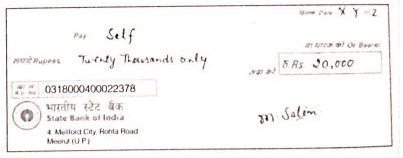
A shoe manufacturer, M. Salim has to make a payment to the leather supplier and writes a cheque for a specific amount. This means that the shoe manufacturer instructs his bank to pay this amount to the leather supplier. The leather supplier takes this cheque and deposits it in his own account in the bank. The money is trans- ferred from one bank account to another bank account in a couple of days. The transaction is complete without any payment of cash.
Now answer the following questions
Mr.Salim wants to withdraw Rs 20,000 in cash for making payments. How would he write a cheque to withdraw money?
38.
Social divisions based on .............. are peculiar to India.
1.
(c)
1929
2.
(b)
Rich households
3.
(b)
Chennai
4.
(c)
It is the finest iron ore with very high content of iron upto 70%.
5.
(b)
| 1 | 2 | 3 | 4 |
| B | A | D | C |
6.
(c)
United Kingdom
7.
(b)
Pakistan
8.
(b)
PMGSY
9.
(c)
| 1 | 2 | 3 | 4 |
| C | A | D | B |
10.
(b)
Mining done by family members in the form of a long narrow tunnel
11.
(b)
SAIL
12.
(b)
mica
13.
Complaints are treated as testimony to the success of democracy in the following ways.
(a) Complaints highlight the awareness of the people and their expectations from the system that has been put in place.
(b) It reflects that citizens are not overawed by those in power and can objectively and critically examine the difference they have made.
(c) It is a measure of their participation in public debates which democracy seeks to encourage.
(d) A public expression of dissatisfaction with democracy shows the success of the democratic project.
(e) It shows that people have transformed themselves from being subjects to being citizens.
14.
(i)Transformation of the world economy: Technology played a major role in all these developments. Railways, steam shipping, telegraph , ect., were important inventions without which it was not possible to imagine the transformation of nineteenth-century world.
(ii) Linking the markets: New investments and improvements in transport faster railways lighter wagons and larger ships helped move food more cheaply and quickly from far away farms to final markets.
(iii) Impact on the meat trade: Till the 1870s, moat from America was shipped to Europe in the form of live animals which were then slaughtered in Europe. But live animals took up a lot of ship space. Many also died in voltage fell ill lost weight or became unfit to eat. So the prices of meat were very high and it was beyond the reacts of the European poor. Due to high price the demand and production meat from one region to another.
(iv) Social peace and imperialism: The refigerated ships reduced shipping cost and lowered meat prices in Europe. The poor Europe could now consume a more varied diet. Better living conditions promoted social peace within the country and support for imperialism abroad.
(v) Colonialism: Technology played very important role in linking the world markets which promoted the sprit of colonialism.
15.
(a) Women
The spread of print culture in the 19th century India benefited Indian women through learning and education. Reading habits improved among them. With increase in literacy, women took great interest in reading and writing. Many journals started emphasising the importance of women's education. Many magazines and books were specially published for women.
The print culture gave the women some amount of freedom to read and develop their own views on various issues, especially those related to women. Women novelists such as Jane Austen and Bronte sisters in Europe and Kailashbashini Debi, Tarabai Shinde and Pandita Ramabai in India presented the new type of woman: a woman with the power to think and with the ability to act with, determination.
(b) The Poor
The poor people benefited from the spread of print culture as books were available at a low price. As the literacy rate improved in Europe as well as in India, printed material, especially for entertainment, began to reach even the poor.
In England, Penny Magazines were carried by peddlars and sold for a penny, so that even poor people could buy them. Those who could not read, could listen to the stories and folklore. These could be read out to them by others.
Books could be hired on a nominal fee from some book owners. Even in India, very cheap small books were brought to market in 19th century Madras and small towns, allowing poor people to have an access to print culture. Public libraries were set up in the early 20th century where poor people could visit and borrow books. Gradually, even poor people began to read religious stories, books with simple instructions or stories and folklore.
(c) Reformers
Reformers used newspapers, journals and books to highlight the social evils prevailing in society. Raja Rammohun Roy published the 'Sambad Kaumudi' to highlight the plight of widows. This newspaper actively campaigned for the abolition of the Sati.
In the 1880s, Tarabai Shinde and Pandita Ramabai wrote with passionate anger about the miserable lives of the upper-caste Hindu women. Especially the widows.
Jyotiba Phule wrote about the poor condition of the 'low caste people.' In his book 'Gulamgiri (1871), he wrote about the injustices of the caste system. In the 20th century, BR Ambedkar also wrote powerfully against the caste system. He also wrote against untouchability. EV Ramaswamy Naicker, also known as Periyar, wrote about the caste system prevailing in Madras
16.
Reserve Bank of India (RBI) supervised the banks in the following ways:
(i) It monitors the balance kept by banks for day-to-day transactions.
(ii) It checks that the banks give loans not just to profit-making businesses and traders but also to small borrowers.
(iii) Periodically banks have to give details about lending, borrowers and interest rate to RBI. It is necessary for securing public welfare. It avoids the bank to run the business with profit motive only. It also keeps a check on interest rate of credit facilities provided by bank. RBI makes sure that the loans from the banks are affordable and cheap.
17.
The importance of Indian Railways as a means of transport are described below
(i) Railways are considered as the principal mode of transportation for freight and passengers in India.
(ii) Railways help to conduct various activities, via, business, sightseeing, pilgrimage, transportation of goods over long distances, etc.
(iii) Railways bind the economic life of our country by accelerating the development of the industry and agriculture.
(iv) The Indian Railways have a huge network, connecting almost every corner of our country.
(v) The Indian Railways is the largest public sector, undertaking in the country which is the biggest employer in India.
18.
The favourable factors for the location of cotton textile industry in Maharashtra-Gujarat region in early years were as follows:
(a) Availability of raw cotton from the cotton growing belt of Deccan in Maharashtra and Gujarat.
(b) The port of Mumbai facilitating export of cotton goods and import of machineries and other inputs.
(c) Moist climate in the belt facilitated spinning.
(d) Market for the finished goods.
(e) Finance or capital from Parsi and Bhatia traders.
(f) Good transport network.
(g) Availability of cheap and skilled labour.
Decentralisation
(i) Huge market, development of transport network, banking facilities and availability of cheap electricity contributed to the decentralisation of cotton mills in the country.
(ii) Weaving is highly decentralised to provide scope for incorporating traditional skills and designs of weaving in cotton, zari, embroidery, etc., prevalent among local weavers in different parts of india.
Three major problems faced by cotton textile industries in India are:
(i) Erratic Power Supply.
(ii) Old and obsolete machinery.
(iii) Stiff competition with the synthetic fibre industry,
The textile industry occupies a unique position in the Indian economy:
(a) It contributes significantly to industrial production, 14 per cent of the total production of industries comes from textiles.
(b) It provides employment to about 35 million people directly.
(c) It contributes about 24.6 percent of the foreign exchange earnings of the country.
(d) Textiles contribute 4 percent towards GDP.
19.
(i) Energy is the basic requirement for economic development.
(ii) Every sector of national economy agriculture, industry, transport and commerce needs greater inputs of energy.
(iii) In the domestic sector also energy demands in the form of electricity are growing because of increasing use of electric gadgets and appliances.
(iv) The economic development plans implemented since independence necessarily required increasing amount of energy.
(v) Because of all these, per capita consumption of energy is continuously increasing.
20.
Use of Indian icons, national heroes.
21.
Two sections of society getting special emphasis in Indian Constitution regarding equal status and equal opportunities are women, and disadvantaged and discriminated castes and tribes.
22.
The term coalition government implies a government which is formed by various parties coming together in the situation in the situation when no single party wins the majority of seats.
23.
Certain minerals may occur as alluvial deposits in the sands of the valley floors and the base of hills. These deposits are called 'placer deposits'
24.
Many industries tend to come together to make use of the advantages offered by the urban centres. This is known as agglomeration economies.
25.
The result of this division of labour is that although women constitute half of the humanity, their role in public life, especially politics, is minimal in most societies.
26.
They were paid servants of East India Company who use to supervise weavers, collect supplies and examine the quality of cloth.
27.
Places where people gathered to drink alcohol, to be served food, and to meet friends and exchange news.
28.
Double coincidence of wants is an essential feature of this system.
29.
Mumbai
30.
Efficient means of transport are a prerequisite for the fast development as
Roads connect distant areas and increase connectivity.
Transport of perishable goods become easier.
Rail transport helps in the movement of heavy goods.
Ports help in the import as well as export of goods.
31.
Ferrous minerals which account for about three-fourths of the total value of the production of metallic minerals in India, provide a strong base for the development of the metallurgical industries in India. These industries extract and purify the metals and produce them in usable forms for their application in various other industries. Iron ore, a ferrous mineral, is the basic mineral and the backbone of industrial development. It is the key to progress in the present mechanical civilisation. Iron and steel made from iron ore and its alloys is used to make machines. Machines determine the development of industries. As the basic tools, implements and machines required in the industries are made of iron, industrial development is determined by iron.
32.
Fresh water sources are polluted by
(a) Organic and inorganic wastes.
(b) Effluents discharged by industries into rivers.
(c) The main culprits are paper and pulp, chemical, textile, petroleum, refineries, tanneries industries, etc.
33.
(i) Handicrafts producers adopted a new technology which helped in improving the production without excessively pushing up the costs.
(ii) By the second decade of the Twentieth century, most of the weavers started using looms with a fly shuttle. This increased productivity per worker, speeded up production, and reduced the labour demand. By 1941 over 35 percent of handlooms in India were fitted with fly shuttles in regions like Travancore, Madras (Chennai) Mysore, Cochin and Bengal where the proportion was 70 to 80 percent.
(iii) There were several other small innovations that helped weavers to improve their productivity and compete with the mill sector.
34.
Communalism can take several forms in politics like
(i) The most common expression of communalism is of communal superiority in our everyday beliefs. For example, Militant religious groups.
(ii) Sometimes, communalism takes its worst form in riots. India and Pakistan suffered some of the worst communal riots at the time of partition.
(iii) A communal mind often leads to a quest for political dominance of one's own religious community.
(iv) Political mobilisation based on religion is another form of communalism. This involves the use of sacred symbols, religious leaders, emotional appeal to bring the followers of one religion together in political areas. In India. politicians are trying to influence voters exploiting their religious sentiments from the two largest religious communities in the country.
35.
(1) Democratic government is a legitimate government
(2) It may be slow, less efficient, not always very responsive or clean. But it is the people's own govt.
(3) There is overwhelming support for the idea of democracy all over the world, in countries with democratic regimes as well as countries without democratic regimes.
36.
No system is ideal for all countries and in all situations because party system is not something any country can choose. It evolves over a long time, depending on the nature of society, its social and regional divisions, its history of politics and its system of elections. Each country develops a party system that is conditioned by its special circumstances.
37.
38.
()
Caste

10th Standard CBSE Syllabus & Materials
10th Standard CBSE
CBSE 10th Social Science PS - Federalism - New Model Questions Papers Study Material - QB365 Set A
NEW10th Standard CBSE
CBSE 10th Social Science PS - Power Sharing - New Model Questions Papers Study Material - QB365 Set A
NEW10th Standard CBSE
CBSE 10th Social Science GEO - Manufacturing Industries - New Model Questions Papers Study Material - QB365 Set A
NEW10th Standard CBSE
CBSE 10th Social Science GEO - Minerals and Energy Resources - New Model Questions Papers Study Material - QB365 Set A



NCERT Books

Syllabus

Exam Pattern

Sample Question Papers

Previous year Question Papers

Important Notes

MCQ Practice test

NCERT Exemplers

Case study Questions

Image Based Questions

Passage based Questions

HOT Questions

Value Based Questions

Model Questions Papers
NCERT ( Book Back ) Questions

Assertion and Reason
Important Questions And Answers

CBSE 10th Standard CBSE Subjects
CBSE Standards



