
 100% FREE ACCESS
10th Standard CBSE Syllabus & Materials
10th Standard CBSE
CBSE 10th Social Science ECO - Globalisation and the Indian Economy - New Model Questions Papers Study Material - QB365 Set A
NEW10th Standard CBSE
CBSE 10th Social Science ECO - Money and Credit - New Model Questions Papers Study Material - QB365 Set A
NEW10th Standard CBSE
CBSE 10th Social Science ECO - Sectors of the Indian Economy - New Model Questions Papers Study Material - QB365 Set A
NEW10th Standard CBSE
CBSE 10th Social Science ECO - Development - New Model Questions Papers Study Material - QB365 Set A
NEW10th Standard CBSE
CBSE 10th Social Science PS - Outcomes of Democracy - New Model Questions Papers Study Material - QB365 Set A
NEW10th Standard CBSE
CBSE 10th Social Science PS - Gender, Religion and Caste - New Model Questions Papers Study Material - QB365 Set A

Published on: 07/12/2018
The Central Board of Secondary Education (CBSE) is a prestigious educational board which comes under the Union Government of India. Here, you will get the clue that from where and how the questions are being framed from the chapter Federalism for CBSE Class 10 Science. These questions can provide students a chapter wise preparation strategy so that they can prepare for their exam more efficiently.
The National Council of Education and Training sets the curriculum for all schools that follow the Central Board of Secondary Education (CBSE) across the nation. The important questions provided below will also make students familiar with the marking scheme and the difficulty level of the exam. The important questions for CBSE class 10 Social Science are prepared by subject experts according to the latest syllabus of CBSE. Students are advised to solve these important questions which can make them more focused on their exam and also bring a sense of discipline and seriousness in their exam preparation.
Creative questions were added in this question paper in order to enhance the student's knowledge and get the idea that how to answer strategic questions asked in the board exams. This question paper is designed based on the academic syllabus. Sample papers should be practiced in examination condition at home or school and also show it to your teachers for checking or compare with the answers provided.
Download CBSE Class 10th Standard CBSE Social Science question papers, sample papers, important questions, and previous year solved papers in PDF format. Get free study materials, NCERT solutions, and exam preparation resources for Class 10th Standard CBSE Social Science
Questions + Answers key
Take MCQ Social Science Test
1.
What is Panchayati Raj? What is its importance?
2.
State any two differences between the local governments before and after the Constitutional Amendment in 1992.
3.
The distinguishing feature of a federal government is:
(a)National government gives some powers to the provincial governments.
(b)Power is distributed among the legislature, executive, and judiciary.
(c)Elected officials exercise supreme power in the government
(d)Governmental power is divided between different levels of government
4.
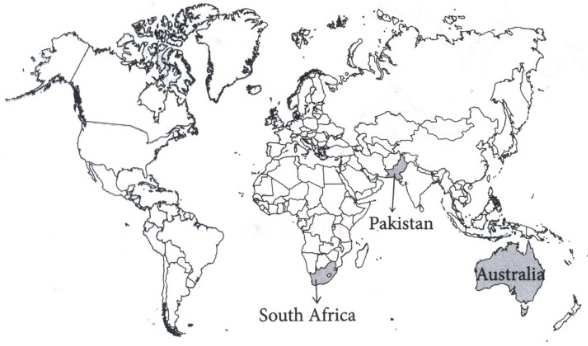
Identify ans Shade three federal countries (Other than India) on a blank outline political map of the world.
5.
Since the United States is a ___________________ type of federation, all the constituent States have equal powers and States are ______________vis-a-vis the federal government. But India is a _____________________ type of federation and some States have more power than others. In India, the ____________ government has more powers.
6.
Who is the chairperson of municipal Corporation?
Block development officer
Mayor
Sarpanch
Member of Lok Sabha
7.
How many scheduled languages are recognized by the constitution?
Besides Hindus, there are 18 scheduled, languages
Besides Hindi, there are 21 scheduled languages
Besides Hindi there are 22 scheduled languages
Besides Hindi there are 19 scheduled languages
8.
Consider the statement: "Coming together federation" involves
(i)the central government to become more powerful
(ii)Independent states coming together on their own to form bigger unit
(iii)Constituent units have unequal powers.
(iv)Constituent states have equal powers.
Which of the statements given above is correct
(i),(ii) and (iv)
(i), (iii) only
(ii) and (iv) only
(i), (iii) and (iv)
9.
Consider the following statements.
A.In a federation, the powers of the federal and provincial governments are clearly demarcated.
B.India is a federation because the powers of the Union and State Governments are specified in the Constitution and they have exclusive jurisdiction on their respective subjects.
C.Sri Lanka is a federation because the country is divided into provinces.
D.India is no longer a federation because some powers of the states have been developed to the local government bodies.
Which of the statements given above are correct?
A, B and C
A, C and D
A and B only
B and C only
10.
Match the List I with List Il and select the correct answer using the codes given below the lists.
| List I | List II |
|---|---|
| 1. Union of India | A. Prime Minister |
| 2. State | B. Sarpanch |
| 3. Municipal corporation | C. Governor |
| 4. Gram Panchayat | D. Mayor |
| 1 | 2 | 3 | 4 |
| D | A | B | C |
| 1 | 2 | 3 | 4 |
| B | C | D | A |
| 1 | 2 | 3 | 4 |
| A | C | D | B |
| 1 | 2 | 3 | 4 |
| C | D | A | B |
11.
Where do we find municipalities and corporation?
12.
Mention the reason for the real success of federation in India
13.
When was India declared as a union of states?
14.
Who is the head of the gram panchayat?
15.
Which type of government to Tamils of Sri Lanka want?
16.
Describe in brief the language policy in India
17.
How is federalism practised in India?
18.
What are the power-sharing arrangement in India?
19.
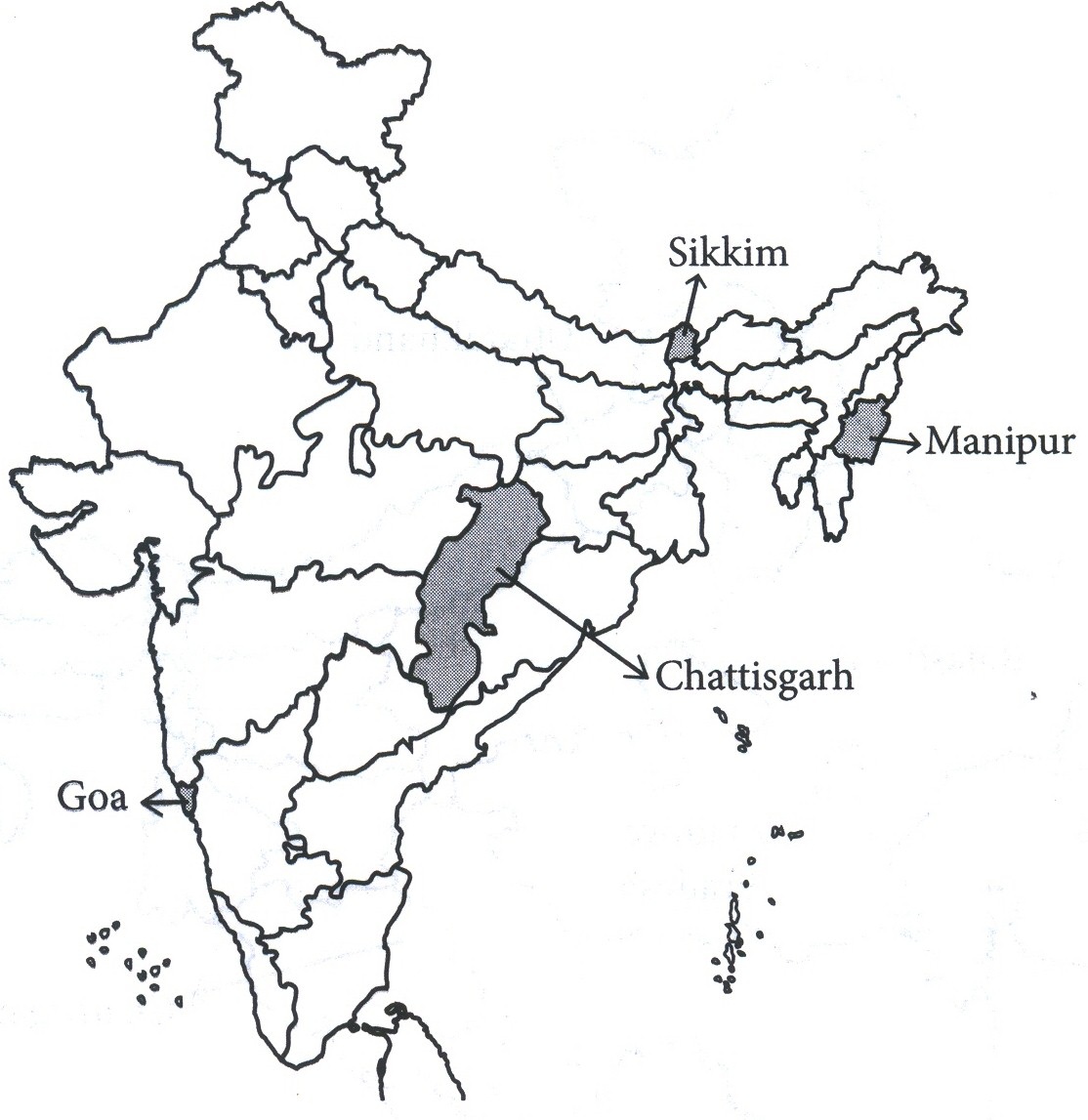
Locate the following states on a blank outline political map of India
(i)Manipur
(ii)sikkim
(iii)Chhattisgarh
(iv)Goa
1.
Each village, or a group of villages in some States, has a gram panchayat which is a council consisting of several ward members, often called, panch and a president or sarpanch. They are directly elected by all the adult population living in that ward or village. It is the decision making body for the entire village. The panchayat works under the overall supervision of the gram sabha. A few gram panchayats are grouped together to form a panchayat samiti or block or mandal. The members of this representative body are elected by all the panchayat members in that area.
All the panchayat samitis and mandals in a district together constitute the zilla (district) parishad. Most of the zilla parishad members are elected. Members of the Lok Sabha and MLAs of that district level body are also its members. Local bodies that exist for the urban areas are known as municipalities. Big cities are constituted into municipal corporations. Both municipalities and municipal corporations are controlled by elected bodies consisting of people's representatives. Municipal Chairperson is the political head of the municipality. In a municipal corporation, such an officer is called the Mayor.
2.
The differences between the Local governments before and after the Constitutional Amendment in 1992 are
| Local Government before 1992 | Local Government after 1992 |
| Local governments were directly under the control of the State Government. | Local governments have got some powers of their own. |
| Elections were controlled by the State Governments. | An independent State Election Commission (SEC) is responsible to conduct the elections. |
3.
Governmental power is divided between different levels of government
4.
Three federal countries other than India are:
(1) South Africa (2) Australia (3) Pakistan
5.
(i) coming together
(ii) stronger
(iii) holding together
(iv) Central
6.
(b)
Mayor
7.
(b)
Besides Hindi, there are 21 scheduled languages
8.
(c)
(ii) and (iv) only
9.
(c)
A and B only
10.
(c)
| 1 | 2 | 3 | 4 |
| A | C | D | B |
11.
Municipalities are set up in towns. Big cities are constituted into municipal corporations. Municipal Chair person is the political head in a Municipality. Incorporation Mayor is the political head.
12.
The real success of the federation in India can be attributed to the nature of democratic politics in our country. This ensured that the spirit of federation, respect for diversity and desire for living together became shared ideals in our country.
13.
Soon after Independence, several princely states became a part of the country. The constitution declared India as a union of states.
14.
Sarpanch is the head of the gram panchayat.
15.
The Tamils of Sri Lanka want Federal type of government
16.
It is practiced in India by
(a) Organizing linguistic states
(b) Developing a language policy
(c) Re-structuring the State-Centre relations
(a) Organizing Linguistic States
(i) The creation of Linguistic States was the first and a major test for democratic politics in our country.
(ii) This was done to ensure that people who spoke the same language lived in the same State.
(iii) Some States were created not on the basis of language but to recognize differences based on culture, ethnicity or geography.
(iv) It has actually made the country, more united.
(v) It has also made administration easier.
(vi) These include States like Nagaland, Uttarakhand and Jharkhand.
(b) Developing a Language Policy
(i) A second test for Indian federation is the language policy.
(ii) Our Constitution did not give the status of national language to any one language.
(iii) Hindi is the official language of the Union of India.
(iv) 21 languages are recognized as Scheduled Languages by the Constitution.
(v) Examinations for the central government posts may be taken by the candidates in any of the scheduled languages.
(vi) Each state has its own official language.
(vii) According to the Constitution, English as an official language was supposed to be discontinued in 1965. However, due to opposition by non-Hindi speaking states, both English and Hindi are being continued for official purposes
(viii) Promotion does not mean that the Central Government can impose Hindi on States where people speak a different language.
Re-structuring the Centre-State Relations
(i) Restructuring the Centre-State relations is one more way in which federalism has been strengthened in practice.
(ii) The constitutional arrangement for sharing power work in reality depends to a large extent on how the ruling parties and leaders follow these arrangements.
(iii) Rise of a number of regional parties and establishment of coalition governments led to a new culture of power sharing and respect for the autonomy of the state governments.
17.
It is practiced in India by
(a) Organizing linguistic states
(b) Developing a language policy
(c) Re-structuring the State-Centre relations
(a) Organizing Linguistic States
(i) The creation of Linguistic States was the first and a major test for democratic politics in our country.
(ii) This was done to ensure that people who spoke the same language lived in the same State.
(iii) Some States were created not on the basis of language but to recognize differences based on culture, ethnicity or geography.
(iv) It has actually made the country, more united.
(v) It has also made administration easier.
(vi) These include States like Nagaland, Uttarakhand and Jharkhand.
(b) Developing a Language Policy
(i) A second test for Indian federation is the language policy.
(ii) Our Constitution did not give the status of national language to any one language.
(iii) Hindi is the official language of the Union of India.
(iv) 21 languages are recognized as Scheduled Languages by the Constitution.
(v) Examinations for the central government posts may be taken by the candidates in any of the scheduled languages.
(vi) Each state has its own official language.
(vii) According to the Constitution, English as an official language was supposed to be discontinued in 1965. However, due to opposition by non-Hindi speaking states, both English and Hindi are being continued for official purposes
(viii) Promotion does not mean that the Central Government can impose Hindi on States where people speak a different language.
Re-structuring the Centre-State Relations
(i) Restructuring the Centre-State relations is one more way in which federalism has been strengthened in practice.
(ii) The constitutional arrangement for sharing power work in reality depends to a large extent on how the ruling parties and leaders follow these arrangements.
(iii) Rise of a number of regional parties and establishment of coalition governments led to a new culture of power sharing and respect for the autonomy of the state governments.
18.
(i) The Constitution originally provided for a two-tier system of government, the Union Government (Central Government) and the State governments.
(ii) A third tier of federalism was added in the form of Panchayats and Municipalities.
(iii) These different tiers enjoy separate jurisdiction.
(iv) The Constitution provided a threefold distribution of legislative powers between the Union Government and the State Governments.
(v) Thus, it contains three lists.
(a) Union List
It includes subjects of national importance such as defence of the country, foreign affairs, banking, communications and currency. These are included in this list because we need a uniform policy on these matters throughout the country. The Union Government alone can make laws relating to the subjects mentioned in the Union List.
(b) State List
It contains subjects of State and local importance such as police, trade, commerce, agriculture and irrigation. The State Governments alone can make laws relating to the subjects mentioned in the State List.
(c) Concurrent List
It includes subjects of common interest to both the Union Government as well as the State Governments, such as education, forest, trade unions, marriage, adoption and succession.
Both the Union as well as the State Governments can make laws on the subjects mentioned in this list. If their laws conflict with each other, the law made by the Union Government will prevail.
19.

10th Standard CBSE Syllabus & Materials
10th Standard CBSE
CBSE 10th Social Science PS - Federalism - New Model Questions Papers Study Material - QB365 Set A
NEW10th Standard CBSE
CBSE 10th Social Science PS - Power Sharing - New Model Questions Papers Study Material - QB365 Set A
NEW10th Standard CBSE
CBSE 10th Social Science GEO - Manufacturing Industries - New Model Questions Papers Study Material - QB365 Set A
NEW10th Standard CBSE
CBSE 10th Social Science GEO - Minerals and Energy Resources - New Model Questions Papers Study Material - QB365 Set A



CBSE 10th Standard CBSE Subjects
CBSE Standards





