
 100% FREE ACCESS
10th Standard CBSE Syllabus & Materials
10th Standard CBSE
CBSE 10th Social Science ECO - Globalisation and the Indian Economy - New Model Questions Papers Study Material - QB365 Set A
NEW10th Standard CBSE
CBSE 10th Social Science ECO - Money and Credit - New Model Questions Papers Study Material - QB365 Set A
NEW10th Standard CBSE
CBSE 10th Social Science ECO - Sectors of the Indian Economy - New Model Questions Papers Study Material - QB365 Set A
NEW10th Standard CBSE
CBSE 10th Social Science ECO - Development - New Model Questions Papers Study Material - QB365 Set A
NEW10th Standard CBSE
CBSE 10th Social Science PS - Outcomes of Democracy - New Model Questions Papers Study Material - QB365 Set A
NEW10th Standard CBSE
CBSE 10th Social Science PS - Gender, Religion and Caste - New Model Questions Papers Study Material - QB365 Set A

Published on: 13/02/2020
10th standard CBSE Mathematics Board Exam Model Question Paper I 2020
Download CBSE Class 10th Standard CBSE Maths question papers, sample papers, important questions, and previous year solved papers in PDF format. Get free study materials, NCERT solutions, and exam preparation resources for Class 10th Standard CBSE Maths
Questions + Answers key
Take MCQ Maths Test
1.
If \(\sqrt { 2 } \sin { \theta } =1\), find the value of \(\sec ^{ 2 }{ \theta } -cosec^{ 2 }\theta \)
2.
Two tangents making an angle of 60° between them are drawn to a circle of radius \(\sqrt{3}\) cm, then find the length of each tangent.
3.
Find the distance of the point (-4, -7) from the y-axis.
4.
What is the sum of five positive integers divisible by 6.
5.
Find the value of k, if - 1 is a zero of the polynomial p(x) = kx2 - 4x + k.
6.
The ages of employees in a factory are as follows:
| Age (in years) | 17-23 | 23-29 | 29-35 | 35-41 | 41-47 | 47-53 |
|---|---|---|---|---|---|---|
| Number of employees | 2 | 5 | 6 | 4 | 2 | 1 |
Find the median age of the employees.
7.
Draw a circle of radius 4 cm. Take a point P outside the circle. Without using the centre of the circle, draw two tangents to the circle from P.
8.
Write the name of the common point of the tangent to a circle and the circle.
9.
The probability of getting a bad egg from a lot of 400 eggs is 0.035.Find the number of bad eggs in the lot.
10.
Find the fourth vertex D of a parallelogram ABCD whose three vertices are A(-2,3) B(6,7) and C(8,3).
11.
A tower stands vertically on the ground. From a point on the ground which is 60m away from the foot of the tower, the angle of elevation of the top of the tower is found to be 60o. Find the height of the tower.
12.
A 20m deep well with diameter 7m is dug and the earth from digging is evenly spread out to form a platform 22m by 14m.Find the height of the platform.
13.
Check whether 301 is a term of the list of numbers 5, 11, 17, 23,......
14.
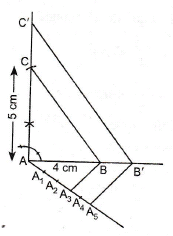
Draw a right triangle in which the sides containing the right angle are 5 cm and 4cm. Construct a similar triangle whose sides are \(5\over 3\) times the sides of the given triangle.
15.
For what value of p, are 2p + 1, 13, 5p - 3 three consecutive terms of an AP?
16.
If in \(\triangle\)ABC, AD is median and AE \(\bot\) BC, then prove that AB2 + AC2 = 2AD2 + \(\frac {1}{2}\)BC2.
17.
AB is a diameter of a circle and AC is its chord such that \(\angle BAC=30°\). If the tangent at C intersects AB extended at D, then prove that BC = BD.
18.
The sum of first n, 2n and 3n terms of an AP are S1, S2 and S3, respectively. Prove that S3 = 3(S2 - S1).
19.
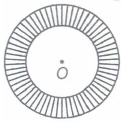
The shaded area, in the figure between the circumference of two concentric circles is 346.5 cm2 . The circumference of the inner circle is 88 cm. Calculate the radius of the outer circle.
20.
A box contain 100red cards, 200 yellow cards and 50blue cards.If a card is drawn at random from the box, the find the probability that it will be:
(i)A blue card
(ii)Not a yellow card
(iii)Neither yellow nor a blue card.
21.
If the point A(0,2) is equidistant from the points B(3,p) and C(p,5), find p. Also find the length of AB.
22.
A pole 5 m high is fixed on the top of a tower. The angle of elevation of the top of the pole observed from a point 'A' on the ground is 60o and the angle of depression of the point 'A' from the top of the tower is 45o . Find the height of the tower. \((\sqrt { 3 } =1.73)\)
23.
To find out the concentration of SO2 in the air (in parts per million, i.e, ppm), the data was collected for 30 localities in a certain city and its presented below:
| Concentration of SO2 (in ppm) | Frequency |
|---|---|
| 0.00-0.04 | 4 |
| 0.04-0.08 | 9 |
| 0.08-0.12 | 9 |
| 0.12-0.16 | 2 |
| 0.16-0.20 | 4 |
| 0.20-0.24 | 2 |
Find the mean concentration of SO2 in the air.
24.
Prove that \(\cot ^{ 2 }{ A } \left[ \frac { \sec { A } -1 }{ 1+\sin { A } } \right] +\sec ^{ 2 }{ A } \left[ \frac { \sin { A } -1 }{ 1+\sec { A } } \right] =0\)
25.
Two sets of English and Social Science Books containing 336 and 96 books respectively in a library, have to be stacked in such a way that all the books are stored topicwise and the height of each stack is the same. Assuming that the books are of the same thickness, determine the total number of stacks. What are the characteristics of library?
[Number of stacks = \(\frac { 336+96 }{ HCF\left( 336,96 \right) } \)]
26.
All the three face cards of spades are removed from a well-shuffled pack of 52 cards. A card is then drawn at random from the remaining pack. Find the probability of getting
(i) a spade
27.
Check whether -3 is a solution of the equation \(3x^{ 2 }+5x+2=0\)
28.
Find the cost of fencing a circular field of area 9856 m2 at the rate of Rs. 20 per metre.
29.
The angle of elevation of the top of a tower from two distinct points s and t from its foot are complementary.Prove that the height of the tower is \(\sqrt{st}\)
30.
Water is flowing at the rate of 15 km/hour through a pipe of diameter 14 cm into a cuboidal pond which is 50 m long and 44 m wide. In what time will the level of water in the pond rise by 21 cm?
31.
Name the type of quadrilateral formed, if any, by the following points, and give reasons for your answer. (-1, -2), (1, 0), (-1, 2), (-3, 0)
32.
The difference of any two sides of a triangle is always __________ than the third side.
33.
There is a circular path around a sport field. Sonia takes 18min to drive one around of the field, while Ravi takes 12min for the same. Suppose they both start at the same point at the same time, and go in the same direction, after how minutes will they meet again at the starting point?
3
36
6
18
34.
If the radius of the base of a right circular cylinder is halved keeping the height same, then the ratio of the volume of the cylinder thus obtained to the volume of original cylinder is
1:2
2:1
4:1
1:4
35.
The length of shadow of a tower on the plane ground is √3 times the height of the tower. The angle of elevation of sun is :
90o
60o
30o
45o
36.
PT and PS are tangents drawn to a circle, with cantre C, from a point P. If ∠TPS = 50° , then the measure of ΔTCS is
150o
120o
100o
130o
1.
Given, \(\sqrt { 2 } \sin { \theta } =1\)
\(\sin { \theta } =\frac { 1 }{ \sqrt { 2 } } =\sin { { 45 }^{ ° } } \)
\(\therefore \quad \theta ={ 45 }^{ ° }\)
Now \(\sec ^{ 2 }{ \theta } -cosec^{ 2 }\theta \) = \(\sec ^{ 2 }{ { 45 }^{ ° } } -cosec^{ 2 }{ 45 }^{ ° }\)
\(={ \left( \sqrt { 2 } \right) }^{ 2 }-{ \left( \sqrt { 2 } \right) }^{ 2 }\)
= 2 - 2
= 0
2.
\(\tan { { 30 }^{ ° } } =\frac { OA }{ AP } \)
\(\Rightarrow \quad \frac { 1 }{ \sqrt { 3 } } =\frac { \sqrt { 3 } }{ AP } \)
\(\Rightarrow \quad AP=\sqrt { 3 } \times \sqrt { 3 } =\) 3 cm
3.
Points are (-4, -7) and (0, -7)
Distance = \(=\sqrt { { \left( 0+4 \right) }^{ 2 }+{ \left( -7+7 \right) }^{ 2 } } =\sqrt { { 4 }^{ 2 }+0 } =\sqrt { 16 } \) = 4 units
4.
Here, a = 6, d = 6, n = 5
\(\because\) S = n/2[2a+(n-l)d]
S5 = 5/2[2x6+(5-1)(6)]
= 5/2[12+4x6]
= 5/2[12+24] = 5/2[36]
= 5x18 = 90
5.
Since, - 1 is a zero of the polynomial
p(x) = kx2 - 4x + k,
then p(-1) = 0
\(\therefore\) k(-1)2 - 4 (- 1) + k = 0
\(\Rightarrow\) k + 4 + k = 0
\(\Rightarrow\) 2k + 4 = 0
\(\Rightarrow\) 2k = - 4
Hence, K = - 2
6.
32
7.
1. Draw a circle of centre O and radius 4 cm.
2. Take a point P outside the circle and draw a secant PAB, intersect~ng the circle at A and B.
3. Produce AP to C such that AP = CP.
4. Draw a semi-circle with CB as diameter.
5. Draw \(PD\bot CB\) intersecting the semi-circle at D.
6. With P as centre and PD as radius, draw arcs to intersect the given circle at T and T'.
7. Join PT and PT'. Thus, PT and PT' are the required tangents.
8.
The common point of the tangent to a circle and the circle is called the point of contact.
9.
Number of bad eggs\(=400\times0.035=400\times{35\over1000}\)
= 14
10.
Here, \(\frac { -2+8 }{ 2 } =\frac { 6+x }{ 2 } \Rightarrow x=0\)
and \(\frac { 3+3 }{ 2 } =\frac { 7+y }{ 2 } \Rightarrow y=-1\)
Thus, the fourth vertex D of parallelogram ABCD is D(0,-1).
11.
Let AB be tower of height h m and C is a point on the ground such that BC=60 m
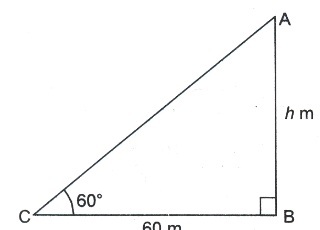
As ㄥACB=600 and AB=h m
Consider rt. angled ΔABC, we have
tan 600=\(\frac { AB }{ BC } \)
⇒ \(\sqrt { 3 } =\frac { h }{ 60 } \)
⇒ h=60\(\sqrt { 3 } \) m.
Hence, the height of the tower is 60 \(\sqrt { 3 } \) m.
12.
The shape of the well will be cylindrical.
Depth (h) of well = 20 m
Radius (r) of circular end of well = 7/2 m
Area of platform = Length × Breadth = 22 × 14 m2
Let height of the platform = H
Volume of soil dug from the well will be equal to the volume of soil scattered on the platform.
Volume of soil from well = Volume of soil used to make such platform
Π x r2 x h = Area of platform x Height of Platform
\(\begin{array}{l} \Pi \times\left(\frac{7}{2}\right)^{2} \times 20=22 \times 14 \times H \\ \therefore H=\frac{22}{7} \times \frac{49}{4} \times \frac{20}{22 \times 14}=\frac{5}{2} m=2.5 \mathrm{~m} \end{array}\)
Therefore, the height of such platform will be 2.5 m.
13.
We have :
a2 – a1 = 11 – 5 = 6,
a3 – a2 = 17 – 11 = 6,
a4 – a3 = 23 – 17 = 6
As ak + 1 – ak is the same for k = 1, 2, 3, etc., the given list of numbers is an AP.
Now, a = 5 and d = 6.
Let 301 be a term, say, the nth term of this AP.
We know that
an = a + (n – 1) d
So, 301 = 5 + (n – 1) x 6
i.e., 301 = 6n – 1
So, \(n=\frac{302}{6}=\frac{151}{3}\)
But n should be a positive integer . So, 301 is not a term of the given list of numbers.
14.
∴ AB'C' is the required triangle.
15.
If terms are in AP, then 13 - (2p + 1) = (5p - 3) - 13
\(\Rightarrow\) 13 - 2p -1 = 5p - 3 - 13
\(\Rightarrow\) 28 = 7p
\(\Rightarrow\) p = 4
16.
AB2 + AC2 = 2AD2 + 2(\(\frac {1}{2}\)BC)2
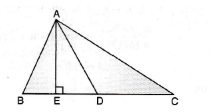
Draw AE \(\bot\) BC
In \(\triangle\)ABE,
AB2 = AE2 + BE2 (Pythagoras theorem)
AB2 = AD2 - DE2 + (BD - DE)2
= AD2- DE2 + BD2 + DE2-2BD x DE
AB2 = AD2 + BD2 - 2BD x DE ....(i)
In \(\triangle\)AEC,
AC2 = AE2 + EC2
\(\Rightarrow\) AC2 = (AD2 - ED2) + (ED + DC)2
= AD2-ED2 + ED2+ DC2 +2ED x DC
\(\Rightarrow\) AC2 = AD2 + CD2 + 2ED x CD
\(\Rightarrow\) AC2 = A02 + OC2 + 20C x DE ....(ii)
Adding eqns. (i) & (ii),
AB2 + AC2 = 2(AD2 + BD2) (\(\therefore\)BD = DC)
\(=2\left[ { AD }^{ 2 }+\left( \frac { 1 }{ 2 } { BC }^{ 2 } \right) \right] \)(as BD = 1/2BC)
or AB2 + AC2 = 2(AD2 + BD2)
Hence proved .
17.
\(50\sqrt { 3 } cm^{ 2 }\)
18.
Let a be the first term and d be the common difference of given AP.
According to the question,
\(S_{ 1 }=S_{ n }=\frac { n }{ 2 } \left[ 2a+(n-1)d \right] \\ S_{ 2 }=S_{ 2n }=\frac { 2n }{ 2 } \left[ 2a+(2n-1)d \right] \)
and \(S_{ 3 }=S_{ 3n }=\frac { 3n }{ 2 } \left[ 2a+(3n-1)d \right] \)
Now, \(S_{ 2 }-S_{ 1 }=\frac { 2n }{ 2 } \left[ 2a+(n-1)d \right] -\frac { n }{ 2 } \left[ 2a+(n-1)d \right] \)
\(=\frac { n }{ 2 } \left[ 2\left\{ 2a+(2n-1d \right\} -\left\{ 2a+(n-1d \right\} \right] \\ =\frac { n }{ 2 } \left[ 2a+(3n-1)d \right] \\ \therefore \ 3\left( S_{ 2 }-S_{ 1 } \right) =\frac { 3n }{ 2 } \left[ 2a+(3n-1)d \right] \\ \Rightarrow \ 3\left( S_{ 2 }-S_{ 1 } \right) =S_{ 3 }\ or S_{ 3 }=3\left( S_{ 2 }-S_{ 1 } \right) \)
19.
Let r and R be inner and outer radii respectively,
then, \(2 \pi r=88\)
and \(\pi\left[R^{2}-r^{2}\right]=346.5\)
= \(17.5 \ cm\)
20.
(i)Total number of cards in the box
=100+200+50=350
Number of blue cards=50
P(a blue card)\(={50\over 350}={1\over7}\)
(ii)Number of yellow cards=200
Number of non yellow cards =350-200=150
P(not a yellow card)\(={150\over350}={3\over 7}\)
(iii)Number of yellow or blue cards in the box = 200+50=250
Number of neither yellow nor blue cards = 350-250=10
P(neither a yellow nor a blue card)
\(={100\over 350}={2\over 7}\)
21.
∵ A(0,2) is equidistant from the points B(3,p) and C(p,5).
∴ AB = AC ⇒ AB2 = AC2
⇒ (0-3)2+(2-p)2=(0-p)2+(2-5)2
⇒ 9+4-4p+p2 = p2+9
⇒ 4p=4 ⇒ p=1
Point B is (3,1)
∴ AB = \(\sqrt { { (0-3) }^{ 2 }+{ (2-1) }^{ 2 } } \)
=\(\\ =\sqrt { 9+1 } =\sqrt { 10 } \) units
22.
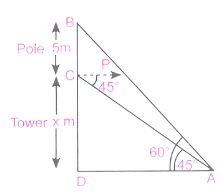
Let CD be a tower of height x m and BC is a pole and ㄥBAD=600 and ㄥPCA=450 ㄥPCA=ㄥCAD=450
In right ΔCDA, \(\frac { CD }{ DA } \)=tan 45o
⇒ \(\frac { x }{ DA } \)=1 ⇒ DA= x m
In right ΔBDA, \(\frac { BD }{ DA } \)=tan 60o
⇒ \(\frac { 5+x }{ x } =\sqrt { 3 } \)
⇒ 5+x=\(\sqrt { 3 } \)x ⇒ 5=(\(\sqrt { 3 } \)-1)x
⇒ x=\(\frac { 5 }{ \sqrt { 3 } -1 } m=\frac { 5(\sqrt { 3 } +1) }{ 2 } m=\frac { 5(1.73+1) }{ 2 } m=\frac { 13.65 }{ 2 } \)m=6.82 m
23.
Table for the given data is
| Concentration of SO2 (in ppm) | Frequency (fi) | Class marks (xi) | \(u_i=\frac{x_i-0.10}{0.04}\) | fiui |
| 0.00-0.04 | 4 | 0.02 | -2 | -8 |
| 0.04-0.08 | 9 | 0.06 | -1 | -9 |
| 0.08-0.12 | 9 | 0.10 = a | 0 | 0 |
| 0.12-0.16 | 2 | 0.14 | 1 | 2 |
| 0.16-0.20 | 4 | 0.18 | 2 | 8 |
| 0.20-0.24 | 2 | 0.22 | 3 | 6 |
| Total | N = 30 | \(\Sigma\)fiui =- 1 |
We have, a = 0.10, h = 0.04,
N = 30 and \(\Sigma\)fiui = -1
By step deviation method,
Mean \((\bar{x})=a+\left(\frac{\Sigma f_i u_i}{N}\right) \times b=0.10+\left(\frac{-1}{30}\right) \times 0.04\)
\(=0.10-\frac{0.04}{30}=0.10-0.001=0.099\)
Hence, the mean concentration of SO2 in air is 0.099 ppm.
24.
LHS = \(\cot ^{ 2 }{ A } \left[ \frac { \sec { A } -1 }{ 1+\sin { A } } \right] +\sec ^{ 2 }{ A } \left[ \frac { \sin { A } -1 }{ 1+\sec { A } } \right] \)
\(=\frac { \cot ^{ 2 }{ A } (\sec { A } -1)(1+\sec { A } )+\sec ^{ 2 }{ A } (\sin { A } -1)(1+\sin { A } ) }{ (1+\sin { A } )(1+\sec { A } ) } \)
\(=\frac { \cot ^{ 2 }{ A } (\sec ^{ 2 }{ A } -1)+\sec ^{ 2 }{ A } (1-\sin ^{ 2 }{ A } ) }{ (1+\sin { A } )(1+\sec { A } ) } \)
\(=\frac { \cot ^{ 2 }{ A } .\tan ^{ 2 }{ A } -\sec ^{ 2 }{ A } \cos ^{ 2 }{ A } }{ (1+\sin { A } )(1+\sec { A } ) } \)
\(=\frac { 1-1 }{ (1+\sin { A } )(1+\sec { A } ) } =0\)
= RHS
Hence proved.
25.
Total number of stacks = 9. Characteristics of library are
(i) It is an organised collection of information and resources that are useful to gain knowledge.
(ii) It provides a place, where one can get a data related to all fields as academics, corporations, law medical, etc.
26.
Remaining cards of spade=13-3=10
So, favourable outcomes=10,
i.e. n(E4)=10
∴ P(getting a spade)\(=\frac { 10 }{ 49 } \)
27.
Given equation is
\(3x^{ 2 }+5x+2=0\)
Let \(p(x)=3x^{ 2 }+5x+2\)
On puttings x=-3 in p(x) ,we get
\(p(-3)=3(-3)^{ 2 }+5(-3)+2\)
=27-15+2=\(14\neq 0\)
Hence,-3 is not a solution of the given equation.
28.
Rs. 7040.00
29.
Let h m be the height of the tower AB. S and T are two distinct points from its foot, such that AS = s and AT =t
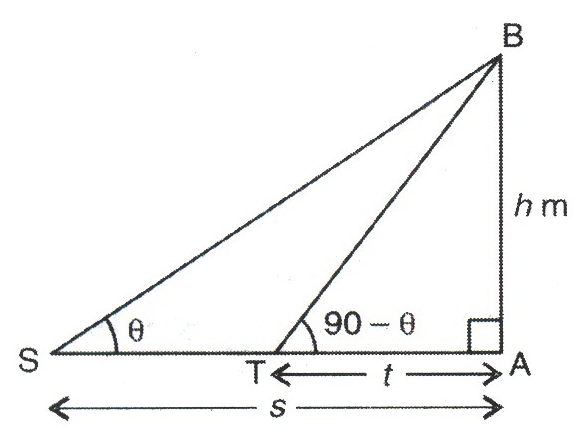
Consider rt. \(\angle ed\Delta SAB,\) we obtain
\(\frac { AB }{ AS } =tan\theta \quad \)
\(\frac { h }{ s } =tan\theta \quad \)
\(h=stan\theta \)
Again, consider rt.\(\angle ed\Delta TAB,\) we obtain
\(\frac { AB }{ AT }=tan\left( { 90 }^{ o }-\theta \right) \)
\(\frac { h }{ t } =cot\theta \)
\(h=t\times \frac { 1 }{ tan\theta } \)
Multiply (i) and (ii) we have
\({ h }^{ 2 }=stan\theta \times t\times \frac { 1 }{ tan\theta } =st\)
\(h=\sqrt { st } \)
hence, the height of tower is \(\sqrt { st } \)
30.
Let the level of water raise in the tank in x hours = 15000x metres
Length of the water flow in x hours = 15000x metres
Diameter of the pipe = 14 cm
radius = \(\frac { 14 }{ 2 } =7cm=\frac { 7 }{ 100 } cm\)
Volume of water = \(\pi r^{ 2 }h\)
Volume of water flow in x hours in the pond = \(\frac { 22 }{ 7 } \times \frac { 7 }{ 100 } \times \frac { 7 }{ 100 } \times 15000x\)
According to the question
\(50\times 44\times \frac { 21 }{ 100 } =\frac { 22 }{ 7 } \times \frac { 7 }{ 100 } \times \frac { 7 }{ 100 } \times 15000x\)
\(\Rightarrow 22\times 21=\frac { 154\times 15 }{ 10 } x\Rightarrow x=\frac { 22\times 21\times 10 }{ 154\times 15 } =2\)
Hence, the level of water in the pond will rise by 21 cm in 2 hours.
31.
Let A(-1, -2), B(1, 0), C(-1, 2) and D(-3, 0) be the given points.
Then, \(\begin{aligned} A B= \sqrt{(1+1)^2+(0+2)^2}=\sqrt{(2)^2+(2)^2} \end{aligned}\)
\(\begin{aligned} {\left[\because \text { distance }=\sqrt{\left(x_2-x_1\right)^2+\left(y_2-y_1\right)^2}\right.} \end{aligned}\)
\(\begin{aligned} =\sqrt{4+4}=\sqrt{8}=2 \sqrt{2} \text { units } \\ \end{aligned}\)
\(\begin{aligned} B C= \sqrt{(-1-1)^2+(2-0)^2}=\sqrt{(-2)^2+(2)^2} \\ \end{aligned}\)
\(\begin{aligned} =\sqrt{4+4}=\sqrt{8}=2 \sqrt{2} \text { units } \\ \end{aligned}\)
\(\begin{aligned} C D=\sqrt{(-3+1)^2+(0-2)^2} \\ \end{aligned}\)
\(\begin{aligned} =\sqrt{(-2)^2+(-2)^2} \end{aligned}\)
\(\begin{aligned} =\sqrt{4+4}=\sqrt{8}=2 \sqrt{2} \text { units } \end{aligned}\)
\(\begin{aligned} D A =\sqrt{(-1+3)^2+(-2-0)^2} \end{aligned}\)
\(\begin{aligned} =\sqrt{(2)^2+(-2)^2}=\sqrt{4+4} \end{aligned}\)
\(\begin{aligned} =\sqrt{8}=2 \sqrt{2} \text { units } \end{aligned}\)
\(\begin{aligned} A C =\sqrt{(-1+1)^2+(2+2)^2} \end{aligned}\)
\(\begin{aligned} =\sqrt{0+4^2}=4 \text { units } \end{aligned}\)
and \(\begin{aligned} BD=\sqrt{(-3-1)^2+(0-0)^2} \end{aligned}\)
\(\begin{aligned} =\sqrt{(-4)^2+0}=4 \text { units } \end{aligned}\)
Here, the four sides AB, BC, CD and DA are equal and also diagonals AC and BD are equal.
So, the quadrilateral ABCD is a square.
32.
()
Less
33.
(b)
36
34.
(d)
1:4
35.
(c)
30o
36.
(d)
130o

10th Standard CBSE Syllabus & Materials
10th Standard CBSE
CBSE 10th Social Science PS - Federalism - New Model Questions Papers Study Material - QB365 Set A
NEW10th Standard CBSE
CBSE 10th Social Science PS - Power Sharing - New Model Questions Papers Study Material - QB365 Set A
NEW10th Standard CBSE
CBSE 10th Social Science GEO - Manufacturing Industries - New Model Questions Papers Study Material - QB365 Set A
NEW10th Standard CBSE
CBSE 10th Social Science GEO - Minerals and Energy Resources - New Model Questions Papers Study Material - QB365 Set A



CBSE 10th Standard CBSE Subjects
CBSE Standards





